
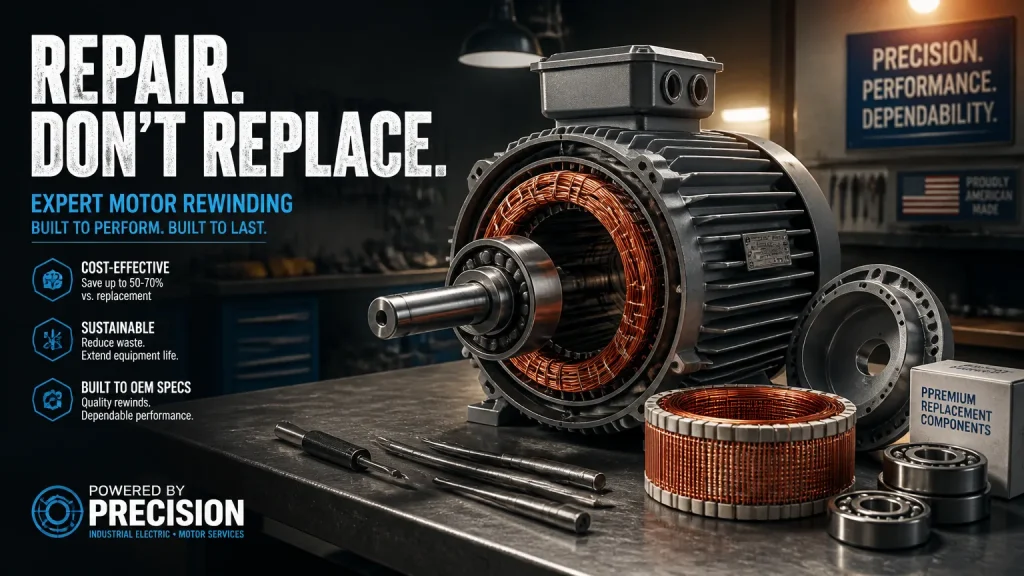
An electric motor rewind can help recover a burned, noisy, overheated, or underperforming motor. But when that motor stops, it can also halt a job, production line, pump, fan, conveyor, or HVAC system.
For contractors, manufacturers, and serious DIYers across southern Michigan, seasonal heat, cold, moisture, and heavy operating demands make the decision more complex. A rewind is not automatically the best repair—or the most economical choice. Motor condition, rewind quality, replacement availability, operating duty, downtime, and total lifecycle cost all matter more than the initial quote.
This guide compares the facts behind diagnosing the failure, evaluating a rewind, and selecting a replacement. It also considers agricultural equipment and other systems where reliability is critical, along with lessons from a recent HVAC motor safety recall. Use the process to choose the repair that protects both performance and budget.
Start With a Proper Motor Failure Diagnosis
A burned winding is visible, but it may not be the original failure. Before approving an electric motor rewind or buying a replacement, identify what damaged the motor and why.
Start with electrical checks. Test insulation resistance, phase-to-phase readings, winding balance, and surge-test results. Voltage imbalance, incorrect overload protection, excessive starts, or a locked load can overheat windings without proving the motor itself was defective.
Inspect mechanical conditions next. Check bearing condition, shaft fit, alignment, and air-gap issues. A tight bearing, poor coupling, or misaligned shaft can overload a healthy motor. In some cases, vibration control also requires controlling vibration and loosening with the right threadlocker.
Look for evidence of overheating, moisture, dust, or chemical contamination. In Michigan shops, humidity, temperature swings, and washdown conditions can shorten insulation life. Inadequate cooling, blocked ventilation, or an enclosure that does not match the environment creates similar problems.
Document the nameplate and application before comparing options. Record frame size, horsepower, voltage, phase, RPM, service factor, enclosure, duty cycle, and driven-equipment requirements. A rewind without correcting the cause can deliver another short service life, while the wrong replacement may fail just as quickly.
When an Electric Motor Rewind Makes Sense
An electric motor rewind makes sense when the motor’s main components remain serviceable. The frame, shaft, rotor, laminations, core, bearings, and housing should be sound. Rewinding is especially practical for high-quality, large, custom, obsolete, or difficult-to-source motors.
A reputable repair shop should test the core before rebuilding the windings. Technicians must preserve the correct winding design and use insulation materials suited to the motor’s voltage, temperature, and duty cycle. The shop should also balance the rotor, replace damaged bearings and seals, and provide test documentation before return.
Rewinding can also reduce installation costs. A replacement may require new couplings, bases, controls, guarding, wiring, or changes to the surrounding machine. Keeping the original motor can protect alignment and limit downtime. Inspect related hardware, including proper washer selection for motor mounting hardware, during reassembly.
Do not choose a repair shop solely by the lowest quote. Excessive heat during stripping can damage laminations. Incorrect wire size, poor winding practices, or inadequate varnish treatment can reduce efficiency and shorten service life. Ask about core testing, materials, balancing, final tests, and warranty coverage before approving the work.
When Replacing the Motor Is the Better Investment
An electric motor rewind is not always the lowest-risk option. Replacement usually makes more sense when the motor has severe core damage, a bent or undersized shaft, cracked housing, damaged rotor, or extensive corrosion. Repeated winding failures also point to an underlying problem that rebuilding may not solve.
Compare the repair estimate with the cost of a suitable new motor. If the totals are close, replacement can provide updated efficiency, warranty coverage, and greater confidence in long-term performance. This matters most for motors that run continuously. A higher-efficiency model may recover its premium through lower electricity use and reduced heat output.
Availability and downtime also influence the decision. A standard replacement may be the practical choice when a southern Michigan contractor or plant cannot wait for teardown, rewinding, testing, and return shipping. Confirm the new motor fits before ordering. Check frame dimensions, mounting style, shaft size, rotation, voltage, frequency, full-load amps, enclosure, and hazardous-location requirements.
Also verify variable-frequency-drive compatibility and starting characteristics. The motor must match the driven equipment, not just the nameplate horsepower. When planning installation and maintenance, choosing the right cordless power tools for installation and maintenance work can help crews work safely and efficiently. If you need help comparing options, bring the failed motor’s nameplate data to CEM Industrial Supply.
Compare Total Cost, Reliability, and Installation Risk
Compare the electric motor rewind quote with the complete replacement cost, not just the invoice. Include freight, rush charges, bearings, seals, couplings, controls, alignment, rigging, labor, testing, and disposal.
Then price the indirect costs. Downtime, lost production, emergency service, energy consumption, and warranty coverage can change the decision quickly. Consider the expected service life and the impact of another failure during peak season or a critical project.
Replacement is not automatically plug-and-play. Verify mounting geometry, shaft alignment, belt or coupling fit, overload settings, rotation, grounding, and protective devices before energizing. Incorrect installation can create vibration, damage equipment, or cause a safety incident.
A relocated motor or newly mounted assembly also needs a secure base and properly rated anchoring. Review correctly installing concrete anchors for equipment mounting before installation. When comparing options, choose the one that delivers reliable service with manageable installation risk—not simply the lowest upfront price.
Make the Decision With a Failure Report and a Long-Term Plan
Choose an electric motor rewind for a sound, valuable, specialized motor when the repair shop documents quality. Replace motors that are severely damaged, inefficient, unreliable, or readily available as standard models.
Keep the failure report, test results, nameplate data, installation measurements, and maintenance history. Use them for future purchasing and troubleshooting. When testing or installation exceeds your equipment or training, contact a qualified motor-repair or electrical professional.
De-energize equipment and follow lockout/tagout, electrical testing, grounding, and final commissioning requirements. Choose the repair that restores dependable service with the lowest long-term risk.