
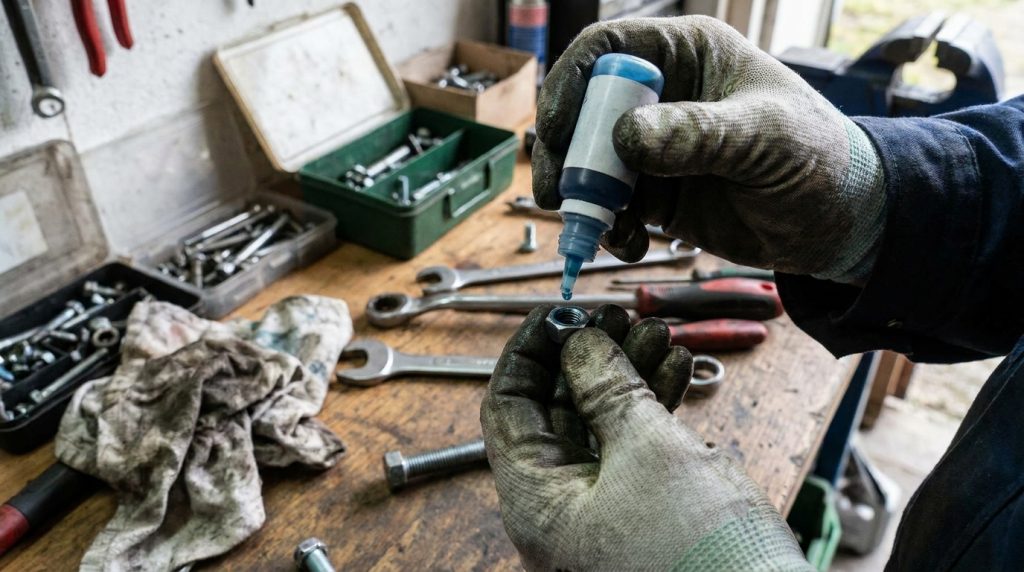
Threaded fasteners are everywhere in construction equipment, HVAC systems, pumps, motors, vehicles, conveyors, agricultural machinery, and manufacturing lines. When bolts, nuts, studs, and screws loosen, the result can be downtime, leaks, misalignment, vibration damage, safety hazards, and expensive rework.
That is where threadlocker comes in.
This threadlocker guide explains the major types, strengths, uses, selection factors, application steps, and removal methods for anaerobic threadlocking adhesives. Whether you are a contractor securing structural equipment, a maintenance technician rebuilding pumps, a mechanic working on engines, or an industrial buyer standardizing MRO supplies, understanding the right threadlocker for the job helps improve reliability and reduce fastener-related failures.
Threadlocker is an adhesive used on threaded fasteners to prevent loosening caused by vibration, shock, thermal cycling, and normal equipment movement. Most liquid threadlockers are anaerobic adhesives, meaning they cure in the absence of air and in the presence of metal ions.
When applied to a bolt or screw, the liquid fills the small gaps between male and female threads. Once assembled, air is excluded and the adhesive hardens, creating a polymer bond that helps lock the fastener in place.
What Threadlocker Does
Threadlocker is designed to:
- Resist vibration loosening
- Maintain clamp load
- Seal threads against fluid leakage
- Help prevent corrosion between threads
- Reduce the need for lock washers, nylon inserts, or double-nutting in many applications
- Improve reliability in rotating, vibrating, or high-duty equipment
What Threadlocker Does Not Do
Threadlocker is not a substitute for proper engineering, fastener sizing, or torque control. It should not be used to compensate for:
- Damaged threads
- Incorrect bolt grade
- Improper torque
- Misaligned parts
- Excessive joint movement
- Contaminated or oily surfaces beyond product limits
- Fasteners exposed to temperatures above the adhesive’s rating
For best results, threadlocker should be used as part of a complete fastening process. For related topics, consider linking to internal resources such as a [fastener torque guide], [bolt grade comparison chart], or [industrial adhesive selection guide].
For those looking to enhance their understanding of industrial applications, a related article that complements the Threadlocker Guide: Types, Strengths & Uses is “10 Essential Tips for Efficient Industrial Motor Repair You Must Know.” This article provides valuable insights into best practices for maintaining and repairing industrial motors, which often require the use of threadlockers to ensure secure fastenings. You can read the article here: 10 Essential Tips for Efficient Industrial Motor Repair You Must Know.
How Threadlocker Works
Most liquid threadlockers cure through an anaerobic chemical reaction. The adhesive remains liquid while exposed to oxygen. Once the fastener is assembled and oxygen is removed from the thread interface, contact with metal surfaces triggers curing.
Anaerobic Curing Process
The basic process is:
- Threadlocker is applied to the bolt, screw, nut, or threaded hole.
- The fastener is assembled.
- Air is excluded from the thread gaps.
- Metal ions activate the curing reaction.
- The adhesive hardens and locks the threads together.
Cure time depends on several factors, including metal type, temperature, thread size, adhesive strength, and surface cleanliness.
Active vs. Inactive Metals
Threadlocker cures faster on active metals and slower on inactive metals.
Common active metals include:
- Steel
- Iron
- Brass
- Bronze
- Copper
Common inactive or less active metals include:
- Stainless steel
- Zinc-plated parts
- Anodized aluminum
- Cadmium-plated parts
- Chrome-plated parts
- Passivated surfaces
When working with inactive metals, a primer or activator may be needed to achieve reliable cure speed and strength. This is especially important in maintenance environments where stainless fasteners, plated bolts, or cold temperatures are common.
Cure Time vs. Fixture Time
Two terms matter when specifying threadlocker:
- Fixture time: The time it takes for the adhesive to develop enough strength that the assembly can be handled.
- Full cure time: The time required for the adhesive to reach its rated final strength.
Many threadlockers fixture within minutes, but full cure often takes longer. Always check the technical data sheet for the product being used, especially for critical equipment, pressure systems, or production assemblies.
Main Types of Threadlocker
Threadlockers are commonly categorized by strength and color. While color coding is widely used, it is not universal across every manufacturer. Always verify the product specification rather than relying on color alone.
Low-Strength Threadlocker
Low-strength threadlocker is used on small fasteners or assemblies that require regular adjustment or removal with hand tools. It provides light resistance to vibration without making disassembly difficult.
Common uses include:
- Small screws
- Instrument panels
- Electrical components
- Adjustment screws
- Access covers
- Light-duty brackets
- Small machine guards
Low-strength threadlocker is often used where fasteners are small enough that a higher-strength product could cause stripped heads, broken screws, or damaged threads during removal.
Medium-Strength Threadlocker
Medium-strength threadlocker is the most commonly used option for general maintenance, manufacturing, mechanical repair, and construction equipment. It provides strong vibration resistance while still allowing disassembly with standard hand tools in most applications.
Common uses include:
- Motor mounts
- Gearbox covers
- Pump housings
- Conveyor components
- Compressor bolts
- Hydraulic system brackets
- HVAC equipment fasteners
- Automotive and heavy equipment assemblies
For many MRO programs, medium-strength threadlocker is the standard choice because it balances holding power and serviceability.
High-Strength Threadlocker
High-strength threadlocker is intended for permanent or semi-permanent assemblies where maximum resistance to loosening is required. Removal typically requires heat and hand tools.
Common uses include:
- Heavy equipment fasteners
- Large studs
- Press assemblies
- Structural machinery bolts
- Suspension components
- Industrial gearbox assemblies
- High-vibration rotating equipment
- Fasteners not intended for routine disassembly
High-strength threadlocker should be selected carefully. It is effective, but using it where frequent service is required can increase labor time and risk damage during removal.
Wicking Threadlocker
Wicking threadlocker is a low-viscosity adhesive designed to penetrate preassembled fasteners through capillary action. It is useful when you discover loose fasteners after assembly or when disassembly is not practical.
Common uses include:
- Preassembled electrical connectors
- Set screws
- Instrumentation screws
- Small fasteners on production equipment
- Calibration hardware
- Assembled brackets where removal is difficult
Wicking threadlocker is typically applied after the fastener has already been tightened. It flows into the engaged threads and cures in place.
High-Temperature Threadlocker
High-temperature threadlocker is formulated to retain performance in elevated-temperature environments. Standard products may soften, degrade, or lose holding strength if exposed to heat beyond their rated service range.
Common uses include:
- Engine components
- Exhaust-adjacent fasteners
- Industrial ovens
- Compressors
- Pumps handling hot fluids
- High-temperature process equipment
Temperature ratings vary by product, so always confirm compatibility with actual operating and peak temperatures.
For more articles on industrial supply, visit https://cemindustrialsupply.com/news/ for the latest updates.
Threadlocker Strengths and Color Codes
Threadlocker strength is usually described as low, medium, high, or permanent. Color codes are helpful but should be treated as a general guide, not a replacement for product data.
| Common Color | Typical Strength | General Serviceability | Common Applications |
|---|---|---|---|
| Purple | Low | Easily removable with hand tools | Small screws, electronics, instruments, and light-duty covers |
| Blue | Medium | Removable with standard hand tools | General maintenance, pumps, electric motors, brackets, and automotive fasteners |
| Red | High | Typically requires heat for removal | Heavy equipment, threaded studs, structural fasteners, and permanent assemblies |
| Green | Wicking (penetrating) | Varies by specific formulation | Preassembled fasteners, set screws, bearings, and small threaded assemblies |
| Orange or specialty colors | Varies by product | Depends on the specific formulation | High-strength removable applications, high-temperature service, and other specialty uses |
Purple Threadlocker: Low Strength
Purple threadlocker is typically chosen for fasteners under approximately 1/4 inch in diameter or for delicate assemblies. It prevents loosening while minimizing the risk of damaging small screws during removal.
Practical examples:
- Securing small machine guard screws
- Locking adjustment screws on control devices
- Preventing vibration loosening on instrumentation panels
- Retaining screws in light-duty electrical enclosures
Blue Threadlocker: Medium Strength
Blue threadlocker is the go-to product for many mechanics, contractors, maintenance teams, and manufacturers. It works well on fasteners that need vibration resistance but may require future service.
Practical examples:
- Bolts on conveyor supports
- Fasteners on pump housings
- Motor mount bolts
- HVAC compressor hardware
- Skid steer attachment hardware
- Automotive brackets and accessories
If your team stocks only one general-purpose threadlocker, a medium-strength grade is often the most practical starting point.
Red Threadlocker: High Strength
Red threadlocker is used when loosening would create a serious problem and disassembly is infrequent. It provides higher breakaway and prevailing torque than medium-strength grades.
Practical examples:
- Large studs in industrial machinery
- Heavy-duty suspension fasteners
- High-vibration crusher or screening equipment
- Permanent mounting hardware
- High-load gearbox components
Use red threadlocker with a clear service plan. If a fastener may need frequent removal, medium strength may be more appropriate.
Green Threadlocker: Wicking Grade
Green threadlocker is commonly associated with wicking formulas. It is useful when fasteners are already assembled and tightened.
Practical examples:
- Securing set screws after final alignment
- Locking small preassembled fasteners on production equipment
- Applying to instrumentation screws after calibration
- Retaining electrical connector screws
Because wicking products are thin, they can spread easily. Apply carefully to avoid contact with plastics, painted surfaces, or components not compatible with the adhesive.
For those interested in enhancing their understanding of industrial applications, a related article that delves into the advantages of modern technology is available. It explores how automation can significantly benefit contractors and manufacturers alike. You can read more about these insights in the article on industrial automation, which complements the Threadlocker Guide by highlighting the importance of reliable fastening solutions in automated processes.
How to Choose the Right Threadlocker
Selecting the correct threadlocker requires more than picking a color. Consider fastener size, required strength, serviceability, material, environment, and application method.
Fastener Size
Small fasteners are easier to break during removal, so low-strength products are usually preferred. Larger fasteners can tolerate higher breakaway torque and may require medium or high strength.
General guidance:
| Fastener Size | Suggested Strength | Notes |
|---|---|---|
| Small screws and precision fasteners | Low | Reduces the risk of thread damage or stripping during removal |
| 1/4 in. to 3/4 in. general-purpose fasteners | Medium | Ideal for most maintenance, machinery, and equipment repair applications |
| Large bolts and studs | Medium to high | Select the appropriate strength based on vibration, load, operating conditions, and future service requirements |
| Preassembled fasteners | Wicking | Applied after assembly to penetrate threads and secure already-tightened fasteners |
Always check the manufacturer’s recommended fastener size range for the specific product.
Vibration and Shock Load
Equipment exposed to constant vibration benefits from threadlocker. Examples include:
- Air compressors
- Pumps
- Diesel engines
- Skid steers and excavators
- Conveyors
- Crushers and screens
- Fans and blowers
- Manufacturing automation systems
For moderate vibration and routine service, medium-strength threadlocker is often suitable. For severe vibration and non-service fasteners, high-strength threadlocker may be appropriate.
Serviceability Requirements
Before choosing strength, ask one important question: Will this fastener need to come apart later?
If yes, consider:
- Low strength for small screws
- Medium strength for general service bolts
- High-strength removable specialty grades where appropriate
If no, high-strength threadlocker may be a good option, provided the materials and environment are compatible.
Temperature Exposure
Threadlocker performance depends on temperature. Consider both normal operating temperature and short-term peak exposure.
Applications with elevated temperatures include:
- Engines
- Exhaust-adjacent brackets
- Industrial ovens
- Compressors
- Pumps moving heated fluids
- Brake-adjacent components
If the fastener will see high heat, select a high-temperature threadlocker and verify its rating.
Fluid and Chemical Exposure
Threaded assemblies may be exposed to oils, coolants, hydraulic fluid, fuels, cleaning chemicals, water, or process fluids. Many threadlockers resist common industrial fluids after full cure, but compatibility varies.
For best results:
- Review the product data sheet
- Allow full cure before fluid exposure when possible
- Avoid applying over heavy oil unless the product is oil-tolerant
- Use a thread sealant instead of threadlocker when sealing pipe threads is the primary goal
For additional education, this article could internally link to a [thread sealant vs. threadlocker guide] or [industrial fluid compatibility chart].
Material Compatibility
Threadlockers are designed primarily for metal fasteners. They may not be suitable for all plastics, composites, painted surfaces, or plated parts.
Special attention is needed for:
- Stainless steel
- Zinc-plated fasteners
- Aluminum assemblies
- Plastic housings
- Painted brackets
- Rubber or elastomer components
- Sensitive electronics
If compatibility is uncertain, test on a small area or consult the adhesive manufacturer’s technical data.
Common Threadlocker Uses by Industry
Threadlocker is widely used across trades and industrial environments. The right grade depends on the application, service schedule, and risk of fastener loosening.
Construction and Contracting
Contractors use threadlocker on equipment, tools, mounting hardware, and jobsite machinery. It is especially helpful where vibration and repeated movement can loosen bolts.
Common applications:
- Generator frames
- Concrete saws
- Lifts and hoists
- Temporary equipment mounts
- Skid steer attachments
- Compressor hardware
- Drilling equipment
- HVAC rooftop units
Example: A contractor installing rooftop HVAC units may use medium-strength threadlocker on vibration-prone mounting bolts while preserving the ability to service the unit later.
Industrial Maintenance and MRO
Maintenance professionals rely on threadlocker to reduce repeat repairs and keep production equipment running.
Common applications:
- Conveyor rollers and guards
- Pump base bolts
- Gearbox fasteners
- Fan housings
- Motor mounts
- Bearing retainers
- Set screws
- Compressor assemblies
Example: A maintenance technician rebuilding a pump can apply medium-strength threadlocker to housing bolts and set screws to help prevent loosening after the unit returns to service.
Manufacturing and Assembly
Manufacturers use threadlocker to improve assembly consistency and reduce warranty issues caused by vibration loosening.
Common applications:
- Power tools
- Appliances
- Industrial machinery
- Electrical enclosures
- Automotive assemblies
- Agricultural equipment
- Robotics and automation systems
For production environments, buyers should consider package size, dispensing equipment, cure time, traceability, and compatibility with automated assembly lines.
Automotive, Fleet, and Heavy Equipment Repair
Mechanics use threadlocker on vehicles and equipment that experience vibration, heat, impact, and repeated duty cycles.
Common applications:
- Brackets and mounts
- Suspension hardware
- Engine accessories
- Transmission components
- Differential covers
- Brake-related hardware where specified
- Off-road equipment attachments
Always follow OEM service information when threadlocker is specified. Some fasteners require dry torque, some require lubricant, and others require specific locking compounds.
Pumps, Valves, and Fluid Systems
Threadlocker can help retain fasteners on pumps, valves, and rotating equipment. However, it should not automatically be used as a pipe thread sealant unless the product is rated for that purpose.
Common applications:
- Pump casing bolts
- Motor-to-pump adapters
- Valve actuator hardware
- Coupling set screws
- Bearing housing fasteners
For threaded pipe connections, use a product designed as a thread sealant. For fastener retention, use threadlocker.
Threadlocker vs. Lock Washers, Nylon Nuts, and Thread Sealant
Threadlocker is one of several options for controlling fastener loosening. Each has advantages and limits.
Comparison of Fastener Locking Methods
| Method | Best For | Advantages | Limitations |
|---|---|---|---|
| Threadlocker | Threaded fasteners exposed to vibration | Fills thread gaps, helps seal threads, and is available in multiple strength grades | Requires clean threads and curing time before reaching full strength |
| Lock washer | General mechanical locking applications | Simple, inexpensive, and requires no curing time | Can lose effectiveness under heavy vibration or joint embedment |
| Nylon insert lock nut | Mechanical locking where occasional reuse is acceptable | Easy to install and does not require liquid adhesives | Limited by operating temperature and the nylon insert can wear with repeated use |
| Prevailing torque nut | High-vibration and demanding industrial applications | Provides strong mechanical locking without adhesives | Higher cost and may require specific torque procedures |
| Thread sealant | Pipe threads and fluid or gas sealing | Prevents leaks while sealing tapered threaded connections | Designed for sealing rather than preventing fastener loosening |
| Safety wire | Critical rotating equipment, aerospace, and safety-critical assemblies | Provides positive retention with easy visual inspection | Labor-intensive to install and requires drilled fasteners or specially designed hardware |
When Threadlocker Is the Better Choice
Threadlocker is often preferred when:
- Vibration is a major concern
- The fastener must also be sealed from corrosion or leakage
- A clean, compact assembly is needed
- Lock washers are impractical
- Consistent production assembly is required
- The fastener must remain serviceable with the right grade
When Not to Use Threadlocker
Avoid or reconsider threadlocker when:
- The fastener is specified to be dry by the OEM
- The joint requires a lubricant for accurate torque
- The assembly operates above the adhesive’s temperature range
- The fastener threads are badly damaged
- The material is incompatible
- The fastener must be adjusted frequently
- The application requires a pipe thread sealant instead
How to Apply Threadlocker Correctly
Proper application is critical. Even the right product can fail if applied incorrectly.
Step 1: Clean the Threads
Remove heavy oil, grease, dirt, cutting fluid, rust, and old adhesive. Use an appropriate cleaner or degreaser that does not leave a residue.
For maintenance work, cleaning is especially important because fasteners often come from oily environments. Some threadlockers are oil-tolerant, but clean threads generally provide more predictable results.
Step 2: Choose the Correct Amount
Use enough threadlocker to wet the engaged threads, but avoid excessive application. Too much product can squeeze out, create cleanup issues, or migrate into unwanted areas.
General application guidance:
- For through holes: Apply to the bolt threads where the nut will engage.
- For blind holes: Apply into the female threads and to the bolt if recommended.
- For large fasteners: Apply a continuous bead around several threads.
- For small screws: Use a small drop to avoid excess.
Step 3: Assemble and Torque Properly
Install the fastener and tighten it to the required torque. Keep in mind that liquid threadlocker may affect friction compared with dry threads. For critical assemblies, follow OEM torque specifications and adhesive recommendations.
If the torque spec assumes dry threads, do not change the assembly condition without engineering approval.
Step 4: Allow Time to Cure
Do not expose the assembly to full load, high vibration, or fluids before the adhesive has developed adequate strength unless the product data allows it.
Cure time depends on:
- Temperature
- Metal type
- Thread size
- Adhesive grade
- Surface cleanliness
- Use of primer or activator
Step 5: Document Critical Applications
For industrial buyers and maintenance managers, standardization improves repeatability.
Document:
- Product name and strength
- Application location
- Torque specification
- Cure time before service
- Primer requirements
- Removal procedure
- Safety data sheet location
This information can be added to preventive maintenance procedures, work instructions, or MRO inventory systems.
Threadlocker Removal and Disassembly
The removal method depends on the strength of the threadlocker, fastener size, material, and application.
Removing Low- and Medium-Strength Threadlocker
Low- and medium-strength threadlockers are usually removable with standard hand tools. Use steady pressure and the correct tool size to avoid rounding bolt heads or damaging screw slots.
Tips:
- Use properly fitting sockets, bits, or wrenches
- Avoid impact tools on delicate fasteners unless appropriate
- Support the assembly to prevent twisting or bending
- Clean old adhesive from threads before reassembly
Removing High-Strength Threadlocker
High-strength threadlocker may require heat to soften the adhesive before removal. Apply heat according to the adhesive manufacturer’s recommendations and the equipment’s safety requirements.
Important precautions:
- Avoid heating near flammable fluids or vapors
- Protect seals, bearings, wires, and painted surfaces
- Use proper PPE
- Follow hot work procedures in industrial facilities
- Confirm that heat will not damage the base material
After removal, clean the threads thoroughly before applying new threadlocker.
Cleaning Old Threadlocker
Old cured adhesive can interfere with reassembly. Remove it with:
- Wire brushes
- Thread chasers
- Approved solvents
- Picks for small internal threads
- Compressed air where safe and appropriate
Avoid damaging the threads. If a fastener shows galling, corrosion, stretching, or thread damage, replace it.
Common Threadlocker Mistakes to Avoid
Even experienced mechanics and technicians run into problems when threadlocker is misapplied.
Using the Wrong Strength
Using high-strength threadlocker on small screws can make removal difficult and may cause stripped heads or broken fasteners. Using low-strength threadlocker on large, high-vibration bolts may not provide enough retention.
Match strength to fastener size, vibration level, and service requirements.
Applying Threadlocker to Dirty or Oily Threads
Oil, grease, and debris can reduce adhesion and slow cure. Clean threads whenever possible. If cleaning is limited, choose an oil-tolerant grade and confirm performance requirements.
Ignoring Cure Time
Putting equipment back into service too soon can compromise results. This is especially important on high-vibration machinery, fluid-exposed assemblies, and critical rotating equipment.
Using Threadlocker as a Universal Sealant
Threadlocker can seal straight threads in many fastener applications, but pipe threads often require dedicated thread sealant. Do not assume one product is correct for both locking and sealing.
Relying Only on Color
Colors are helpful, but formulations vary. A blue product from one manufacturer may not match another blue product in viscosity, temperature rating, cure speed, or oil tolerance.
Always check:
- Strength rating
- Viscosity
- Temperature range
- Fixture time
- Full cure time
- Compatible metals
- Chemical resistance
- Removal method
Buying Threadlocker for Industrial and Professional Use
For contractors, mechanics, maintenance departments, and industrial buyers, threadlocker selection should support both performance and workflow.
Key Specifications to Compare
When evaluating products, compare:
- Strength level
- Breakaway torque
- Prevailing torque
- Viscosity
- Temperature range
- Cure speed
- Primer requirements
- Oil tolerance
- Fastener size range
- Chemical resistance
- Package size
- Shelf life
- Dispensing method
- Safety and regulatory documentation
Packaging Options
Common packaging formats include:
- Small bottles for toolboxes and mobile service
- Medium bottles for shop use
- Large bottles for maintenance departments
- Syringes or pens for precision application
- Bulk containers for automated dispensing
For field contractors, small bottles reduce waste and fit easily into service kits. For manufacturers, controlled dispensing systems can improve consistency and reduce overuse.
Standardizing Your Threadlocker Program
A practical MRO program may include:
- Low-strength threadlocker for small screws
- Medium-strength threadlocker for general repairs
- High-strength threadlocker for permanent assemblies
- Wicking threadlocker for preassembled fasteners
- High-temperature grade for hot equipment
- Primer or activator for stainless or plated fasteners
- Cleaner for thread preparation
Standardizing reduces confusion and helps technicians choose the right product quickly. Consider building internal links to a [maintenance supply checklist], [MRO inventory management guide], or [equipment reliability best practices] page.
Quick Selection Guide
Use this simplified guide as a starting point. Always verify the product’s technical data sheet before using threadlocker on critical assemblies.
| Application | Recommended Type | Why |
|---|---|---|
| Small screws on panels or instruments | Low-strength threadlocker | Helps prevent loosening while allowing easy removal with hand tools |
| General equipment bolts | Medium-strength threadlocker | Provides an excellent balance between vibration resistance and future serviceability |
| Motor mounts and pump housings | Medium-strength threadlocker | Resists vibration while still allowing routine maintenance and disassembly |
| Large studs or permanent assemblies | High-strength threadlocker | Delivers maximum holding power for applications that are not intended for frequent disassembly |
| Already assembled set screws | Wicking-grade threadlocker | Penetrates existing threads after assembly without requiring disassembly |
| Hot machinery or engine-adjacent fasteners | High-temperature threadlocker | Maintains locking performance under elevated operating temperatures |
| Stainless steel fasteners | Compatible threadlocker with primer if required | Improves curing performance on less-reactive stainless steel surfaces |
| Pipe threads carrying fluids or gases | Thread sealant (not standard threadlocker) | Specifically formulated to seal tapered pipe threads and help prevent leaks |
Safety and Handling Best Practices
Threadlockers are professional chemical products and should be handled responsibly.
Personal Protective Equipment
Follow the safety data sheet for the specific product. Typical precautions may include:
- Safety glasses
- Chemical-resistant gloves
- Adequate ventilation
- Avoiding skin and eye contact
- Washing hands after use
Storage
Store threadlocker according to the manufacturer’s instructions. In general:
- Keep containers closed when not in use
- Store away from excessive heat
- Avoid contamination of the bottle tip
- Do not pour used product back into the bottle
- Track expiration dates for critical applications
Jobsite and Shop Considerations
For contractors and mobile mechanics, keep threadlocker bottles protected from dirt, moisture, and extreme temperatures. For manufacturing plants, use labeled dispensing stations and train operators on correct application amounts.
Frequently Asked Questions About Threadlocker
Is blue threadlocker removable?
Yes, most medium-strength blue threadlockers are designed to be removable with standard hand tools. However, removal effort depends on fastener size, thread engagement, cure time, temperature exposure, and product formulation.
Is red threadlocker permanent?
Red threadlocker is commonly considered high strength or permanent, but many assemblies can still be disassembled with heat and proper tools. Plan for more difficult removal compared with medium-strength grades.
Can threadlocker be used on stainless steel?
Yes, but stainless steel is less active than plain steel, so cure may be slower. A primer or activator may be recommended depending on the product and application.
Can threadlocker be used on oily bolts?
Some threadlockers are formulated to tolerate light oil contamination, but clean threads are preferred. Heavy oil, grease, or dirt should be removed before application.
Does threadlocker replace torque?
No. Threadlocker helps resist loosening, but fasteners still need to be tightened to the correct torque or assembly specification.
Can threadlocker be reused?
No. Once cured and disassembled, old threadlocker should be cleaned off and fresh product should be applied during reassembly.
Conclusion: Choose the Right Threadlocker for Reliable Fastening
Threadlocker is a simple but valuable solution for preventing threaded fasteners from loosening under vibration, shock, and thermal cycling. The key is choosing the correct type and strength for the application.
Use low-strength threadlocker for small screws, medium-strength threadlocker for general maintenance and repair, high-strength threadlocker for permanent or high-load assemblies, wicking threadlocker for preassembled fasteners, and high-temperature formulas for hot environments. Clean the threads, apply the right amount, torque properly, and allow adequate cure time.
For contractors, maintenance professionals, manufacturers, mechanics, and industrial buyers, a well-planned threadlocker program can reduce repeat repairs, improve equipment reliability, and simplify fastener selection across teams.
Need help choosing the right threadlocker for your application? Review your fastener size, material, temperature, vibration level, and service requirements, then compare products using the manufacturer’s technical data sheet—or contact a knowledgeable industrial supplier for application-specific support.