
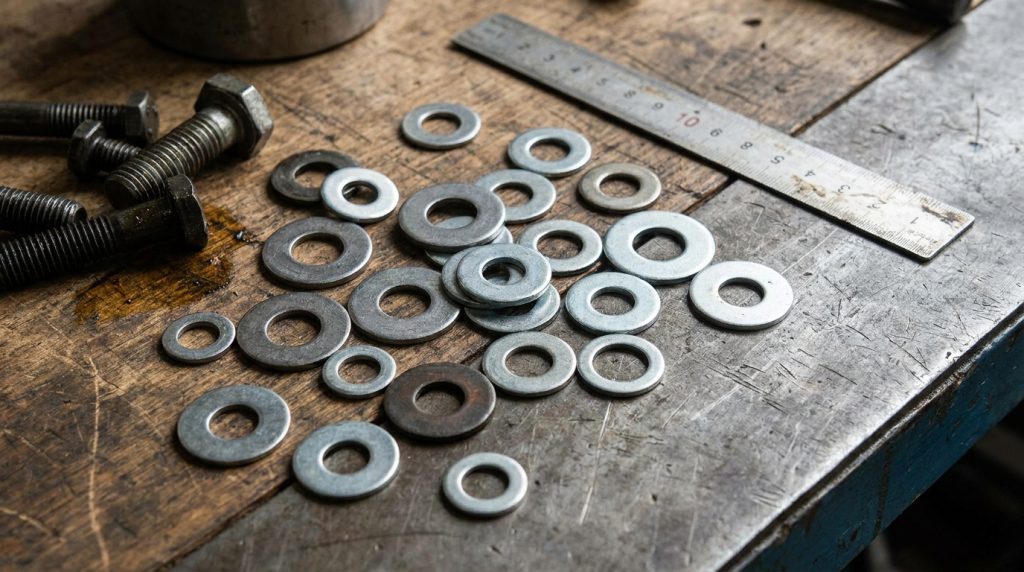
Flat washers are among the most common—and most misunderstood—fastener components used in construction, maintenance, machinery, manufacturing, and industrial repair. At first glance, a flat washer looks simple: a thin, round disc with a hole in the center. In practice, the right washer can help distribute load, protect surfaces, improve joint reliability, reduce wear, and support proper torque application.
For contractors, mechanics, maintenance teams, OEM buyers, and industrial purchasers, choosing the correct flat washer is not just a hardware-bin decision. Washer size, material, finish, thickness, and standard can all affect performance, especially in structural assemblies, outdoor equipment, rotating machinery, electrical panels, and corrosive environments.
This guide explains flat washers, their major types and uses, material options, sizing standards, selection criteria, and common mistakes to avoid. It is designed to help professionals make better purchasing and installation decisions while supporting safer, longer-lasting bolted joints.
A flat washer is a thin plate, typically circular, with a centrally located hole sized to fit around a bolt, screw, threaded rod, or other fastener. It is installed between the fastener head or nut and the surface being fastened.
The main purpose of a flat washer is to spread the load of a threaded fastener over a larger area. This helps reduce surface damage, prevent pull-through in softer materials, and provide a smoother bearing surface for tightening.
Basic Function of a Flat Washer
Flat washers are used to:
- Distribute clamping force over a wider area
- Protect finished or soft surfaces from galling, scoring, or indentation
- Improve contact between the fastener and the workpiece
- Help compensate for oversized or irregular holes
- Provide spacing or shimming in mechanical assemblies
- Reduce friction under a bolt head or nut during tightening
- Support consistent torque-tension relationships when properly specified
Flat washers do not typically prevent loosening by themselves. For vibration resistance, engineers often use locking nuts, thread-locking compounds, prevailing torque nuts, lock washers, wedge-lock washers, or other joint-control methods depending on the application.
Where Flat Washers Are Commonly Used
Flat washers appear across nearly every industry, including:
- Commercial and residential construction
- HVAC installation and service
- Plumbing and pipe support systems
- Automotive and fleet maintenance
- Heavy equipment repair
- Agricultural machinery
- Electrical enclosures and panels
- Conveyor systems
- Steel fabrication
- Furniture and cabinetry
- OEM product assembly
- Marine and outdoor applications
For example, a maintenance technician may use stainless steel flat washers when replacing fasteners on a food-processing conveyor exposed to washdown chemicals. A contractor may use galvanized flat washers with anchor bolts on exterior framing hardware. A mechanic may use hardened flat washers under high-strength bolts in suspension or equipment assemblies.
For those interested in understanding the practical applications of flat washers, you might find it beneficial to explore an article that discusses essential tips for maintaining a clean and organized job site. This resource highlights the importance of using the right tools and materials, which can complement your knowledge of flat washers and their various types and uses. To read more, visit How to Clean Up a Job Site: Pro Tips and Must-Have Gear.
Why Flat Washers Matter in Bolted Joints
Although flat washers are inexpensive compared with bolts, nuts, and structural components, they can play an important role in joint performance. Using the wrong washer—or omitting one where required—can lead to damaged materials, poor clamp load, premature loosening, or maintenance problems.
Load Distribution and Surface Protection
When a bolt or nut is tightened directly against a surface, the contact pressure is concentrated under the fastener head or nut. On harder materials, this may not be a problem. On softer materials such as aluminum, plastic, wood, fiberglass, rubber, or painted steel, the fastener can dig into the surface.
A flat washer spreads that pressure across a larger bearing area. This helps prevent:
- Crushing or embedding
- Paint damage
- Surface deformation
- Cracking in brittle materials
- Pull-through in sheet metal or thin panels
This is especially useful in applications such as mounting brackets to sheet metal, fastening wood components, installing equipment guards, or assembling plastic housings.
Better Torque Application
Flat washers can reduce friction between the nut or bolt head and the joint surface. This can help the fastener turn more smoothly during tightening.
However, torque results depend on many variables, including washer material, plating, lubrication, surface roughness, thread condition, and fastener grade. In critical assemblies, torque values should come from engineering specifications, equipment manuals, or recognized standards—not general assumptions.
For maintenance professionals, the key takeaway is simple: use the washer type specified by the equipment manufacturer whenever available. Substituting a thinner, softer, or incorrectly finished washer may change the behavior of the joint.
Hole Coverage and Alignment Support
Flat washers are often used when a hole is slightly oversized, slotted, or rough. The washer helps bridge the opening and provides a more uniform bearing surface.
This is common in:
- Metal framing systems
- Slotted angle brackets
- Machinery bases
- Pipe hangers
- Electrical mounting rails
- Field-drilled holes
- Adjustable mounting plates
In these cases, washer outside diameter matters. A standard flat washer may not provide enough coverage, while a fender washer or oversized washer may be better suited.
Common Types of Flat Washers
Not all flat washers are the same. They vary by size, thickness, outside diameter, material, hardness, and manufacturing standard. Understanding the major types helps buyers and installers select the correct washer for the job.
Standard Flat Washers
Standard flat washers are the general-purpose washers found in most hardware, MRO, and industrial supply inventories. They are used with machine screws, bolts, lag screws, and nuts in routine fastening applications.
Common uses include:
- General equipment assembly
- Bracket mounting
- Light-duty construction
- Electrical enclosures
- Furniture and fixtures
- Maintenance repairs
Standard flat washers are available in steel, stainless steel, brass, nylon, and other materials. For non-critical applications, they are often selected by bolt diameter and finish.
SAE Flat Washers
SAE flat washers follow dimensional standards associated with the Society of Automotive Engineers. Compared with USS washers, SAE washers generally have a smaller outside diameter and are often thinner.
SAE flat washers are commonly used in:
- Automotive repair
- Machinery assembly
- Precision equipment
- Applications where space is limited
- General mechanical fastening
Because of their smaller profile, SAE washers are useful when there is limited clearance around the bolt head or nut. They provide a clean fit without excessive overhang.
USS Flat Washers
USS flat washers are based on United States Standard dimensions. They generally have a larger outside diameter and may be thicker than SAE washers of the same nominal bolt size.
USS flat washers are commonly used in:
- Construction
- Heavy equipment
- Agricultural machinery
- Wood fastening
- Structural brackets
- General industrial maintenance
The larger outside diameter provides more bearing surface. This makes USS washers useful when fastening to wood, softer metals, or surfaces where additional load distribution is needed.
Fender Washers
Fender washers are flat washers with an extra-large outside diameter relative to the hole size. Their wide surface area makes them ideal for spreading load over thin or soft materials.
Typical fender washer applications include:
- Sheet metal attachment
- Automotive bodywork
- Plastic panels
- Wood assemblies
- Sign mounting
- Repair work where holes have enlarged
- Guard and cover installation
For example, if a machine guard has a mounting hole that has become worn or elongated, a fender washer can provide additional coverage and help secure the guard until a permanent repair is made.
Hardened Flat Washers
Hardened flat washers are heat-treated for strength and resistance to deformation. They are used with high-strength bolts and in applications where standard low-carbon steel washers may compress, dish, or embed under load.
Common uses include:
- Structural steel connections
- Heavy machinery
- High-strength bolting
- Load-bearing assemblies
- Equipment foundations
- Suspension and chassis components
Hardened washers are often required under specific structural bolting standards. In these applications, using an ordinary washer can compromise joint performance.
Metric Flat Washers
Metric flat washers are sized according to metric fasteners, such as M6, M8, M10, M12, and M16 bolts. They are used in equipment and assemblies designed to ISO, DIN, or other metric standards.
Metric washers are common in:
- Imported machinery
- Automotive systems
- Robotics and automation equipment
- Packaging machinery
- European or Asian OEM equipment
- Industrial controls
Maintenance teams should avoid mixing inch and metric washers unless explicitly approved. A washer that appears close in size may have an incorrect inner diameter, outside diameter, or thickness.
Extra-Thick and Heavy Flat Washers
Extra-thick flat washers, sometimes called heavy washers, provide more stiffness and bearing strength than standard washers. They are used where a thin washer may bend or deform.
Applications include:
- Anchor bolts
- Base plates
- Structural supports
- Heavy-duty machinery mounting
- Industrial racks
- Large-diameter fasteners
For concrete anchors, thick washers are often used to distribute load across base plates and help maintain proper clamping force.
For more articles on industrial supply, visit https://cemindustrialsupply.com/news/ for the latest updates.
Flat Washer Materials and Finishes
Material selection is one of the most important parts of choosing a flat washer. The washer must be compatible with the fastener, the joined materials, the environment, and the load requirements.
Steel Flat Washers
Steel flat washers are the most common choice for general-purpose fastening. They offer good strength at a reasonable cost and are available in many sizes and finishes.
Common finishes include:
- Plain steel
- Zinc plated
- Black oxide
- Phosphate coated
- Hot-dip galvanized
- Mechanical galvanized
Plain steel washers are suitable for dry indoor environments but can rust if exposed to moisture. Zinc-plated washers provide moderate corrosion resistance for indoor or light-duty applications. Hot-dip galvanized washers are preferred for many outdoor and construction uses, especially when paired with galvanized bolts and nuts.
Stainless Steel Flat Washers
Stainless steel flat washers are used where corrosion resistance, cleanliness, or appearance is important. Common stainless grades include 18-8, 304, and 316.
Typical applications include:
- Marine environments
- Food and beverage processing
- Chemical plants
- Outdoor equipment
- Medical and laboratory equipment
- Washdown areas
- Architectural hardware
316 stainless steel offers better resistance to chlorides and harsh environments than 304 stainless steel. For coastal, chemical, or high-moisture applications, 316 is often the better choice.
Brass Flat Washers
Brass flat washers provide corrosion resistance, electrical conductivity, and a decorative appearance. They are softer than steel and are often used in electrical, plumbing, and marine applications.
Common uses include:
- Electrical terminals
- Decorative hardware
- Plumbing fixtures
- Instrumentation
- Non-sparking applications where appropriate
Because brass is softer, it is not usually selected for high-load structural joints.
Nylon and Plastic Flat Washers
Nylon and plastic flat washers are lightweight, non-conductive, and corrosion resistant. They are useful where electrical insulation, vibration damping, or surface protection is needed.
Applications include:
- Electrical panels
- Electronics
- Plastic housings
- Light-duty assemblies
- Appliances
- Corrosion-sensitive environments
Plastic washers are not suitable for high-temperature or high-load applications unless specifically engineered for those conditions.
Rubber and Neoprene Washers
Rubber and neoprene washers are used for sealing, cushioning, and vibration isolation rather than high-load clamping. They may be used with metal washers in roofing, plumbing, HVAC, or enclosure applications.
Common uses include:
- Weather sealing
- Pipe supports
- Vibration damping
- Electrical enclosure sealing
- Roofing fasteners
- Plumbing fixtures
Rubber washers can compress over time, so they should be selected based on the required sealing and compression properties.
Comparison Table: Flat Washer Materials
| Material | Strength | Corrosion Resistance | Common Uses | Notes |
|---|---|---|---|---|
| Plain steel | High | Low | Indoor machinery, equipment, and general repairs | Economical but requires protection to prevent rust |
| Zinc-plated steel | Medium to high | Moderate | General maintenance, MRO, and light indoor or outdoor applications | One of the most common choices for general-purpose fastening |
| Hot-dip galvanized steel | High | Good | Construction, outdoor structures, utility work, and anchoring | Best used with hot-dip galvanized fasteners to minimize galvanic corrosion |
| 304 stainless steel | Medium | Good | Food processing equipment, outdoor hardware, and clean environments | Widely available with excellent general-purpose corrosion resistance |
| 316 stainless steel | Medium | Excellent | Marine, chemical processing, coastal, and washdown environments | Superior resistance to chlorides and harsh corrosive conditions |
| Brass | Low to medium | Good | Electrical components, plumbing, and decorative hardware | Softer than steel but naturally corrosion resistant |
| Nylon or plastic | Low | Excellent | Electrical insulation, spacers, and light-duty assemblies | Non-conductive and resistant to many chemicals |
| Rubber or neoprene | Low | Good | Sealing, cushioning, and vibration isolation | Designed for sealing and isolation rather than structural clamping |
In addition to understanding the various types and uses of flat washers, it’s important to consider the overall maintenance of machinery that utilizes these components. For instance, knowing when it’s time for industrial motor repair can significantly enhance the performance and longevity of your equipment. You can read more about this topic in the article on signs that indicate it’s time for industrial motor repair, which provides valuable insights into keeping your machinery in optimal condition.
Flat Washer Standards and Sizing
Washer sizing is more than matching the hole to the bolt. Industrial buyers and mechanics should consider inside diameter, outside diameter, thickness, hardness, and applicable standards.
Key Washer Dimensions
The main dimensions of a flat washer are:
- Inside diameter: The hole size that fits over the fastener
- Outside diameter: The overall diameter of the washer
- Thickness: The washer’s height or gauge
- Material hardness: Resistance to deformation under load
- Finish thickness: Coating thickness, important for fit and corrosion protection
For example, a 1/2-inch flat washer is intended to fit a 1/2-inch bolt, but SAE, USS, hardened, and fender versions can all have different outside diameters and thicknesses.
Inch Washer Sizes
Inch flat washers are commonly specified by nominal bolt size, such as:
- #6
- #8
- #10
- 1/4 inch
- 5/16 inch
- 3/8 inch
- 1/2 inch
- 5/8 inch
- 3/4 inch
- 1 inch
Industrial applications often require washers that conform to recognized standards such as ASME or ASTM specifications. When sourcing washers for production or structural work, confirm the required standard and material certification.
Metric Washer Sizes
Metric flat washers are matched to metric bolt sizes, such as:
- M3
- M4
- M5
- M6
- M8
- M10
- M12
- M16
- M20
- M24
Common metric washer standards include ISO and DIN patterns. In equipment maintenance, always check the OEM manual or parts list when replacing metric washers, especially on imported machinery.
SAE vs. USS Flat Washers
SAE and USS washers are commonly confused because both are used with inch fasteners. The difference is mainly dimensional.
| Feature | SAE Flat Washer | USS Flat Washer |
|---|---|---|
| Outside diameter | Smaller | Larger |
| Typical thickness | Generally thinner | Generally thicker |
| Common use | Automotive, machinery, and applications with limited space | Construction, woodworking, and heavy-duty general-purpose fastening |
| Bearing area | Moderate | Larger, providing better load distribution |
| Clearance needs | Better suited for compact assemblies | Requires additional clearance due to the larger outside diameter |
If you need a washer for compact machine assembly, SAE may be the better fit. If you need more surface coverage on wood, sheet metal, or a slotted hole, USS or fender washers may be more appropriate.
If you’re interested in understanding more about the various components that can affect machinery performance, you might find the article on how to determine when your motor needs rewinding particularly insightful. This resource provides valuable information that complements the knowledge gained from exploring flat washers and their applications in different mechanical systems. For more details, you can read the article here.
Types of Flat Washers by Application
Selecting flat washers by application helps prevent common fastening problems. A washer that works well for a cabinet hinge may be inappropriate for a crane bracket, pump base, or outdoor steel frame.
Construction and Structural Applications
In construction, flat washers are used with bolts, anchors, threaded rod, framing hardware, and steel connectors. They help distribute load and provide a stable bearing surface.
Typical construction uses include:
- Anchor bolt assemblies
- Steel-to-wood connections
- Framing brackets
- Pipe supports
- Channel framing systems
- Exterior hardware
- Structural base plates
For exterior construction, galvanized or stainless steel washers are often preferred. For structural bolting, hardened washers may be required by specification. Contractors should follow project drawings, code requirements, and engineered fastener schedules.
Internal linking opportunity: link to related resources such as “Anchor Bolts and Washers for Concrete Applications” or “Galvanized vs. Stainless Steel Fasteners.”
Machinery and Equipment Maintenance
Maintenance professionals use flat washers to service pumps, motors, conveyors, gearboxes, guards, frames, and production equipment. Washers can help maintain consistent fastening and protect mounting surfaces during repeated assembly and disassembly.
Examples include:
- Mounting electric motor feet to a base
- Fastening belt guards to machine frames
- Securing conveyor brackets
- Installing vibration isolators
- Replacing worn hardware during preventive maintenance
For high-vibration machinery, flat washers alone are not a locking solution. Consider the full joint design, including locking nuts, thread-locking compounds, or manufacturer-recommended hardware.
Automotive, Fleet, and Heavy Equipment
Mechanics commonly use flat washers in automotive, truck, trailer, and heavy equipment repair. SAE washers are often used in automotive assemblies because of their compact dimensions, while hardened washers may be required in high-load areas.
Common applications include:
- Brackets and accessories
- Body panels
- Suspension components
- Engine accessories
- Trailer hardware
- Agricultural equipment repairs
When servicing safety-critical systems such as brakes, steering, suspension, lifting systems, or load-bearing equipment, always use OEM-approved fasteners and washers.
Electrical and Electronic Assemblies
In electrical work, washers may support grounding connections, protect panel surfaces, or provide insulation when made from nylon or other non-conductive materials.
Common electrical uses include:
- Panel mounting
- Bus bar connections
- Grounding lugs
- Control cabinets
- Circuit board standoffs
- Cable tray hardware
Material choice matters. Stainless or zinc-plated washers may be used for general panel work, while nylon washers can isolate conductive components where required.
Plumbing, HVAC, and Pipe Support
Flat washers are widely used in HVAC and plumbing installations with hanger rods, strut channel, brackets, and equipment mounts.
Applications include:
- Pipe hangers
- Duct supports
- Rooftop unit mounting
- Equipment stands
- Vibration isolators
- Flange support hardware
For rooftop or exterior installations, corrosion resistance is critical. Galvanized, stainless steel, or coated washers should be selected based on exposure conditions and compatibility with the rest of the hardware.
How to Choose the Right Flat Washer
Choosing the right flat washer requires more than grabbing the nearest size. The washer should fit the fastener, support the load, resist the environment, and match the assembly requirements.
Step 1: Match the Fastener Size
Start with the bolt, screw, or threaded rod diameter. A washer should slide over the fastener without excessive play. Too small, and it will not fit properly. Too large, and it may not provide stable bearing around the fastener.
For example:
- Use a 3/8-inch flat washer with a 3/8-inch bolt
- Use an M10 flat washer with an M10 bolt
- Confirm whether SAE, USS, DIN, or ISO dimensions are required
Step 2: Determine Load Requirements
For light-duty assemblies, a standard zinc-plated or stainless flat washer may be enough. For higher loads, consider thickness, hardness, and outside diameter.
Use hardened or heavy washers when:
- The bolt is high strength
- The joint is heavily loaded
- The washer must resist deformation
- The assembly is structural
- The surface has slotted or oversized holes
- The equipment manufacturer specifies it
Step 3: Evaluate the Surface Material
The material being fastened influences washer selection.
| Surface Material | Washer Consideration |
|---|---|
| Wood | Use larger outside-diameter washers, such as USS or fender washers, to distribute the load and reduce wood crushing |
| Sheet metal | Use fender washers or other large outside-diameter washers to help prevent pull-through |
| Aluminum | Use stainless steel, plated, or other compatible washers to help minimize galvanic corrosion |
| Plastic | Use nylon or wide-diameter washers to spread the load and reduce the risk of cracking |
| Painted steel | Use washers that minimize coating damage and provide appropriate corrosion protection |
| Hardened steel | Select washers with suitable hardness and load ratings to match the application |
Step 4: Consider the Environment
Environmental exposure affects both washer life and joint performance.
For dry indoor areas, zinc-plated steel may be sufficient. For outdoor environments, galvanized or stainless washers are usually better. For marine, chemical, or washdown applications, stainless steel—often 316—is commonly selected.
Consider:
- Moisture
- Salt spray
- Chemicals
- Temperature
- UV exposure
- Cleaning agents
- Contact with dissimilar metals
Step 5: Check Compatibility With Other Fasteners
Washers should be compatible with the bolt, nut, and base material. Mixing incompatible metals can increase the risk of galvanic corrosion, especially in wet or corrosive environments.
Examples:
- Use galvanized washers with galvanized bolts and nuts in many exterior steel applications
- Use stainless washers with stainless fasteners in corrosive environments
- Avoid pairing stainless and aluminum without considering isolation or corrosion risk
- Use manufacturer-specified washers for coated structural fasteners
Internal linking opportunity: link to a corrosion guide such as “Fastener Material Compatibility Chart” or “How to Prevent Galvanic Corrosion in Bolted Joints.”
Flat Washers vs. Other Washer Types
Flat washers are often compared with lock washers, fender washers, sealing washers, and Belleville washers. Each type serves a different purpose.
Flat Washers vs. Lock Washers
A flat washer distributes load and protects surfaces. A lock washer is intended to help resist loosening, though effectiveness depends on joint design and application.
| Washer Type | Primary Purpose | Common Uses |
|---|---|---|
| Flat washer | Distributes clamping force and protects the mating surface | General fastening, machinery, construction, and maintenance |
| Split lock washer | Helps resist fastener loosening in light-duty applications | General maintenance and non-critical bolted joints |
| Tooth lock washer | Bites into mating surfaces to improve grip and electrical continuity | Electrical panels, grounding connections, and light assemblies |
| Wedge-lock washer | Prevents loosening under vibration by maintaining clamp load | Heavy equipment, industrial machinery, and high-vibration applications |
In many modern industrial applications, prevailing torque nuts, thread-locking adhesives, or wedge-lock washers may outperform traditional split lock washers in vibration-prone joints.
Flat Washers vs. Fender Washers
Fender washers are technically a type of flat washer, but their oversized outside diameter gives them much more bearing area.
Use fender washers when:
- The material is thin
- The hole is oversized
- The surface is soft
- A wider clamping area is needed
- Repairing worn mounting holes
Use standard flat washers when:
- Space is limited
- The hole is properly sized
- The material is strong enough
- A standard bearing surface is sufficient
Flat Washers vs. Belleville Washers
Belleville washers, also called conical spring washers, are designed to provide spring force. They can help maintain preload in assemblies affected by thermal expansion, vibration, or relaxation.
Flat washers do not provide meaningful spring action. They are used for bearing support, not preload compensation.
Installation Best Practices for Flat Washers
Proper installation improves joint consistency and helps prevent avoidable failures.
Place the Washer Correctly
Flat washers are commonly installed under the rotating component, which is usually the nut when tightening a nut-and-bolt assembly. They may also be installed under the bolt head, especially when the bolt head is turned or when surface protection is needed on both sides.
Some assemblies require washers under both the bolt head and the nut. Follow the manufacturer’s instructions, engineering drawings, or project specifications.
Use Clean, Undamaged Washers
Do not reuse washers that are:
- Bent or cupped
- Cracked
- Severely corroded
- Galled or gouged
- Deformed from overloading
- Contaminated with incompatible chemicals
A damaged washer can create uneven loading or reduce bearing support.
Avoid Oversized Holes Without Proper Washer Support
If a hole is oversized or slotted, confirm that the washer outside diameter is large enough to fully support the joint. If the washer bends into the hole during tightening, clamp load and joint stability can suffer.
For slotted holes, plate washers, heavy washers, or engineered washer solutions may be required.
Follow Torque Specifications
Flat washers affect friction, which affects the relationship between applied torque and bolt tension. In critical equipment, always follow the specified torque procedure.
Best practices include:
- Use calibrated torque tools
- Follow lubrication requirements
- Replace damaged threads
- Tighten in proper sequence
- Verify washer type and orientation where applicable
- Do not substitute washer material or thickness without approval
Store Washers Properly
For industrial buyers and maintenance teams, washer storage affects reliability and inventory control.
Recommended storage practices:
- Keep washers dry and covered
- Separate stainless, zinc, galvanized, brass, nylon, and specialty washers
- Label bins by size, material, and standard
- Keep metric and inch washers separate
- Use lot control where certifications matter
- Avoid mixing hardened and standard washers
Good inventory practices reduce installation errors and downtime.
Common Mistakes When Using Flat Washers
Even experienced professionals can make washer-related mistakes when working quickly or replacing hardware in the field.
Using the Wrong Material
A plain steel washer used outdoors may rust quickly. A zinc washer in a chemical washdown area may fail prematurely. A soft washer under a high-strength bolt may deform.
Match the washer material to the environment and load.
Mixing Metric and Inch Washers
Metric and inch washers may look similar, but small dimensional differences can affect fit and bearing area. Mixing them can create loose fits, poor alignment, or inconsistent assemblies.
Using Flat Washers as Locking Devices
Flat washers are not designed to prevent loosening by themselves. In vibration-prone applications, use appropriate locking methods recommended by the equipment manufacturer or engineer.
Choosing Too Small an Outside Diameter
If a washer does not cover enough surface area, it may not prevent pull-through or surface damage. This is common when fastening thin sheet metal, plastic, or wood.
Reusing Deformed Washers
A washer that has dished, flattened unevenly, or corroded should be replaced. Reusing damaged washers can reduce the quality of the joint.
Ignoring Galvanic Corrosion
Dissimilar metals in the presence of moisture can create galvanic corrosion. This is especially important with stainless steel, aluminum, carbon steel, and galvanized coatings.
Purchasing Flat Washers for Industrial and Maintenance Use
For manufacturers, purchasing teams, and MRO buyers, washer selection affects inventory efficiency, assembly quality, and long-term maintenance costs.
What to Specify When Ordering
When buying flat washers, specify:
- Nominal fastener size
- Inch or metric standard
- Washer type, such as SAE, USS, fender, or hardened
- Material, such as steel, stainless steel, brass, or nylon
- Finish or coating
- Thickness or standard specification
- Hardness requirement if applicable
- Quantity and packaging
- Certification requirements
- Country of origin requirements if needed
- Applicable ASTM, ASME, SAE, ISO, or DIN standard
A clear specification reduces the risk of receiving a washer that fits the bolt but fails the application.
Bulk Buying vs. Job-Specific Ordering
For common maintenance needs, bulk washer assortments can reduce downtime. For engineered assemblies, job-specific ordering is safer.
Bulk inventory is useful for:
- General repair
- Shop maintenance
- Light-duty equipment
- Non-critical brackets and guards
Job-specific ordering is better for:
- Structural work
- OEM production
- High-strength bolting
- Corrosive environments
- Certified materials
- Safety-critical equipment
Quality and Traceability
In critical applications, washers may need material certifications, lot traceability, or compliance with specific standards. This is common in construction, aerospace, energy, transportation, and OEM manufacturing.
Industrial buyers should work with suppliers that can provide accurate product data, consistent sourcing, and documentation when required.
Internal linking opportunity: link to related product pages or guides such as “Hardened Flat Washers,” “Stainless Steel Fasteners,” “Metric Fastener Size Chart,” and “Bulk Fastener Purchasing Guide.”
Practical Examples of Flat Washer Selection
Real-world examples make washer selection easier.
Example 1: Mounting a Motor to a Steel Base
A maintenance technician is reinstalling a motor on a steel base plate. The motor uses 1/2-inch Grade 5 bolts. The base plate holes are standard size and the environment is indoors.
A suitable choice may be zinc-plated steel flat washers sized for 1/2-inch bolts, assuming the equipment manual does not require hardened washers. If the joint carries high loads or experiences vibration, the technician should check OEM specifications for washer hardness and locking method.
Example 2: Fastening a Bracket to Wood Framing
A contractor is fastening a steel bracket to wood framing with lag screws. Because wood is softer than steel, a larger washer helps distribute load and reduce crushing.
A USS flat washer or appropriately sized fender washer may be better than a small SAE washer.
Example 3: Repairing a Sheet Metal Guard
A mechanic is reinstalling a sheet metal machine guard with worn mounting holes. A standard washer does not fully cover the damaged area.
A fender washer can provide wider coverage and better support. If the guard is safety-related, the worn hole should also be evaluated for proper repair or replacement.
Example 4: Outdoor Pipe Support
An HVAC contractor is installing rooftop pipe supports with threaded rod and strut hardware. The assembly will be exposed to rain and temperature changes.
Galvanized or stainless steel washers should be considered, depending on the rest of the hardware and project requirements. Plain steel washers would not be appropriate for long-term outdoor exposure.
Example 5: Food Processing Washdown Area
A plant maintenance team is replacing fasteners on equipment exposed to frequent cleaning. Corrosion resistance and sanitation are important.
Stainless steel flat washers, often 304 or 316 depending on chemicals and exposure, are typically preferred. The team should confirm compatibility with cleaning agents and OEM requirements.
Frequently Asked Questions About Flat Washers
What is the main purpose of a flat washer?
The main purpose of a flat washer is to distribute fastener load over a larger area and protect the surface being fastened. It can also help provide a smooth bearing surface and cover oversized holes.
Do flat washers prevent bolts from loosening?
Flat washers do not normally prevent loosening by themselves. For vibration resistance, use an appropriate locking method such as a locknut, thread-locking compound, wedge-lock washer, or OEM-specified solution.
Should a flat washer go under the bolt head or the nut?
It depends on the assembly. A washer is often placed under the part being turned during tightening, commonly the nut. Some assemblies require washers under both the bolt head and nut. Always follow the equipment manual or engineering specification.
What is the difference between SAE and USS flat washers?
SAE flat washers usually have a smaller outside diameter and are commonly used in automotive and machinery applications. USS flat washers usually have a larger outside diameter and are often used in construction, wood fastening, and general heavy-duty applications.
Are stainless steel flat washers stronger than steel washers?
Not necessarily. Stainless steel offers better corrosion resistance, but carbon steel or hardened steel washers may provide higher strength depending on grade and heat treatment. Choose based on both strength and environment.
When should I use a fender washer?
Use a fender washer when you need a larger bearing surface, such as with sheet metal, plastic, wood, oversized holes, or repair applications where a standard washer does not provide enough coverage.
Conclusion: Choose Flat Washers by Application, Not Appearance
Flat washers may be simple components, but they play an important role in fastening performance. The right flat washer can distribute load, protect surfaces, improve assembly consistency, and support long-term reliability. The wrong washer can deform, corrode, damage materials, or contribute to joint problems.
For contractors, mechanics, maintenance professionals, manufacturers, and industrial buyers, the best approach is to select flat washers based on fastener size, washer type, material, finish, load, environment, and applicable standards. When in doubt, follow OEM documentation, engineering drawings, or recognized fastener specifications.
If you are sourcing washers for maintenance, production, construction, or repair, review your application requirements before ordering. Build a reliable inventory of SAE, USS, fender, stainless, galvanized, metric, and hardened flat washers so your team has the right fastener support when the job demands it. Contact a qualified fastener supplier or review your internal fastener specifications to choose the correct flat washers for your next project.