
Understanding the Silent Threat: How Voltage Imbalance Damages Three-Phase Motors
In the relentless hum of industrial operations, three-phase electric motors are the workhorses, powering everything from conveyor belts and pumps to complex machinery. Their efficiency and robustness are critical to productivity. However, a subtle yet pervasive threat can silently undermine their performance and lifespan: voltage imbalance. While seemingly minor deviations from ideal conditions, these imbalances can lead to significant operational issues, premature failure, and costly downtime. For industrial maintenance technicians, plant managers, electricians, and equipment owners in Coldwater, Michigan, and beyond, understanding and mitigating voltage imbalance is not just good practice – it’s essential for maintaining reliable operations. This article will delve into the mechanics of voltage imbalance, its detrimental effects on three-phase motors, how to identify it, and crucially, how to prevent and address it, ensuring your vital equipment continues to perform optimally.
Understanding the impact of voltage imbalance on three-phase motors is crucial for maintaining their efficiency and longevity. For further insights into the importance of proper electrical equipment and its maintenance, you may find the article on heat guns particularly useful. It discusses various aspects of electrical tools and their applications, which can help in comprehending the broader context of electrical equipment management. You can read more about it here: Heat Guns.
The Fundamentals of Three-Phase Power and Voltage Imbalance
To grasp the impact of voltage imbalance, it’s important to first understand the principles of three-phase power. In a three-phase system, three alternating current (AC) voltages are produced, each with the same frequency and amplitude, but shifted in phase by 120 degrees from one another. This specific phase relationship is what allows three-phase motors to generate a consistent, rotating magnetic field, which is the basis of their operation and efficiency. Ideally, the voltage supplied to each of the three phases (often designated as L1, L2, and L3, or A, B, and C) should be identical.
Voltage imbalance occurs when these voltages are not equal. Even small deviations can have disproportionately large effects. The degree of imbalance is typically quantified by a percentage, calculated using the following formula:
**Voltage Imbalance (%) = [1 – (Minimum Phase Voltage / Average Phase Voltage)] * 100**
- Average Phase Voltage: The sum of the three phase voltages divided by three.
- Minimum Phase Voltage: The lowest voltage among the three phases.
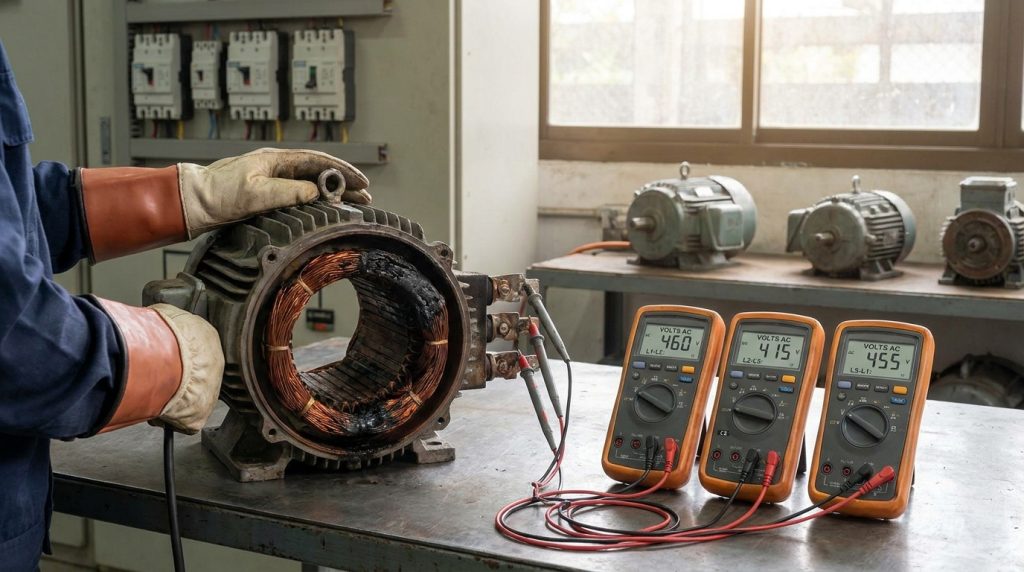
For example, if the voltages are 460V, 455V, and 450V:
Average Voltage = (460 + 455 + 450) / 3 = 455V
Minimum Voltage = 450V
Voltage Imbalance = [1 – (450 / 455)] 100 = [1 – 0.989] 100 = 1.1%
While 1.1% might seem negligible, standards like those from NEMA (National Electrical Manufacturers Association) recommend that voltage imbalance should not exceed 1% for optimal motor operation. Exceeding this threshold can significantly accelerate motor degradation.
Common Causes of Voltage Imbalance
Voltage imbalance isn’t typically an inherent flaw in the motor itself but rather an issue within the electrical distribution system feeding it. Several factors can contribute to this problem:
Uneven Single-Phase Loading
This is arguably the most common culprit. In a facility, single-phase loads (lights, small machines, office equipment) are often distributed across the three phases of the incoming three-phase power. If these loads are not evenly distributed, one phase might be significantly more heavily loaded than the others. This increased load draws more current, leading to a voltage drop on that particular phase, thus creating an imbalance.
Example: Imagine a factory where most of the administrative offices are concentrated on one side of the building, drawing power primarily from Phase A. If there isn’t a comparable load on Phases B and C, Phase A’s voltage will likely be lower.
Single-Phase Component Failures
A failure in a single-phase component within the distribution system, such as a blown fuse or a faulty breaker on one phase, can effectively disconnect or severely reduce the load on that phase. This will cause the voltage on the affected phase to rise relative to the others, creating a significant imbalance.
Inadequate Conductor Sizing
If the electrical conductors (wires) supplying the motor or the distribution panels are undersized for the load they carry, they will exhibit higher resistance. This increased resistance leads to a greater voltage drop, especially under heavy load. If one phase’s conductor is undersized or has a poor connection, it can lead to an imbalance.
Faulty Connections and High Resistance Joints
Corrosion, loose connections, or damaged wiring at terminals, busbars, or splice points can introduce unwanted resistance into the circuit. A high-resistance connection on one phase will cause a voltage drop, manifesting as an imbalance. These can be insidious, developing over time due to vibration, environmental factors, or improper installation.
Problems with the Utility Supply
While less common, issues originating from the power utility’s distribution network can also cause voltage imbalance. This could include problems with transformers, voltage regulators, or imbalances in their own distribution grid.
Older or Undersized Distribution Transformers
If a facility’s distribution transformer is old, damaged, or not adequately sized for the total connected load, its internal windings might become unbalanced, leading to imbalanced output voltages.
How Voltage Imbalance Impacts Three-Phase Motors
The consistent, rotating magnetic field in a three-phase motor is its lifeblood. When voltage is imbalanced, this smooth rotation becomes compromised, leading to a cascade of detrimental effects:
Increased Current Draw and Overheating
The most immediate and significant consequence of voltage imbalance is an increase in the motor’s current draw, particularly on the most lightly loaded phase. While the voltage on one phase might be lower, the motor still attempts to produce its rated torque. To compensate for the weaker magnetic field on the lower voltage phase, the motor draws more current from the higher voltage phases. This unbalanced current flow leads to uneven heating within the stator windings.
Technical Explanation: The unbalanced voltage creates a negative-sequence current component in addition to the normal positive-sequence current. This negative-sequence current interacts with the rotating magnetic field to produce a magnetic field rotating in the opposite direction at twice synchronous speed. This counter-rotating field induces additional currents in the rotor and stator windings, leading to increased I²R (current squared times resistance) losses and thus, overheating.
This extra heat is the primary driver of accelerated motor degradation. Overheating weakens the insulation of the stator windings, making them more susceptible to electrical breakdown and short circuits. It also accelerates bearing wear and can even affect the rotor and frame components.
Reduced Efficiency and Increased Power Consumption
As mentioned, voltage imbalance leads to increased current draw and overheating, both of which reduce the motor’s overall efficiency. A significant portion of the increased energy consumed is simply wasted as heat, rather than being converted into useful mechanical work. This translates directly to higher electricity bills and a reduced return on investment for the equipment.
Example: A motor operating with a 2% voltage imbalance can experience an increase in current draw of up to 10-15%. This increased current not only leads to overheating but also significantly boosts power consumption.
Decreased Torque and Output Power
While the motor might initially compensate by drawing more current, the unbalanced magnetic field ultimately leads to reduced torque production. This means the motor will struggle to perform its intended task, especially under heavy load. In severe cases, it can lead to stalling or the inability to start.
Increased Vibrations and Noise
The unbalanced magnetic forces generated by the imbalanced voltage create pulsations in the torque and magnetic field. These pulsations cause the motor to vibrate more than usual and can produce an audible humming or knocking noise. Excessive vibration can lead to premature wear of bearings, couplings, and mounting systems, further contributing to mechanical failures.
Shortened Motor Lifespan and Premature Failure
The cumulative effects of overheating, increased electrical and mechanical stress, and vibration significantly shorten the operational lifespan of a three-phase motor. What might have been a motor designed for years of service can fail prematurely within months or even weeks if subjected to consistent voltage imbalance. This leads to unexpected downtime, expensive repair or replacement costs, and lost production.
Rule of Thumb: For every 1% increase in voltage imbalance, motor efficiency can decrease by approximately 2-3%, and motor temperature can increase by several degrees Celsius.
Diagnosing Voltage Imbalance: Tools and Techniques
Identifying voltage imbalance requires systematic testing and diagnostic tools. For industrial maintenance technicians and electricians, having the right equipment and knowing how to use it is crucial.
Essential Diagnostic Tools
- Digital Multimeter (DMM) or True RMS Meter: A quality DMM capable of measuring AC voltage is the primary tool. A “True RMS” meter is preferable as it provides more accurate readings on non-sinusoidal waveforms, although standard AC voltage measurements are usually sufficient for imbalance detection.
- Power Quality Analyzer: For more in-depth analysis and continuous monitoring, a power quality analyzer is invaluable. These devices can measure voltage, current, frequency, harmonics, and most importantly, calculate voltage imbalance with greater precision and provide historical data.
- Clamp Meter (AC Current): To complement voltage measurements, a clamp meter is used to measure current on each phase. This helps correlate voltage imbalances with current imbalances and identifies excessive current draw.
Steps for Accurate Measurement
- Safety First: Always prioritize safety. Ensure you are trained in electrical safety procedures and wear appropriate Personal Protective Equipment (PPE), including insulated gloves and eye protection. Verify that the equipment is de-energized before making any physical connections where possible and follow lockout/tagout procedures diligently.
- Locate Test Points: Identify accessible test points for voltage measurement. These are typically at the motor terminals (if safely accessible), the motor control center (MCC) buckets, distribution panels, or main service entrances.
- Measure Phase-to-Phase Voltages: With the motor running under its normal operating load, carefully measure the AC voltage between each pair of phases: L1-L2, L2-L3, and L1-L3.
- Measure Phase-to-Ground Voltages: For a more comprehensive assessment, measure the AC voltage from each phase to ground (L1-G, L2-G, L3-G). While phase-to-phase imbalance is the primary concern for motor operation, phase-to-ground readings can reveal other system issues.
- Calculate Voltage Imbalance: Use the measured phase-to-phase voltages and the formula provided earlier to calculate the percentage of voltage imbalance.
- Measure Phase Currents: While the motor is running, use a clamp meter to measure the AC current flowing through each phase conductor feeding the motor.
- Analyze Results: Compare the measured phase currents. Ideally, they should be very close to each other. Significant differences in current, especially when coupled with voltage imbalance, strongly indicate a problem.
Important Note: Always measure voltages and currents when the motor is operating under its typical load. Imbalances may be less apparent or even absent when the motor is idling.
Prevention and Mitigation Strategies
Preventing voltage imbalance is far more cost-effective than dealing with the consequences of motor failure. A proactive approach to electrical system maintenance is key.
Regular Electrical System Audits
Performing periodic audits of your facility’s electrical distribution system can help identify potential issues before they escalate. These audits should include:
- Load Balancing Checks: Regularly assess the distribution of single-phase loads across the three phases. Look for areas where one phase is disproportionately loaded.
- Connection Inspections: Visually inspect all electrical connections, including terminals, splices, and busbars, for signs of corrosion, looseness, or overheating. Torque connections to manufacturer specifications.
- Wire Gauge Verification: Ensure that all wiring is appropriately sized for the connected loads according to electrical codes and standards.
Implementing Load Balancing Techniques
Actively managing the distribution of single-phase loads is critical. This can involve:
- Strategic Placement of Single-Phase Loads: When installing new equipment or relocating existing loads, consciously distribute them across all three phases to maintain a balance.
- Dedicated Phase Balancing Equipment: For facilities with persistent single-phase load imbalances, consider installing phase balancing devices. These are specialized transformers that can dynamically shift loads or inject compensating voltages to equalize phase loads.
- Sub-Panel Design: When designing or upgrading sub-panels, ensure that single-phase circuits are distributed as evenly as possible across the three phases.
Maintaining Electrical Infrastructure
Proper maintenance of the entire electrical infrastructure is vital:
- Regular Torque Checks: Periodically re-torque all electrical connections at breakers, panels, motor starters, and motor terminals. Vibration and thermal cycling can cause connections to loosen over time.
- Preventative Lubrication/Cleaning: For connections prone to corrosion, consider using anti-oxidant compounds and cleaning contacts during scheduled maintenance.
- Insulation Testing: Periodically test the insulation resistance of wiring and motor windings to detect degradation that could lead to future problems.
Addressing Utility Supply Issues
If voltage imbalance is suspected to be originating from the utility supply, it’s important to:
- Communicate with Your Provider: Contact your local utility company. They have the responsibility and the equipment to monitor and correct voltage imbalances on their side of the service point. Provide them with your measurements and observations.
- On-Site Power Quality Analysis: Employing a power quality specialist or using advanced power quality analyzers can help pinpoint whether the issue lies within your facility or with the utility.
Motor Protection Devices
While not directly preventing voltage imbalance, appropriate motor protection can mitigate its effects and prevent catastrophic failures:
- Three-Phase Voltage Monitors: These devices are installed in motor control circuits and continuously monitor the phase-to-phase voltages. If an imbalance exceeds a preset threshold (e.g., 1% or 2%), they can trip the motor starter, preventing operation and further damage. Many modern motor overload relays have built-in voltage monitoring capabilities.
- Properly Sized Overload Relays: Ensure that overload relays are correctly sized and calibrated for the specific motor. While they primarily protect against overcurrent, some advanced units offer features that can detect imbalances.
Understanding the implications of voltage imbalance on three-phase motors is crucial for maintaining their efficiency and longevity. A related article that delves into the intricacies of industrial machinery can be found at this link, where the focus is on the gearbox build process and its significance in overall motor performance. By exploring such connections, one can gain a more comprehensive view of how various components interact and the importance of proper voltage levels in ensuring optimal operation.
Addressing Existing Voltage Imbalance and Motor Issues
When voltage imbalance is detected, and especially if a motor is showing signs of distress, prompt action is required.
Troubleshooting Steps for Motor Performance Issues
If a motor is exhibiting symptoms like overheating, reduced power, or excessive vibration, voltage imbalance is a prime suspect. Follow these steps:
- Verify Load: Ensure the motor is operating under its rated load. An unloaded motor may not reveal existing imbalances.
- Measure Voltages: As detailed in the diagnosis section, carefully measure phase-to-phase voltages with the motor running.
- Calculate Imbalance: Determine the voltage imbalance percentage.
- Measure Currents: Measure phase currents simultaneously. Look for significant differences between phases.
- Inspect Connections: Examine all electrical connections from the supply to the motor for looseness, corrosion, or signs of overheating.
- Check Fuses/Breakers: Verify that all fuses are intact and that circuit breakers are properly seated and functioning on all three phases.
- Consider Harmonics: In some industrial settings with variable frequency drives (VFDs) or other non-linear loads, harmonic distortion can also contribute to motor issues and might be present alongside voltage imbalance. A power quality analyzer can detect this.
Immediate Actions to Take
- If Imbalance is High (>1%):
- Disengage Motor: If the voltage imbalance is significantly high (e.g., >2-3%) or if the motor is showing signs of distress (excessive heat, noise), shut down the motor to prevent further damage.
- Investigate Source: Immediately begin investigating the cause of the imbalance, starting with load distribution and connection checks.
- Temporary Measures: If immediate repair isn’t possible and production is critical, temporary measures might involve redistributing single-phase loads or, in extreme cases, temporarily running a critical motor on a less ideal but functional phase if absolutely necessary (with extreme caution and monitoring). However, this is not a long-term solution.
- If Motor Shows Signs of Damage:
- Professional Assessment: If the motor is overheating, vibrating excessively, or has failed, it likely requires professional assessment and repair. Contact an experienced electric motor repair service.
- Rewinding vs. Replacement: Depending on the severity of the damage and the age/cost of the motor, a decision will need to be made whether to rewind the motor (replacing the stator windings) or to replace the entire unit. CEM Industrial Supply offers expert motor repair and can advise on the best course of action.
When to Consider Motor Rewinding or Replacement
The decision to rewind or replace a motor damaged by voltage imbalance depends on several factors:
- Severity of Damage: If winding insulation is significantly degraded or burned, rewinding is often feasible.
- Age and Cost of Motor: Older motors may be less efficient than modern replacements. The cost of a rewind versus a new motor of comparable or superior efficiency should be compared.
- Downtime Constraints: Rewinding can take time. If downtime is critical, purchasing a new motor may be faster.
- Efficiency Upgrades: Replacing an older motor with a new, high-efficiency model can offer long-term energy savings that offset the initial cost. CEM Industrial Supply can help you select the right replacement motor.
Understanding the impact of voltage imbalance on three-phase motors is crucial for maintaining their efficiency and longevity. For those interested in exploring related topics, an insightful article on the importance of proper electrical insulation can be found here. This resource highlights how inadequate insulation can exacerbate issues caused by voltage imbalances, ultimately leading to motor failure. By addressing these interconnected factors, operators can better safeguard their equipment and enhance operational reliability.
Safety Precautions When Working with Three-Phase Motors
Working with three-phase electrical systems and motors inherently involves risks. Strict adherence to safety protocols is paramount.
- Lockout/Tagout (LOTO): Always implement proper LOTO procedures before performing any maintenance, inspection, or testing on electrical equipment. This ensures the equipment cannot be accidentally energized.
- Personal Protective Equipment (PPE): Wear appropriate PPE at all times when working near energized electrical equipment. This includes:
- Arc-rated (AR) clothing: Designed to protect against arc flash hazards.
- Insulated gloves: Rated for the voltage levels you are working with.
- Safety glasses or face shield: To protect against flying debris or arc flash.
- Safety shoes: With electrical hazard protection.
- Qualified Personnel: Only trained and qualified electricians or technicians should perform electrical work.
- Use Insulated Tools: When working on or near electrical components, use tools that are properly insulated and rated for electrical work.
- Maintain Safe Distances: Be aware of approach boundaries for energized equipment to avoid accidental contact.
- Understand Arc Flash Hazards: Be aware of the potential for arc flash incidents and take steps to mitigate them, such as de-energizing equipment whenever possible.
- Proper Grounding: Ensure all equipment and enclosures are properly grounded.
The Role of CEM Industrial Supply in Coldwater, Michigan
For businesses in Coldwater, Michigan, and the surrounding areas relying on three-phase motors, CEM Industrial Supply is a trusted partner. We understand the critical nature of reliable motor operation and the detrimental impact of issues like voltage imbalance.
Our expertise extends to:
- Electric Motor Repair Services: Our skilled technicians can diagnose, repair, and rebuild three-phase motors of all types and sizes. We specialize in identifying the root causes of failures, including those related to electrical imbalances. You can learn more about our comprehensive repair services by visiting our Electric Motor Repair page.
- Electric Motor Sales and Replacements: If your motor is beyond repair or if an upgrade is more cost-effective, we offer a wide selection of new and remanufactured electric motors from leading manufacturers. We can help you select the right motor for your application, ensuring proper efficiency and performance. Explore our Electric Motor Sales offerings.
- Industrial Supply and Diagnostics: Beyond motors, we provide a vast inventory of industrial supplies, including electrical components, testing equipment, and safety gear. Our team can assist with diagnostic tools and provide guidance on identifying and troubleshooting electrical issues like voltage imbalance.
- Preventative Maintenance Support: We can advise on and supply components for preventative maintenance programs that can help avert problems like voltage imbalance before they impact your operations.
Don’t let voltage imbalance silently degrade your valuable equipment and lead to costly downtime. Regular checks and prompt, expert service are key to maintaining peak operational efficiency and extending the life of your three-phase motors.
Frequently Asked Questions About Voltage Imbalance
Q1: What is considered a “normal” level of voltage imbalance for a three-phase motor?
A1: NEMA standards generally recommend that voltage imbalance should not exceed 1%. Operating with an imbalance of 1% or less is ideal. Anything above 1% can begin to negatively impact motor performance and lifespan, and levels above 2-3% are generally considered critical.
Q2: Can a single-phase motor be affected by voltage imbalance?
A2: No, voltage imbalance is a phenomenon specific to three-phase power systems and their motors. Single-phase motors operate on a single AC voltage and are not directly affected by the phase relationships of a three-phase system.
Q3: How can I quickly check if my facility has a voltage imbalance issue?
A3: The quickest way is to use a multimeter to measure the phase-to-phase voltages at the motor terminals or at the motor control center while the motor is running under load. Calculate the percentage of imbalance. If you suspect a persistent issue or need more detailed analysis, consider a power quality analyzer.
Q4: My motor is humming more than usual, could this be related to voltage imbalance?
A4: Yes, an increase in humming or vibration, especially if it’s a low-frequency, pulsating sound, can be a strong indicator of voltage imbalance. The uneven magnetic forces created by imbalanced voltages cause these pulsations.
Q5: If I find a significant voltage imbalance, should I immediately shut down the motor?
A5: If the voltage imbalance is high (e.g., above 2-3%) or if the motor is showing signs of distress (overheating, excessive noise), it is generally recommended to shut down the motor to prevent further damage. For minor imbalances (e.g., 1-1.5%), continued monitoring and investigation into the cause are advised.
Conclusion: Proactive Management for Reliable Operations
Voltage imbalance is a stealthy adversary to the efficiency and longevity of three-phase electric motors. Its insidious effects – increased heat, reduced efficiency, vibration, and ultimately, premature failure – can disrupt production and lead to significant financial losses. However, by understanding the causes, implementing diligent diagnostic practices, and prioritizing preventative maintenance, industrial facilities can effectively combat this threat.
For the industrial maintenance technicians, plant managers, electricians, and equipment owners who rely on the consistent performance of their machinery, staying vigilant about electrical system health is paramount. Regular checks, load balancing efforts, and prompt attention to any detected anomalies are the cornerstones of reliable operations.
If you suspect your facility is experiencing voltage imbalance, or if you need expert assistance with electric motor repair, diagnostics, or sourcing replacement motors and supplies, CEM Industrial Supply is here to help. Our team of experienced professionals in Coldwater, Michigan, is dedicated to providing the solutions and support you need to keep your operations running smoothly and efficiently. Don’t wait for a motor failure to address the issue. Contact CEM Industrial Supply today to schedule an assessment, discuss your needs, or inquire about our comprehensive services in electric motor repair, diagnostics, and industrial supply.