
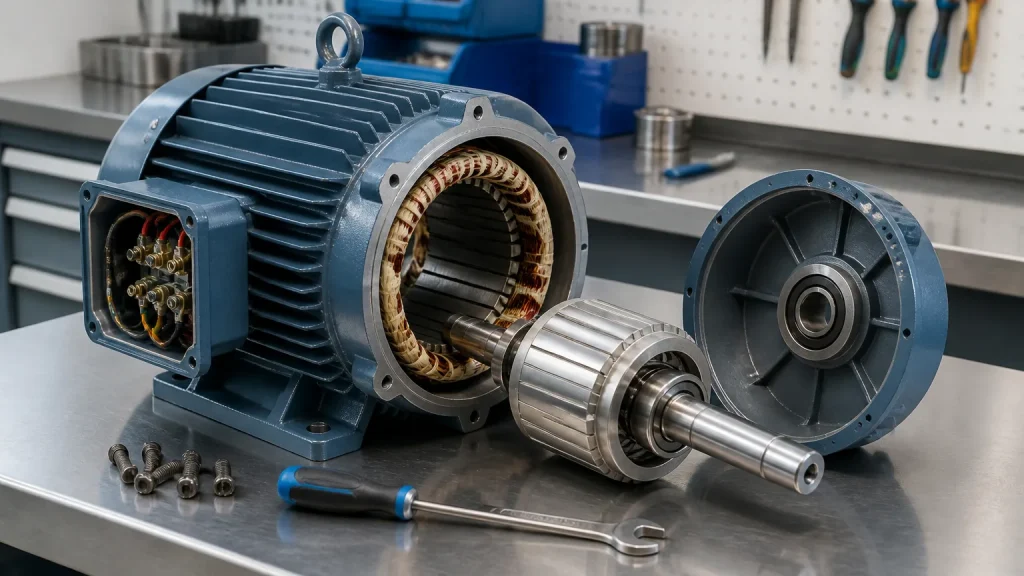
Electric motor repair becomes a serious decision when a motor overheats, hums, trips breakers, or loses power. The failure can create a safety hazard and raise production costs through damaged equipment, lost work, and unplanned downtime. Disconnect power before inspection, and use qualified electrical help whenever testing involves energized circuits.
The right answer depends on the failure type, motor condition, replacement cost, downtime, and application demands. Seasonal moisture, freeze-thaw cycles, agricultural dust, and demanding shop environments can accelerate wear, especially in southern Michigan. A failed bearing may justify repair, while winding damage or repeated overheating may point toward replacement.
This article helps you diagnose the problem first, then compare repair economics, reliability, and long-term performance. Good records and routine checks, such as a preventive maintenance checklist, can also reveal warning signs before failure stops your operation.
Start With a Proper Motor Diagnosis
Before starting electric motor repair, confirm the motor is actually the problem. Document when the issue occurs, whether the motor hums or stalls, and any unusual noise, heat, odor, or vibration. Note whether a breaker or overload trips.
Begin with safe checks. Verify the motor’s nameplate against the system requirements. With power isolated and locked out, inspect terminals, ventilation openings, and the shaft for free movement. Look for contamination, loose connections, damaged belts, worn couplings, or seized driven equipment. Shop corrosion prevention practices, such as preventing corrosion in your shop, can also reduce long-term motor damage.
The fault may involve wiring, controls, capacitors, overloads, bearings, or the driven machine. A motor that will not start may have a control or capacitor issue, while repeated overload trips can indicate excess load, misalignment, or bearing failure.
Deeper testing often requires a qualified electrician or repair shop. Insulation resistance, winding resistance, current balance, voltage, and bearing condition all help confirm the cause. Replacing the motor without correcting the original problem can lead to another failure, especially when poor ventilation, voltage issues, overload, or misalignment remain.
When Electric Motor Repair Makes Sense
Electric motor repair makes sense when the windings and frame remain sound. Replacing worn bearings, cooling fans, terminal hardware, capacitors, seals, brushes, or damaged leads can restore reliable operation at a reasonable cost. These repairs often suit industrial equipment, pumps, fans, machinery, and shop tools.
A qualified technician should inspect corrosion before choosing a repair. Surface rust and light contamination may be cleaned and treated. Deeply damaged laminations, seized shafts, or moisture-damaged windings can make rebuilding uneconomical. Use proven ways to prevent rust on shop tools to reduce future damage.
Professional rewinding can also be practical for larger, specialized, or hard-to-source motors. It may avoid substantial downtime, system modifications, or difficult alignment work. This option deserves serious consideration for custom motors with unusual voltage or phase requirements.
Repair becomes more attractive when the motor has premium efficiency, compatible mounting dimensions, or a known service history. Keeping the original unit may preserve system performance and avoid changes to belts, couplings, controls, or wiring. Compare the repair estimate with replacement cost, expected service life, and downtime before deciding.
Ask the repair shop for test results and a clear scope of work. Confirm insulation condition, winding health, shaft integrity, and bearing fit. A sound rebuild should address the original failure, not simply return the motor to service.
When Replacing the Motor Is the Better Investment
Repair is not always the best value. Replacement usually makes more sense when windings are burned or grounded, the housing is cracked, or the shaft has severe damage. Repeated failures, obsolete designs, unavailable parts, or a repair estimate near replacement cost are also strong warning signs.
A newer high-efficiency motor can lower operating costs when equipment runs many hours each day. Replacement may also improve compatibility with modern controls or variable-frequency drives. Compare the motor’s efficiency rating and expected service life, not just its purchase price. Apply the same battery and equipment care practices to support reliable operation across your equipment.
Do not select a replacement by horsepower alone. Confirm voltage, phase, RPM, frame, enclosure, service factor, mounting, shaft dimensions, duty cycle, ambient conditions, and hazardous-location requirements. The wrong specifications can create fitment, performance, or safety problems.
Downtime belongs in the comparison, too. A readily available motor with warranty coverage, technical support, and a clear delivery date may provide more value than a cheaper electric motor repair with uncertain turnaround. Before ordering, verify the application and ask whether the replacement includes the correct bearings, enclosure, and connection options.
Compare Total Cost, Reliability, and Application Fit
Compare more than the initial invoice. Add diagnosis, labor, parts, rewinding, shipping, installation, alignment, controls, lost production, emergency sourcing, and future maintenance. For contractors, a delayed repair can disrupt the job schedule. In manufacturing, downtime may cost more than the motor.
A repair should include documented testing and a clear warranty. Confirm the shop corrected the failure cause and tested insulation, current balance, bearings, and rotation. A replacement should include proper installation, rotation verification, overload protection, and confirmation that the original problem was corrected.
Choose replacement when another failure could damage connected equipment, create a fire hazard, interrupt a critical process, or compromise your schedule. For serious DIY projects, local tool rentals for temporary project support can maintain momentum while the motor is evaluated. Rental equipment does not replace qualified electrical repair or safe installation.
Make the Decision Before the Next Failure
Diagnose the motor first. Repair sound motors with repairable faults, but replace units with severe damage, poor efficiency, or limited remaining life. Correct the underlying cause—such as overload, misalignment, voltage problems, or poor ventilation—before returning equipment to service.
Contractors and manufacturers should keep nameplate data, motor history, and a reliable replacement source on file. DIYers should prioritize electrical isolation, accurate testing, and professional evaluation over uncertain savings. The cheapest option today is not always the lowest-cost choice over the motor’s remaining service life.