
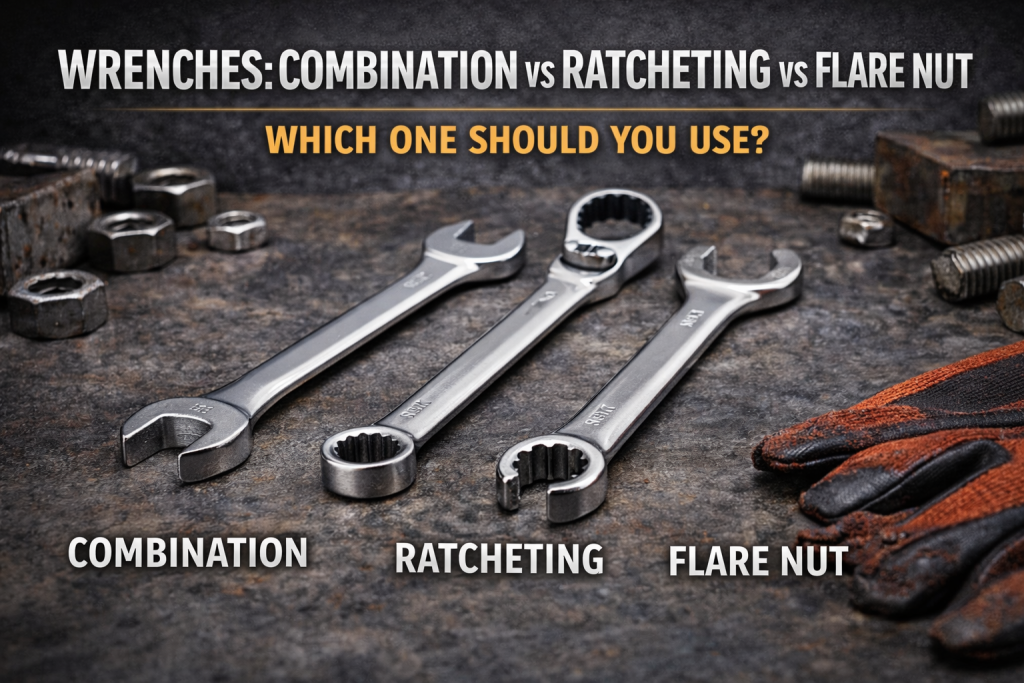
Not all wrenches are interchangeable, even when they’re the same size. Choosing between combination, ratcheting, and flare nut wrenches affects speed, access, grip, and whether you round off a fastener or get the job done cleanly.
This guide breaks down how each wrench type works, what it’s best for, and when using the wrong wrench can actually cause damage.
Why Wrench Type Matters
Wrench choice impacts:
- Fastener grip
- Torque control
- Speed of work
- Access in tight spaces
- Risk of rounding or slipping
Most fastener damage we see isn’t from over-tightening — it’s from using the wrong wrench for the application.
Combination Wrenches: The All-Purpose Standard
Combination wrenches have an open-end on one side and a box-end on the other. They’re the most common and versatile wrench found in toolboxes.
Best uses:
- General mechanical work
- Automotive repairs
- Equipment maintenance
- Assembly and disassembly
Strengths:
- Simple and durable
- Good torque with box end
- Open end works in tight access
- Affordable and widely available
Limitations:
- Slower for repetitive fastening
- Open end can slip if misaligned
- Requires repositioning after each turn
Combination wrenches are the foundation of any wrench set and work well for most everyday tasks.
Ratcheting Wrenches: Speed and Efficiency
Ratcheting wrenches look like combination wrenches but include a ratcheting mechanism in the box end, allowing continuous turning without removing the wrench.
Best uses:
- Repetitive fastening
- Tight spaces
- Automotive and machinery work
- Production and maintenance tasks
Strengths:
- Faster than standard wrenches
- Minimal repositioning
- Excellent in confined spaces
- Available in reversible and flex-head styles
Limitations:
- Higher cost
- Ratchet mechanisms can fail under extreme torque
- Not ideal for breaking stubborn fasteners loose
Ratcheting wrenches shine once the fastener is already broken free. Many techs use a standard wrench to crack a bolt loose, then switch to ratcheting for speed.
Flare Nut Wrenches: Maximum Grip on Soft Fittings
Flare nut wrenches are designed specifically for fittings with soft metals and thin walls. They look like a box wrench with a small slot cut out to pass over tubing.
Best uses:
- Brake lines
- Fuel lines
- Hydraulic fittings
- Refrigeration and HVAC lines
Strengths:
- Grips more sides of the fastener
- Reduces rounding
- Designed for tubing applications
- Essential for fluid systems
Limitations:
- Limited application
- Slower than ratcheting wrenches
- Not for general fastening
Using a standard open-end wrench on flare fittings is one of the fastest ways to round them off. Flare nut wrenches exist to prevent exactly that.
Side-by-Side Comparison
Combination Wrenches
Best for: General use
Speed: Moderate
Grip strength: Good
Versatility: High
Ratcheting Wrenches
Best for: Speed and tight spaces
Speed: Fast
Grip strength: Moderate
Versatility: High
Flare Nut Wrenches
Best for: Tubing and fluid fittings
Speed: Slower
Grip strength: High
Versatility: Low
Common Mistakes We See
Using ratcheting wrenches to break bolts loose
This damages the mechanism and shortens tool life.
Using open-end wrenches on flare fittings
This rounds fittings and creates leaks.
Using the wrong size “because it’s close enough”
This leads to slipping, rounding, and injury.
How to Choose the Right Wrench
Choose a combination wrench when:
- You need durability and torque
- Speed isn’t critical
- Space allows repositioning
Choose a ratcheting wrench when:
- You’re doing repetitive work
- Space is tight
- Fasteners are already loosened
Choose a flare nut wrench when:
- You’re working with tubing or fluid lines
- Fastener damage isn’t an option
- Safety and sealing matter
Final Takeaway
Combination, ratcheting, and flare nut wrenches each serve a specific purpose. Having the right wrench not only makes the job faster — it prevents damage, saves time, and reduces frustration.
If you’re unsure which wrench type fits your application, ask us. Using the correct tool from the start almost always costs less than fixing a rounded fitting later.