
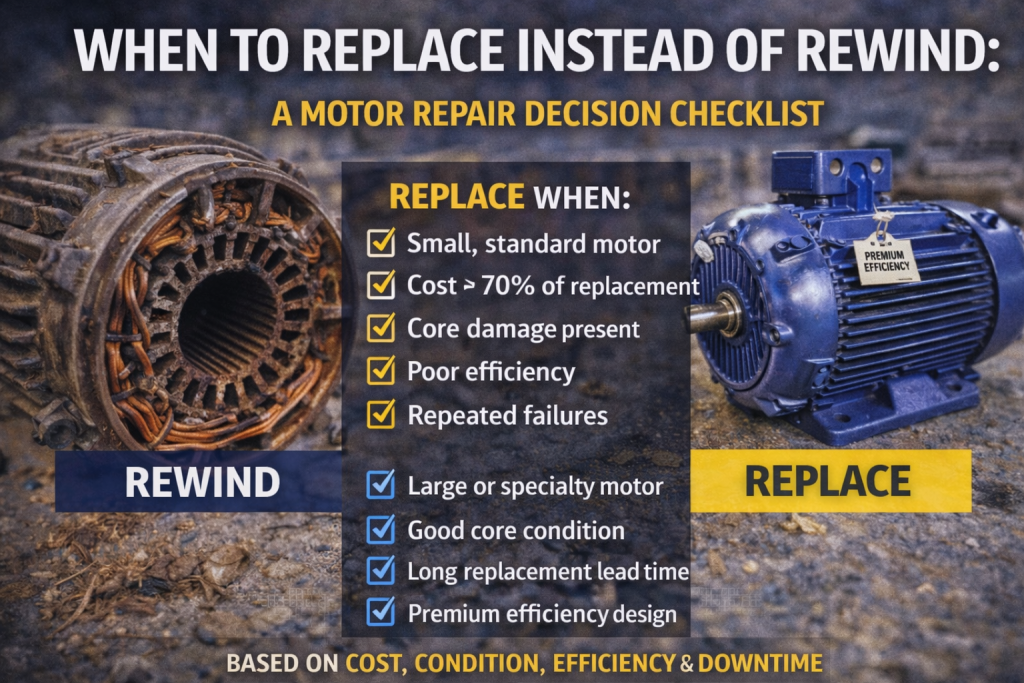
One of the hardest calls in motor repair is deciding whether to rewind or replace. Rewinding can save money and preserve custom motors — but in the wrong situation, it becomes a sunk cost that leads to repeat failure.
This guide gives you a practical, step-by-step checklist to decide when replacement is the smarter move.
Why This Decision Matters
Choosing incorrectly can result in:
- Spending more than a new motor costs
- Extended downtime
- Repeat failures
- Reduced efficiency
- Wasted labor and materials
The right decision balances cost, reliability, efficiency, and downtime — not emotion or habit.
The Core Rule of Thumb
If the total rewind cost approaches 60–70% of the replacement cost for a standard motor, replacement usually makes more sense.
But cost alone is not the full story.
Decision Checklist: Replace or Rewind?
Work through this checklist in order.
1. Motor Size and Horsepower
Small motors are rarely good rewind candidates.
Replace if:
- Fractional HP to ~10 HP
- Standard frame
- Off-the-shelf availability
Rewind if:
- Large horsepower motor
- Specialty frame or configuration
- Long replacement lead times
Small motors are cheaper to replace than rewind almost every time.
2. Motor Age and Design
Older motors may not justify investment.
Replace if:
- Motor is obsolete
- Efficiency class is outdated
- Replacement is readily available
Rewind if:
- Motor is modern
- Inverter-duty or severe-duty
- Built for harsh environments
Rewinding an outdated design often locks in inefficiency.
3. Efficiency and Energy Costs
Energy costs often exceed repair costs over time.
Replace if:
- Motor is pre-premium efficiency
- Runs continuously
- Energy savings justify upgrade
Rewind if:
- Premium efficiency motor
- Efficiency will be maintained
- Downtime costs outweigh energy savings
Efficiency upgrades matter most on continuously running motors.
4. Core and Stator Condition
This is a major deciding factor.
Replace if:
- Core lamination damage exists
- Hot spots are present
- Core losses are excessive
Rewind if:
- Core tests good
- No lamination damage
- Insulation failure only
A damaged core often makes rewinding uneconomical or unreliable.
5. Cause of Failure
Understanding why the motor failed is critical.
Replace if:
- Chronic overheating occurred
- Voltage imbalance was severe and prolonged
- Moisture contamination is extensive
- Multiple past rewinds exist
Rewind if:
- Single isolated failure
- Insulation breakdown only
- Bearings or mechanical issues caused the failure
Repeating the same rewind without fixing the root cause guarantees another failure.
6. Application and Environment
Environment matters as much as motor condition.
Replace if:
- Original motor was not suited for environment
- Frequent dust, moisture, or chemical exposure
- Washdown or farm duty conditions exist
Rewind if:
- Motor design matches environment
- Proper protection is in place
- Environmental cause has been corrected
Sometimes the problem isn’t the motor — it’s where it’s installed.
7. Downtime and Lead Time
Time is often more valuable than repair cost.
Replace if:
- New motor is available immediately
- Downtime cost is high
- Repair turnaround is long
Rewind if:
- Replacement lead time is long
- Motor is critical or custom
- Expedited rewind is available
Production losses often outweigh repair savings.
8. History of Previous Repairs
Repeated rewinds reduce reliability.
Replace if:
- Motor has been rewound multiple times
- Failure intervals are shortening
- Performance is declining
Rewind if:
- First rewind
- Strong repair history
- Known root cause addressed
Each rewind stresses the core and insulation system.
Quick Decision Matrix
Replace when:
- Small, standard motor
- Rewind cost > 70% of replacement
- Core damage present
- Poor efficiency
- Repeated failures
Rewind when:
- Large or specialty motor
- Good core condition
- Long replacement lead time
- Premium efficiency design
- First-time insulation failure
Common Mistakes We See
Rewinding small motors out of habit
Ignoring energy efficiency gains
Repairing without fixing root causes
Assuming rewinding is always cheaper
Letting downtime drive rushed decisions
The cheapest option upfront is not always the cheapest long-term.
How a Good Shop Helps You Decide
A reputable motor shop should:
- Test the core
- Explain failure causes
- Compare repair vs replacement honestly
- Factor in efficiency and downtime
- Recommend replacement when appropriate
If replacement is never suggested, that’s a red flag.
Final Takeaway
Rewinding is a powerful tool — but not always the right one. When motors are small, inefficient, damaged, or repeatedly failing, replacement is often the smarter, safer investment.
Use this checklist before committing money to a rewind. A clear decision upfront prevents repeat failures and wasted cost later.