
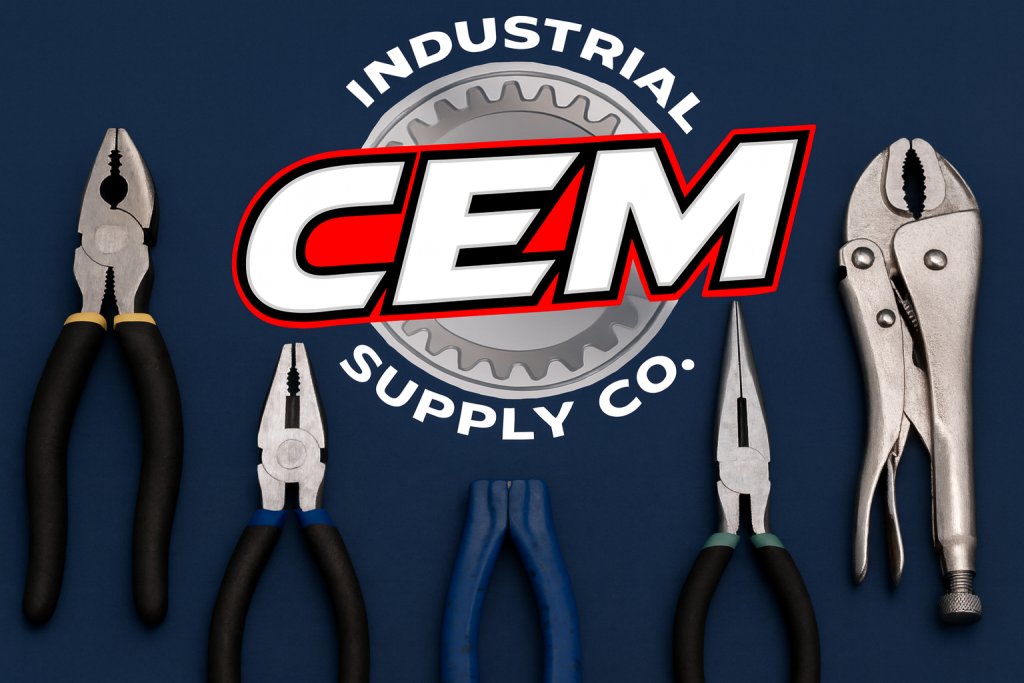
Pliers are one of the most essential tools in any toolbox—whether you’re a mechanic, electrician, machinist, HVAC tech, or a weekend DIY builder. At CEM Industrial Supply, we carry professional-grade pliers designed for real job-site demands: gripping, cutting, twisting, bending, pulling, crimping, and more.
If you want to understand which pliers you need — and why — this guide breaks down every major type, what they’re used for, and how to choose the right pair.
What Are Pliers? (Quick Definition)
Pliers are hand tools designed to grip, bend, twist, pull, or cut materials using leverage. They’re made of hardened steel with specially shaped jaws optimized for different tasks.
They give you precision, force, and control that fingers simply can’t.
Types of Pliers and Their Uses
Below are the most common professional-grade pliers used in industrial, automotive, electrical, construction, and maintenance work.
1. Slip-Joint Pliers
Best for: General gripping, basic repairs, household tasks.
Why they matter: The adjustable pivot point gives you two jaw positions for different thicknesses.
Common uses:
- Gripping nuts and bolts
- Holding objects steady
- Bending light metal
- Household maintenance
2. Linesman Pliers
Best for: Electrical work
Why they matter: Strong jaws for cutting wire + flat gripping surface for twisting multiple wires together.
Common uses:
- Electrical installation
- Cutting copper/aluminum wire
- Crimping connectors
- Twisting wires
3. Needle-Nose Pliers
Best for: Precision work and tight spaces
Why they matter: Long, tapered jaws reach where nothing else can.
Common uses:
- Electrical panel work
- Jewelry repair
- Craft work
- Bending or forming detailed shapes
- Retrieving objects in tight spaces
4. Diagonal Cutting Pliers (Dikes)
Best for: Cutting wire
Why they matter: Sharp, angled blades slice through wiring cleanly.
Common uses:
- Electrical wire cutting
- Zip tie trimming
- Cutting nails or small rivets
- Snipping metal wire
5. Tongue-and-Groove Pliers (Channel Locks)
Best for: Plumbing, HVAC, mechanical work
Why they matter: Quick-adjust jaws with a wide opening range.
Common uses:
- Turning pipes and fittings
- Gripping large nuts and connectors
- General heavy-duty gripping
- HVAC ducting work
6. Locking Pliers (Vise-Grips)
Best for: Clamping, holding, and maximum grip
Why they matter: They lock into place and act like a temporary vise.
Common uses:
- Holding a bolt in place
- Breaking loose stuck fasteners
- Welding and metal fabrication
- Clamping parts together
7. End-Cutting Pliers
Best for: Flush-cutting and pulling nails
Why they matter: Their rounded head gives high leverage for pulling or snipping.
Common uses:
- Cutting wire close to a surface
- Pulling nails or staples
- Trimming rivets
- Jewelry repairs
8. Bent-Nose Pliers
Best for: Specialty reaching and gripping
Why they matter: The angled jaw helps reach around obstacles.
Common uses:
- Electronics
- Tight mechanical spaces
- Automotive engine bays
- Jewelry and craft work
How to Choose the Right Pliers
Choose by Task
- Electrical work: Linesman, needle-nose, dikes
- Mechanical work: Tongue-and-groove, locking pliers
- Precision work: Needle-nose, bent-nose
- Cutting jobs: Diagonal cutters, end-cutting pliers
Look for High-Quality Steel
Industrial users should prioritize:
- Chrome-vanadium steel
- Induction-hardened cutting edges
- Non-slip grip handles
Comfort Matters
If you work all day with your tools, choose:
- Padded ergonomic grips
- Spring-loaded options for repetitive use
Pro Tips from the CEM Industrial Supply Team
- Keep pliers clean and lightly oiled to prevent rust.
- Don’t use pliers as a hammer — it ruins alignment.
- For cutting hardened steel, always use the correct cutter type to avoid damaging the blades.
- Locking pliers are perfect when you need a “third hand.”
- Choose insulated handles for any electrical application.
FAQ: Pliers
What are the strongest pliers for heavy-duty jobs?
Tongue-and-groove pliers and locking pliers offer the highest clamping force and durability.
Which pliers are best for electricians?
Linesman pliers, diagonal cutters, and needle-nose pliers are the essential trio.
What’s the difference between cutting pliers and gripping pliers?
Cutting pliers use sharp blades to slice materials, while gripping pliers rely on grooved jaws to hold objects firmly.
Shop Pliers in Coldwater, Michigan
Looking for professional-grade pliers for your job site, shop, or toolbox?
CEM Industrial Supply carries reliable brands at competitive prices — plus local pickup and job-site delivery.