
Whether you are a maintenance technician, engineer, machine builder, farmer, student, or simply someone trying to make a wise purchasing decision, you are welcome here. In Bhakti Yoga, the path of devotion and loving service, we learn that even practical work can become meaningful when done with care, attention, and a sincere heart.
The Sanskrit word seva means “service.” When we maintain a machine properly, reduce waste, prevent breakdowns, and protect the people who work around equipment, that too can be approached as seva. It is not only the temple, prayer room, or meditation mat where spiritual growth happens. The Bhagavad-gita teaches that work offered with sincerity can become a path of inner purification and devotion.
In this article, we will explore the difference between pillow block bearings and flange bearings in clear, practical language. If you are comparing “pillow block vs flange bearing,” the main difference comes down to mounting style, load direction, space, alignment, and application.
Both bearing types support a rotating shaft. Both help reduce friction. Both can be used in many industrial, agricultural, and mechanical systems. But they are not the same, and choosing the right one can save time, money, and frustration.
When comparing pillow block bearings and flange bearings, it’s essential to consider their applications and functionalities in various machinery setups. For a deeper understanding of how different components, such as motors, can influence the performance of these bearings, you may find the article on single-phase vs. three-phase motors insightful. It discusses common failures and symptoms that can arise in motor systems, which can directly impact the effectiveness of bearing types. You can read more about it in this article: Single Phase vs Three Phase Motors: Common Failures and Symptoms.
What Is a Pillow Block Bearing?
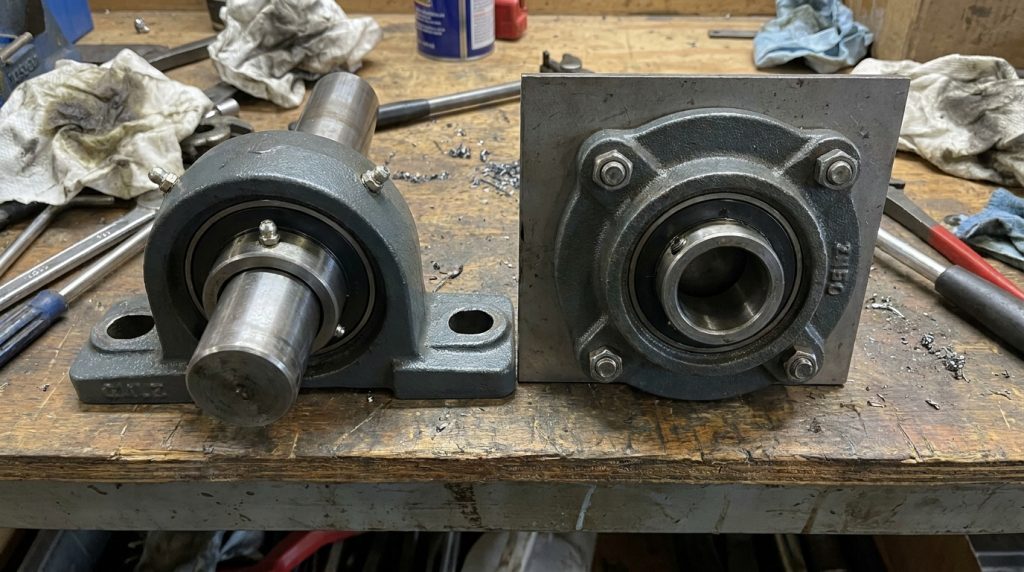
A pillow block bearing is a mounted bearing unit designed to support a rotating shaft while being bolted to a flat surface. It usually has a housing shaped like a small pedestal or block, which is why it is often called a pillow block.
Inside the housing is an insert bearing, commonly a ball bearing, though other types may be used depending on the application. The shaft passes through the bearing, and the bearing allows the shaft to rotate smoothly with reduced friction.
Basic Structure of a Pillow Block Bearing
A typical pillow block bearing includes:
- A housing or base
- A bearing insert
- A shaft-locking mechanism
- Mounting holes
- Seals or shields
- Sometimes a grease fitting for lubrication
The housing may be made from cast iron, stainless steel, pressed steel, thermoplastic, or other materials. Cast iron pillow block bearings are common in heavy-duty industrial use, while stainless steel or thermoplastic units may be preferred in food processing, washdown, or corrosive environments.
How Pillow Block Bearings Are Mounted
Pillow block bearings are mounted on a surface that is usually parallel to the shaft. The base of the bearing housing has two or more bolt holes. These bolts secure the bearing to a machine frame, conveyor bed, support rail, or other flat structure.
This style makes pillow block bearings especially useful when a shaft needs support from below or from a horizontal base. They are simple to install and easy to inspect, which is one reason they are so common.
Common Uses of Pillow Block Bearings
Pillow block bearings are found in many applications, including:
- Conveyor systems
- Agricultural equipment
- Fans and blowers
- Packaging machines
- Textile machinery
- Material handling systems
- Industrial rollers
- Woodworking machines
- Food processing equipment
They are often used where the shaft is long and needs support at one or more points along its length.
What Is a Flange Bearing?
A flange bearing is also a mounted bearing unit, but instead of sitting on a pedestal-style base, it is mounted using a flange. The flange is a flat plate-like part of the housing with bolt holes. This allows the bearing to be attached to a vertical surface, side wall, machine panel, or frame.
Flange bearings are very useful when the shaft passes through a wall, plate, or structural member. They provide support while allowing the shaft to rotate smoothly.
Basic Structure of a Flange Bearing
A flange bearing usually includes:
- A flanged housing
- A bearing insert
- Mounting holes
- Shaft-locking mechanism
- Seals or shields
- Optional lubrication fitting
Like pillow block bearings, flange bearings may use different housing materials. Cast iron is common for strength. Stainless steel is preferred where corrosion resistance is important. Plastic or thermoplastic housings may be used in lighter-duty or sanitary applications.
Types of Flange Bearings
Flange bearings come in several common styles:
Two-Bolt Flange Bearing
A two-bolt flange bearing has two mounting holes. It is compact and useful where space is limited. It is often used in light to medium-duty applications.
Three-Bolt Flange Bearing
A three-bolt flange bearing has three mounting points, usually arranged in a triangular pattern. It offers more stability than a two-bolt flange in certain applications.
Four-Bolt Flange Bearing
A four-bolt flange bearing is often used for heavier loads and more secure mounting. The four mounting holes provide strong support and help distribute forces evenly.
Piloted Flange Bearing
A piloted flange bearing has a raised circular section that helps center the bearing in a matching hole or recess. This improves alignment and can make installation more accurate.
Common Uses of Flange Bearings
Flange bearings are often used in:
- Conveyor side frames
- Vertical machine panels
- Augers
- Mixers
- Packaging equipment
- Food processing machinery
- Farm machinery
- HVAC systems
- Industrial automation equipment
They are especially helpful where the shaft must be supported at the end of a machine or pass through a plate.
Please check out our latest article at https://cemindustrialsupply.com/news/ for more information.
Pillow Block vs Flange Bearing: Main Differences
When comparing pillow block vs flange bearing units, the key difference is how they mount to the machine.
A pillow block bearing mounts on a flat surface below or beside the shaft, usually with the shaft running parallel to the mounting surface. A flange bearing mounts to a surface that is often perpendicular to the shaft, such as a wall, plate, or machine frame.
Both can support rotating shafts, but their shape and mounting style make them suitable for different layouts.
Difference in Mounting Style
Pillow block bearings use a base mount. They sit on top of a support surface like a small pedestal.
Flange bearings use a face mount. They are bolted to a vertical or flat face, usually around the shaft opening.
If your machine has a horizontal support surface under the shaft, a pillow block bearing may be the natural choice. If the shaft passes through a side panel or end plate, a flange bearing may be better.
Difference in Space Requirements
Pillow block bearings need enough room for the base and bolts below the shaft. This can require more horizontal surface area.
Flange bearings may be more compact in certain designs because they mount directly to a wall or plate. They are helpful when there is no room for a pedestal-style base.
Difference in Load Direction
Both pillow block and flange bearings can handle radial loads, which are loads acting perpendicular to the shaft. Some designs can also handle limited axial loads, which are loads acting along the shaft.
However, the machine layout and load direction matter. Pillow block bearings are often used when the load pushes downward toward the mounting base. Flange bearings are often used when the load is carried through a machine wall or side frame.
Always check the manufacturer’s load ratings before choosing a bearing.
Difference in Alignment
Many mounted bearings, both pillow block and flange types, are designed with some self-aligning ability. This means the bearing insert can adjust slightly inside the housing to compensate for minor shaft misalignment.
Still, good alignment is important. Misalignment can cause heat, vibration, noise, seal wear, and early failure.
In Bhakti practice, there is a beautiful word: sadhana, meaning steady spiritual practice. Just as steady chanting, prayer, and service help align the heart, careful mechanical alignment helps a bearing work peacefully and efficiently. Small corrections made with patience can prevent larger problems later.
When comparing Pillow Block and Flange Bearings, it’s essential to understand their distinct applications and advantages in various mechanical systems. For those interested in exploring more about different tools and their functionalities, a related article on the differences between hammer drills and rotary hammers can provide valuable insights into selecting the right equipment for specific tasks. You can read more about this topic in the article here. Understanding these differences can enhance your knowledge of mechanical components and their uses in construction and manufacturing.
Advantages of Pillow Block Bearings
Pillow block bearings are popular because they are practical, strong, and easy to work with. They are widely available and come in many sizes and materials.
Easy Installation
One major advantage of pillow block bearings is simple installation. The housing can be bolted directly to a flat surface. Once the bearing is positioned correctly, the shaft can be locked into place using set screws, eccentric locking collars, adapter sleeves, or other mechanisms.
This makes pillow block bearings a favorite for maintenance teams who need a straightforward solution.
Good Shaft Support
Pillow block bearings provide strong support for rotating shafts. They are often used in pairs, with one bearing near each end of the shaft. For longer shafts, additional pillow block bearings may be used along the length.
This helps prevent shaft deflection, vibration, and uneven wear.
Easy Maintenance Access
Because pillow block bearings sit openly on a base, they are usually easy to inspect. Maintenance workers can check seals, lubrication fittings, mounting bolts, temperature, and vibration without removing major machine parts.
This ease of access can reduce downtime.
Wide Range of Sizes and Materials
Pillow block bearings are available in many bore sizes, housing styles, and materials. You can choose heavy-duty cast iron units, corrosion-resistant stainless steel units, or lighter thermoplastic units depending on the environment.
Good for Conveyors and Rollers
Pillow block bearings are commonly used on conveyors and rollers because they can be mounted along the frame and provide reliable support for rotating shafts.
For farms, factories, warehouses, and processing plants, this makes them a dependable choice.
Advantages of Flange Bearings
Flange bearings also offer many benefits, especially when the shaft must be supported through a machine wall, plate, or side frame.
Excellent for Face Mounting
The biggest advantage of a flange bearing is its ability to mount directly to a surface facing the shaft. This is very helpful when there is no flat base below the shaft or when the machine design requires a side-mounted bearing.
For example, if a shaft passes through a vertical conveyor frame, a flange bearing can be bolted directly to that frame.
Compact and Clean Layout
Flange bearings often create a clean, compact design. Because they mount to the face of the machine, they can reduce the need for extra brackets or support structures.
This can be especially helpful in machinery where space is limited.
Strong Mounting Options
Four-bolt flange bearings provide a very stable mounting arrangement. The load is spread across multiple bolts, which can help improve rigidity.
Two-bolt flange bearings are smaller and easier to fit in tight spaces, while four-bolt versions are better for more demanding applications.
Useful for Shaft Ends and Panels
Flange bearings are often used where shafts come through panels or frames. They help locate and support the shaft at the boundary of a machine section.
This makes them common in augers, mixers, conveyors, packaging machines, and processing equipment.
Good Alignment with Piloted Designs
Piloted flange bearings can improve installation accuracy. The pilot fits into a matching hole, helping center the bearing. This can reduce alignment errors and make assembly easier.
Good alignment is a quiet form of wisdom. In the Bhagavad-gita, Krishna encourages mindful, balanced action. In a practical sense, when we work carefully and thoughtfully, we honor both the task and the people who depend on the machine.
Disadvantages and Limitations to Consider
No bearing type is perfect for every situation. Choosing between pillow block and flange bearing units requires honest attention to the application.
Pillow Block Bearing Limitations
Pillow block bearings need a solid mounting surface. If the machine does not have a flat base or support rail in the right location, installation can be difficult.
They may also require more space beneath or beside the shaft. In compact machines, this can be a challenge.
If the base is not rigid, the bearing may shift or vibrate. This can lead to noise, wear, and eventual failure.
Flange Bearing Limitations
Flange bearings require a strong mounting face. If the wall, plate, or panel is too thin or flexible, the bearing may not be properly supported.
They can also be less convenient to inspect in some machine layouts, especially if the flange is mounted in a tight or enclosed space.
If the shaft alignment through the panel is poor, the bearing may experience stress and premature wear.
Shared Limitations
Both pillow block and flange bearings can fail if they are:
- Overloaded
- Poorly aligned
- Incorrectly lubricated
- Exposed to contamination
- Installed with loose bolts
- Used with damaged shafts
- Operated beyond speed limits
- Selected with the wrong bore size or seal type
A bearing may be small compared to the whole machine, but its role is essential. Similarly, in Bhakti Yoga, small daily acts—chanting one mantra, offering one prayer, serving one person kindly—may appear simple, yet they gradually support the whole life.
How to Choose Between Pillow Block and Flange Bearing
Choosing the right bearing begins with understanding the machine, the load, and the environment. Instead of asking only, “Which bearing is better?” it is more helpful to ask, “Which bearing is better for this application?”
Consider the Mounting Surface
If you have a horizontal surface below the shaft, a pillow block bearing may be best.
If you have a vertical plate, side frame, or machine wall, a flange bearing may be the better choice.
The available mounting surface often decides the answer quickly.
Consider the Shaft Position
Look at how the shaft is arranged. Does it run above a base? Does it pass through a wall? Is it at the end of a machine? Is it inside a compact frame?
Pillow block bearings are often better for shafts running along a frame. Flange bearings are often better for shafts passing through a panel.
Consider the Load
Check the radial and axial load requirements. Radial load is the force across the shaft. Axial load is the force along the shaft.
Different bearing inserts and housing designs have different capacities. Always compare your actual load with the bearing manufacturer’s rating.
Consider Speed
Every bearing has a speed rating. Running a bearing beyond its recommended speed can create heat and reduce life.
If your application has high speed, choose a bearing designed for that speed and make sure lubrication is appropriate.
Consider Environment
Ask what the bearing will be exposed to:
- Dust
- Dirt
- Water
- Chemicals
- Food products
- High temperature
- Low temperature
- Outdoor weather
- Washdown cleaning
For wet or corrosive environments, stainless steel or thermoplastic housings may be suitable. Better seals may also be needed.
Consider Maintenance Needs
If the bearing must be lubricated regularly, make sure the grease fitting is accessible. If the bearing is difficult to reach, you may need a sealed-for-life option or a design that allows easier maintenance.
Maintenance is a humble discipline. It is not glamorous, but it protects life and livelihood. In the spirit of seva, careful maintenance is a form of responsibility and care.
Installation Tips for Better Bearing Life
Proper installation is one of the most important factors in bearing performance. Even a high-quality bearing can fail early if it is installed poorly.
Prepare the Shaft
The shaft should be clean, smooth, and correctly sized. Rust, burrs, dents, or dirt can prevent proper fit and cause vibration.
Measure the shaft diameter to ensure it matches the bearing bore. A loose or overly tight fit can create problems.
Align the Bearing Carefully
Do not force the shaft into the bearing. If the shaft does not pass through smoothly, check alignment before tightening everything.
Misalignment causes stress, heat, and wear. Take time to position the bearing properly.
Tighten Mounting Bolts Evenly
Mounting bolts should be tightened securely and evenly. Loose bolts can allow the bearing housing to move. Over-tightening can damage the housing or distort the mounting surface.
Use the manufacturer’s torque recommendations when available.
Lock the Shaft Properly
Mounted bearings use different shaft-locking methods, such as:
- Set screws
- Eccentric collars
- Adapter sleeves
- Concentric locking collars
Follow the correct procedure for the locking style. Tighten set screws to the recommended torque and, where appropriate, use thread-locking compound.
Lubricate Correctly
Some bearings come pre-lubricated. Others require periodic greasing.
Too little grease can cause metal-to-metal contact and heat. Too much grease can also create heat and damage seals. Use the right grease type and the right amount.
Inspect After Startup
After installation, run the machine and check for:
- Unusual noise
- Excessive vibration
- Heat
- Movement in the housing
- Loose bolts
- Seal problems
Early inspection helps catch small issues before they become expensive failures.
Pillow Block vs Flange Bearing in Common Applications
Let us look at some practical examples. These can help clarify which bearing may be better in different situations.
Conveyor Systems
For conveyor rollers and drive shafts running along a frame, pillow block bearings are often used. They can be mounted on support rails and allow easy access for inspection.
However, flange bearings may be used where the shaft passes through a conveyor side frame or where space is tight.
Agricultural Equipment
Both pillow block and flange bearings are common in agricultural machines. Pillow block bearings may support rotating shafts on augers, spreaders, or harvesters. Flange bearings may be used where shafts pass through panels or housings.
Because agricultural environments involve dirt, moisture, and heavy loads, seals and housing strength are especially important.
Food Processing Equipment
In food processing, cleanliness and corrosion resistance matter. Stainless steel or thermoplastic mounted bearings may be used.
Flange bearings are often helpful for compact equipment and washdown areas. Pillow block bearings may be used on conveyors or processing lines where they are easy to clean and maintain.
Fans and Blowers
Pillow block bearings are commonly used to support fan shafts because they provide stable support and easy access. Depending on the design, flange bearings may also be used when the shaft passes through a housing or panel.
Packaging Machinery
Packaging machines often have limited space and many moving shafts. Flange bearings can be useful for compact mounting. Pillow block bearings may be used where shafts run along open frames.
Cost, Availability, and Long-Term Value
Cost is important, but the cheapest bearing is not always the most economical choice. A low-cost bearing that fails early can lead to downtime, lost production, damaged equipment, and safety risks.
Initial Cost
Pillow block bearings and flange bearings are both widely available at many price points. The price depends on:
- Bore size
- Housing material
- Bearing insert quality
- Seal type
- Load capacity
- Brand
- Special coatings
- Lubrication features
In many standard sizes, pillow block and flange bearing prices may be similar, though heavy-duty or specialty versions can vary.
Replacement Cost
If a bearing is easy to access and replace, maintenance cost may be lower. Pillow block bearings are often easy to reach, but this depends on the machine.
Flange bearings may be simple to replace if they are mounted on an accessible panel. If they are inside a tight machine area, labor may be higher.
Downtime Cost
Downtime can cost far more than the bearing itself. Choosing the correct bearing for the application helps prevent unexpected failure.
A good choice includes proper load capacity, sealing, lubrication, and mounting style.
Long-Term Value
The best bearing is one that performs reliably, protects the shaft, reduces maintenance stress, and supports safe operation.
In the Bhagavad-gita 2.50, Krishna speaks of yogaḥ karmasu kauśalam, often translated as “yoga is skill in action.” In practical life, skill means thoughtful choices, careful work, and a spirit of offering. Even selecting the right bearing can be done with attention and integrity.
Maintenance Practices for Pillow Block and Flange Bearings
Both pillow block and flange bearings benefit from regular inspection and care. A simple maintenance routine can greatly extend bearing life.
Listen for Noise
A healthy bearing usually runs smoothly and quietly. Grinding, squealing, clicking, or rumbling can indicate trouble.
Noise may come from contamination, lack of lubrication, misalignment, or internal damage.
Check Temperature
Some warmth is normal, but excessive heat is a warning sign. Heat may come from over-lubrication, under-lubrication, misalignment, overload, or high speed.
Use temperature checks as part of routine maintenance.
Watch for Vibration
Vibration can indicate imbalance, misalignment, looseness, or bearing wear. If vibration increases over time, investigate quickly.
Inspect Seals
Seals help keep grease in and contaminants out. Damaged seals allow dirt, water, and particles to enter the bearing.
In dirty or wet environments, seal condition is especially important.
Maintain Lubrication Schedule
Follow the manufacturer’s lubrication recommendations. The schedule may depend on speed, load, temperature, and environment.
A bearing in a clean, light-duty indoor environment may need less frequent lubrication than one exposed to dust, water, or heavy load.
Keep Mounting Bolts Tight
Loose mounting bolts can cause movement, misalignment, and housing damage. Include bolt checks in your maintenance routine.
Quick Comparison: Pillow Block vs Flange Bearing
Here is a simple summary to help you decide.
Choose a Pillow Block Bearing When:
- The shaft runs parallel to a flat mounting surface
- You have a strong base or support rail
- You need easy access for maintenance
- The application uses conveyors, rollers, fans, or long shafts
- The load is well-supported by a pedestal-style housing
Choose a Flange Bearing When:
- The shaft passes through a wall, plate, or machine frame
- You need face mounting
- Space below the shaft is limited
- You want a compact design
- You need two-bolt, three-bolt, four-bolt, or piloted mounting
Remember the Main Difference
The main difference between pillow block and flange bearing units is the mounting style.
Pillow block bearings mount on a base.
Flange bearings mount on a face.
From there, the right choice depends on load, speed, environment, space, and maintenance access.
A Practical and Spiritual Closing Reflection
Machines need support, alignment, lubrication, and steady care. In our own lives, we also need support, alignment, nourishment, and loving maintenance of the heart.
Bhakti Yoga is the path of loving devotion to God. Bhakti means devotion or loving service. It can be practiced through chanting sacred names, offering prayers, serving others, studying wisdom texts like the Bhagavad-gita and Srimad-Bhagavatam, and living with sincerity.
Just as a bearing helps a shaft turn smoothly, spiritual practice helps our life move with more grace, purpose, and peace. We may begin very simply: one heartfelt prayer, one moment of gratitude, one act of kindness, one sacred mantra chanted with sincerity.
Whether you came here for technical guidance, spiritual encouragement, or both, you are welcome. May your work be safe, your choices be wise, and your heart be gently drawn toward love.
Everyone is welcome to take one sincere step toward God today.
[fluentform id=”3″]
FAQs
What is a pillow block bearing?
A pillow block bearing, also known as a plummer block bearing, is a mounted bearing that is used to provide support for a rotating shaft. It is typically used in applications where the shaft is perpendicular to the mounting surface.
What is a flange bearing?
A flange bearing is a type of mounted bearing that has a flange on one side to aid in mounting and positioning. It is commonly used in applications where the shaft is parallel to the mounting surface.
What are the differences between pillow block and flange bearings?
The main difference between pillow block and flange bearings is the orientation of the shaft in relation to the mounting surface. Pillow block bearings are used when the shaft is perpendicular to the mounting surface, while flange bearings are used when the shaft is parallel to the mounting surface.
What are the common applications for pillow block bearings?
Pillow block bearings are commonly used in conveyor systems, agricultural equipment, and industrial machinery where the shaft needs to be supported and aligned.
What are the common applications for flange bearings?
Flange bearings are commonly used in applications such as conveyor systems, printing presses, and food processing equipment where the shaft needs to be supported and aligned parallel to the mounting surface.