
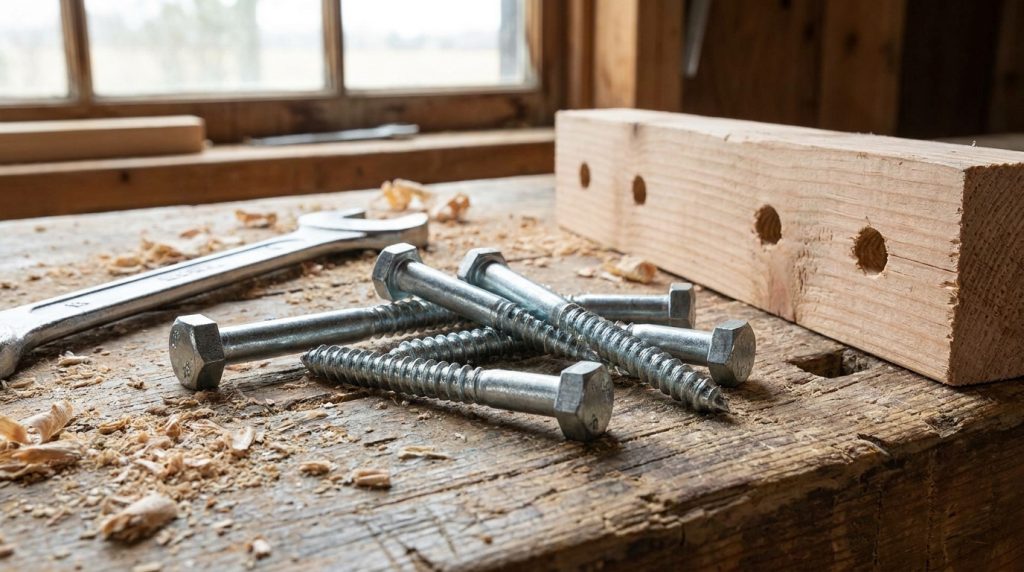
When a fastening job calls for serious holding power, lag screws are often the hardware of choice. Contractors use them to secure deck ledgers, framers rely on them for heavy wood connections, maintenance teams keep them on hand for equipment mounts, and manufacturers specify them when a strong threaded fastener is needed in wood or other base materials with the right anchoring system.
Also called lag bolts, lag screws are heavy-duty fasteners with coarse threads, a pointed tip, and a hex head or specialty drive head. They are designed to bite deeply into wood and provide strong resistance to pull-out and shear forces when installed correctly.
This guide explains lag screw sizes, materials, uses, pilot hole requirements, installation steps, and selection tips for professional buyers and field installers. It also includes practical examples and internal linking opportunities for related purchasing and technical resources.
Lag screws are large, heavy-duty screws commonly used for structural and non-structural fastening in wood, masonry with anchors, and other heavy assemblies. Unlike machine bolts, they do not use a nut in standard wood applications. Instead, the coarse threads cut into the material and create holding strength.
Lag Screw vs. Lag Bolt: What’s the Difference?
In everyday use, the terms lag screw and lag bolt are often used interchangeably. Technically, “lag screw” is the more accurate term because the fastener screws directly into the material rather than passing through with a nut like a traditional bolt.
However, many contractors, maintenance professionals, and suppliers still say “lag bolt,” especially when referring to hex-head lag screws.
| Term | Common Meaning | Technical Note |
|---|---|---|
| Lag screw | Heavy-duty threaded fastener driven into wood or anchors | Most accurate term |
| Lag bolt | Common trade term for the same fastener | Often used because of the hex head |
| Hex lag screw | Lag screw with a hexagonal head | Installed with a wrench, socket, or impact driver |
| Structural wood screw | Engineered screw used for structural wood connections | Often has higher published performance data |
Key Features of Lag Screws
Lag screws are easy to identify by their heavy-duty design:
- Hex head or specialty drive head for high installation torque
- Coarse threads for strong engagement in wood
- Pointed tip to help start the screw in the pilot hole
- Partially threaded shank on many sizes for clamping two materials together
- Large diameter options for higher load applications
- Available finishes for indoor, outdoor, corrosive, and industrial environments
For buyers comparing fasteners, this is a good place to internally link to resources such as [Hex Bolts vs. Lag Screws], [Structural Wood Screws Guide], or [Fastener Thread Types Explained].
For those looking to deepen their understanding of fasteners and their applications, the article “Drill Bits Explained: Types, Materials, and When to Use Each One” provides valuable insights that complement the information found in “Lag Screws Explained: Sizes, Uses & Installation.” This related article covers various types of drill bits, their materials, and the specific scenarios in which each type is most effective, making it a great resource for anyone interested in enhancing their knowledge of tools and hardware. You can read the article here: Drill Bits Explained.
Common Lag Screw Uses
Lag screws are used where a standard wood screw is not strong enough and where the application requires a more substantial mechanical connection. They are common in construction, repair, manufacturing, and facility maintenance.
Construction and Framing Applications
Contractors often use lag screws for wood-to-wood connections and heavy attachments. Common examples include:
- Deck ledger boards
- Pergolas and gazebos
- Fence posts and gate hardware
- Timber framing connections
- Stair stringer supports
- Handrail and guardrail brackets
- Beam-to-post connections in non-engineered or approved applications
- Wood blocking for equipment support
For structural applications, always follow the project plans, local building code, and manufacturer or engineer specifications. Some jobs require rated structural screws, through-bolts, or connectors instead of general-purpose lag screws.
Maintenance and Facility Repair
Maintenance teams use lag screws because they are reliable, readily available, and easy to install with common tools.
Typical facility maintenance uses include:
- Mounting shelving and storage racks to wood studs
- Securing wall-mounted equipment
- Installing bumper rails and protective guards
- Anchoring machinery bases to wood platforms
- Repairing pallet racks or support framing where permitted
- Securing signs, brackets, and safety barriers
When fastening into wall framing, installers should confirm stud size, spacing, and condition. A lag screw installed into weak, split, or deteriorated wood will not perform as expected.
Manufacturing and Industrial Assembly
Manufacturers may use lag screws in crates, skids, fixtures, jigs, and heavy wooden assemblies. Industrial buyers often purchase them in bulk for:
- Shipping crates and export packaging
- Equipment skids
- Machine guards
- Temporary wood fixtures
- Production line repairs
- Heavy-duty wooden forms
- Utility trailers and wood deck assemblies
For repeat production, it is important to standardize lag screw diameter, length, finish, and grade or specification. This helps purchasing teams control inventory and ensures installers use the correct part.
Masonry and Concrete Applications with Anchors
Lag screws can also be used with certain anchors in masonry or concrete. In these cases, the lag screw does not thread directly into the concrete. Instead, it expands or engages the anchor installed in a drilled hole.
Common anchor types used with lag screws include:
- Lag shields
- Lead anchors
- Plastic anchors for lighter-duty applications
- Expansion shields designed for lag screws
For concrete fastening, buyers may also compare lag screws with wedge anchors, sleeve anchors, concrete screws, or drop-in anchors. Internal linking opportunities include [Concrete Anchor Selection Guide] and [Lag Shields vs. Sleeve Anchors].
Lag Screw Sizes Explained
Lag screw sizing is based on diameter, length, thread length, head size, and sometimes material or finish. Selecting the correct size is critical for performance and installation quality.
Lag Screw Diameter
Diameter refers to the major outside diameter of the threaded portion. Common lag screw diameters include:
| Diameter | Common Use |
|---|---|
| 1/4 in. | Light-duty brackets, small hardware, and wood blocking |
| 5/16 in. | Medium-duty mounting, handrail brackets, and equipment supports |
| 3/8 in. | Deck ledgers, heavier brackets, and framing repairs |
| 1/2 in. | Heavy wood connections, posts, beams, and structural hardware |
| 5/8 in. | Large timber connections and heavy industrial applications |
| 3/4 in. | Heavy timber construction, specialty projects, and large equipment supports |
A larger diameter generally provides greater load capacity, but only when installed in sound material with proper pilot holes and adequate edge distance. Oversizing the screw can split wood, especially near the end of a board or post.
Lag Screw Length
Length is measured from under the head to the tip for hex lag screws. The correct length depends on the thickness of the material being fastened and the required embedment into the base material.
A practical rule is to ensure the lag screw penetrates deeply enough into the main member without breaking through the opposite side unless the application allows it.
Example:
- Fastening a 1-1/2 in. thick board to a wood post may require a 3 in. or 4 in. lag screw, depending on load and required embedment.
- Installing a 1/4 in. steel bracket to a wood beam may require a shorter screw if the bracket is thin but the wood embedment is sufficient.
Thread Length and Grip
Many lag screws are partially threaded. The unthreaded shank helps pull the top material tightly against the base material. This is useful for wood-to-wood fastening because the threads engage the main member while the shank passes through the outer member.
Fully threaded lag screws may be preferred when maximum thread engagement is needed across the full length or when fastening thinner materials.
Head Size and Drive Type
Most lag screws have a hex head. The hex head allows installers to use:
- Socket wrench
- Ratchet
- Box-end wrench
- Open-end wrench
- Impact wrench or impact driver with socket adapter
Some modern structural lag-style screws use washer heads, Torx drives, or proprietary drive systems. These may install faster and may include published engineering values.
Standard Lag Screw Size Chart
The following table gives general reference information. Always verify dimensions with the supplier, applicable standards, and project requirements.
| Lag Screw Diameter | Typical Length Range | Common Socket/Wrench Size | Typical Applications |
|---|---|---|---|
| 1/4 in. | 1 in. to 6 in. | 7/16 in. | Light brackets, fixtures, and small wood connections |
| 5/16 in. | 1-1/2 in. to 8 in. | 1/2 in. | Hardware mounting, light framing, and maintenance work |
| 3/8 in. | 2 in. to 10 in. | 9/16 in. | Deck components, handrails, and heavier brackets |
| 1/2 in. | 2 in. to 12 in.+ | 3/4 in. | Posts, beams, and heavy wood connections |
| 5/8 in. | 3 in. to 12 in.+ | 15/16 in. | Heavy timber construction and industrial assemblies |
| 3/4 in. | 4 in. to 16 in.+ | 1-1/8 in. | Large timber construction and specialty heavy-duty fastening |
For more articles, visit https://cemindustrialsupply.com/news/.
Lag Screw Materials, Finishes, and Grades
Choosing the right lag screw is not only about size. Material and finish affect corrosion resistance, strength, appearance, and suitability for treated lumber or outdoor exposure.
Zinc-Plated Lag Screws
Zinc-plated lag screws are common for indoor and dry-location applications. The zinc coating provides basic corrosion resistance but is not the best choice for long-term outdoor exposure or corrosive environments.
Common uses include:
- Interior framing
- Indoor shelving
- Shop fixtures
- General maintenance
- Dry equipment rooms
Hot-Dip Galvanized Lag Screws
Hot-dip galvanized lag screws have a thicker zinc coating than standard zinc-plated fasteners. They are often used outdoors and in applications involving pressure-treated lumber.
Common uses include:
- Deck construction
- Exterior wood framing
- Fencing
- Outdoor equipment mounts
- Agricultural buildings
- Utility structures
When working with treated wood, verify fastener compatibility with the lumber manufacturer’s recommendations and applicable building code requirements.
Stainless Steel Lag Screws
Stainless steel lag screws offer strong corrosion resistance and are commonly used in wet, coastal, food-processing, and chemical-adjacent environments. The most common stainless options are 18-8 stainless steel and 316 stainless steel.
| Stainless Type | Corrosion Resistance | Common Uses |
|---|---|---|
| 18-8 stainless steel | Good general corrosion resistance | Outdoor fixtures, general wet environments, and everyday exterior applications |
| 316 stainless steel | Superior resistance in marine and chloride-rich environments | Coastal construction, marine hardware, and washdown areas |
Stainless steel may have different strength characteristics than carbon steel fasteners, so confirm suitability for load-bearing applications.
Plain Steel and Black Oxide Lag Screws
Plain steel or black oxide lag screws are generally used indoors where corrosion protection is not a major concern. Black oxide provides limited corrosion resistance and is often selected for appearance or light-duty indoor use.
Common uses include:
- Interior industrial fixtures
- Furniture and display assemblies
- Dry shop environments
- Non-corrosive manufacturing areas
Specialty Coated Lag Screws
Some lag screws and structural wood screws are available with proprietary coatings designed for corrosion resistance, treated lumber compatibility, or reduced installation friction. These products may include manufacturer-published approvals or load data.
For specification work, internal links could include [Fastener Coating Comparison], [Stainless Steel Fastener Guide], and [Fasteners for Pressure-Treated Lumber].
For those looking to enhance their understanding of hardware components, the article on lag screws provides valuable insights into their sizes, uses, and installation techniques. Additionally, if you’re interested in improving overall project efficiency, you might find the article on mastering material handling particularly useful. It discusses various strategies to streamline processes and boost productivity in every project. You can read more about it here.
How to Choose the Right Lag Screw
Selecting the correct lag screw requires evaluating the base material, load type, exposure, and installation conditions. The best fastener is the one that meets the mechanical and environmental requirements without damaging the assembly.
Consider the Base Material
Lag screws perform differently depending on the material.
For wood:
- Confirm the wood species and condition.
- Avoid installing too close to edges or ends.
- Use pilot holes to prevent splitting.
- Make sure the screw penetrates into solid wood, not voids or damaged sections.
For masonry:
- Use a compatible lag shield or anchor.
- Drill to the correct diameter and depth.
- Clean the hole before anchor installation.
- Follow anchor manufacturer instructions.
For metal-to-wood:
- Drill clearance holes through the metal.
- Use washers where required.
- Ensure the screw threads engage the wood, not the metal.
Match the Screw to the Load
Fasteners may be loaded in different ways:
- Withdrawal load: Force pulling the screw straight out of the wood
- Shear load: Force applied across the screw, perpendicular to its length
- Tension load: Force pulling connected members apart
- Combined load: A mix of pull-out, shear, and tension forces
For critical structural or overhead applications, use fasteners specified by an engineer or listed in approved design documents. Do not substitute a larger lag screw for an engineered connector without approval.
Choose the Right Diameter and Length
A lag screw should be large enough to carry the load but not so large that it weakens or splits the wood. In many wood applications, the screw should pass through the attached material and embed deeply into the structural member.
Practical selection example:
- A light shelf bracket may use 1/4 in. or 5/16 in. lag screws into studs.
- A deck ledger connection often requires larger fasteners installed at specified spacing according to code and design details.
- A heavy gate hinge on a wood post may use 3/8 in. or 1/2 in. lag screws, depending on gate size and hinge design.
Account for Corrosion and Environment
The operating environment can determine whether a lag screw lasts for years or fails prematurely due to corrosion.
Use this general guide:
| Environment | Recommended Finish or Material |
|---|---|
| Dry indoor | Zinc-plated, plain steel, or black oxide |
| Outdoor general | Hot-dip galvanized or an approved exterior coating |
| Pressure-treated lumber | Hot-dip galvanized, stainless steel, or an approved corrosion-resistant coating |
| Coastal or marine | 316 stainless steel |
| Food processing or washdown | Stainless steel (typically 304 or 316, depending on chemical exposure) |
| Industrial chemical exposure | Consult material compatibility data before selecting a fastener material or finish |
For those interested in understanding the various fastening options available, you might find the article on wire wheels particularly insightful. It discusses the safety differences and best uses of crimped versus knotted wire wheels, which can complement your knowledge of lag screws and their applications. To explore this topic further, you can read the article here.
Pilot Holes for Lag Screws
Pilot holes are essential for proper lag screw installation. They reduce wood splitting, help the screw track straight, and lower installation torque.
Why Pilot Holes Matter
Lag screws are much larger than standard wood screws. Driving them without a pilot hole can cause:
- Split wood
- Broken screws
- Misalignment
- Excessive installation torque
- Reduced clamping force
- Damaged heads or tools
A pilot hole allows the shank and threads to engage correctly without overstressing the wood.
Pilot Hole Components
A proper pilot hole may include:
- Clearance hole through the top member
- Pilot hole in the base member for the threaded section
- Countersink or washer seat if needed under the head
- Anchor hole if installing into masonry with a lag shield
For wood-to-wood applications, the top piece often needs a clearance hole large enough for the screw shank to pass through. This helps the lag screw pull the two pieces tightly together.
General Pilot Hole Guidelines
Pilot hole size depends on lag screw diameter, wood species, and fastener design. Hardwoods typically require larger pilot holes than softwoods because they are denser and more likely to split.
General guidance:
| Lag Screw Diameter | Softwood Pilot Hole | Hardwood Pilot Hole |
|---|---|---|
| 1/4 in. | 3/16 in. | 7/32 in. |
| 5/16 in. | 7/32 in. | 1/4 in. |
| 3/8 in. | 1/4 in. | 5/16 in. |
| 1/2 in. | 5/16 in. | 13/32 in. |
| 5/8 in. | 13/32 in. | 1/2 in. |
| 3/4 in. | 1/2 in. | 5/8 in. |
These are general reference values. Always check fastener manufacturer recommendations, especially for structural screws, dense woods, treated lumber, or engineered wood products.
How to Install Lag Screws Correctly
Correct installation is just as important as fastener selection. Even the right lag screw can underperform if it is installed at an angle, overdriven, or placed too close to an edge.
Tools and Supplies
Common tools for installing lag screws include:
- Drill or impact driver
- Drill bits for pilot and clearance holes
- Socket set or wrench
- Torque wrench for controlled tightening
- Washers, if required
- Tape measure and marker
- Clamps for alignment
- Safety glasses and gloves
- Vacuum or compressed air for cleaning holes
- Lubricant or wax for large screws in dense wood, if allowed
Step-by-Step Installation in Wood
- Confirm the fastener size and layout.
Check the drawing, bracket hole size, code table, or manufacturer instructions.
- Mark the hole locations.
Keep adequate edge distance and spacing to reduce splitting.
- Clamp the materials if needed.
Prevent shifting while drilling.
- Drill a clearance hole through the top piece.
This allows the lag screw shank to pass freely and create clamping force.
- Drill the pilot hole into the base material.
Drill straight and to the correct depth.
- Add a washer if required.
A washer helps distribute load under the head and protects softer materials.
- Drive the lag screw slowly.
Use a socket, ratchet, or impact driver. Keep the screw aligned.
- Tighten snugly without overdriving.
Over-tightening can strip the wood threads, crush the material, or break the fastener.
- Inspect the connection.
Confirm the head is seated, the materials are tight, and there are no cracks.
Installing Lag Screws in Masonry Anchors
For masonry, the process is different:
- Select the correct lag shield or anchor for the screw size.
- Drill the hole to the specified diameter and depth.
- Clean the hole thoroughly.
- Insert the anchor fully.
- Position the fixture.
- Drive the lag screw into the anchor until tight.
- Avoid over-tightening, which can damage the anchor or masonry.
Do not assume a lag screw can be driven directly into concrete or brick. It needs a compatible anchor system unless the fastener is specifically designed as a concrete screw.
Common Installation Mistakes to Avoid
Avoid these frequent jobsite problems:
- Skipping the pilot hole
- Using the wrong pilot hole diameter
- Installing too close to the edge of the wood
- Over-tightening and stripping the wood
- Using indoor zinc-plated screws outdoors
- Mixing incompatible metals in corrosive environments
- Using lag screws where through-bolts are required
- Reusing damaged or bent lag screws
- Ignoring manufacturer torque guidance
- Installing into rotten, cracked, or undersized framing
Lag Screws vs. Other Fasteners
Lag screws are strong and versatile, but they are not always the best option. Comparing them with other fasteners helps buyers and installers choose correctly.
Lag Screws vs. Wood Screws
| Feature | Lag Screws | Standard Wood Screws |
|---|---|---|
| Strength | Higher load capacity for heavy-duty applications | Lower load capacity, depending on size and design |
| Diameter | Larger | Smaller |
| Head style | Typically a hex head | Flat, pan, round, trim, and other head styles |
| Installation | Requires a properly sized pilot hole | Often self-starting in softwood, though pilot holes may still be recommended |
| Typical use | Heavy wood connections, structural framing, and post installations | General woodworking, cabinetry, and light-duty fastening |
Use lag screws when the application requires greater holding power than a standard wood screw can provide.
Lag Screws vs. Through-Bolts
Through-bolts pass completely through the materials and are secured with a washer and nut. They often provide a more secure connection when both sides are accessible.
| Feature | Lag Screws | Through-Bolts |
|---|---|---|
| Access required | Only one side of the connection | Access to both sides for the bolt and nut |
| Installation speed | Faster and generally easier | Slower due to nut and washer installation |
| Clamping strength | Good when installed correctly | Excellent for high-load structural connections |
| Removal | Can be removed from one side | Requires access to the nut for removal |
| Best use | Blind wood fastening, framing, and structural wood connections | Critical structural connections where both sides are accessible |
For deck ledgers, structural supports, and heavy equipment mounts, building code or engineering documents may require bolts or approved alternatives.
Lag Screws vs. Structural Screws
Structural screws are engineered fasteners designed for high-performance wood connections. Many install faster than lag screws and may require smaller or no pilot holes depending on the product.
| Feature | Lag Screws | Structural Screws |
|---|---|---|
| Standards | Traditional heavy-duty fastener | Engineered fastener with manufacturer-rated performance |
| Installation | Usually requires a pilot hole | Often installs faster with little or no pre-drilling, depending on the application |
| Drive style | Typically a hex head | Torx®, washer head, or hex washer head |
| Load data | Varies by applicable standards and supplier | Manufacturer-published load and design values are commonly available |
| Cost | Generally more economical | Typically higher cost per fastener |
| Use case | General heavy-duty wood fastening | Engineered structural wood connections and code-compliant applications |
For professional construction, structural screws may be preferred when approved load data and code compliance are required.
Buying Lag Screws for Industrial and Contractor Use
Industrial buyers, contractors, and maintenance departments should consider more than unit price. The wrong finish, size, or specification can increase labor time, cause rework, or create safety risks.
Key Purchasing Specifications
When ordering lag screws, specify:
- Diameter
- Length
- Material
- Finish or coating
- Head style
- Thread length, if critical
- Standard or specification, if required
- Packaging quantity
- Country of origin, if required by project documents
- Compatibility with treated lumber or environment
- Required documentation, such as material certifications
A complete purchasing description might look like:
1/2 in. x 6 in. hex lag screw, hot-dip galvanized, carbon steel, bulk carton, compatible with exterior treated wood applications per project requirements.
Bulk Buying Considerations
For contractors and manufacturers, bulk buying can simplify inventory management and reduce downtime. Consider stocking common sizes based on your typical work.
Useful inventory sizes may include:
- 1/4 in. x 2 in.
- 1/4 in. x 3 in.
- 5/16 in. x 3 in.
- 3/8 in. x 4 in.
- 3/8 in. x 6 in.
- 1/2 in. x 4 in.
- 1/2 in. x 6 in.
- 1/2 in. x 8 in.
Maintenance teams may also stock washers, lag shields, drill bits, and socket sizes that match the lag screws in inventory.
Quality and Documentation
For critical applications, ask suppliers for applicable product standards, material information, and coating details. Professional buyers may need:
- Mill test reports
- Certificates of compliance
- Coating specifications
- Dimensional data
- Lot traceability
- Manufacturer installation instructions
This is especially important in commercial construction, government work, transportation projects, and manufacturing environments with quality control requirements.
Safety, Inspection, and Maintenance
Lag screw connections should be inspected during installation and periodically in service, especially in load-bearing, vibrating, outdoor, or corrosive environments.
Jobsite Safety Tips
Follow standard safety practices:
- Wear eye protection when drilling or driving screws.
- Use the correct socket and fully seat it on the head.
- Keep hands clear of pinch points.
- Support heavy assemblies before fastening.
- Do not rely on one partially installed lag screw to hold a heavy load.
- Use fall protection and proper access equipment when working at height.
- Avoid using damaged drill bits, sockets, or adapters.
Inspection Checklist
After installation, check for:
- Proper screw size and finish
- Correct washer use
- Tight seating under the head
- No visible wood splitting
- Correct embedment depth
- Straight alignment
- No stripped or rounded heads
- No gaps between connected members
- No corrosion or coating damage
- Compliance with drawings or specifications
Maintenance Considerations
In service, lag screws may loosen due to vibration, wood shrinkage, moisture cycling, or movement of the connected members. Periodic inspection is important for:
- Decks and exterior structures
- Gates and fences
- Equipment platforms
- Industrial guards
- Wall-mounted fixtures
- Agricultural buildings
- Marine and coastal installations
If a lag screw has stripped out, do not simply reinstall the same screw in the same damaged hole. Options may include using an approved larger fastener, repairing the wood, moving the fastener location, using an insert or anchor, or redesigning the connection.
Frequently Asked Questions About Lag Screws
Do Lag Screws Need Pilot Holes?
Yes, lag screws usually need pilot holes. Pilot holes reduce splitting, improve alignment, and make installation easier. This is especially important in hardwoods, dense softwoods, engineered lumber, and large-diameter lag screw applications.
Are Lag Screws Stronger Than Regular Screws?
Lag screws are generally stronger than standard wood screws because they are larger, have heavier shanks, and are designed for heavy-duty fastening. Actual performance depends on screw size, material, embedment, wood species, installation quality, and load direction.
Can Lag Screws Be Used in Concrete?
Lag screws can be used in concrete only with compatible anchors such as lag shields. They are not the same as concrete screws and should not be driven directly into concrete unless the product is specifically designed for that use.
How Deep Should a Lag Screw Go Into Wood?
Required embedment depends on the load and application. As a practical guideline, the screw should penetrate deeply into the main structural member, not just the surface. For engineered or code-regulated work, follow the specified embedment and spacing requirements.
Should I Use Washers with Lag Screws?
Washers are commonly used with lag screws, especially under hex heads. They distribute load, protect the surface, and help prevent the head from crushing into softer materials. Use washers when specified by the hardware manufacturer, engineer, or project plans.
Can Lag Screws Be Removed and Reused?
Lag screws can often be removed, but reuse is not always recommended. If the threads, head, coating, or shank are damaged, replace the screw. In structural or safety-related applications, use new fasteners unless reuse is specifically permitted.
Conclusion: Choose the Right Lag Screws for Reliable Heavy-Duty Fastening
Lag screws are essential fasteners for contractors, maintenance professionals, manufacturers, mechanics, and industrial buyers who need strong, practical fastening in wood and compatible anchor systems. The right lag screw size, material, finish, pilot hole, and installation method can make the difference between a secure connection and a costly failure.
For best results, match the screw to the load, base material, environment, and project requirements. Use pilot holes, avoid over-tightening, and choose corrosion-resistant materials for outdoor, treated lumber, marine, or industrial settings.
If you are sourcing lag screws for construction, maintenance, production, or repair work, review your application requirements before ordering. For related products and technical support, consider linking to [Lag Screw Size Charts], [Fastener Materials and Coatings], [Concrete Anchors], [Washers], and [Structural Wood Screws] to help your team select the right fastening solution for the job.