
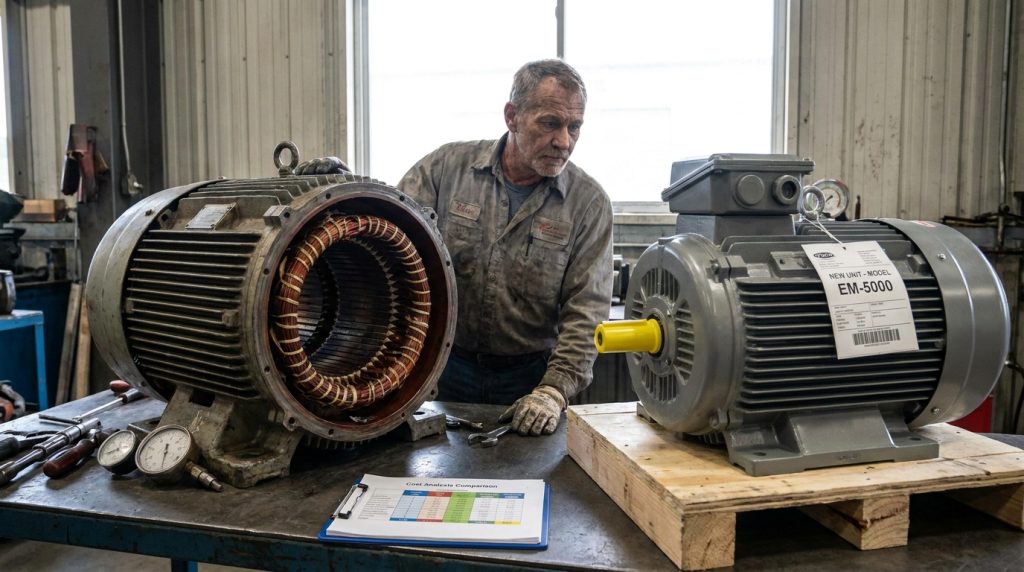
The Price of Power: Repairing or Replacing Your Electric Motor
When an electric motor sputters, groans, or simply stops working, a crucial question arises: do you fix it or buy a new one? This isn’t just about getting things running again; it’s a financial decision with significant implications for your budget. The “repair versus replace” dilemma is common in many areas of life, but when it comes to electric motors, the stakes can be particularly high for businesses and homeowners alike. Understanding the factors involved will help you make the most cost-effective choice.
When considering whether to repair or replace an electric motor, it’s essential to evaluate the signs that indicate a motor may need repair. A related article that delves into this topic is “Signs It’s Time for Industrial Motor Repair,” which outlines key indicators that can help you make an informed decision. You can read more about this important aspect of motor maintenance by visiting the article here: Signs It’s Time for Industrial Motor Repair.
Assessing the Damage: What’s Really Wrong?
Before you can decide whether to repair or replace, you need to understand the problem. Not all motor failures are created equal. Some are minor issues that can be addressed relatively cheaply, while others indicate deep-seated problems that might make repair impractical.
Common Motor Maladies
Electric motors are complex machines, and various components can fail. The most frequent culprits include issues with the windings, bearings, seals, and control systems.
Worn-Out Bearings
Bearings are the unsung heroes of an electric motor, allowing the shaft to spin smoothly and with minimal friction. Over time, they can wear down, leading to increased noise, vibration, and eventually, motor seizure. Replacing bearings is often a straightforward and relatively inexpensive repair. However, if the bearing failure has caused significant damage to the rotor or stator, the repair cost can escalate.
Damaged Windings
The windings are the heart of an electric motor, generating the magnetic fields that produce rotation. If the insulation on these wires breaks down due to overheating, moisture, or age, it can cause short circuits, leading to reduced efficiency, overheating, and complete motor failure. Rewinding a motor is a specialized process. While it can be a viable option for larger, more expensive motors, the cost might approach that of a new motor for smaller units.
Seal and Gasket Degradation
Seals and gaskets are vital for keeping lubricants in and contaminants out. When they fail, lubricants can leak, leading to bearing damage, and dirt and moisture can enter the motor, causing corrosion and electrical problems. Replacing seals and gaskets is generally a minor repair.
Control System Glitches
For motors integrated with complex control systems, like variable frequency drives (VFDs), the issue might lie with the electronics rather than the motor itself. Diagnosing and repairing these control boards can be a specialized task. Sometimes, replacing the entire drive unit might be more economical than attempting a complex electronic repair.
The Role of Motor Size and Type
The size and type of electric motor play a significant role in the repair versus replace decision. Smaller, more common motors, like those found in household appliances or small workshop tools, are often manufactured in massive quantities and have a relatively low per-unit cost. For these, replacement is frequently the more sensible option. Larger industrial motors, on the other hand, represent a much more substantial investment. The cost of a new, equivalent large motor can be very high, making repair a more attractive proposition, even if it’s more complex. Specialty motors, such as those designed for specific high-performance applications or with unique configurations, also tend to favor repair due to the difficulty and expense of sourcing a direct replacement.
The Bottom Line: Calculating Costs
Making a financially sound decision requires a clear understanding of all associated costs, both immediate and long-term. It’s not just about the sticker price of a new motor versus the repair bill; other factors contribute to the overall financial picture.
Repair Cost Breakdown
When you get a quote for motor repair, ensure it’s comprehensive. What exactly is included? Are parts and labor detailed? What is the estimated turnaround time?
Parts and Labor: The Obvious Expenses
The most direct costs of repair involve the price of replacement parts (bearings, windings, seals, etc.) and the labor required to install them. These costs can vary widely depending on the complexity of the repair and the hourly rates of the service provider.
Diagnostic Fees and Unexpected Issues
It’s important to factor in potential diagnostic fees, even if you decide to proceed with the repair. Sometimes, during the repair process, technicians uncover additional problems that weren’t initially apparent. It’s wise to establish a policy with your repair shop regarding how they will handle unexpected issues – will they call for approval before proceeding with additional work, or do they have a threshold for immediate repair? Understanding this upfront can prevent budget surprises.
Downtime and Lost Productivity
This is a critical, often overlooked, cost. If the motor is essential for your operations, its downtime directly translates into lost production, missed deadlines, and potentially lost revenue. The longer the repair takes, the higher this cost will be. A quick repair might be worth a slightly higher repair bill if it minimizes this downtime. Conversely, a long repair process, even if cheaper in terms of parts and labor, could end up costing you more in the long run.
Replacement Cost Analysis
When considering replacement, it’s not just about the price of the new motor. There are other expenses and benefits to weigh.
The Price of a New Motor
This is the most obvious cost. Research the price of a new motor with equivalent specifications (horsepower, voltage, frame size, efficiency rating). Don’t just look at the initial purchase price; consider the total cost of ownership.
Installation and Integration
Installing a new motor can involve more than just bolting it in place. You might need to consider the cost of new mounting hardware, potential modifications to existing electrical connections, and the labor involved in physically replacing the old unit. If the new motor has different mounting dimensions or electrical requirements, these integration costs can add up.
Potential for Efficiency Gains
Newer motors often incorporate advancements in efficiency that can lead to significant energy savings over their lifespan. While the upfront cost of an energy-efficient motor might be higher, the reduced electricity bills can offset this over time. Calculating the payback period for these energy savings is a valuable part of the replacement decision.
Warranty and Reliability
New motors come with warranties, offering peace of mind and protection against immediate failures. This can be a significant advantage over a repaired motor, which may not have the same level of warranty coverage, or any at all.
The Expert’s Eye: When to Call in the Professionals
Deciding whether to tackle a motor issue yourself or call in a specialist depends on your skillset, the complexity of the problem, and the value of the motor. For significant repairs, professional expertise is usually essential.
Diagnosing the Root Cause
An experienced motor repair technician can quickly and accurately diagnose the underlying problem. They have specialized tools and knowledge to identify issues that might be invisible to the untrained eye. This diagnostic phase is crucial for determining the viability and cost-effectiveness of a repair.
Specialized Tools and Techniques
Professional repair shops have access to specialized equipment like winding testers, surge testers, and dynamic balancers. These tools allow them to accurately assess the condition of motor components and perform repairs to manufacturer specifications, ensuring the motor operates correctly and reliably after the work is done.
Risk Mitigation in Repairs
Attempting complex motor repairs without the proper knowledge and tools can lead to further damage, potentially making the motor irreparable or even creating safety hazards. Professionals understand the nuances of motor construction and repair, minimizing the risk of mistakes.
Navigating Warranty and Service Agreements
If your motor is still under warranty, attempting a repair yourself could void that warranty. It’s always best to consult the warranty terms first. For industrial settings, service agreements with motor repair specialists can provide proactive maintenance and rapid response, ensuring minimal downtime.
When considering whether to repair or replace an electric motor, it’s essential to evaluate the long-term costs and benefits associated with each option. A related article that provides valuable insights into making informed decisions about construction projects is available at Essential Construction Supplies: Your Complete Guide for Every Project. This resource can help you understand the broader context of equipment maintenance and investment, ultimately aiding in your decision-making process regarding electric motor issues.
The Long-Term View: Beyond the Initial Cost
The decision to repair or replace isn’t just about the immediate financial impact. Thinking about the future operational life and reliability of the motor is crucial for making the best long-term decision.
Expected Lifespan and Future Costs
A properly repaired motor can have a significantly extended lifespan, often rivaling that of a new motor, especially for larger, well-maintained units. However, the quality of the repair is paramount. A subpar repair might only be a temporary fix, leading to recurring problems and higher costs down the line. Conversely, a brand-new motor comes with a fresh warranty and the expectation of a full operational life.
The Impact of Motor Efficiency
As mentioned earlier, newer motors are generally more energy-efficient. This isn’t just a small saving; for motors that run continuously, the cumulative energy savings over several years can be substantial. When comparing the cost of repair versus replacement, it’s essential to factor in the potential for reduced electricity bills with a new, more efficient model. A worn-out motor often operates at reduced efficiency, even if it’s still functional, leading to unnecessary energy consumption.
Reliability and Uptime
For businesses, motor reliability directly impacts uptime and productivity. A motor that is constantly breaking down, even if it’s being repaired, can be a significant drain on resources and a source of frustration. Investing in a new, reliable motor with a solid warranty might offer greater peace of mind and predictable operational performance, even if the initial cost is higher.
When considering whether to repair or replace an electric motor, it’s essential to evaluate the long-term costs and benefits of each option. A related article that explores custom industrial gearbox builds from trusted brands can provide valuable insights into the efficiency and reliability of various components that may complement your motor system. For more information on how these gearboxes can impact your decision-making process, check out this informative piece on custom industrial gearboxes.
Making the Smart Choice: Your Decision Framework
To simplify the decision-making process, consider a structured approach. This framework will help you weigh the various factors and arrive at the most financially sensible conclusion for your specific situation.
Creating a Decision Matrix
A decision matrix can be a powerful tool. List the key factors (initial cost, repair cost, potential for efficiency gains, expected lifespan, downtime cost, warranty, etc.) and assign a weighting to each based on its importance to you. Then, score each option (repair and replace) against these factors.
Quantifying Intangibles
While some costs are easy to quantify (e.g., repair bill, price of a new motor), others are less tangible, such as the cost of lost productivity due to downtime or the peace of mind from a new warranty. Try to assign a monetary value to these where possible, or at least acknowledge their impact in your decision-making. For instance, estimate the revenue lost per hour of downtime and multiply it by the estimated repair time.
Consulting with Experts and Manufacturers
Don’t hesitate to get quotes from multiple reputable motor repair shops. Compare their proposed repairs, warranties, and turnaround times. Similarly, consult with motor manufacturers or distributors for information on new motor options, their efficiency ratings, and their expected lifespan. Their insights can be invaluable in making an informed choice.
The ‘When’ Factor: Urgency and Lead Times
The urgency of your need can significantly influence the decision. If you need a motor back online immediately, a readily available replacement might be the only practical option, even if repair is theoretically cheaper. Conversely, if you have some flexibility, a more involved repair might be feasible. Always inquire about the lead times for both repair and replacement parts. Sometimes, a specialized motor might have a long lead time for a new unit, making repair the only viable path to quick restoration.