
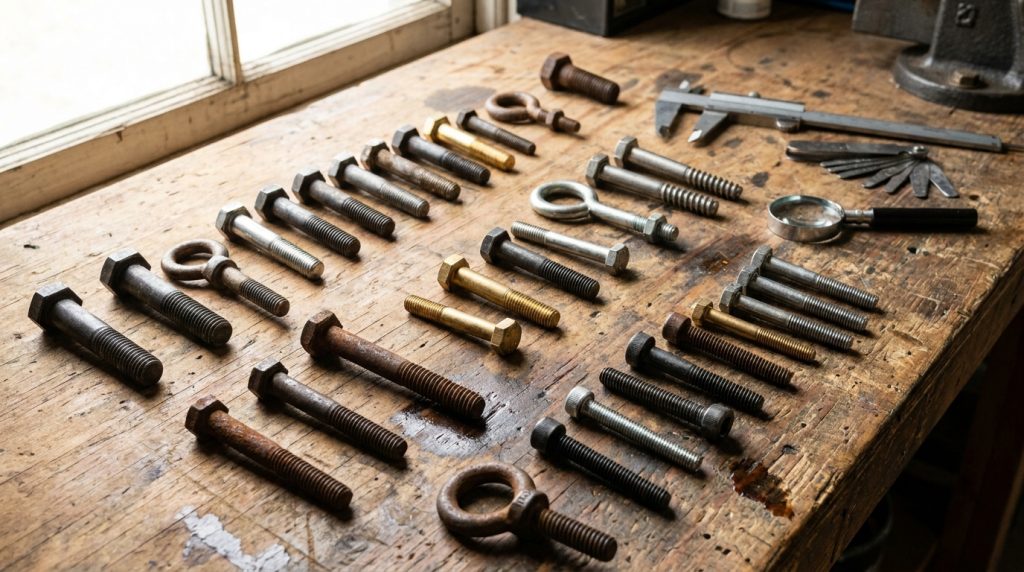
Choosing the wrong bolt can cause equipment downtime, failed inspections, joint loosening, corrosion problems, or serious safety risks. For contractors, maintenance professionals, mechanics, manufacturers, and industrial buyers, bolt identification is more than reading a number on a bolt head. It means understanding bolt grades, head markings, thread sizes, materials, coatings, and standards before specifying or replacing fasteners.
This bolt identification guide explains how to identify common bolt grades, marks, and sizes used in construction, equipment repair, manufacturing, fleet maintenance, and industrial applications. You’ll learn how to read bolt head markings, compare SAE, ASTM, ISO metric, and stainless steel bolts, measure bolt dimensions correctly, and avoid costly mismatches when sourcing replacements.
Bolts may look similar, but their mechanical properties can be very different. Two bolts with the same diameter and length may have different tensile strength, yield strength, thread pitch, corrosion resistance, and intended use.
Using the wrong bolt can lead to:
- Joint failure under load
- Thread stripping or galling
- Premature corrosion
- Equipment vibration issues
- Improper torque readings
- Failed code or quality inspections
- Warranty or liability problems
For example, replacing a high-strength structural bolt with a low-carbon general-purpose bolt may seem acceptable if the size matches, but the lower-strength bolt may not withstand the required load. Likewise, using an uncoated bolt outdoors may lead to rust and seized threads, increasing future maintenance costs.
Bolt identification helps buyers and technicians confirm:
- Grade or property class
- Material type
- Thread type and pitch
- Length and diameter
- Head style and drive type
- Coating or plating
- Applicable standard or specification
For those looking to deepen their understanding of essential components in construction and DIY projects, the article on electrical components is a valuable resource. It provides a comprehensive overview that complements the information found in the Bolt Identification Guide: Grades, Marks & Sizes. You can explore this related article for more insights by visiting Essential Electrical Components: The Complete Guide for Contractors and DIYers.
How to Identify a Bolt: The Basic Checklist
Before selecting or replacing a bolt, inspect it carefully and document its key characteristics. A simple bolt identification process can prevent ordering mistakes and installation problems.
1. Inspect the Bolt Head Markings
Most bolts have markings on the head that identify the grade, manufacturer, or standard. These markings are one of the fastest ways to determine bolt strength.
Common markings include:
- Radial lines on SAE bolts
- Numbers such as 8.8, 10.9, or 12.9 on metric bolts
- Letters or symbols indicating ASTM structural grades
- Manufacturer identification marks
- Stainless steel markings such as A2, A4, 304, or 316
If the head is worn, painted, corroded, or damaged, identification may require measurement, material testing, or comparison to purchase records.
2. Measure the Diameter
Bolt diameter is measured across the outside of the threads, also called the major diameter.
For inch fasteners, common diameters include:
- 1/4″
- 5/16″
- 3/8″
- 1/2″
- 5/8″
- 3/4″
- 1″
For metric fasteners, sizes are designated with “M” followed by the nominal diameter in millimeters:
- M6
- M8
- M10
- M12
- M16
- M20
Example: An M12 bolt has a nominal diameter of 12 mm.
3. Measure Thread Pitch or Threads Per Inch
Thread measurement depends on whether the bolt is inch or metric.
For inch bolts, measure threads per inch, commonly abbreviated as TPI. For example:
- 1/2″-13 means 1/2″ diameter with 13 threads per inch
- 1/2″-20 means 1/2″ diameter with 20 threads per inch
For metric bolts, measure thread pitch, which is the distance between threads in millimeters. For example:
- M10 x 1.5 means 10 mm diameter with 1.5 mm thread pitch
- M10 x 1.25 means 10 mm diameter with 1.25 mm thread pitch
A thread pitch gauge is the best tool for accurate identification.
4. Measure Bolt Length Correctly
Bolt length is measured differently depending on head style.
For most hex head bolts, measure from under the head to the end of the bolt. Do not include the head height.
For flat head countersunk bolts, measure from the top of the head to the end because the head sits flush with the surface.
Incorrect length measurement can cause poor clamping, bottoming out in blind holes, or insufficient thread engagement.
5. Identify the Head Style and Drive Type
The bolt head affects installation tooling, clearance, torque, and application suitability.
Common bolt head styles include:
- Hex head bolts
- Socket head cap screws
- Carriage bolts
- Flange bolts
- Structural bolts
- Button head socket screws
- Flat head socket screws
- Square head bolts
Drive types may include:
- External hex
- Internal hex socket
- Torx
- Phillips
- Slotted
- Square drive
- 12-point
For maintenance buyers, matching the head style is often as important as matching the grade and size.
Bolt Grades and Head Markings Explained
Bolt grade identifies the strength level and mechanical properties of a bolt. Different standards use different marking systems, so it is important to know whether the bolt follows SAE, ASTM, ISO metric, or stainless steel specifications.
SAE Bolt Grades for Inch Fasteners
SAE J429 is commonly used for inch-series bolts in automotive, equipment, agricultural, and general mechanical applications. SAE bolt grades are typically identified by radial lines on the bolt head.
| SAE Grade | Head Marking | Common Material | Typical Use |
|---|---|---|---|
| Grade 2 | No radial lines | Low- or medium-carbon steel | Light-duty fastening, general repairs, woodworking, and non-critical assemblies |
| Grade 5 | Three radial lines | Quenched and tempered medium-carbon steel | Automotive, industrial machinery, agricultural equipment, and general-purpose mechanical applications |
| Grade 8 | Six radial lines | Quenched and tempered medium-carbon alloy steel | High-strength machinery, heavy equipment, suspension components, and other demanding mechanical applications |
A common rule is that the number of radial lines plus two equals the SAE grade. For example, three lines indicate Grade 5, and six lines indicate Grade 8.
SAE Grade 2 Bolts
SAE Grade 2 bolts are general-purpose fasteners used where high strength is not required. They are commonly found in light-duty assemblies, non-critical brackets, and low-load applications.
They are not suitable for high-load structural joints, heavy equipment, or applications where bolt failure could create a safety hazard.
SAE Grade 5 Bolts
SAE Grade 5 bolts are a common choice for automotive repair, machinery, and equipment maintenance. They provide higher strength than Grade 2 and are often used in medium-duty bolted joints.
Examples include:
- Engine accessories
- Equipment guards
- Brackets
- Frame components
- General industrial maintenance
SAE Grade 8 Bolts
SAE Grade 8 bolts are high-strength inch-series bolts used where greater clamping force and tensile strength are required. They are commonly used in heavy equipment, suspension components, machinery, and high-stress mechanical assemblies.
However, Grade 8 is not automatically the best choice for every application. Harder, stronger bolts may be less forgiving in certain conditions, especially where shock loading, improper torque, or thread engagement issues exist. Always follow the equipment manufacturer’s specification.
ASTM Bolt Grades and Structural Bolt Markings
ASTM fasteners are widely used in construction, structural steel, infrastructure, piping, and heavy industrial applications. ASTM grades are typically marked with letters and numbers on the bolt head.
| ASTM Specification | Common Head Marking | Common Application |
|---|---|---|
| ASTM A307 | A307 or manufacturer identification | Low-carbon, general-purpose bolts for construction, maintenance, and non-critical structural applications |
| ASTM A325 (superseded by ASTM F3125 Grade A325) | A325 | Structural steel connections in buildings, bridges, and other heavy construction |
| ASTM A490 (superseded by ASTM F3125 Grade A490) | A490 | High-strength structural steel connections requiring greater tensile capacity |
| ASTM F3125 | A325, A490, F1852, or F2280 (depending on grade or fastener type) | Unified specification covering high-strength structural bolts used in steel construction |
| ASTM A193 Grade B7 | B7 | High-temperature and high-pressure bolting for refineries, power plants, pressure vessels, and piping systems |
| ASTM A320 Grade L7 | L7 | Low-temperature pressure-service applications, including cryogenic piping, valves, and pressure vessels |
ASTM A307 Bolts
ASTM A307 bolts are low-carbon steel bolts used for general-purpose fastening. They are common in light structural, maintenance, and industrial applications where high strength is not required.
They may be used in:
- Pipe supports
- Light frames
- General maintenance
- Non-critical bolted assemblies
ASTM A325 and A490 Structural Bolts
ASTM A325 and A490 bolts are high-strength structural bolts used in steel-to-steel connections. These bolts are common in building construction, bridges, and structural fabrication.
Structural bolts often have a heavy hex head and are used with specified nuts and washers. They should be installed according to project specifications and applicable standards, including torque, tensioning, or turn-of-nut requirements where specified.
ASTM A193 B7 Bolts
ASTM A193 Grade B7 bolts are alloy steel fasteners commonly used in pressure vessels, flanges, valves, and high-temperature service. They are often paired with compatible ASTM A194 nuts.
Typical applications include:
- Petrochemical plants
- Refineries
- Power generation
- Process piping
- Industrial flanges
If you purchase flange bolting, an internal link opportunity would be: See our guide to [ASTM A193 B7 bolts and compatible nuts].
Metric Bolt Property Classes
Metric bolts are usually marked with a property class such as 8.8, 10.9, or 12.9. These markings are common on ISO metric fasteners used in automotive, industrial machinery, imported equipment, and manufacturing.
| Metric Class | Head Marking | Common Use |
|---|---|---|
| Class 4.6 | 4.6 | Light-duty fastening, brackets, covers, and non-critical assemblies |
| Class 8.8 | 8.8 | General high-strength industrial, construction, automotive, and machinery applications |
| Class 10.9 | 10.9 | Automotive, heavy equipment, industrial machinery, and other high-load mechanical assemblies |
| Class 12.9 | 12.9 | High-strength socket head cap screws, tooling, dies, molds, and other specialty high-load applications |
Metric property class numbers relate to tensile strength and yield strength. For example, a Class 10.9 bolt has a higher strength rating than a Class 8.8 bolt.
Metric Class 8.8 Bolts
Class 8.8 bolts are often considered a common high-strength metric fastener. They are used in equipment, machinery, automotive assemblies, and fabricated components.
They are not identical to SAE Grade 5, but they are often compared in general strength range. Always verify the exact mechanical requirements before substituting.
Metric Class 10.9 Bolts
Class 10.9 metric bolts are higher-strength fasteners used in demanding mechanical applications. They are common in vehicles, heavy machinery, and industrial assemblies where stronger metric bolts are required.
They are often compared to SAE Grade 8 in general applications, but they are not a direct replacement unless size, thread pitch, material, and design requirements match.
Metric Class 12.9 Bolts
Class 12.9 bolts are very high-strength metric fasteners, frequently found in socket head cap screws. They are used in tooling, dies, machinery, and compact designs requiring high clamp load.
Because of their high strength, correct torque, lubrication, thread engagement, and installation practices are critical.
For more articles on industrial supply, visit https://cemindustrialsupply.com/news/ for the latest updates.
Stainless Steel Bolt Identification
Stainless steel bolts are used where corrosion resistance is more important than maximum strength. They are common in food processing, marine environments, outdoor construction, water treatment, chemical processing, and architectural assemblies.
Common Stainless Steel Markings
Stainless bolts may be marked with material designations such as:
- 18-8
- 304
- 316
- A2
- A4
- A2-70
- A4-80
A2 is commonly associated with 304 stainless steel. A4 is commonly associated with 316 stainless steel, which offers better corrosion resistance in many chloride-containing or marine environments.
| Stainless Marking | Approximate Type | Common Use |
|---|---|---|
| 18-8 | 300-series stainless steel | General-purpose corrosion-resistant fasteners for industrial, commercial, and outdoor applications |
| 304 / A2 | Austenitic stainless steel | Food processing equipment, general outdoor installations, architectural hardware, and industrial machinery |
| 316 / A4 | Austenitic stainless steel | Marine, coastal, chemical processing, pharmaceutical, and other highly corrosive environments |
| A2-70 | 304 stainless steel, Property Class 70 | Metric stainless steel bolts, screws, and nuts used in general industrial and construction applications |
| A4-80 | 316 stainless steel, Property Class 80 | Higher-strength metric stainless fasteners for marine, chemical, and other demanding corrosion-resistant applications |
304 vs. 316 Stainless Bolts
304 stainless steel bolts are suitable for many indoor, outdoor, and washdown applications. They resist rust better than plain steel but may not be the best choice for coastal, marine, or chemical exposure.
316 stainless steel bolts contain molybdenum, which improves resistance to many corrosive environments, especially chloride exposure. For marine hardware, coastal construction, and some chemical processing applications, 316 is often specified.
Stainless Steel Galling Concerns
Stainless steel fasteners can gall, meaning the threads seize due to friction and material transfer during tightening. Galling is especially common with stainless bolts and nuts of the same alloy.
To reduce galling risk:
- Use appropriate anti-seize compound
- Tighten at controlled speed
- Avoid impact tools when possible
- Use compatible but not identical materials when specified
- Follow torque guidance for lubricated stainless threads
Internal linking opportunity: Learn more in our [stainless steel fastener selection guide].
For those looking to deepen their understanding of industrial components, the Bolt Identification Guide: Grades, Marks & Sizes is an essential resource. It provides comprehensive insights into various bolt specifications, which can be crucial for ensuring the right fit and performance in your projects. Additionally, if you’re interested in related topics, you might find the article on flap disc grit helpful, as it discusses the appropriate grit sizes for different materials, including steel and stainless. You can read more about it here.
Bolt Size Identification: Diameter, Thread Pitch, and Length
Correct bolt size identification ensures the bolt fits the mating nut, tapped hole, washer, or threaded insert. Size errors are among the most common causes of fastener purchasing mistakes.
Inch Bolt Size Format
Inch bolt sizes are typically written as:
Diameter - Threads Per Inch x Length
Example:
1/2"-13 x 2"
This means:
- 1/2″ nominal diameter
- 13 threads per inch
- 2″ length measured from under the head
Another example:
3/8"-16 x 1-1/4"
This means:
- 3/8″ diameter
- 16 TPI
- 1-1/4″ length
Metric Bolt Size Format
Metric bolt sizes are usually written as:
M Diameter x Thread Pitch x Length
Example:
M12 x 1.75 x 40
This means:
- M12 nominal diameter
- 1.75 mm thread pitch
- 40 mm length
If the pitch is omitted, it may be assumed to be coarse thread in some catalogs, but industrial buyers should avoid assumptions. Always confirm thread pitch for replacement bolts, especially on imported equipment.
Coarse Thread vs. Fine Thread Bolts
Thread pitch affects strength, vibration resistance, assembly speed, and compatibility.
| Thread Type | Inch Example | Metric Example | Common Advantages |
|---|---|---|---|
| Coarse Thread | 1/2″-13 UNC | M12 × 1.75 | Faster assembly, better performance in softer materials, greater resistance to cross-threading, and better tolerance for minor thread damage |
| Fine Thread | 1/2″-20 UNF | M12 × 1.25 | More precise tension control, larger minor diameter, greater thread engagement, and commonly used in precision or high-performance assemblies |
Coarse threads are common in construction, general maintenance, and assemblies involving castings or softer metals. Fine threads are often used in automotive, machinery, aerospace, and applications needing precise clamping or adjustment.
Thread Length and Grip Length
Not all bolts are fully threaded. A partially threaded bolt has an unthreaded shank under the head. The grip length is the portion of the bolt that carries shear load through the joint.
For structural and mechanical applications, grip length may be specified to ensure the unthreaded shank passes through the shear plane. Using a fully threaded bolt in a shear-loaded joint may not match the original design intent.
For those looking to deepen their understanding of fasteners, the Bolt Identification Guide: Grades, Marks & Sizes is an essential resource. Additionally, you may find the article on electric motor repair particularly useful, as it discusses the importance of using the right bolts and fasteners in maintaining motor efficiency. To explore this topic further, check out the article on electric motor repair.
Bolt Head Styles and Their Applications
Head style affects tool access, bearing surface, appearance, and load distribution. Identifying the head style helps ensure the replacement bolt installs correctly.
Hex Head Bolts
Hex head bolts are among the most common fasteners in construction, industrial maintenance, and machinery. They are installed with wrenches, sockets, or impact tools.
Common uses include:
- Steel frames
- Equipment mounting
- Brackets
- Engine assemblies
- General repairs
Heavy Hex Bolts
Heavy hex bolts have a larger head than standard hex bolts. They are common in structural steel, pressure vessels, piping, and heavy industrial applications.
Common specifications include:
- ASTM A325
- ASTM A490
- ASTM A193 B7
- ASTM A307
Socket Head Cap Screws
Socket head cap screws use an internal hex drive and are common in machinery, tooling, automation equipment, and tight-clearance assemblies.
They provide high strength in compact designs and are often made to metric Class 12.9 or alloy steel specifications.
Carriage Bolts
Carriage bolts have a rounded head and a square neck under the head that resists turning when installed in wood or square holes.
They are common in:
- Wood-to-metal connections
- Fencing
- Decking
- Outdoor structures
- Agricultural equipment
Flange Bolts
Flange bolts include an integrated washer-like flange under the head. The flange distributes load and may reduce the need for a separate washer.
They are common in:
- Automotive assemblies
- Sheet metal
- Equipment covers
- Engine components
- Manufacturing lines
Some flange bolts have serrated flanges for locking action, but serrations can damage painted or plated surfaces.
Bolt Materials and Coatings
Bolt grade is only one part of identification. Material and coating affect corrosion resistance, temperature limits, electrical compatibility, and appearance.
Common Bolt Materials
Common bolt materials include:
- Low-carbon steel
- Medium carbon steel
- Alloy steel
- Stainless steel
- Brass
- Silicon bronze
- Aluminum
- Titanium
- Nickel alloys
Steel and alloy steel bolts are common where strength is the priority. Stainless steel, brass, and bronze are used where corrosion resistance or non-magnetic properties may be required.
Zinc-Plated Bolts
Zinc plating provides basic corrosion resistance for indoor and mild environments. Zinc-plated bolts are common in general hardware, machinery, and maintenance applications.
They are not ideal for severe outdoor, marine, or chemical exposure unless specified with an appropriate coating system.
Hot-Dip Galvanized Bolts
Hot-dip galvanized bolts have a thicker zinc coating than standard electroplated zinc. They are commonly used outdoors, in utility work, construction, and infrastructure.
When using hot-dip galvanized bolts, choose compatible galvanized nuts and washers. The coating thickness can affect thread fit, so matching components is important.
Black Oxide Bolts
Black oxide provides a dark finish and mild corrosion resistance when oiled. It is common on socket head cap screws and machine components.
Black oxide is not suitable as a primary corrosion-resistant coating for harsh environments.
Plain Finish Bolts
Plain steel bolts have no protective coating and can rust quickly in humid or outdoor environments. They are commonly used where the bolt will be painted, oiled, installed indoors, or used in controlled environments.
How to Compare Common Bolt Grades
When identifying or substituting bolts, it helps to compare common grade systems. However, grade systems are not always directly interchangeable. Standards differ in material, testing, dimensions, thread series, and intended applications.
General Bolt Grade Comparison
| System | Common Grade / Class | Marking | Typical Category |
|---|---|---|---|
| SAE | Grade 2 | No radial lines | Low-strength general-purpose fastening |
| SAE | Grade 5 | Three radial lines | Medium- to high-strength automotive and industrial applications |
| SAE | Grade 8 | Six radial lines | High-strength machinery and heavy equipment applications |
| Metric ISO | Class 8.8 | 8.8 | High-strength metric fasteners for general industrial use |
| Metric ISO | Class 10.9 | 10.9 | Higher-strength metric fasteners for machinery and heavy equipment |
| Metric ISO | Class 12.9 | 12.9 | Very high-strength metric fasteners for tooling and precision applications |
| ASTM | A307 | A307 | General-purpose construction and maintenance bolts |
| ASTM | F3125 Grade A325 (formerly ASTM A325) | A325 | High-strength structural steel connections |
| ASTM | F3125 Grade A490 (formerly ASTM A490) | A490 | High-strength structural steel connections requiring maximum strength |
| Stainless | A2-70 | A2-70 | Corrosion-resistant 304 stainless steel fasteners for general industrial applications |
| Stainless | A4-80 | A4-80 | Higher-strength 316 stainless steel fasteners for marine and corrosive environments |
Practical Substitution Rules
Before substituting a bolt, confirm:
- Same diameter
- Same thread pitch
- Same length
- Same or approved grade/property class
- Same head style if clearance matters
- Compatible nut and washer
- Compatible coating
- Same installation method
- Approved by engineering, OEM, or project specification when required
Never substitute bolts in critical applications based only on appearance. Structural steel, lifting equipment, pressure systems, braking systems, suspension systems, cranes, and safety-critical machinery require strict compliance with specifications.
Tools for Bolt Identification
A few inexpensive tools can make bolt identification faster and more accurate in the shop, on the jobsite, or at the purchasing counter.
Recommended Identification Tools
- Digital calipers
- Thread pitch gauge
- Bolt size gauge
- Nut and bolt checker board
- Ruler or tape measure
- Micrometer
- Magnifier for head markings
- Fastener reference chart
- Material test reports when required
Field Identification Example
A maintenance technician removes a worn bolt from a conveyor bracket and needs a replacement. The head has three radial lines, the diameter measures 1/2″, and the thread gauge shows 13 TPI. The length from under the head is 1-1/2″.
The correct identification is likely:
1/2"-13 x 1-1/2" SAE Grade 5 hex bolt
The buyer should also confirm finish, nut compatibility, and whether the assembly requires a washer or locking feature.
Metric Identification Example
A mechanic removes a bolt from imported equipment. The head is marked 10.9. The diameter measures about 12 mm, thread pitch is 1.75 mm, and length is 50 mm.
The correct identification is likely:
M12 x 1.75 x 50 Class 10.9 hex head bolt
If the equipment manual specifies flange head or a special coating, those details must also be included in the purchase order.
Common Bolt Identification Mistakes to Avoid
Even experienced mechanics and buyers can misidentify bolts when working quickly. The following mistakes are common in maintenance, construction, and manufacturing environments.
Confusing Inch and Metric Bolts
Some inch and metric bolts appear similar but are not interchangeable. For example, a 3/8″ bolt is close to 10 mm, but the thread forms and pitch are different.
Forcing mismatched threads can damage tapped holes, nuts, and expensive equipment components.
Assuming All Stainless Bolts Are the Same
304 and 316 stainless bolts may look nearly identical, but they perform differently in corrosive environments. If the application is marine, chemical, or coastal, confirm the exact stainless grade.
Replacing a Graded Bolt with a Lower-Strength Bolt
A lower-strength bolt may fit but fail under service load. Always match or verify the required grade.
Ignoring Coating Compatibility
Mixing plain, zinc-plated, galvanized, and stainless components can create corrosion or fit problems. Galvanized bolts often require compatible oversized tapped nuts due to coating thickness.
Using the Wrong Nut
Bolts must be paired with compatible nuts. A high-strength bolt used with a low-strength nut can strip threads or fail to achieve proper clamping force.
Measuring Length Incorrectly
Including the head in the length of a hex bolt can result in ordering bolts that are too short. Always measure based on head style.
Bolt Identification for Purchasing and Inventory Control
Industrial buyers and maintenance teams can reduce downtime by standardizing how bolts are identified, labeled, and stocked.
What to Include on a Purchase Order
A complete bolt description should include:
- Quantity
- Diameter
- Thread pitch or TPI
- Length
- Grade or property class
- Material
- Finish or coating
- Head style
- Standard or specification
- Nut and washer requirements
- Certification or test report requirements
Example purchase description:
500 pcs, 1/2"-13 x 2", SAE Grade 8 hex cap screws, zinc yellow finish, with matching Grade 8 nuts and hardened flat washers
For structural projects, purchase orders may also need ASTM specification, lot traceability, domestic origin requirements, rotational capacity testing, or mill test reports.
Labeling Bolt Bins
Well-labeled bins help mechanics and installers avoid mistakes. Each bin should show:
- Size
- Thread
- Length
- Grade
- Finish
- Part number
- Approved use
- Reorder point
Example bin label:
M10 x 1.5 x 30 | Class 10.9 | Zinc | Hex Head | PN 10458
When to Request Certifications
Certifications are commonly required for:
- Structural steel projects
- Government or infrastructure work
- Pressure vessels and piping
- OEM manufacturing
- Aerospace or defense applications
- Safety-critical equipment
- Quality-controlled production environments
Internal linking opportunity: Review our [fastener certification and traceability checklist].
Quick Reference: Bolt Identification Tables
Use these reference tables as a starting point. Always verify against the relevant standard, engineering drawing, equipment manual, or project specification.
SAE Head Marking Reference
| Head Marking | SAE Grade | Common Description |
|---|---|---|
| No radial lines | Grade 2 | Low-strength, general-purpose fasteners for light-duty and non-critical applications |
| Three radial lines | Grade 5 | Medium- to high-strength fasteners commonly used in automotive, agricultural, industrial, and general machinery applications |
| Six radial lines | Grade 8 | High-strength fasteners designed for heavy equipment, demanding machinery, and other high-load mechanical applications |
Metric Head Marking Reference
| Head Marking | Property Class | Common Description |
|---|---|---|
| 4.6 | Class 4.6 | Light-duty metric fasteners for non-critical assemblies and general-purpose applications |
| 8.8 | Class 8.8 | High-strength metric fasteners for industrial, automotive, construction, and machinery applications |
| 10.9 | Class 10.9 | Higher-strength metric fasteners for heavy equipment, automotive systems, and high-load machinery |
| 12.9 | Class 12.9 | Very high-strength metric fasteners, commonly used for socket head cap screws, tooling, and precision high-load applications |
Common Bolt Measurement Format
| Bolt Type | Format | Example |
|---|---|---|
| Inch Bolt | Diameter – TPI × Length | 1/2″-13 × 2″ |
| Metric Bolt | M Diameter × Pitch × Length | M12 × 1.75 × 40 mm |
| Fully Threaded Inch Bolt | Diameter – TPI × Length + FT | 3/8″-16 × 1″ FT |
| Partially Threaded Metric Bolt | M Diameter × Pitch × Length | M16 × 2.0 × 80 mm |
Frequently Asked Questions About Bolt Identification
What do the lines on a bolt head mean?
On SAE inch bolts, radial lines on the head usually identify the grade. Three radial lines indicate Grade 5, and six radial lines indicate Grade 8. No lines often indicate Grade 2, though manufacturer marks may still be present.
What does 8.8 mean on a bolt?
An 8.8 marking identifies a metric property class. It indicates a high-strength metric bolt manufactured to specific mechanical property requirements. Metric 8.8 bolts are common in machinery, vehicles, and industrial equipment.
Can I replace a Grade 5 bolt with a Grade 8 bolt?
Sometimes, but not always. A Grade 8 bolt is stronger, but the joint design, nut grade, washer type, torque specification, and application conditions must be considered. Follow OEM or engineering requirements before substituting.
How do I know if a bolt is metric or standard?
Check the head markings and measure the diameter and thread pitch. Metric bolts use millimeter dimensions and pitch, such as M10 x 1.5. Inch bolts use diameter and threads per inch, such as 3/8″-16.
Are stainless steel bolts stronger than Grade 8 bolts?
In most common applications, stainless steel bolts are selected for corrosion resistance rather than maximum strength. Common 18-8 or 316 stainless bolts are generally not equivalent to SAE Grade 8 alloy steel bolts. Always compare the specified mechanical properties before substituting.
What is the difference between a bolt and a cap screw?
In general industry use, the terms are sometimes used interchangeably. Traditionally, cap screws are often more precisely manufactured and may be used in tapped holes, while bolts are commonly used with nuts. Catalog definitions vary, so specify dimensions, grade, and standard rather than relying only on the name.
Best Practices for Safe Bolt Selection
Correct bolt identification should be part of a broader fastener selection process. The right bolt must fit the application mechanically, environmentally, and operationally.
Match the Application
Consider:
- Tensile load
- Shear load
- Vibration
- Temperature
- Corrosion exposure
- Joint material
- Installation method
- Serviceability
- Safety requirements
A bolt used on a conveyor guard has different requirements than a bolt used on a crane component, structural column, or pressure flange.
Use Compatible Washers and Nuts
High-strength bolts often require compatible nuts and washers. In structural and heavy mechanical applications, washers are not just optional accessories; they can affect load distribution, torque accuracy, and installation reliability.
Follow Torque Specifications
Torque depends on bolt size, grade, lubrication, coating, thread condition, and joint design. A generic torque chart may be useful for reference, but the equipment manual, engineering drawing, or project specification should control.
Overtightening can stretch or break bolts. Undertightening can allow joint movement, loosening, or fatigue failure.
Internal linking opportunity: Use our [bolt torque chart and tightening guide] to support field installation.
Replace Damaged or Unknown Bolts
Do not reuse bolts that are:
- Stretched
- Cracked
- Severely corroded
- Rounded
- Cross-threaded
- Heat damaged
- Missing clear identification in critical applications
If grade markings are unreadable and the application is critical, replace the bolt with a properly specified fastener rather than guessing.
Conclusion: Identify Bolts Before You Install or Buy
Bolt identification is essential for safe installations, reliable repairs, and efficient purchasing. By reading head markings, verifying grade or property class, measuring diameter and thread pitch, confirming length, and checking material and coating, contractors and maintenance teams can avoid costly fastener mistakes.
Whether you are replacing a hex bolt on heavy equipment, sourcing structural bolts for a steel project, or stocking metric fasteners for manufacturing, the details matter. Match the bolt to the application, use compatible nuts and washers, and follow the applicable standard or OEM specification.
Need help identifying or sourcing the right bolts for your job? Contact your fastener supplier with the bolt size, head marking, thread pitch, length, grade, material, and finish—or request expert support to confirm the correct fastener before you order.