
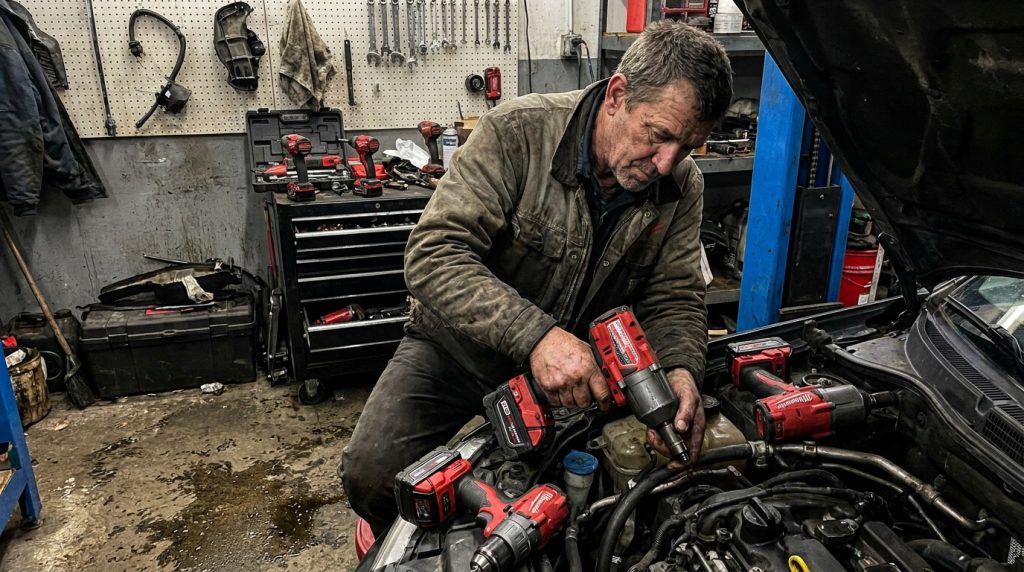
For mechanics, a tool is not just a tool—it is production equipment. Whether you are repairing farm equipment outside Coldwater, maintaining fleet trucks in Branch County, servicing industrial machinery in Southern Michigan, or working in a professional automotive bay, downtime costs money. That is why Milwaukee tools have become a go-to choice for many mechanics who need cordless power, durability, and jobsite-ready performance.
At CEM Industrial Supply, we work with tradespeople, maintenance teams, fleet technicians, fabricators, and industrial shops that need tools capable of handling real-world abuse. When customers ask about the best Milwaukee tools for mechanics, the right answer depends on the work: automotive repair, diesel maintenance, fabrication, equipment service, MRO, or mobile repair.
This guide breaks down the Milwaukee tools mechanics should consider first, how to choose between M12 and M18 platforms, what accessories matter, and how to maintain your tools for long service life.
For mechanics looking to enhance their tool collection, understanding the nuances of tool specifications can be crucial. A related article that delves into the importance of tool dimensions is available at this link: Cutoff Wheel Thickness: 0.45 vs. 0.40 vs. 1/16 – Why It Matters. This article provides insights into how the thickness of cutoff wheels can impact performance, which is essential knowledge for anyone working with Milwaukee tools or similar equipment.
Milwaukee M12 vs. M18: Which Platform Is Best for Mechanics?
Milwaukee’s cordless tool lineup is built around two major battery platforms: M12 and M18. Both are excellent, but they serve different needs in a mechanic’s toolbox.
Milwaukee M12 Tools: Compact Power for Tight Spaces
The Milwaukee M12 system is ideal for mechanics who work under dashboards, inside engine bays, around hydraulic components, and in other confined spaces. These 12V tools are compact, lightweight, and surprisingly capable.
M12 is especially useful for:
- Interior automotive work
- Light to medium fastening
- Tight engine compartments
- Small equipment repair
- Electrical and diagnostic support
- Mobile service trucks
- Assembly and disassembly tasks
For mechanics who spend a lot of time reaching into awkward spaces, M12 tools reduce fatigue and improve access.
Milwaukee M18 Tools: Higher Power for Heavy-Duty Work
The Milwaukee M18 platform is better suited for high-torque applications, larger fasteners, cutting, grinding, drilling, and shop maintenance. If you work on trucks, trailers, agricultural equipment, industrial machinery, or structural components, M18 is often the better choice.
M18 is well suited for:
- Heavy-duty impact wrench use
- Rusted or large fasteners
- Cutting and grinding
- Drilling steel
- Fleet maintenance
- Industrial repair
- Fabrication work
- Construction equipment service
Many professional mechanics use both systems: M12 for access and M18 for power.
Quick Comparison: M12 vs. M18 for Mechanics
| Feature | Milwaukee M12 | Milwaukee M18 |
||:|:|
| Voltage Platform | 12V | 18V |
| Best For | Compact access, lighter fastening | Heavy-duty torque, cutting, drilling |
| Weight | Lighter | Heavier |
| Tool Size | Smaller | Larger |
| Ideal Users | Automotive techs, mobile mechanics, electrical repair | Diesel mechanics, fleet shops, industrial maintenance |
| Battery Runtime | Good for compact work | Better for high-demand work |
| Common Mechanic Tools | Ratchets, compact impacts, inspection lights | Impact wrenches, grinders, drills, saws |
Best Milwaukee Impact Wrenches for Mechanics
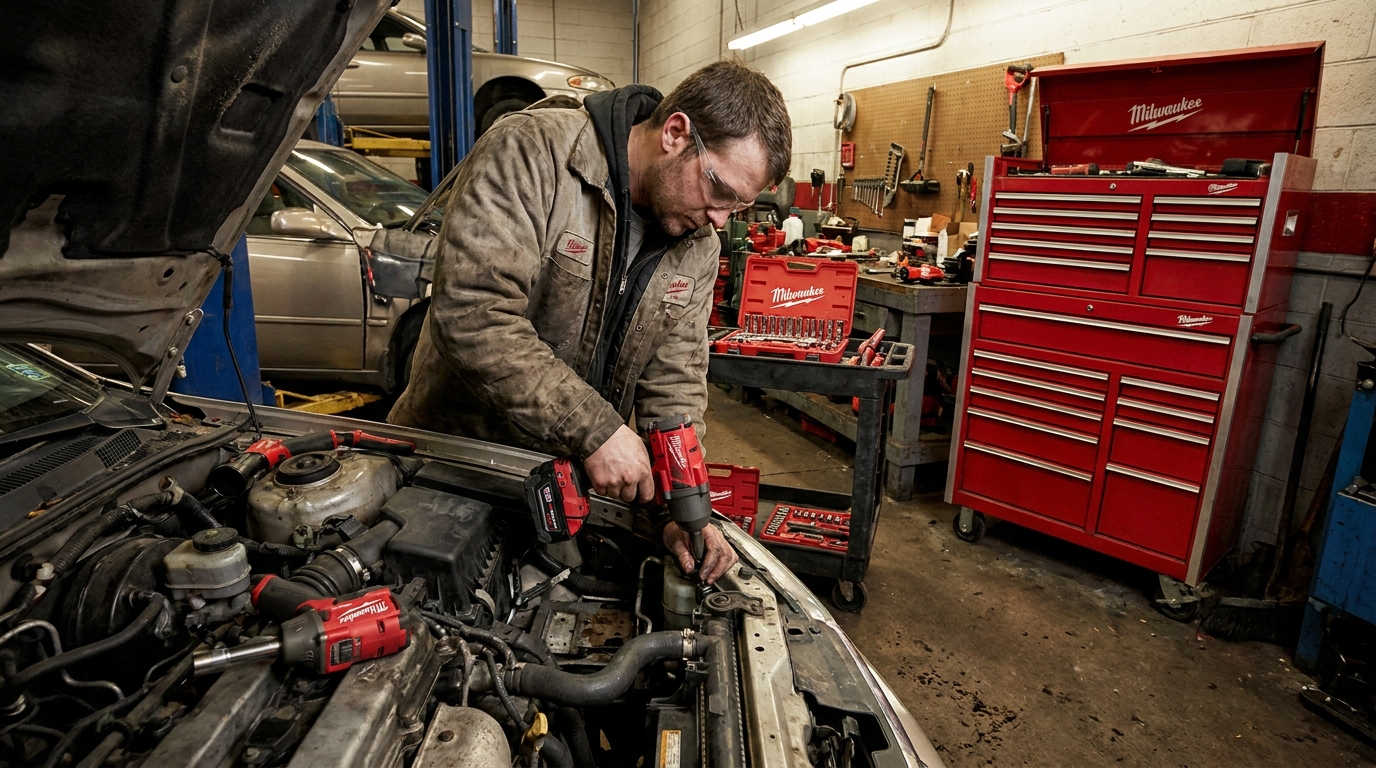
Impact wrenches are among the most important Milwaukee tools for mechanics. From lug nuts and suspension bolts to frame hardware and equipment fasteners, the right impact wrench can save hours of manual labor.
Milwaukee M18 FUEL High Torque Impact Wrench
For heavy-duty mechanics, the Milwaukee M18 FUEL High Torque Impact Wrench is one of the top choices. It is designed for serious fastening and removal work, especially where large, corroded, or high-torque bolts are common.
Best uses include:
- Truck and trailer wheel service
- Heavy equipment repair
- Suspension and chassis work
- Agricultural machinery maintenance
- Industrial equipment service
- Rusted bolt removal
This is the type of tool that belongs in professional shops across Southern Michigan where mechanics regularly deal with road salt corrosion, outdoor equipment, and high-load fasteners.
Milwaukee M18 FUEL Mid-Torque Impact Wrench
The M18 FUEL Mid-Torque Impact Wrench is often the best all-around choice for mechanics. It offers a strong balance of power, size, and control. It is easier to maneuver than a high-torque model but still strong enough for many automotive and light truck applications.
Best uses include:
- Brake jobs
- Suspension service
- General automotive repair
- Light truck maintenance
- Equipment panels and covers
- Shop maintenance work
If you are building a Milwaukee cordless mechanic tool set, this is one of the first tools I would recommend.
Milwaukee M12 FUEL Stubby Impact Wrench
The M12 FUEL Stubby Impact Wrench is a favorite for tight spaces. It is small enough to reach areas where larger tools cannot fit, yet powerful enough for many common mechanic tasks.
Best uses include:
- Engine bay work
- Underbody fasteners
- Brake calipers
- Interior brackets
- Small machinery repairs
- Compact equipment service
For automotive technicians, this tool is one of the best Milwaukee tools for mechanics because it solves a common problem: access.
Impact Wrench Buying Guide
Before buying a Milwaukee impact wrench, consider:
- Drive size: 3/8-inch for versatility, 1/2-inch for heavier work.
- Torque needs: Higher torque is not always better; too much power can damage fasteners.
- Tool size: Compact models fit tighter spaces.
- Battery platform: Choose M12 for access, M18 for sustained power.
- Anvil type: Friction ring anvils are common for fast socket changes; pin detent may be preferred for secure retention.
- Control modes: Multiple speed and torque settings help prevent over-tightening.
Please visit our latest post at https://cemindustrialsupply.com/news/ for more information.
Best Milwaukee Ratchets for Automotive and Equipment Mechanics
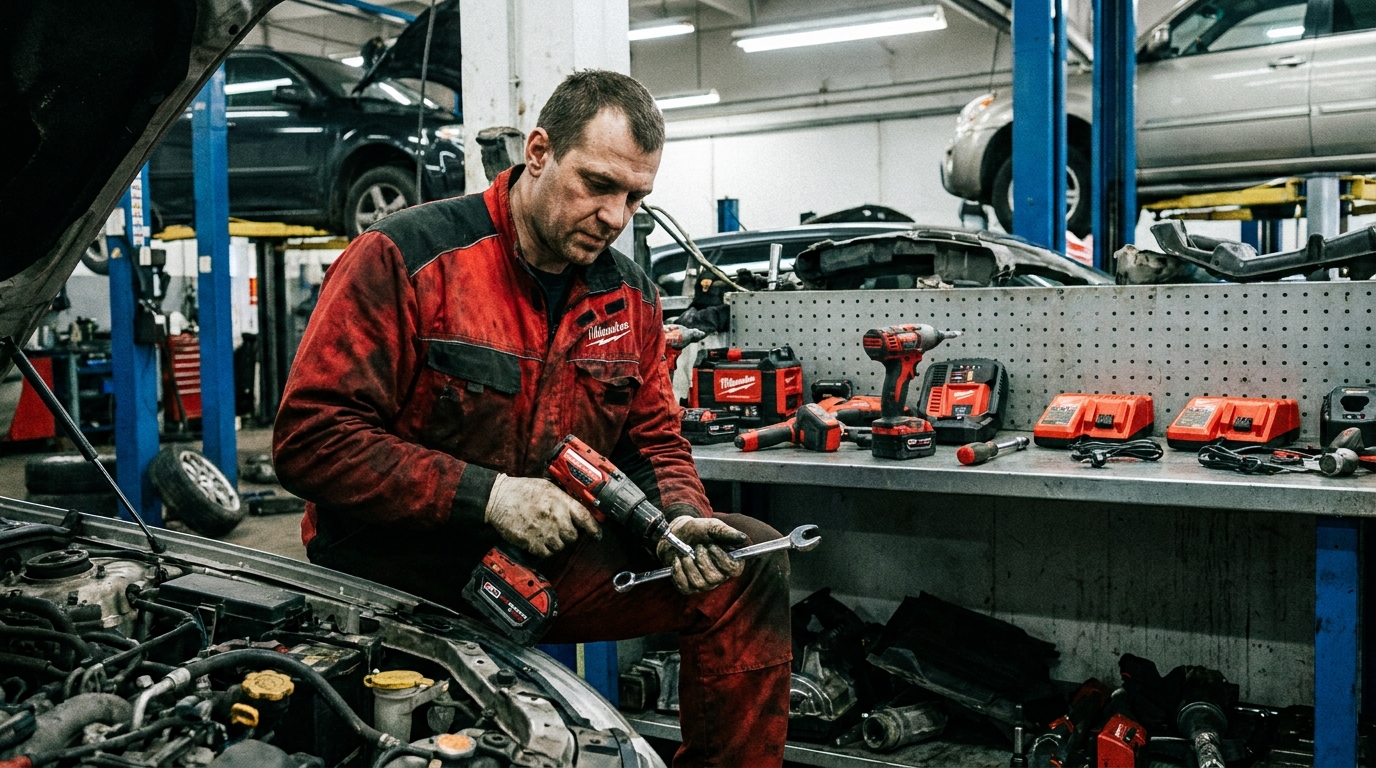
Cordless ratchets are one of the biggest time-savers in a mechanic’s toolbox. They do not replace a breaker bar or impact wrench, but they dramatically speed up repetitive fastening.
Milwaukee M12 FUEL Ratchet
The Milwaukee M12 FUEL Ratchet is excellent for automotive technicians and industrial maintenance mechanics who work in tight spaces. It is compact, easy to control, and well suited for repeated fastening tasks.
Common uses include:
- Removing engine covers
- Interior trim and brackets
- Battery trays
- Hose clamps
- Small equipment panels
- Underhood repairs
Milwaukee M12 Extended Reach Ratchet
An extended reach ratchet is useful when standard ratchets cannot reach deep or obstructed fasteners. This is especially valuable on modern vehicles and industrial equipment where access is often limited.
Best applications include:
- Engine accessory work
- HVAC repairs
- Machinery guards
- Deep bracket fasteners
- Tight hydraulic equipment areas
Milwaukee M12 High-Speed Ratchet
For mechanics who value speed, the M12 High-Speed Ratchet can improve productivity on assembly and disassembly jobs. It is useful where fasteners are not extremely tight but need to be removed quickly.
Ideal tasks include:
- Repetitive service work
- Light-duty assembly
- Panel removal
- Maintenance access covers
- Small engine repair
When to Use a Ratchet Instead of an Impact
Use a Milwaukee cordless ratchet when:
- You need access in a tight space.
- The fastener is not heavily rusted or over-torqued.
- You want better control.
- You are removing multiple small fasteners.
- You want to avoid damaging threads or brackets.
Use an impact wrench when:
- The fastener is large.
- The bolt is rusted or seized.
- You need breakaway torque.
- You are working on wheels, suspension, or heavy equipment.
For mechanics looking to enhance their toolkit, exploring the best Milwaukee tools is essential for efficiency and reliability. A related article that offers valuable insights on selecting the right tools for specific tasks can be found here: how to choose the right tape. This resource provides guidance that can complement your understanding of tool selection, ensuring you have the right equipment for every job.
Best Milwaukee Drills, Drivers, and Screwdrivers for Mechanics
Mechanics often think first about impact wrenches and ratchets, but drills and drivers are just as important in a professional shop. They support fabrication, repair, installation, and maintenance tasks.
Milwaukee M18 FUEL Drill/Driver
The M18 FUEL Drill/Driver is a strong choice for mechanics who drill metal, install hardware, or perform shop maintenance. It provides the power needed for demanding work while remaining manageable for daily use.
Useful for:
- Drilling steel brackets
- Installing accessories
- Shop repair tasks
- Maintenance workstations
- Trailer and equipment repair
- Fabrication support
When paired with quality drill bits, cutting fluid, and clamps, it becomes a dependable tool for metalworking and industrial maintenance.
Milwaukee M18 FUEL Hammer Drill
A hammer drill is useful for mechanics and maintenance teams who also anchor equipment, install shelving, or mount shop fixtures into concrete or masonry.
Common applications include:
- Anchoring equipment
- Mounting hose reels
- Installing safety barriers
- Securing racks and cabinets
- Facility maintenance
For shops in Coldwater and Branch County that handle both repair work and facility upkeep, an M18 hammer drill is a practical addition.
Milwaukee M12 Screwdriver
The M12 Screwdriver is excellent for controlled fastening, especially in electrical, dashboard, panel, and light assembly work. It is compact and easy to handle, making it a smart option for mechanics who need precision rather than brute force.
Best uses include:
- Interior automotive work
- Electrical panels
- Sensor brackets
- Small covers
- Light-duty assembly
- Instrumentation and controls
Drill and Driver Accessories to Keep on Hand
A Milwaukee drill or driver performs best when paired with the right accessories. CEM Industrial Supply can support mechanics and maintenance teams with related product categories such as cutting tools, drill bits, abrasives, safety supplies, and shop consumables.
Recommended accessories include:
- High-speed steel drill bits
- Cobalt drill bits for harder metals
- Step bits
- Driver bit sets
- Nut drivers
- Tap and drill sets
- Cutting fluid
- Deburring tools
- Clamps and vises
- Safety glasses and gloves
For those interested in enhancing their toolkit, exploring the best Milwaukee tools for mechanics can significantly improve efficiency and performance. Additionally, if you’re looking to maintain your equipment in top condition, you might find it helpful to read about how to recognize when your motor needs rewinding. This information can be crucial for ensuring that your tools remain reliable and effective in the long run. You can find the article here: how to know when your motor needs rewinding.
Best Milwaukee Grinders, Cut-Off Tools, and Saws for Mechanics
Cutting and grinding are part of daily life in many mechanical shops. Rusted hardware, damaged brackets, exhaust components, seized bearings, and fabricated parts often require more than a wrench.
Milwaukee M18 FUEL Angle Grinder
The Milwaukee M18 FUEL Angle Grinder is a must-have for mechanics who cut, grind, clean, and prep metal. Cordless grinders are especially useful for mobile repair and field maintenance.
Best uses include:
- Cutting bolts
- Grinding welds
- Cleaning metal surfaces
- Removing rust
- Preparing parts for welding
- Cutting brackets and hardware
For safety and performance, always match the grinder with the correct wheel, guard, and PPE.
Milwaukee M12 Cut-Off Tool
The Milwaukee M12 Cut-Off Tool is compact and useful for smaller cutting jobs. It is especially helpful where a full-size grinder is too large or aggressive.
Useful applications include:
- Cutting small bolts
- Trimming sheet metal
- Cutting plastic panels
- Light exhaust work
- Removing clamps
- Precision repair tasks
Milwaukee M18 Hackzall or Sawzall
Milwaukee reciprocating saws are valuable for mechanics working on exhaust systems, frames, brackets, seized components, and demolition-style repair work.
Best uses include:
- Cutting exhaust pipe
- Removing damaged bolts
- Cutting seized components
- Farm equipment repair
- Trailer maintenance
- Industrial maintenance
Cutting and Grinding Safety Tips
Cutting tools demand respect. Before using any grinder, cut-off tool, or reciprocating saw:
- Wear ANSI-rated safety glasses or a face shield.
- Use hearing protection.
- Inspect wheels and blades before use.
- Never use a damaged abrasive wheel.
- Keep guards installed.
- Match RPM ratings between tool and accessory.
- Secure the workpiece.
- Keep sparks away from flammables.
- Use gloves appropriate for the task.
- Allow wheels to stop before setting the tool down.
Best Milwaukee Lighting, Inspection, and Diagnostic Support Tools
Good lighting is not optional in mechanical work. Poor visibility leads to slower repairs, missed defects, and safety risks. Milwaukee offers several cordless lighting tools that help mechanics work faster and more accurately.
Milwaukee M12 and M18 Work Lights
Milwaukee cordless work lights are useful for underhood repair, undercarriage service, equipment maintenance, and emergency roadside work.
Common uses include:
- Engine bay inspection
- Brake and suspension work
- Mobile service calls
- Electrical troubleshooting
- Night repairs
- Facility maintenance
Milwaukee Underhood Light
An underhood light is one of the most practical Milwaukee tools for automotive mechanics. It provides broad, hands-free illumination across the engine compartment.
Best features to look for:
- Adjustable mounting
- Strong light output
- Long battery runtime
- Durable lens and housing
- Compatibility with your battery platform
Milwaukee Inspection Light or Penlight
Small inspection lights help mechanics identify leaks, cracks, worn components, electrical issues, and hidden fasteners.
Useful for:
- Checking hydraulic leaks
- Inspecting belts and hoses
- Finding missing clips
- Diagnosing wiring issues
- Looking behind panels
- Reading stamped part numbers
Best Milwaukee Specialty Tools for Mechanics
Beyond the basics, Milwaukee offers specialty tools that can make a mechanic’s work easier, cleaner, and more efficient.
Milwaukee M12 Grease Gun
For agricultural equipment, trailers, heavy machinery, and industrial maintenance, a cordless grease gun can save time and improve lubrication consistency.
Best uses include:
- Farm equipment lubrication
- Bearings and bushings
- Trailer maintenance
- Industrial machinery
- Construction equipment
- Preventive maintenance routes
A cordless grease gun is especially useful for maintenance teams that service multiple machines across a facility or jobsite.
Milwaukee M18 Tire Inflator
A tire inflator is practical for fleet service, light truck maintenance, trailers, shop vehicles, and mobile mechanics. It is not a replacement for a full shop compressor in every situation, but it is extremely convenient.
Good uses include:
- Fleet tire pressure checks
- Trailer tires
- Service vehicles
- Emergency roadside support
- Seasonal equipment preparation
Milwaukee M12 Soldering Iron
Mechanics who handle wiring repairs may benefit from a cordless soldering iron. It is useful for mobile electrical repair, trailer wiring, sensor connections, and small equipment electronics.
Use it for:
- Trailer wiring
- Automotive electrical repairs
- Heat-shrink terminals
- Sensor wiring
- Control wiring
- Field repairs
Milwaukee M12 Rotary Tool
A cordless rotary tool is useful for small grinding, cleaning, polishing, deburring, and trimming tasks.
Common mechanic uses include:
- Cleaning gasket surfaces carefully
- Deburring brackets
- Modifying plastic panels
- Polishing small contacts
- Removing corrosion
- Light precision grinding
Recommended Milwaukee Tool Sets for Different Types of Mechanics
Not every mechanic needs the same Milwaukee setup. A passenger vehicle technician has different needs than a diesel mechanic, and a plant maintenance technician has different priorities than a mobile service contractor.
Automotive Mechanic Starter Setup
For general automotive repair, start with:
- M12 FUEL Stubby Impact Wrench
- M12 FUEL Ratchet
- M18 FUEL Mid-Torque Impact Wrench
- M12 or M18 Work Light
- M18 Drill/Driver
- M12 Screwdriver
- Quality sockets and impact socket sets
- Safety glasses and gloves
This combination covers most common automotive tasks while keeping tools compact and manageable.
Diesel and Fleet Mechanic Setup
For diesel, fleet, and heavy truck service, consider:
- M18 FUEL High Torque Impact Wrench
- M18 FUEL Mid-Torque Impact Wrench
- M18 FUEL Grinder
- M18 Drill/Driver or Hammer Drill
- M18 Sawzall
- M12 Extended Reach Ratchet
- M18 Work Light
- M12 or M18 Grease Gun
- Heavy-duty impact sockets
Fleet mechanics in Branch County and Southern Michigan often deal with corrosion, high-torque fasteners, and repetitive service work. This setup provides both power and coverage.
Industrial Maintenance Mechanic Setup
For maintenance teams in manufacturing, processing, and facility repair, a balanced setup includes:
- M18 Drill/Driver
- M18 Hammer Drill
- M18 Impact Wrench
- M18 Grinder
- M18 Sawzall
- M12 Ratchet
- M12 Screwdriver
- M18 Work Light
- M12 Grease Gun
- Cutting tools, abrasives, anchors, and PPE
CEM Industrial Supply supports these needs with product categories such as power tools, hand tools, safety supplies, cutting tools, abrasives, material handling, and MRO supplies.
Mobile Mechanic Setup
For mobile technicians, portability and battery management matter.
Recommended tools include:
- M18 Mid-Torque Impact Wrench
- M12 Stubby Impact Wrench
- M12 Ratchet
- M18 Inflator
- M18 Work Light
- M12 Inspection Light
- M18 Drill/Driver
- Compact charger
- Extra batteries
- Tool storage and organizers
Mobile mechanics should also carry PPE, spill control items, penetrating oil, electrical connectors, zip ties, fasteners, and basic hand tools.
Milwaukee Tool Buying Guide for Mechanics
Choosing the best Milwaukee tools for mechanics is easier when you match the tool to the job instead of buying based only on maximum power.
Step 1: Identify Your Main Work Type
Ask yourself:
- Do I work mostly on cars, trucks, equipment, or industrial machinery?
- Do I need compact access or maximum power?
- Am I in a fixed shop or mobile service truck?
- Do I already own M12 or M18 batteries?
- How often will I use the tool?
- Will the tool be used by one person or a full crew?
Step 2: Prioritize High-Use Tools First
For most mechanics, the first Milwaukee purchases should be:
- Impact wrench
- Cordless ratchet
- Work light
- Drill/driver
- Grinder or cut-off tool
- Extra batteries and charger
After that, consider specialty tools such as grease guns, inflators, soldering irons, and inspection lights.
Step 3: Buy the Right Batteries
Battery selection affects performance, runtime, and tool balance.
General guidance:
- Use compact batteries for ratchets, screwdrivers, and inspection lights.
- Use higher-capacity batteries for grinders, saws, and high-torque impact wrenches.
- Keep multiple batteries charged for continuous shop work.
- Label batteries by crew, truck, or department if used in a shared environment.
Step 4: Do Not Overlook Accessories
Accessories often determine how well the tool performs. A premium impact wrench paired with low-quality sockets is a poor investment.
Important accessories include:
- Impact-rated sockets
- Extensions and adapters
- Drill bits
- Driver bits
- Grinding wheels
- Cut-off wheels
- Reciprocating saw blades
- Grease cartridges
- Work lights
- PPE
- Tool storage
Milwaukee Tools vs. Pneumatic Tools for Mechanics
Many mechanics still rely on air tools, and for good reason. Pneumatic tools are durable, proven, and effective. However, cordless Milwaukee tools have changed the way many shops operate.
Comparison Table: Cordless Milwaukee Tools vs. Air Tools
| Category | Milwaukee Cordless Tools | Pneumatic Tools |
||||
| Mobility | Excellent, no air hose needed | Limited by hose and compressor |
| Setup Time | Fast | Requires air supply |
| Power | Very strong, especially M18 FUEL | Strong and consistent |
| Maintenance | Battery and tool care | Compressor, hoses, fittings, lubrication |
| Noise | Generally quieter | Compressor and exhaust noise |
| Best For | Mobile repair, fast access, modern shops | High-volume air-equipped shops |
| Upfront Cost | Tool and battery investment | Tool plus compressor system |
| Safety | No hose trip hazard | Hose management required |
When Cordless Makes the Most Sense
Milwaukee cordless tools are ideal when:
- You work in multiple bays.
- You perform mobile service.
- Air hoses create trip hazards.
- You need faster setup.
- You service equipment outdoors.
- You want fewer compressor-related maintenance issues.
When Air Tools Still Make Sense
Pneumatic tools may still be useful when:
- Your shop already has a high-capacity air system.
- You perform constant high-volume production work.
- You need lightweight tools for repetitive tasks.
- Your workflow is built around compressed air.
In many modern shops, the best setup is a mix of both.
Maintenance Tips to Extend Milwaukee Tool Life
Milwaukee tools are built for hard work, but proper maintenance makes a major difference. A mechanic’s environment includes dust, oil, metal chips, coolant, grease, and vibration. Tool care should be part of the shop routine.
Daily Tool Care Checklist
At the end of each shift:
- Wipe down tools with a clean rag.
- Remove metal chips and dust.
- Inspect housings for cracks.
- Check triggers and switches.
- Inspect battery contacts.
- Remove batteries before storage.
- Return tools to assigned storage.
- Place batteries on the charger as needed.
Weekly Maintenance Checklist
Once a week:
- Inspect sockets, bits, blades, and wheels.
- Clean battery terminals gently.
- Check chargers for cord damage.
- Inspect tool cases and storage drawers.
- Verify guards are in place on grinders.
- Replace worn accessories.
- Review any tool performance issues with the team.
Battery Care Tips
To get better life from Milwaukee batteries:
- Avoid leaving batteries in extreme heat or cold.
- Do not store batteries on wet surfaces.
- Use the correct charger.
- Let overheated batteries cool before charging.
- Keep battery contacts clean.
- Rotate batteries so one pack is not overused.
- Store batteries partially charged if not used for long periods.
Shop Storage Recommendations
Good tool storage improves safety and productivity.
Consider:
- Locking tool cabinets
- Mobile work carts
- Drawer organizers
- Battery charging stations
- Wall-mounted tool storage
- Labels for shared tools
- Separate storage for cutting wheels and blades
CEM Industrial Supply can help mechanics and maintenance teams source related storage, safety, abrasive, cutting, and MRO supplies to support a complete shop setup.
Safety Tips for Mechanics Using Milwaukee Power Tools
Power tools improve productivity, but they also introduce risk. Every shop should have clear safety expectations.
Personal Protective Equipment
At minimum, mechanics should have access to:
- Safety glasses
- Face shields
- Cut-resistant gloves
- Mechanic’s gloves
- Hearing protection
- Respiratory protection when grinding or cutting
- Steel-toe or safety-toe footwear
- Flame-resistant gear where required
Fastening Safety
When using impact wrenches and ratchets:
- Use impact-rated sockets only.
- Do not use chrome sockets on impact tools.
- Start fasteners by hand when possible.
- Use torque sticks or torque wrenches where required.
- Never rely on an impact wrench for final torque on critical fasteners.
- Keep hands clear of pinch points.
- Be cautious around rusted or stretched bolts.
Drilling and Cutting Safety
When drilling, grinding, or cutting:
- Clamp the work securely.
- Use the correct speed and accessory.
- Keep guards installed.
- Avoid loose clothing.
- Watch spark direction.
- Use cutting fluid where appropriate.
- Let tools stop fully before setting them down.
- Keep bystanders clear.
Battery Safety
Lithium-ion batteries should be handled properly:
- Do not use damaged battery packs.
- Keep batteries away from metal debris.
- Avoid crushing or dropping batteries.
- Do not expose batteries to standing water.
- Use manufacturer-approved chargers.
- Remove damaged batteries from service immediately.
Mechanic’s Milwaukee Tool Checklist
Use this checklist when building or upgrading your Milwaukee tool lineup.
Core Cordless Tools
- M18 Mid-Torque Impact Wrench
- M18 High Torque Impact Wrench
- M12 Stubby Impact Wrench
- M12 Cordless Ratchet
- M12 Extended Reach Ratchet
- M18 Drill/Driver
- M18 Grinder
- M18 Sawzall or Hackzall
- M12 or M18 Work Light
Specialty Tools
- M12 or M18 Grease Gun
- M18 Tire Inflator
- M12 Soldering Iron
- M12 Rotary Tool
- Inspection light
- Heated gear for cold-weather work
Accessories and Supplies
- Impact sockets
- Extensions and adapters
- Drill bits
- Driver bits
- Cut-off wheels
- Grinding wheels
- Saw blades
- Grease cartridges
- Penetrating oil
- Shop towels
- PPE
- Tool storage
Maintenance and Safety Supplies
- Safety glasses
- Gloves
- Hearing protection
- Face shields
- First aid supplies
- Spill control products
- Lockout/tagout supplies
- Cleaning supplies
- Lubricants
- Battery storage solutions
Local Support for Milwaukee Tools and Industrial Supplies in Southern Michigan
For mechanics in Coldwater, Branch County, and throughout Southern Michigan, local supply support matters. When a tool, abrasive, fastener, PPE item, or shop supply is needed, waiting too long can slow down the job.
CEM Industrial Supply supports professionals who need dependable products for:
- Power tools
- Hand tools
- Abrasives
- Cutting tools
- Safety supplies
- MRO supplies
- Material handling
- Shop supplies
- Janitorial and facility maintenance
- Industrial equipment support
Whether you are maintaining a farm fleet, repairing municipal vehicles, servicing production equipment, or running an automotive repair shop, having a reliable industrial supplier helps keep your operation moving.
FAQs About the Best Milwaukee Tools for Mechanics
What are the best Milwaukee tools for mechanics to buy first?
For most mechanics, the best Milwaukee tools to buy first are an impact wrench, cordless ratchet, work light, drill/driver, and grinder. Automotive mechanics may start with M12 compact tools, while diesel and fleet mechanics often benefit from M18 mid-torque and high-torque impact wrenches.
Is Milwaukee M12 powerful enough for mechanics?
Yes, Milwaukee M12 tools are powerful enough for many mechanic tasks, especially tight-space work. M12 ratchets, stubby impacts, screwdrivers, and inspection lights are very popular with automotive technicians. For heavy-duty fasteners, M18 is usually the better option.
Should mechanics choose Milwaukee M18 or M12?
Many mechanics should use both. M12 is best for compact access and lighter fastening. M18 is best for high-torque work, drilling, cutting, grinding, and heavy-duty maintenance. If you can only choose one platform, select based on your most common work.
What Milwaukee impact wrench is best for automotive work?
The Milwaukee M18 FUEL Mid-Torque Impact Wrench is an excellent all-around choice for automotive work. The M12 FUEL Stubby Impact Wrench is also very useful for tight spaces. For lug nuts and larger suspension fasteners, many mechanics prefer an M18 model.
What Milwaukee tools are best for diesel mechanics?
Diesel mechanics should consider an M18 High Torque Impact Wrench, M18 Mid-Torque Impact Wrench, M18 Grinder, M18 Drill/Driver, M18 Sawzall, M12 Extended Reach Ratchet, and cordless work lights. A Milwaukee grease gun is also very useful for fleet and equipment maintenance.
Are cordless Milwaukee tools better than air tools?
Cordless Milwaukee tools are often better for mobility, speed, and convenience. Air tools can still be useful in high-volume shops with strong compressor systems. Many professional mechanics use both, but cordless tools reduce hose clutter and improve flexibility.
Do I need impact-rated sockets with Milwaukee impact wrenches?
Yes. Always use impact-rated sockets with impact wrenches. Chrome hand sockets can crack or shatter under impact loads, creating a serious safety hazard. Impact sockets are designed to handle repeated shock loads.
How many Milwaukee batteries should a mechanic have?
A mechanic should typically have at least two to four batteries per platform, depending on workload. Heavy-use tools such as grinders, saws, and high-torque impact wrenches require higher-capacity batteries and more frequent charging.
Where can mechanics in Coldwater, MI find Milwaukee tools and shop supplies?
Mechanics in Coldwater, Branch County, and Southern Michigan can work with CEM Industrial Supply for power tools, hand tools, abrasives, cutting tools, safety supplies, MRO products, and related industrial supplies for automotive, fleet, agricultural, and facility maintenance work.
FAQs
What are some of the best Milwaukee tools for mechanics?
Some of the best Milwaukee tools for mechanics include the M18 Fuel 1/2″ High Torque Impact Wrench, M12 Fuel 3/8″ Ratchet, M18 Fuel 3/8″ Mid-Torque Impact Wrench, M18 Fuel 1/2″ Extended Anvil High Torque Impact Wrench, and M18 Fuel 1/2″ Stubby Impact Wrench.
What makes Milwaukee tools a popular choice for mechanics?
Milwaukee tools are popular among mechanics due to their durability, high performance, and innovative features. They are known for their reliability and ability to withstand tough working conditions in automotive repair and maintenance.
Are Milwaukee tools suitable for professional mechanics?
Yes, Milwaukee tools are suitable for professional mechanics. They are designed to meet the demands of professional use and are widely used in automotive repair shops and garages.
What are some key features of Milwaukee tools for mechanics?
Key features of Milwaukee tools for mechanics include brushless motors for increased efficiency and power, REDLINK Plus intelligence for optimized performance and overload protection, ergonomic designs for comfortable use, and long-lasting battery life for extended use.
Where can I purchase Milwaukee tools for mechanics?
Milwaukee tools for mechanics can be purchased at authorized Milwaukee tool dealers, hardware stores, and online retailers. It is important to ensure that the tools are purchased from reputable sources to guarantee authenticity and warranty coverage.