
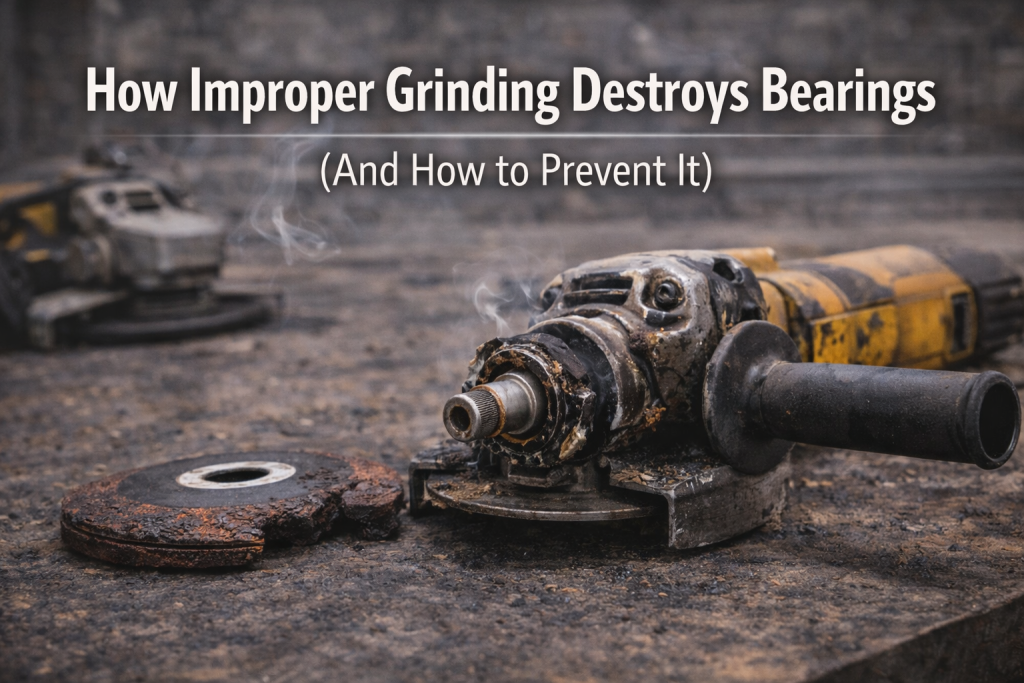
Most people blame grinders when tools fail early. In reality, the grinder is usually the victim. Improper grinding techniques generate heat, vibration, and side-loading that quietly destroy bearings long before the motor gives out.
At CEM Industrial Supply, we see this pattern constantly—especially on grinders that should have lasted years.
Heat Is the Silent Bearing Killer
Bearings are designed to operate within specific temperature ranges. Improper grinding generates excessive heat that transfers directly into the spindle and bearing races.
Common causes include:
- Using dull or incorrect discs
- Applying excessive pressure
- Running grinders continuously without cooling breaks
Once heat degrades bearing grease, failure accelerates rapidly.
Side-Loading Is a Bigger Problem Than People Realize
Angle grinders are designed for radial loads, not heavy side pressure. Using the wrong disc profile or forcing the grinder at steep angles puts lateral stress on bearings.
Side-loading happens when:
- Flat discs are forced aggressively
- Improper disc angles are used
- The tool is leveraged instead of guided
This causes premature bearing wear, vibration, and eventual seizure.
Vibration Multiplies Bearing Damage
Unbalanced or low-quality discs introduce vibration that compounds bearing wear.
Vibration causes:
- Micro-fractures in bearing surfaces
- Accelerated grease breakdown
- Increased heat generation
Even small vibrations add up over time, especially in continuous-use applications.
The Role of Proper Abrasive Selection
Correct abrasive selection dramatically reduces bearing stress.
Well-matched abrasives:
- Cut faster with less pressure
- Generate less heat
- Run smoother at rated RPMs
High-quality flap discs and properly rated grinding wheels protect both the tool and the operator.
Preventing Premature Bearing Failure
To extend grinder life:
- Replace dull discs early
- Match disc type to application
- Avoid excessive pressure
- Allow cooling periods during continuous use
- Use quality abrasives rated for the grinder’s RPM
These small adjustments often double or triple tool lifespan.
When Bearing Damage Is Already Done
Early signs of bearing failure include:
- Increased noise
- Excess vibration
- Heat buildup near the spindle
Ignoring these signs leads to catastrophic failure. Addressing them early saves both the grinder and the job.
The Bottom Line
Improper grinding doesn’t just ruin abrasives—it destroys bearings, shortens tool life, and increases downtime. Most failures are preventable with correct technique and proper accessory selection.
If grinders in your shop keep failing early, the issue isn’t luck—it’s process.
CEM Industrial Supply can help you correct it before it costs you another tool.