
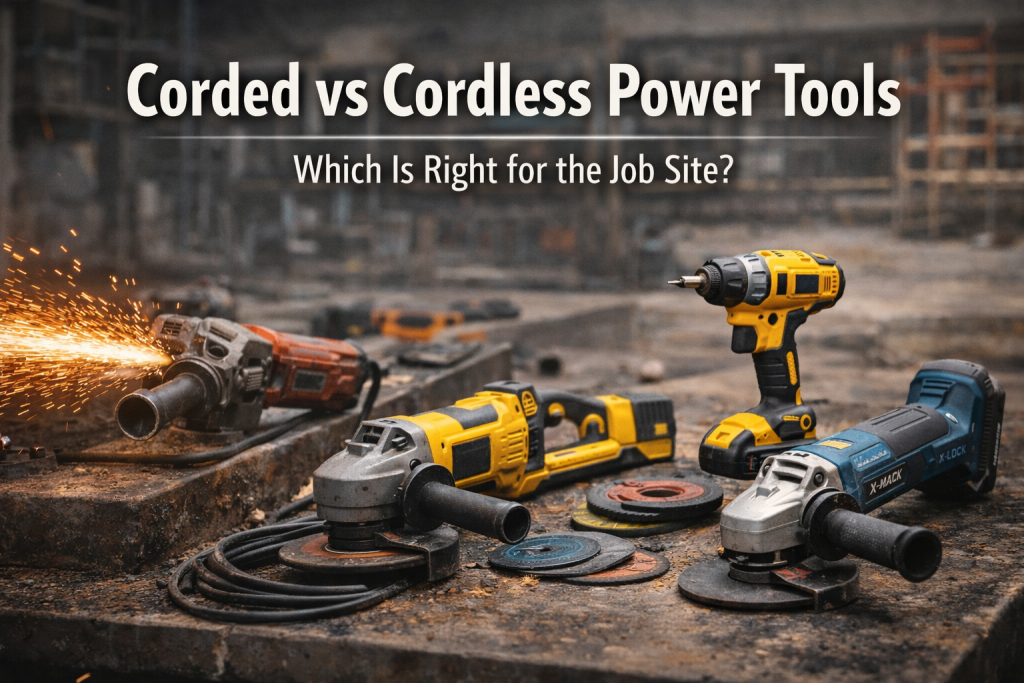
Few debates on the job site are as common as corded versus cordless power tools. Both have their place, and choosing the wrong one can cost you productivity, tool life, and money. The right choice depends less on brand loyalty and more on how, where, and how long the tool will be used.
At CEM Industrial Supply, we help contractors and maintenance teams make this decision every day. Here’s how to choose correctly.
When Cordless Power Tools Make Sense
Cordless tools are all about mobility and speed. They excel in environments where power access is limited or constantly changing.
Cordless tools are ideal for:
- Service calls and repairs
- Framing and construction work
- Jobs requiring frequent repositioning
- Work at heights or in tight spaces
Modern cordless platforms deliver impressive torque and runtime, especially for drilling, fastening, and light cutting. Battery technology has improved, but runtime is still finite, and heat buildup remains a concern under continuous load.
Cordless tools perform best when used intermittently rather than nonstop.
When Corded Power Tools Are the Better Choice
Corded tools dominate applications that require sustained power. Grinding, sanding, cutting, and polishing place constant stress on motors, and corded tools handle this far better.
Corded tools are ideal for:
- Angle grinding and metal fabrication
- Continuous sanding and surface prep
- Heavy cutting applications
- Shop-based or fixed-location work
With no batteries to drain, corded tools deliver consistent power and often last longer in high-demand environments. They also cost less over time for continuous-duty applications.
Duty Cycle Matters More Than Brand
The biggest mistake buyers make is choosing tools based on brand instead of workload.
A cordless grinder pushed all day will fail faster than a corded grinder doing the same work. Likewise, dragging extension cords across a job site for quick fastening tasks slows crews down unnecessarily.
The smartest setups use both: cordless tools for mobility and speed, corded tools for power and endurance.
Cost of Ownership: What People Forget
Cordless tools have a higher upfront cost due to batteries and chargers. Replacement batteries add up over time, especially in cold environments or heavy-use conditions.
Corded tools typically have:
- Lower upfront cost
- Longer service life in continuous use
- Fewer consumable components
Neither option is cheaper in every scenario. The correct choice minimizes downtime and replacement costs for your specific application.
Safety and Performance Considerations
Corded tools provide steady torque and RPM, reducing the temptation to force the tool. Cordless tools can lose power as batteries drain, which increases user fatigue and unsafe operating habits.
No matter which you choose:
- Match the tool to the task
- Use rated accessories
- Avoid pushing tools beyond their intended duty cycle
The Bottom Line
Cordless tools win on mobility. Corded tools win on endurance. The best tool is the one matched correctly to how the job is actually done.
If you’re unsure which makes more sense for your work, talk to the team at CEM Industrial Supply. We’ll help you choose tools that last—not tools that come back broken.