
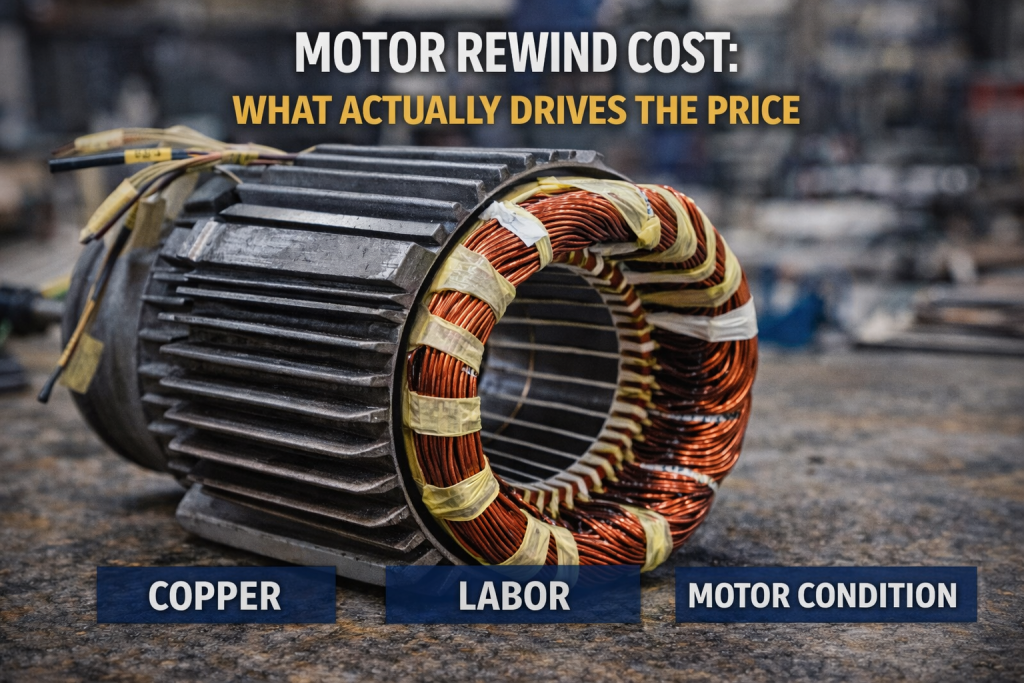
Motor rewind pricing can feel unpredictable. One motor rewinds for a few hundred dollars, another jumps into the thousands — even when horsepower looks similar on paper. The truth is, rewind cost has very little to do with just HP and everything to do with construction, labor, materials, and condition.
This guide breaks down what actually drives motor rewind cost, why quotes vary so much, and when rewinding makes sense versus replacement.
Why Motor Rewind Pricing Varies So Much
Motor rewinding is not a flat-rate service. Cost depends on:
- Motor size and design
- Winding complexity
- Copper requirements
- Labor hours
- Testing and documentation
- Turnaround time
Two motors with the same horsepower can have wildly different rewind costs.
Horsepower Is Only a Starting Point
Horsepower affects rewind cost, but it’s only one variable.
In general:
- Small fractional HP motors cost less to rewind
- Larger HP motors require more copper and labor
- High-efficiency motors require tighter tolerances
However, HP alone does not determine complexity. Frame size, speed, and winding design often matter more.
Copper: The Single Biggest Cost Driver
Copper is usually the largest material cost in a rewind.
Factors that increase copper cost:
- Larger stator slots
- Higher voltage motors
- Multi-turn windings
- Premium efficiency designs
Copper pricing fluctuates with the market, which directly impacts rewind quotes. A rewind done today may cost significantly more than the same rewind two years ago.
Motor Type and Construction
Motor design plays a major role in rewind cost.
Single-phase motors
Generally cheaper to rewind, but some designs are not rewind-friendly.
Three-phase motors
Most common rewind candidates. Cost increases with size and efficiency level.
Explosion-proof motors
Heavier housings, tighter tolerances, and added testing increase labor and cost.
High-efficiency and inverter-duty motors
Require precision winding and insulation systems, increasing labor time.
Custom or OEM-specific motors
Non-standard designs often increase both labor and material costs.
Labor Time: Where Costs Add Up
Rewinding is labor-intensive, skilled work.
Labor includes:
- Strip and burn-out
- Core inspection
- Slot cleaning and insulation
- Rewinding and lacing
- Varnish or VPI process
- Baking and curing
- Final testing
Motors with complex windings or damaged cores require significantly more time, which directly increases cost.
Core Condition Matters
If the stator core is damaged, rewind cost rises quickly.
Common issues:
- Core lamination damage
- Hot spots
- Ground faults
- Slot deformation
Severe core damage can make a rewind uneconomical, even if the motor is otherwise serviceable.
Voltage, Speed, and Pole Count
Higher voltage motors require:
- More insulation
- Tighter clearances
- Additional testing
Multi-speed or multi-pole motors:
- Have more complex winding patterns
- Take longer to rewind
- Increase labor cost
These factors often surprise customers because they aren’t visible externally.
Testing and Documentation Requirements
Industrial and critical-duty motors often require extensive testing.
Additional testing may include:
- Surge comparison testing
- Hi-pot testing
- Vibration analysis
- No-load run testing
- Documentation for compliance or insurance
These steps add value — and cost — to the rewind.
Turnaround Time and Expediting
Standard rewind timelines are typically more cost-effective.
Expedited rewinds:
- Require overtime labor
- Interrupt shop scheduling
- Increase overall cost
If downtime is critical, expediting may still be the right choice — but it’s never free.
When Rewinding Makes Sense
Rewinding is usually a good option when:
- The motor is large or specialty
- Replacement lead times are long
- The motor is custom or OEM-specific
- The frame and core are in good condition
When Replacement Is Smarter
Replacement often makes more sense when:
- The motor is small and standard
- Rewind cost approaches new motor price
- Efficiency upgrades are desired
- Core damage is present
A good repair shop should explain this honestly — not push a rewind that doesn’t make economic sense.
Common Misconceptions About Rewind Cost
“Rewinding is always cheaper than replacing”
Not always true, especially for small motors.
“All rewind shops charge the same”
Labor quality, testing, and materials vary significantly.
“A rewind reduces efficiency”
A properly done rewind maintains or restores efficiency when done correctly.
Final Takeaway
Motor rewind cost is driven by copper, labor, motor design, and condition — not just horsepower. Understanding these factors helps set realistic expectations and prevents sticker shock.
If you’re evaluating whether to rewind or replace a motor, the best move is getting the motor inspected. A clear explanation of cost drivers usually tells you which option makes the most sense.