
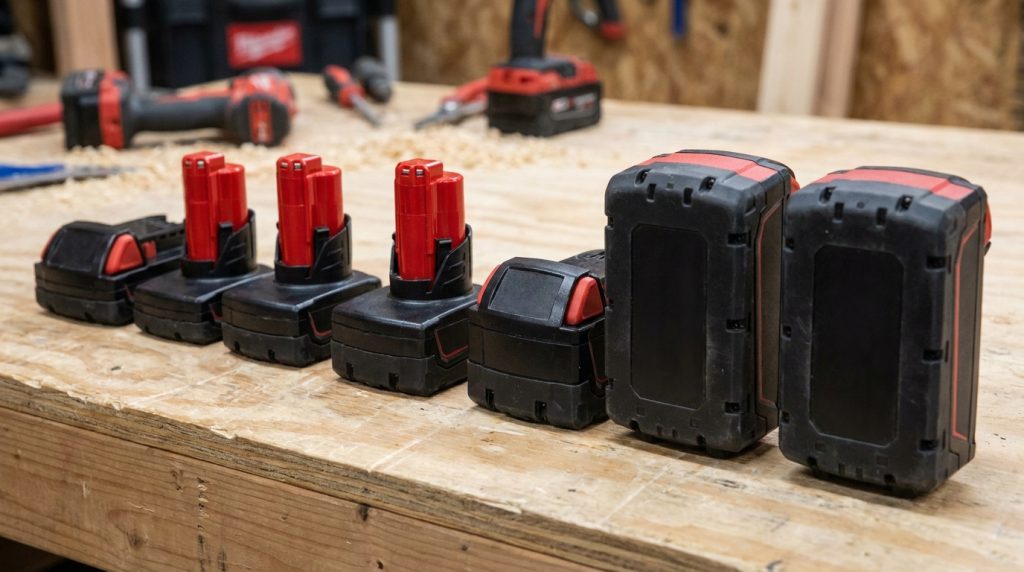
When customers ask us at CEM Industrial Supply which Milwaukee battery size they need, they are usually asking one of three things:
- Which voltage platform do I need? M12, M18, or MX FUEL?
- How much runtime do I need? Measured in amp-hours, or Ah.
- How much power output do I need? Especially for high-demand tools like grinders, saws, rotary hammers, and outdoor power equipment.
Milwaukee battery sizes are not just about physical dimensions. A “larger” battery may mean higher voltage, higher amp-hour capacity, more advanced cell design, better heat control, or higher current delivery. Choosing correctly affects tool performance, productivity, comfort, charging strategy, and long-term cost.
For contractors, maintenance teams, fabricators, farmers, municipalities, and industrial crews in Coldwater, Branch County, and Southern Michigan, the right Milwaukee battery setup can reduce downtime and keep jobs moving.
At CEM Industrial Supply, we regularly help customers match Milwaukee cordless tools, batteries, chargers, accessories, PPE, and jobsite supplies to real working conditions—not just catalog specifications.
If you’re looking to deepen your understanding of battery sizes and their applications, you might find the article on abrasive wheel safety quite insightful. It discusses important safety standards that can be crucial for anyone working with power tools, including those that utilize batteries. You can read more about it here: Abrasive Wheel Safety: What OSHA Actually Cares About and What Most Shops Get Wrong.
Milwaukee Battery Platforms: M12, M18, and MX FUEL
Milwaukee cordless batteries are grouped into three main platforms: M12, M18, and MX FUEL. Each platform is designed for a different level of work.
M12 Batteries: Compact, Lightweight, and Precise
The Milwaukee M12 system is a 12-volt cordless platform designed for compact tools and tight-space work.
M12 batteries are commonly used with:
- Compact drills and drivers
- Ratchets
- Inspection cameras
- Tubing cutters
- Soldering irons
- Compact lights
- Small saws and specialty trade tools
M12 tools are popular with electricians, HVAC technicians, plumbers, auto technicians, maintenance departments, and service crews because they are lightweight and easy to carry.
When M12 Makes Sense
Choose Milwaukee M12 batteries when you need:
- Better access in tight spaces
- Reduced hand and arm fatigue
- Lightweight tools for all-day use
- Compact jobsite kits
- Precision over brute force
For many Southern Michigan maintenance teams and service contractors, M12 tools are ideal for repair calls, panel work, equipment maintenance, and installation tasks where portability matters.
M18 Batteries: The Main Workhorse Platform
The Milwaukee M18 system is an 18-volt cordless platform and the most widely used Milwaukee battery system for construction, industrial maintenance, fabrication, and general contracting.
M18 batteries power:
- Impact drivers and drills
- Circular saws
- Reciprocating saws
- Angle grinders
- Rotary hammers
- Bandsaws
- Impact wrenches
- Jobsite lights
- Vacuums
- Outdoor power equipment
- Pumps and specialty tools
If you are building a cordless tool lineup for professional use, M18 is usually the foundation.
When M18 Makes Sense
Choose Milwaukee M18 batteries when you need:
- Higher power than M12
- Broad tool compatibility
- Jobsite durability
- Strong runtime options
- Corded-tool replacement performance
For contractors and industrial users in Branch County, M18 batteries are often the best balance between performance, portability, and tool selection.
MX FUEL Batteries: Heavy-Duty Equipment Power
The Milwaukee MX FUEL platform is designed for light equipment and high-demand applications traditionally powered by gas engines or cords.
MX FUEL tools and equipment may include:
- Cut-off saws
- Core drills
- Breakers
- Plate compactors
- Sewer drum machines
- Concrete vibrators
- Tower lights
- Large power supplies
MX FUEL batteries are physically larger and built for demanding work where M12 or M18 would not be practical.
When MX FUEL Makes Sense
Choose MX FUEL when you need:
- Gas-equipment replacement
- Indoor operation without fumes
- Reduced maintenance compared to small engines
- High-output equipment performance
- Heavy-duty concrete, utility, or construction capability
For municipal crews, concrete contractors, excavators, and industrial facilities around Coldwater and Southern Michigan, MX FUEL can reduce fuel storage, emissions, noise, and engine maintenance.
Milwaukee Battery Size Terms: CP, XC, HD, High Output, and FORGE
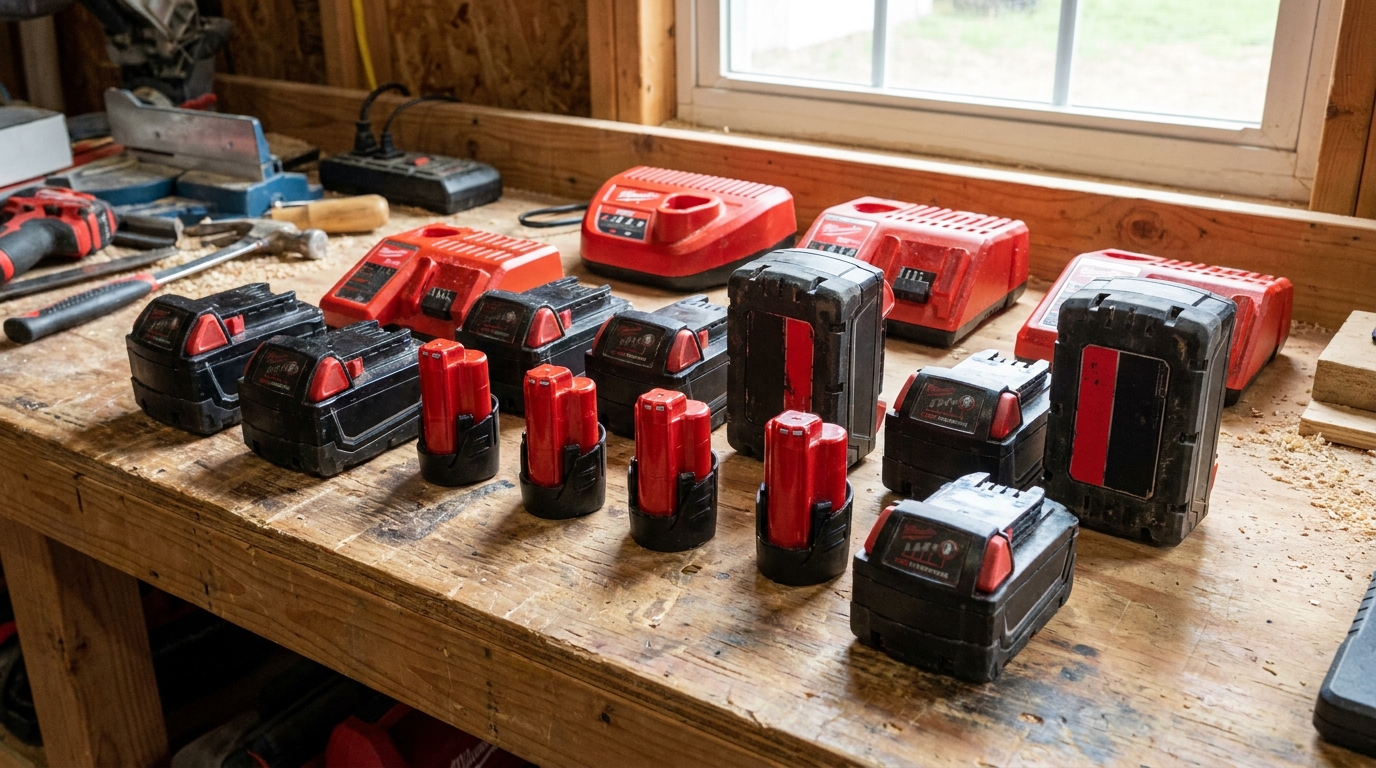
Milwaukee battery names can look confusing at first. Terms like CP, XC, HD, High Output, and FORGE describe battery size, capacity, and performance level.
Understanding these labels helps you choose the right pack for the job.
CP Batteries: Compact Packs
CP stands for Compact Pack.
These batteries are smaller, lighter, and easier to handle. They are best for lower-demand tools or work where weight matters more than maximum runtime.
Common uses include:
- Impact drivers
- Compact drills
- Lights
- Ratchets
- Inspection tools
- Light fastening work
Pros of CP Batteries
- Lightweight
- Lower cost
- Easier overhead use
- Faster to recharge
- Ideal for compact tools
Cons of CP Batteries
- Shorter runtime
- Less ideal for high-draw tools
- May not deliver peak performance on demanding applications
A Milwaukee M18 CP battery may be excellent on an impact driver but underpowered for extended grinder or saw use.
XC Batteries: Extended Capacity Packs
XC stands for Extended Capacity.
These packs are larger than CP batteries and provide more runtime. They are a common choice for professional users who need better balance between runtime and weight.
Common uses include:
- Drills
- Impact wrenches
- Reciprocating saws
- Circular saws
- Bandsaws
- Work lights
- Vacuums
Pros of XC Batteries
- Longer runtime than compact packs
- Good balance of size and performance
- Suitable for many professional tools
- Often the best “all-around” battery choice
Cons of XC Batteries
- Heavier than CP packs
- More expensive than compact batteries
- May still be insufficient for very high-demand tools
For many CEM Industrial Supply customers, an M18 XC battery is the everyday workhorse battery.
HD Batteries: Heavy-Duty High-Capacity Packs
HD stands for Heavy Duty.
These batteries are larger packs designed for demanding applications that require longer runtime and stronger power delivery.
Common uses include:
- Large saws
- Grinders
- Rotary hammers
- High-torque impact wrenches
- Outdoor power equipment
- Heavy-duty jobsite tools
Pros of HD Batteries
- Maximum runtime
- Better suited for high-demand tools
- More power delivery under load
- Ideal for production work
Cons of HD Batteries
- Heavier
- Higher upfront cost
- Can make compact tools feel unbalanced
- Longer charging time
HD batteries make sense when downtime is expensive and the tool is pulling serious current.
High Output Batteries: More Power Under Load
Milwaukee High Output batteries are designed to deliver more power and run cooler than standard battery packs.
They use advanced cells and battery management to support higher-demand tools. In practical terms, High Output batteries can help tools cut faster, grind harder, and maintain performance longer under load.
High Output batteries are especially useful for:
- M18 FUEL grinders
- Circular saws
- Table saws
- Miter saws
- Chainsaws
- Blowers
- Rotary hammers
- High-torque impacts
If your tool bogs down during heavy cutting, drilling, or grinding, a High Output battery may improve performance.
REDLITHIUM FORGE Batteries: Advanced Performance Packs
Milwaukee REDLITHIUM FORGE batteries are engineered for faster charging, higher output, and improved performance compared to traditional packs of similar capacity.
FORGE batteries are designed for users who want premium performance from cordless tools, especially in heavy-duty applications.
Benefits may include:
- Faster charging capability with compatible chargers
- Strong power delivery
- Better heat management
- High productivity for demanding users
- Corded-replacement performance in select applications
FORGE batteries are a strong choice for contractors, industrial crews, and fleet users who depend on cordless tools every day.
Please visit our latest post at https://cemindustrialsupply.com/news/ for more information.
Milwaukee Battery Amp-Hours Explained
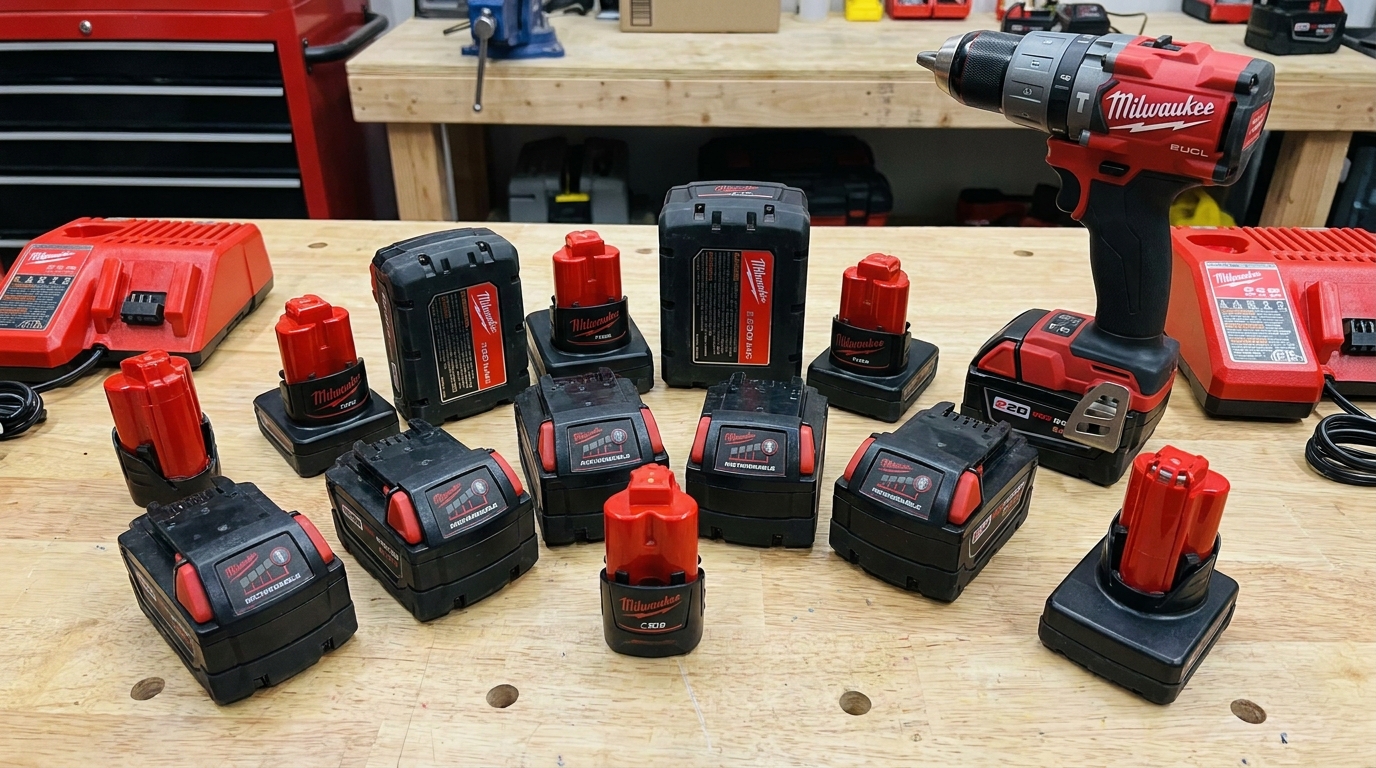
Amp-hours, shown as Ah, indicate battery capacity. In simple terms, a higher Ah rating usually means longer runtime.
For example:
- A 2.0Ah battery is compact and lightweight.
- A 5.0Ah battery provides more runtime.
- An 8.0Ah or 12.0Ah battery provides much longer runtime and better support for demanding tools.
However, amp-hours do not tell the entire story. Battery cell type, voltage, tool demand, temperature, and charger selection also matter.
What Does Ah Mean in Real Use?
Amp-hours are similar to fuel tank size. A larger fuel tank lets a vehicle run longer, but fuel efficiency still depends on the engine and workload.
In cordless tools:
- Driving small screws uses less energy.
- Drilling large holes uses more energy.
- Grinding steel uses much more energy.
- Cutting concrete or running outdoor equipment uses a lot of energy.
A 5.0Ah battery might last a long time on an impact driver but drain quickly on a grinder.
Higher Ah Does Not Always Mean Better
A larger battery is not always the best choice.
For overhead fastening, a compact battery reduces fatigue. For a small inspection tool, a large battery may add unnecessary weight. For a grinder, saw, or rotary hammer, a compact battery may limit performance and runtime.
The best Milwaukee battery size depends on:
- Tool type
- Job duration
- Power demand
- Ergonomics
- Charging access
- Crew size
- Budget
At CEM Industrial Supply, we often recommend a mixed battery setup rather than buying only the largest packs.
Understanding Milwaukee battery sizes is essential for maximizing the performance of your tools, and if you’re considering different power tools, you might find it helpful to read about the distinctions between various saws. For instance, the article on circular saws, miter saws, and table saws provides valuable insights into choosing the right tool for your projects. You can check it out here to learn more about how these tools can complement your Milwaukee battery-operated equipment.
Milwaukee M12 Battery Sizes
Milwaukee M12 batteries are available in compact and extended capacity styles.
Common M12 Battery Types
| M12 Battery Type | Best For | Main Advantage | Consideration |
|---|---|---|---|
| Compact M12 batteries | Ratchets, drivers, lights, and inspection tools | Lightest weight | Shorter runtime |
| M12 High Output Compact batteries | Higher-demand compact tools | More performance in a compact size | Higher cost |
| M12 XC batteries | Saws, lights, and specialty tools | Longer runtime | Larger grip and battery footprint |
| M12 High Output XC batteries | More demanding M12 applications | Better power and longer runtime | Heavier than compact battery packs |
Best M12 Battery Size for Service Work
For service technicians, a compact M12 battery is often preferred for:
- Tight engine compartments
- Electrical panels
- Cabinet work
- HVAC service
- Plumbing access areas
- Preventive maintenance routes
A compact M12 pack keeps the tool small and easy to maneuver.
Best M12 Battery Size for Longer Runtime
For longer jobs, M12 XC batteries are a better option. They add runtime and can improve stability when the tool is set down.
M12 XC batteries are useful for:
- Jobsite lights
- Compact saws
- Tubing tools
- Specialty trade tools
- Repetitive fastening
A good M12 kit often includes both compact and XC batteries.
If you’re looking to understand more about Milwaukee battery sizes, you might find it helpful to explore the intricacies of contractor tools and their specifications. A related article that delves into the essential tools for contractors can be found here: contractor tools. This resource provides valuable insights that can complement your knowledge of Milwaukee batteries and their compatibility with various tools.
Milwaukee M18 Battery Sizes
Milwaukee M18 batteries offer the widest range of size and performance options.
Common M18 Battery Types
| M18 Battery Type | Best For | Main Advantage | Consideration |
|---|---|---|---|
| CP batteries | Impact drivers, drills, and lights | Lightweight and compact | Limited runtime |
| XC batteries | General construction and maintenance | Best all-around balance of power and runtime | Moderate weight |
| High Output CP batteries | Compact tools that need more power | Strong performance in a smaller battery | Less runtime than XC or HD batteries |
| High Output XC batteries | Saws, impact wrenches, and grinders | Better performance and longer runtime | Higher cost |
| High Output HD batteries | Heavy-duty tools and production work | Maximum runtime and power output | Heavier weight |
| FORGE batteries | Premium, high-demand applications | Ultra-fast charging and high power | Premium price |
Best M18 Battery Size for Drills and Impact Drivers
For drills and impact drivers, the best battery depends on the work:
- Light-duty fastening: CP battery
- General drilling and driving: XC battery
- Large hole saws or auger bits: High Output XC or HD battery
For an electrician, a compact battery may be preferred for overhead work. For a carpenter drilling large holes or driving structural fasteners, an XC or High Output pack is more practical.
Best M18 Battery Size for Saws
Cordless saws draw more power than drills and drivers.
For circular saws, reciprocating saws, bandsaws, and table saws, consider:
- M18 XC batteries for moderate cutting
- M18 High Output XC batteries for frequent cutting
- M18 High Output HD or FORGE batteries for production cutting
If you are cutting treated lumber, steel, conduit, pipe, or demolition material, a higher-output battery helps maintain speed under load.
CEM Industrial Supply can also help pair batteries with Milwaukee saw blades, abrasives, cutting wheels, PPE, and jobsite storage so crews have a complete setup.
Best M18 Battery Size for Grinders
Angle grinders are high-draw tools. They can drain compact batteries quickly.
For Milwaukee M18 grinders, we generally recommend:
- High Output XC batteries for general grinding
- HD batteries for extended grinding
- FORGE batteries for premium performance and faster turnaround
Avoid relying on small compact packs for heavy grinding unless it is only for quick touch-up work.
For fabrication shops, farms, repair crews, and industrial maintenance teams in Southern Michigan, having enough high-output batteries on hand can make cordless grinding much more practical.
Best M18 Battery Size for Impact Wrenches
Impact wrenches vary widely. A compact impact wrench may work well with a CP or XC battery, while a high-torque impact wrench performs better with a larger pack.
Use this general guide:
| Impact Wrench Type | Recommended Battery |
|---|---|
| Compact impact wrench | CP or XC battery |
| Mid-torque impact wrench | XC or High Output XC battery |
| High-torque impact wrench | High Output XC, High Output HD, or FORGE battery |
| Repetitive heavy fastening | High Output HD or FORGE battery |
For equipment repair, fleet maintenance, agriculture, and industrial work around Branch County, larger M18 batteries are often worth the investment for high-torque impacts.
Milwaukee MX FUEL Battery Sizes
MX FUEL batteries are built for heavy equipment-level applications.
MX FUEL Battery Categories
MX FUEL packs are larger than M12 and M18 batteries and are designed for demanding tools that require substantial energy.
Typical MX FUEL users include:
- Concrete contractors
- Utility crews
- Municipal departments
- Road and bridge crews
- Mechanical contractors
- Industrial facilities
Choosing MX FUEL Battery Size
When selecting MX FUEL batteries, consider:
- Equipment type
- Runtime per charge
- Charging access
- Number of operators
- Backup battery needs
- Jobsite power availability
For example, a tower light may require long runtime, while a cut-off saw may require high power output and fast battery rotation.
MX FUEL vs Gas Equipment
MX FUEL can be attractive because it reduces:
- Gasoline storage
- Engine maintenance
- Pull-start issues
- Indoor emissions concerns
- Noise levels
- Fuel mixing and carburetor problems
For crews working in enclosed spaces, schools, plants, hospitals, or municipal buildings, battery-powered equipment can offer major safety and convenience benefits.
Milwaukee Battery Compatibility: What Fits What?
Milwaukee batteries are platform-specific.
M12 Batteries Fit M12 Tools
M12 batteries only work with Milwaukee M12 tools and M12 chargers.
They do not fit M18 tools.
M18 Batteries Fit M18 Tools
M18 batteries work with Milwaukee M18 tools.
In general, an M18 tool can accept different M18 battery sizes, including CP, XC, High Output, HD, and FORGE batteries, as long as the pack physically fits the tool design.
MX FUEL Batteries Fit MX FUEL Equipment
MX FUEL batteries are only for MX FUEL equipment and chargers.
They are not interchangeable with M12 or M18 batteries.
Can You Use a Bigger Milwaukee Battery on a Smaller Tool?
Often, yes—within the same platform.
For example, an M18 impact driver can usually run on a larger M18 XC or HD battery. However, the tool may feel heavier and less balanced.
A bigger battery can improve runtime, but it may not always improve performance if the tool itself is not power-hungry.
Milwaukee Battery Buying Guide
The best Milwaukee battery size depends on how you work. Use the guide below as a practical starting point.
Quick Selection Table
| Application | Recommended Platform | Recommended Battery Size |
|---|---|---|
| Light service work | M12 | Compact or XC battery |
| Electrical and HVAC | M12 or M18 | Compact for overhead work, XC for longer runtime |
| General maintenance | M18 | XC battery |
| Carpentry and remodeling | M18 | XC or High Output XC battery |
| Metal fabrication | M18 | High Output XC, High Output HD, or FORGE battery |
| Automotive repair | M12 and M18 | Compact for ratchets, XC or High Output HD for impact tools |
| Concrete drilling | M18 or MX FUEL | High Output HD, FORGE, or MX FUEL battery |
| Outdoor power equipment | M18 | High Output XC, High Output HD, or FORGE battery |
| Heavy equipment replacement | MX FUEL | MX FUEL battery packs sized for the required runtime |
Best Battery Setup for a Starter Kit
For someone building a Milwaukee cordless system, a practical M18 starter battery setup may include:
- Two M18 XC batteries for general use
- One compact CP battery for overhead or light work
- One High Output battery for saws, grinders, or heavy tools
- One rapid charger or multi-bay charger
For M12 users, a good starter setup may include:
- Two compact batteries
- One XC battery
- One compatible charger
This gives flexibility without overspending on batteries that may not be needed every day.
Best Battery Setup for Contractors
A contractor setup should account for multiple tools and charging rotation.
Consider:
- Multiple XC batteries for daily use
- High Output batteries for saws and grinders
- A rapid charger for faster turnaround
- A multi-bay charger for crew organization
- Jobsite storage to protect batteries and tools
CEM Industrial Supply can support complete cordless setups with Milwaukee power tools, batteries, chargers, blades, bits, abrasives, PPE, fasteners, lubricants, and other jobsite essentials.
Best Battery Setup for Industrial Maintenance
Industrial maintenance teams often need reliability more than maximum portability.
A good setup may include:
- M12 compact batteries for inspection and tight-access tools
- M18 XC batteries for general maintenance
- M18 High Output batteries for heavier repair work
- Dedicated charging stations
- Battery labeling and rotation procedures
- PPE and lockout/tagout supplies for safe maintenance work
For plants and facilities in Coldwater, Branch County, and Southern Michigan, standardizing battery platforms can reduce confusion and improve tool availability.
Charging Milwaukee Batteries
Battery size affects charging time. Larger batteries generally take longer to charge, although rapid chargers and super chargers can reduce downtime.
Milwaukee Charger Types
Common Milwaukee charging options include:
- Standard chargers
- Rapid chargers
- Super chargers
- Multi-voltage chargers
- Multi-bay chargers
- Vehicle chargers
Standard Charger vs Rapid Charger
| Charger Type | Best For | Advantage |
|---|---|---|
| Standard charger | Occasional users | Lower cost |
| Rapid charger | Contractors and maintenance crews | Faster charging and turnaround |
| Super charger | High Output and large-capacity batteries | Maximum charging speed |
| Multi-bay charger | Crews and maintenance shops | Keeps multiple batteries organized and ready |
| Vehicle charger | Mobile service technicians | Charge batteries while traveling between jobs |
Charging Strategy for Crews
A good charging strategy prevents downtime.
Use these tips:
- Keep at least one spare battery per high-use tool.
- Use rapid chargers for large M18 packs.
- Use multi-bay chargers for crews.
- Label batteries by department, truck, or crew.
- Rotate batteries instead of using the same pack repeatedly.
- Keep batteries out of extreme cold when possible.
In Michigan winters, cold batteries may deliver reduced performance until warmed to a normal operating temperature.
Milwaukee Battery Maintenance Tips
Milwaukee REDLITHIUM batteries are designed for jobsite durability, but proper care still matters.
How to Extend Battery Life
To get the best service life from Milwaukee batteries:
- Store batteries in a cool, dry location.
- Avoid leaving batteries in direct sunlight.
- Keep batteries away from standing water.
- Do not use damaged packs.
- Let hot batteries cool before charging.
- Avoid fully draining batteries whenever possible.
- Use Milwaukee-compatible chargers.
- Keep terminals clean and dry.
- Transport batteries in a tool bag, case, or storage system.
Cold Weather Battery Tips
Southern Michigan winters can be hard on cordless batteries.
For better cold-weather performance:
- Store batteries indoors overnight.
- Keep spare batteries in a warm vehicle cab when practical.
- Avoid charging batteries below recommended temperatures.
- Let batteries warm up before heavy use.
- Rotate batteries more often in freezing conditions.
Cold does not usually permanently ruin a healthy lithium-ion battery, but it can temporarily reduce runtime and output.
Hot Weather Battery Tips
Heat is one of the biggest enemies of lithium-ion batteries.
In summer:
- Do not leave batteries baking in a truck bed.
- Avoid charging immediately after heavy use.
- Keep batteries shaded on jobsites.
- Use High Output batteries for high-draw tools to reduce heat stress.
- Allow tools and packs to cool during demanding work.
Milwaukee Battery Safety Tips
Battery safety is critical in industrial and construction environments.
Inspect Batteries Before Use
Before using a Milwaukee battery, check for:
- Cracks in the housing
- Burn marks
- Swelling
- Loose terminals
- Corrosion
- Liquid leakage
- Unusual odor
- Signs of impact damage
Remove damaged batteries from service immediately.
Safe Handling Checklist
Use this quick checklist:
- Do not modify battery packs.
- Do not tape damaged housings and keep using them.
- Do not expose batteries to water or chemicals.
- Do not carry loose batteries with metal objects.
- Do not force batteries into incompatible tools.
- Do not charge with damaged chargers.
- Do not use batteries that have been crushed or punctured.
- Follow all manufacturer instructions.
PPE and Jobsite Safety
Batteries are only one part of safe cordless tool use. Operators should also use proper PPE.
Depending on the task, this may include:
- Safety glasses
- Face shields
- Cut-resistant gloves
- Hearing protection
- Respirators
- Hard hats
- Fall protection
- Flame-resistant clothing
- Lockout/tagout equipment
CEM Industrial Supply carries PPE, safety supplies, cutting accessories, abrasives, hand tools, power tools, and MRO supplies to support safer jobsites and facilities.
Common Mistakes When Choosing Milwaukee Battery Sizes
Mistake 1: Buying Only the Largest Batteries
Large batteries are powerful, but they are not always practical. A heavy battery on a small driver can cause fatigue and poor balance.
A mixed battery lineup is usually better.
Mistake 2: Using Compact Batteries on High-Draw Tools
Compact batteries are not ideal for heavy grinding, cutting, or drilling. They may drain quickly and limit performance.
Use High Output, HD, or FORGE batteries for demanding tools.
Mistake 3: Ignoring Chargers
A large battery fleet with too few chargers causes downtime.
Plan chargers along with batteries.
Mistake 4: Mixing Platforms Without a Plan
M12, M18, and MX FUEL each have a purpose. Owning all three can be useful, but it should be intentional.
Standardizing by crew or department can simplify inventory.
Mistake 5: Not Accounting for Local Weather
Coldwater and Branch County jobsites deal with cold winters and warm summers. Battery storage and charging practices should reflect seasonal conditions.
Milwaukee Battery Size Checklist Before You Buy
Before buying Milwaukee batteries, ask these questions:
- What tools will the battery power?
- Is the tool low-draw or high-draw?
- Do I need lightweight handling or maximum runtime?
- Will the tool be used overhead?
- How many hours per day will it run?
- Do I have enough chargers?
- Will this be used outdoors in cold weather?
- Do multiple crew members share batteries?
- Do I need a compact pack, XC pack, HD pack, High Output pack, or FORGE pack?
- Would a mixed battery setup be better than one size?
If you are unsure, CEM Industrial Supply can help match Milwaukee batteries to your tool list, workload, and budget.
Recommended Milwaukee Battery Pairings by Tool Type
Light-Duty Tools
For lights, compact drivers, inspection tools, and light fastening:
- M12 compact batteries
- M18 CP batteries
- M18 XC batteries for longer runtime
Medium-Duty Tools
For drills, mid-torque impacts, bandsaws, and general saw use:
- M18 XC batteries
- M18 High Output XC batteries
- M12 XC batteries for compatible compact tools
Heavy-Duty Tools
For grinders, high-torque impacts, rotary hammers, circular saws, and outdoor power equipment:
- M18 High Output XC batteries
- M18 HD batteries
- M18 FORGE batteries
- MX FUEL batteries for equipment-level tasks
Continuous Production Work
For fabrication, concrete, heavy construction, and industrial maintenance:
- Multiple High Output or FORGE batteries
- Rapid or super chargers
- Multi-bay charging stations
- Organized battery rotation
- Backup packs for critical tools
Local Support for Milwaukee Batteries in Coldwater and Southern Michigan
Choosing the right Milwaukee battery size is easier when you can match the battery to the actual work.
CEM Industrial Supply serves customers in:
- Coldwater, Michigan
- Branch County
- Southern Michigan
- Nearby industrial, agricultural, construction, and maintenance markets
Whether you are outfitting a service truck, upgrading a maintenance department, building a contractor kit, or replacing corded tools, CEM can help with Milwaukee cordless tools, batteries, chargers, accessories, PPE, abrasives, hand tools, storage, and industrial supplies.
Local support matters because tool selection is not one-size-fits-all. A battery that works well for a residential installer may not be the right choice for a fabrication shop, county maintenance crew, or agricultural repair operation.
FAQs
1. What Milwaukee battery size lasts the longest?
Higher amp-hour batteries generally last the longest. On the M18 platform, larger HD, High Output, and FORGE batteries typically provide the longest runtime. However, runtime depends on the tool and application.
2. Are all Milwaukee M18 batteries interchangeable?
Most Milwaukee M18 batteries work with M18 tools, but performance and fit can vary by tool. Larger batteries may feel bulky on compact tools, while smaller batteries may not perform well on high-demand tools.
3. What is the best Milwaukee M18 battery for everyday use?
For many users, an M18 XC battery is the best everyday choice because it balances runtime, weight, and cost. For saws and grinders, a High Output XC battery is often better.
4. Should I buy M12 or M18 Milwaukee tools?
Choose M12 for compact, lightweight, tight-space work. Choose M18 for higher power, broader tool selection, and heavier professional use. Many technicians and contractors use both.
5. What does High Output mean on Milwaukee batteries?
High Output batteries are designed to deliver more power and run cooler under load than standard packs. They are especially useful for saws, grinders, rotary hammers, and outdoor power equipment.
6. Are Milwaukee FORGE batteries worth it?
FORGE batteries can be worth it for heavy users who need premium power delivery, faster charging capability, and strong performance in demanding tools. Occasional users may be fine with standard XC or High Output batteries.
7. Can I leave Milwaukee batteries on the charger?
Milwaukee chargers are designed to manage charging, but for long-term storage it is better to remove batteries and store them in a cool, dry place. Always follow Milwaukee’s current instructions for your specific charger and battery.
8. What Milwaukee battery should I use for a grinder?
For an M18 grinder, use a High Output XC, HD, or FORGE battery for best performance. Compact batteries are only practical for quick, light grinding tasks.
9. Do bigger Milwaukee batteries give tools more power?
Sometimes. Larger or High Output batteries can improve performance on tools that demand more current. On low-demand tools, the difference may be mostly longer runtime rather than more noticeable power.
10. Where can I get help choosing Milwaukee batteries near Coldwater, MI?
CEM Industrial Supply in Coldwater, Michigan can help customers in Branch County and Southern Michigan choose Milwaukee batteries, chargers, cordless tools, accessories, PPE, and related industrial supplies for their specific applications.