
Fasteners rarely fail because a bolt “just came loose” for no reason. In the field, loosening is usually tied to vibration, joint settlement, thermal cycling, poor installation, mismatched materials, or the wrong locking method for the application. That is why understanding lock washers is important for contractors, maintenance technicians, OEM manufacturers, mechanics, and industrial buyers responsible for reliable assemblies.
Lock washers are designed to help maintain clamp load, resist rotation, or add friction in bolted joints. They are inexpensive, widely available, and familiar across construction, automotive, machinery, electrical, HVAC, plumbing, and industrial maintenance work. However, not every lock washer works the same way, and not every type is appropriate for every joint.
This guide explains the main types of lock washers, how they work, where they are commonly used, when they should be avoided, and how to choose the right washer for demanding fastening applications.
Lock washers are fastener components installed under a nut or bolt head to help reduce loosening in a bolted joint. They are typically made from spring steel, stainless steel, alloy steel, bronze, or other materials depending on the application environment.
In simple terms, a lock washer is used to improve fastener security by adding one or more of the following:
- Spring tension
- Friction
- Mechanical biting action
- Load distribution
- Resistance to vibration-induced rotation
- Compensation for small amounts of joint settlement
Lock washers are commonly used with bolts, screws, nuts, threaded studs, and machine screws. They may be installed under the bolt head, under the nut, or both, depending on the joint design.
Lock Washers vs. Flat Washers
A flat washer primarily spreads load and protects the mating surface. A lock washer is intended to help resist loosening.
| Feature | Flat Washer | Lock Washer |
|---|---|---|
| Main purpose | Distributes the clamping load over a larger surface area | Helps resist fastener loosening under vibration or movement |
| Common shape | Flat, circular disk | Split, toothed, conical, or other specialty designs |
| Helps protect surfaces | Yes | Sometimes, depending on the washer type |
| Adds spring tension | No | Yes, for spring-style lock washers |
| Provides biting action | No | Yes, for external and internal toothed lock washers |
| Best for vibration resistance | Limited | Varies by washer type and joint design |
In many assemblies, a flat washer and a lock washer may be used together, but this is not always required or recommended. The correct arrangement depends on the fastener type, joint material, torque requirement, and manufacturer specifications.
Why Lock Washers Matter in Industrial Applications
Loose fasteners can lead to:
- Equipment downtime
- Misalignment
- Noise and vibration
- Leaks in flanged systems
- Electrical connection failures
- Safety hazards
- Warranty claims
- Increased maintenance labor
For example, a loose mounting bolt on a pump base can allow vibration to increase, which may shorten bearing and seal life. In an electrical panel, a loose terminal connection can cause heat buildup. In a conveyor system, a loose bracket can lead to tracking issues, belt damage, or unplanned shutdowns.
Choosing the correct locking method is a small decision with a large impact on reliability.
In addition to understanding the various types and applications of lock washers, it’s also beneficial to explore related topics that can enhance your knowledge of industrial supplies. For instance, you might find the article on brake cleaners particularly informative, as it compares popular brands like CRC, Blaster, 3M, and NAPA, providing insights into their effectiveness and applications. You can read more about it here: Brake Cleaner Showdown: CRC vs. Blaster vs. 3M vs. NAPA.
How Lock Washers Work
Lock washers work by increasing resistance to fastener loosening. The exact method depends on the washer design.
Spring Force and Clamp Load Support
Split lock washers and some wave washers provide a spring-like action. When compressed during tightening, the washer pushes back against the fastener. This helps maintain some tension in the joint, especially where minor settling or compression may occur.
However, it is important to understand that a lock washer is not a substitute for proper preload. The main holding force in a bolted joint comes from correct torque and clamp load. If the bolt is under-tightened, overloaded, or installed into damaged threads, a lock washer cannot compensate for poor joint design.
Friction Between Surfaces
Some lock washers increase friction between the fastener and the mating surface. This can make it harder for the nut or bolt to rotate loose under light vibration.
Friction-based locking is common in general-purpose applications, but it may not be enough for high-vibration equipment, heavy impact loading, or safety-critical assemblies.
Mechanical Biting or Tooth Engagement
Toothed lock washers use internal or external teeth that bite into the fastener head, nut, or joint surface. This creates a mechanical resistance to rotation. Tooth-style washers are often used in electrical bonding, grounding, and light-to-medium-duty assemblies.
The tradeoff is that toothed washers can mark, scratch, or damage surfaces. They are not ideal for finished surfaces, soft metals, or applications where surface integrity and corrosion resistance are critical.
Wedge Locking Action
Wedge lock washers use a more advanced locking principle. They typically feature cams on one side and serrations on the other. When vibration tries to rotate the bolt loose, the cams create a wedging action that increases tension rather than allowing the joint to relax.
Wedge lock washers are often selected for high-vibration environments such as heavy equipment, rail, wind energy, mining, and industrial machinery. They are more expensive than standard lock washers, but they can offer better performance where bolt security is critical.
Common Types of Lock Washers
Different lock washer types are designed for different fastening conditions. Selecting the right type requires understanding the joint, load, environment, and maintenance expectations.
Split Lock Washers
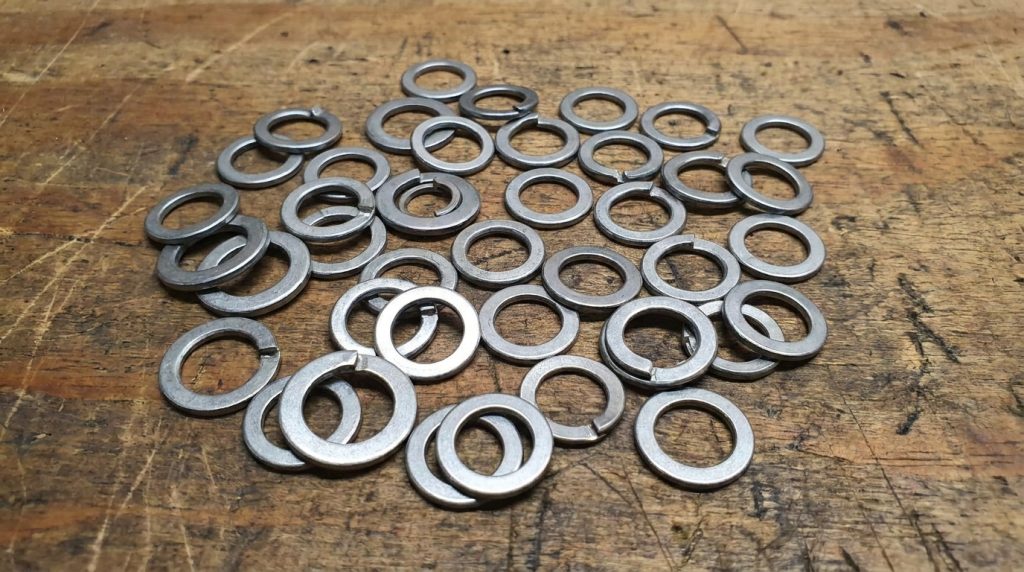
Split lock washers, also called helical spring lock washers, are among the most recognizable types. They look like a ring that has been cut and twisted into a slight spiral.
When tightened, the washer flattens and applies spring pressure against the nut or bolt head. The sharp split ends may also dig slightly into the mating surfaces.
Common uses include:
- General machinery
- Light structural assemblies
- HVAC equipment
- Electrical enclosures
- Furniture and fixtures
- Maintenance repairs
- Farm and shop equipment
Advantages:
- Low cost
- Easy to install
- Widely available
- Familiar to most technicians
- Available in many sizes and materials
Limitations:
- Limited effectiveness under severe vibration
- Can flatten and lose spring action
- May damage softer materials
- Not ideal for hardened surfaces where it cannot bite effectively
- Often unsuitable for critical joints unless specified by engineering standards
Split lock washers are still useful in many general-purpose applications, but they should not be assumed to solve all loosening problems.
Internal Tooth Lock Washers
Internal tooth lock washers have teeth around the inside diameter. These teeth grip the fastener shank or underside of the screw head or nut.
They are commonly used with smaller screws and applications where the outer edge of the washer should remain relatively smooth or hidden.
Common uses include:
- Electrical terminals
- Control panels
- Appliance assemblies
- Instrumentation
- Light sheet metal work
- Small machine screws
Advantages:
- Good grip on smaller fasteners
- More concealed than external tooth designs
- Useful for electrical contact
- Helps resist rotation in light-duty assemblies
Limitations:
- Can damage plating or coatings
- Less effective on hard surfaces
- Not suitable for heavy structural loading
- May lose effectiveness after reuse
Internal tooth lock washers are often chosen where appearance, compactness, or electrical contact is important.
External Tooth Lock Washers
External tooth lock washers have teeth around the outside diameter. Because the teeth are farther from the center, they can provide good resistance to rotation.
Common uses include:
- Electrical grounding
- Sheet metal assemblies
- Automotive trim and brackets
- Light industrial equipment
- Control box hardware
- Small motors and pumps
Advantages:
- Strong biting action
- Good resistance to loosening in light and medium applications
- Useful where electrical continuity is needed
- Effective under larger screw heads or nuts
Limitations:
- Teeth can scratch or gouge surfaces
- Not ideal for painted or finished materials
- Can accelerate corrosion if coatings are broken
- Not recommended for high-load structural joints unless specified
External tooth washers are popular in maintenance and manufacturing environments where secure electrical or mechanical contact is needed.
Internal-External Tooth Lock Washers
Internal-external tooth lock washers combine teeth on both the inner and outer diameters. This design increases the number of contact points and improves gripping action.
Common uses include:
- Electrical bonding
- Grounding connections
- Appliance manufacturing
- Instrument panels
- Light-duty mechanical assemblies
Advantages:
- Grip both fastener and surface
- Good electrical contact
- Improved resistance compared to single-tooth styles
- Useful in compact assemblies
Limitations:
- Surface damage is likely
- Not ideal for soft materials
- Not intended for heavy dynamic loads
- May not be reusable
These washers are helpful where reliable electrical conductivity and anti-rotation support are both required.
Star Lock Washers
The term “star lock washer” is often used to describe internal, external, or internal-external tooth washers. The teeth create a star-like appearance. In purchasing and maintenance catalogs, star lock washers may be listed separately or grouped under tooth lock washers.
When ordering, it is best to specify:
- Internal tooth
- External tooth
- Internal-external tooth
- Material
- Finish
- Fastener size
- Applicable standard, if required
This avoids confusion and helps ensure compatibility with the assembly.
For more articles on industrial supply, visit https://cemindustrialsupply.com/news/ for the latest updates.
Specialty Lock Washers and Advanced Designs
Some applications require more than basic spring or tooth action. Specialty lock washers are designed for demanding environments, controlled preload, or specific installation constraints.
Wedge Lock Washers
Wedge lock washers are typically supplied as a matched pair. The outside faces have serrations that grip the bolt head or nut and the joint surface. The inside faces have cams with a wedge angle greater than the thread pitch angle.
When the fastener tries to loosen, the washer pair expands slightly due to the cam geometry. This increases tension in the joint and helps prevent rotation.
Common uses include:
- Heavy equipment
- Mining machinery
- Rail systems
- Wind turbines
- Bridge and infrastructure components
- Industrial pumps and compressors
- Vibrating conveyors and screens
- Off-road vehicles
Advantages:
- Excellent vibration resistance when properly installed
- Reusable in some applications if not damaged
- Works with lubricated fasteners
- Suitable for high-load joints
- Available in stainless steel and coated versions
Limitations:
- Higher cost than standard lock washers
- Requires correct orientation and pair installation
- Serrations can mark mating surfaces
- May require hardened mating surfaces for best performance
- Must be selected to match fastener grade and application conditions
For severe vibration, wedge lock washers are often a better choice than split lock washers. Buyers should confirm compatibility with torque specifications, surface hardness, and environmental exposure.
Belleville Washers
Belleville washers, also called conical spring washers or disc springs, are cone-shaped washers that provide controlled spring force. They are not always categorized as lock washers, but they are commonly used to maintain preload in bolted joints.
Common uses include:
- Flange assemblies
- Thermal cycling applications
- Electrical bus bars
- Heavy machinery
- Clamping systems
- Bearing preload applications
- Expansion joints
Advantages:
- Maintains tension under load changes
- Useful where thermal expansion occurs
- Can be stacked for specific spring characteristics
- Helps compensate for joint relaxation
- Available in engineered sizes and materials
Limitations:
- Requires proper orientation
- Must be selected based on load and deflection requirements
- Not primarily a tooth-style anti-rotation device
- Incorrect stacking can cause assembly failure
Belleville washers are valuable where maintaining clamp load is more important than simply adding friction.
Wave Washers
Wave washers have a wavy profile and provide light spring force in compact spaces. They are typically used to take up play, reduce rattling, or apply light preload.
Common uses include:
- Bearings
- Electric motors
- Small mechanical assemblies
- Gearboxes
- Instrumentation
- Retaining ring assemblies
Advantages:
- Compact spring action
- Useful for light preload
- Helps reduce vibration noise
- Fits in limited axial space
Limitations:
- Not designed for heavy bolt locking
- Limited load capacity
- Can flatten under excessive compression
- Requires correct sizing
Wave washers are best considered preload or spacing components rather than primary locking devices for high-load bolted joints.
Serrated Conical Washers
Serrated conical washers combine a conical spring shape with serrations that bite into the mating surfaces. They provide both spring tension and friction.
Common uses include:
- Automotive assemblies
- Sheet metal fastening
- Industrial equipment panels
- Brackets and guards
- Medium-duty machinery
Advantages:
- Better load distribution than some toothed washers
- Adds spring force and surface grip
- Compact profile
- Effective in many production assemblies
Limitations:
- Can damage coatings
- Not ideal for soft materials
- Requires proper orientation
- May not perform well if reused after deformation
These washers are often used in OEM manufacturing where repeatable assembly and vibration resistance are important.
Tab Washers
Tab washers use one or more tabs that bend against a nut, bolt head, or adjacent part to physically prevent rotation. They are common in applications where a positive locking method is required.
Common uses include:
- Bearings and shafts
- Gearboxes
- Axle nuts
- Heavy machinery
- Rotating equipment
- Aerospace and marine applications where specified
Advantages:
- Positive mechanical locking
- Good for applications with rotation or vibration
- Visual confirmation of installation
- Can lock against a fixed feature
Limitations:
- Usually single-use
- Requires bending during installation
- Needs compatible geometry
- Slower to install than standard washers
Tab washers are effective but must be matched carefully to the shaft, nut, keyway, or locking feature.
For those interested in understanding the various fastening solutions available, a related article on the importance of selecting the right fasteners can provide valuable insights. This resource delves into different types of fasteners and their applications, complementing the information found in Lock Washers Explained: Types and Applications. You can explore this further by visiting this link to enhance your knowledge on the subject.
Lock Washer Materials and Finishes
Material selection affects strength, corrosion resistance, temperature performance, electrical conductivity, and cost. Industrial buyers should avoid choosing lock washers based only on size and price.
Carbon Steel Lock Washers
Carbon steel is common for general-purpose lock washers. It offers good strength and affordability.
Best for:
- Indoor equipment
- General repairs
- Machinery
- Non-corrosive environments
- Construction hardware
Carbon steel lock washers are often zinc-plated or mechanically galvanized for corrosion protection.
Stainless Steel Lock Washers
Stainless steel lock washers are used where corrosion resistance is important. Common grades include 18-8 stainless steel, 304 stainless steel, and 316 stainless steel.
Best for:
- Outdoor equipment
- Food processing
- Marine environments
- Chemical plants
- Washdown areas
- HVAC and plumbing systems
316 stainless steel generally offers better corrosion resistance than 304 stainless steel in chloride-rich environments, such as coastal or marine applications.
Alloy Steel Lock Washers
Alloy steel lock washers are used for high-strength applications, especially with high-grade fasteners. They may be heat-treated and coated for durability.
Best for:
- Heavy machinery
- Structural equipment
- High-load joints
- Mining and construction equipment
- Industrial production lines
When using high-strength bolts, confirm that the washer hardness and strength are compatible with the fastener grade.
Bronze, Brass, and Non-Ferrous Lock Washers
Bronze and brass lock washers are selected for electrical conductivity, corrosion resistance, or non-magnetic properties.
Best for:
- Electrical connections
- Marine hardware
- Instrumentation
- Non-sparking applications where specified
- Corrosion-sensitive assemblies
Non-ferrous materials are typically softer than steel, so load requirements must be reviewed carefully.
Common Coatings and Platings
Lock washer finishes may include:
- Zinc plating
- Black oxide
- Phosphate
- Mechanical galvanizing
- Hot-dip galvanizing
- Nickel plating
- Cadmium alternatives
- PTFE or specialty coatings
- Zinc flake coatings
Coatings can affect friction, torque-tension relationship, corrosion resistance, and compatibility with other materials. If torque accuracy matters, verify whether the coating changes the recommended tightening torque.
Lock Washer Applications by Industry
Lock washers are used across many trades and industrial sectors. The right type depends on the application’s vibration level, environmental exposure, safety requirements, and maintenance cycle.
Construction and Structural Maintenance
Contractors often use lock washers in equipment supports, metal framing, handrails, brackets, access panels, rooftop units, and utility installations.
Practical example:
A contractor installing rooftop HVAC curb accessories may use stainless steel lock washers with stainless bolts to reduce corrosion risk in outdoor exposure. For structural steel connections, however, the contractor should follow project specifications and applicable codes rather than substituting lock washers without approval.
Industrial Machinery and Plant Maintenance
Maintenance professionals use lock washers on guards, brackets, motor mounts, conveyor components, pumps, gear reducers, and production equipment.
Practical example:
A conveyor guard that vibrates loose may be corrected with a serrated conical washer or a wedge lock washer, depending on the severity of vibration and the required service access. If the joint loosens repeatedly, technicians should also inspect for worn holes, improper torque, missing flat washers, or misalignment.
Automotive and Heavy Equipment
Mechanics commonly encounter lock washers on brackets, accessory mounts, exhaust components, chassis hardware, and older vehicle assemblies. Modern automotive designs may use prevailing torque nuts, flange bolts, thread-locking compounds, or engineered washer systems instead.
Practical example:
On off-road equipment, a simple split lock washer may not provide enough resistance for a bracket exposed to constant shock loading. A flanged fastener with serrations, a wedge lock washer, or a thread-locking compound may be more appropriate if allowed by the equipment manufacturer.
Electrical and Grounding Applications
Toothed lock washers are widely used in electrical work because their teeth can bite through light oxidation or coatings to improve metal-to-metal contact.
Practical example:
A maintenance electrician installing a grounding lug may use an external tooth lock washer where specified to improve bonding. However, paint removal, correct torque, and code-compliant installation are still essential. A lock washer alone does not guarantee a reliable ground.
Manufacturing and OEM Assembly
Manufacturers use lock washers to improve assembly consistency, reduce warranty issues, and speed production. Selection often depends on automated installation, torque control, cost targets, and performance testing.
Practical example:
An OEM building small motor assemblies may choose external tooth lock washers for speed and grip. A manufacturer producing vibration-heavy industrial pumps may specify wedge lock washers or engineered fastener systems after validation testing.
Plumbing, HVAC, and Facility Maintenance
Lock washers appear in pipe supports, equipment bases, flange accessories, fan housings, compressor mounts, and service panels.
Practical example:
A facility technician replacing corroded outdoor fasteners on an air handling unit should choose compatible stainless steel hardware, not mix dissimilar metals without considering galvanic corrosion, and avoid over-tightening sheet metal screws.
How to Choose the Right Lock Washer
Choosing the correct lock washer requires more than matching the bolt diameter. Use the following factors to guide selection.
Evaluate the Vibration Level
For low-vibration applications, a split lock washer or tooth lock washer may be sufficient. For high-vibration equipment, consider wedge lock washers, prevailing torque nuts, thread-locking compounds, safety wire, or engineered locking fasteners.
Low vibration examples:
- Access panels
- Light brackets
- Enclosures
- Furniture
- Indoor equipment
High vibration examples:
- Crushers
- Screens
- Compressors
- Engines
- Rail equipment
- Heavy machinery
- Wind turbines
- Off-road vehicles
Match the Washer to the Fastener Grade
High-strength bolts need washers that can withstand the same loading environment. A soft washer under a hardened bolt can deform, embed, or lose effectiveness.
Check:
- Bolt grade or property class
- Washer hardness
- Nut grade
- Mating material
- Torque specification
- Applicable standard
For critical assemblies, follow engineering drawings, OEM manuals, or industry standards.
Consider the Joint Material
The washer must be compatible with the material being clamped.
| Joint Material | Washer Consideration |
|---|---|
| Steel | Most washer types are suitable when the washer hardness and protective coating are compatible with the fastener |
| Stainless steel | Use compatible stainless steel washers to minimize the risk of galvanic corrosion |
| Aluminum | Avoid aggressive toothed washers unless surface damage is acceptable |
| Plastic or composite | Lock washers may embed or crack the material; consider inserts or specialty fastening solutions |
| Painted steel | Toothed washers can break the protective coating and may increase the risk of corrosion |
| Soft metals | Use washers with a larger bearing surface and avoid excessive biting action to reduce material damage |
Account for Corrosion and Environment
Environmental exposure affects washer life. Outdoor, marine, chemical, and washdown areas require corrosion-resistant materials and coatings.
Consider:
- Moisture exposure
- Salt spray
- Chemicals
- Temperature
- UV exposure
- Galvanic compatibility
- Cleaning agents
- Food-grade or sanitary requirements
For outdoor structural or mechanical work, stainless steel, hot-dip galvanized, or zinc flake coated washers may be better choices than plain carbon steel.
Check Reusability Requirements
Some lock washers are intended for one-time use. Split lock washers, tooth lock washers, and tab washers may lose effectiveness after removal. Wedge lock washers may be reusable if they are not worn or damaged, but this depends on manufacturer guidance and inspection.
Do not reuse lock washers that are:
- Flattened
- Cracked
- Corroded
- Missing teeth
- Deformed
- Worn smooth
- Contaminated with debris
- Installed in safety-critical joints without approval
Review Torque Requirements
Lock washers can influence torque readings because they change friction under the fastener head or nut. If a torque specification is provided, use the washer type and lubrication condition specified by the manufacturer.
Never assume that adding a lock washer improves a joint if the original torque specification was developed without one.
Lock Washer Installation Best Practices
Correct installation is just as important as selecting the right washer.
Install in the Correct Location
A lock washer is usually placed under the rotating component, typically the nut or bolt head that is turned during tightening. In many assemblies, it is installed between the nut and the joint surface or between the bolt head and the joint surface.
If a flat washer is also used, the order depends on the application. A common arrangement is:
- Bolt head
- Flat washer, if needed
- Joint material
- Flat washer, if needed
- Lock washer
- Nut
However, this is not universal. Some locking washers need direct contact with the fastener and mating surface to work properly. Always follow product instructions or equipment specifications.
Use the Correct Orientation
Some washers are directional.
Examples include:
- Belleville washers
- Serrated conical washers
- Wedge lock washer pairs
- Tab washers
- Some specialty tension washers
Incorrect orientation can reduce locking performance or damage the joint.
Tighten to Proper Torque
Under-tightening is one of the most common causes of fastener loosening. Over-tightening can yield the bolt, crush the washer, strip threads, or damage the joint.
Use:
- Calibrated torque tools
- OEM torque specifications
- Correct lubrication condition
- Proper thread engagement
- Clean threads
- Compatible fastener grades
For production work, consider torque audits or joint testing to confirm repeatability.
Inspect the Mating Surfaces
Before installing lock washers, check for:
- Paint buildup
- Rust
- Oil or grease
- Burrs
- Damaged holes
- Oversized holes
- Soft or crushed material
- Misalignment
- Old washer marks
A lock washer cannot perform correctly if the joint surfaces are unstable or contaminated.
Avoid Stacking Lock Washers
Stacking multiple lock washers is usually not recommended unless specifically engineered. Stacking can create unpredictable compression, uneven loading, and poor torque control.
If one lock washer is not solving the loosening issue, investigate the root cause and consider a more appropriate locking method.
When Lock Washers Are Not the Best Choice
Lock washers are useful, but they are not a universal solution. In some cases, other fastener locking methods are more reliable.
High-Vibration Critical Joints
For severe vibration, impact, or safety-critical equipment, standard split lock washers may not be enough. Consider:
- Wedge lock washers
- Prevailing torque lock nuts
- All-metal lock nuts
- Nylon insert lock nuts, where temperature allows
- Thread-locking adhesives
- Safety wire
- Castle nuts with cotter pins
- Double-nut arrangements
- Flanged serrated fasteners
- Direct tension indicators where applicable
Soft or Fragile Materials
Lock washers with teeth or sharp edges can damage aluminum, plastic, composites, brass, or thin sheet metal. In these cases, a larger flat washer, shoulder washer, threaded insert, or specialty fastener may be a better choice.
Sealed, Painted, or Coated Surfaces
Toothed lock washers may break protective coatings and create corrosion points. This can be a problem in outdoor, marine, food processing, or chemical environments.
If corrosion protection is critical, consider sealing washers, compatible coatings, stainless hardware, or non-damaging locking methods.
Precision Assemblies
In precision machinery, a washer that embeds, shifts, or changes preload can affect alignment. For precision joints, follow the engineering specification exactly and use controlled preload methods.
Lock Washer Standards, Sizing, and Purchasing Tips
Industrial buyers and maintenance teams should standardize lock washer selection where possible. This reduces inventory confusion and improves installation consistency.
Common Sizing Considerations
When buying lock washers, confirm:
- Nominal bolt or screw size
- Inside diameter
- Outside diameter
- Thickness
- Material
- Finish
- Hardness
- Washer type
- Standard or specification
- Package quantity
- Compatibility with fastener grade
Common inch sizes include #4, #6, #8, #10, 1/4 inch, 5/16 inch, 3/8 inch, 1/2 inch, 5/8 inch, 3/4 inch, and larger industrial sizes. Metric lock washers are commonly sized for M3, M4, M5, M6, M8, M10, M12, M16, and beyond.
Questions to Ask Before Ordering
Before purchasing lock washers for production or maintenance, ask:
- What type of loosening are we trying to prevent?
- Is the joint exposed to vibration or impact?
- Is the application indoors, outdoors, marine, or chemical?
- What is the fastener material and grade?
- Is electrical conductivity required?
- Will the washer damage the surface?
- Is the joint safety-critical?
- Is reuse expected during maintenance?
- Does the OEM manual specify a washer type?
- Are there torque requirements affected by washer selection?
Bulk Purchasing and Inventory Control
For contractors and industrial buyers, standardizing washer inventory can reduce downtime and purchasing errors.
Useful inventory practices include:
- Label bins by size, type, and material
- Separate stainless steel and carbon steel hardware
- Store coated washers in dry areas
- Avoid mixing inch and metric sizes
- Keep specialty lock washers in original packaging
- Track lot numbers for critical applications
- Train technicians on washer identification
For related purchasing guides, consider linking internally to resources such as:
- [Flat Washers vs. Lock Washers: What’s the Difference?]()
- [How to Choose the Right Bolt Grade for Industrial Applications]()
- [Stainless Steel Fasteners for Outdoor and Marine Use]()
- [Thread Lockers vs. Lock Nuts: Which Is Better?]()
- [Fastener Torque Charts and Installation Best Practices]()
Lock Washer Comparison Table
The table below provides a quick reference for common lock washer types and applications.
| Lock Washer Type | How It Works | Best Applications | Key Limitations |
|---|---|---|---|
| Split lock washer | Uses spring tension and edge bite to help resist loosening | General-purpose fastening, light machinery, and brackets | Limited effectiveness under severe vibration; can flatten over time |
| Internal tooth washer | Teeth grip near the center of the fastener | Small screws, electrical terminals, and compact assemblies | Can damage mating surfaces; best for light-duty applications |
| External tooth washer | Teeth bite around the outer diameter for increased grip | Grounding connections, sheet metal, panels, and light equipment | May scratch protective coatings; not intended for heavy loads |
| Internal-external tooth washer | Teeth grip both the fastener and the mating surface | Electrical bonding, appliances, and light industrial assemblies | Can damage surfaces and is generally not recommended for repeated reuse |
| Wedge lock washer | Cam-wedge design maintains clamp load and resists loosening under vibration | High-vibration machinery, heavy equipment, and structural applications | Higher cost and requires proper installation |
| Belleville washer | Conical spring design maintains preload during movement or thermal expansion | Thermal cycling, flanges, and precision clamping systems | Must be selected based on the required load and deflection |
| Wave washer | Provides light spring preload in compact spaces | Bearings, electric motors, and compact mechanical assemblies | Not intended for heavy bolt-locking applications |
| Serrated conical washer | Combines spring force with serrated gripping surfaces | Automotive components, brackets, and medium-duty assemblies | May damage coatings; proper orientation is important |
| Tab washer | Bent tab physically prevents fastener rotation | Shafts, bearings, locknuts, and gearboxes | Typically single-use and slower to install than other locking methods |
Common Lock Washer Mistakes to Avoid
Even experienced professionals can run into problems when lock washers are used incorrectly.
Using a Lock Washer Instead of Proper Torque
A lock washer does not replace correct torque. If the fastener is not tightened enough to create proper clamp load, the joint can still loosen.
Reusing Damaged Washers
Flattened split washers, worn serrations, broken teeth, and bent tab washers should be replaced. Reusing damaged washers can create a false sense of security.
Mixing Incompatible Materials
Using plain steel washers with stainless fasteners in a wet environment can cause rust staining and corrosion. Mixing dissimilar metals without considering galvanic corrosion can reduce service life.
Ignoring Surface Hardness
A tooth washer may not bite into very hard surfaces. A soft washer may deform under a high-strength bolt. Both problems can reduce locking performance.
Adding Lock Washers to Engineered Joints Without Approval
Some assemblies are designed with specific fasteners, washers, lubricants, and torque values. Adding a lock washer can change clamp load or interfere with the design. Always follow OEM instructions for critical equipment.
Practical Selection Examples
Example 1: Light-Duty Electrical Panel
A technician needs to secure a grounding screw inside a control enclosure.
Recommended option: External tooth or internal tooth lock washer, if specified for bonding.
Why: The teeth help maintain metal-to-metal contact and resist loosening under minor vibration.
Check: Remove paint where required, tighten properly, and follow electrical code and panel manufacturer instructions.
Example 2: Outdoor Pump Base
A maintenance crew is fastening a pump guard in a damp outdoor environment.
Recommended option: Stainless steel serrated conical washer or stainless split lock washer for light-duty fastening, depending on vibration level.
Why: Stainless steel improves corrosion resistance, and the locking feature helps resist loosening.
Check: If the pump vibration is significant, evaluate wedge lock washers or another higher-performance locking method.
Example 3: Vibrating Screen in an Aggregate Plant
A contractor is replacing hardware on a vibrating screen guard.
Recommended option: Wedge lock washers or manufacturer-specified vibration-resistant fasteners.
Why: Standard split lock washers may not provide enough resistance in severe vibration.
Check: Inspect holes for elongation, use correct bolt grade, and torque to specification.
Example 4: Aluminum Machine Cover
An OEM is fastening an aluminum cover plate that must be removed for service.
Recommended option: Flanged fastener, flat washer with thread-locking patch, or low-profile locking feature approved by engineering.
Why: Aggressive tooth washers may gouge aluminum and create wear over repeated service cycles.
Check: Confirm torque limits to avoid stripping threads or crushing the cover.
Frequently Asked Questions About Lock Washers
Are Split Lock Washers Still Useful?
Yes, split lock washers can still be useful in general-purpose and light-duty applications. However, they are not the best choice for every joint, especially where severe vibration, impact loading, or critical safety requirements exist.
Which Side of a Lock Washer Faces the Nut?
For standard split lock washers, orientation usually is not critical in the way it is for conical or wedge designs. The washer is commonly placed under the nut or bolt head being tightened. For toothed, conical, wedge, or specialty washers, follow manufacturer instructions.
Can You Use a Lock Washer With a Flat Washer?
Yes, in some applications. However, toothed or serrated lock washers often need direct contact with the fastener and joint surface to grip properly. Adding a flat washer in the wrong location can reduce locking effectiveness.
Are Lock Washers Reusable?
Some may be reusable in non-critical applications if undamaged, but many should be replaced after removal. Tooth washers, tab washers, and flattened split washers are commonly treated as single-use components. For critical equipment, follow OEM or engineering guidance.
What Is the Best Lock Washer for Vibration?
For high-vibration applications, wedge lock washers generally provide better vibration resistance than standard split or tooth lock washers when properly selected and installed. Other options include prevailing torque nuts, thread-locking compounds, and safety locking methods depending on the joint.
Do Lock Washers Prevent Bolts From Loosening Completely?
They can help reduce loosening, but no washer can overcome poor installation, incorrect torque, damaged threads, weak joint design, or excessive dynamic loading. The best results come from matching the locking method to the application.
Conclusion: Choose Lock Washers Based on the Joint, Not Habit
Lock washers are simple components, but choosing the right one requires careful attention to vibration, load, material, corrosion exposure, torque requirements, and service conditions. A split lock washer may be adequate for a light bracket, while a wedge lock washer may be necessary for vibrating industrial equipment. Tooth lock washers can be useful for electrical bonding, but they may damage painted or soft surfaces. Belleville washers can help maintain preload under thermal cycling, but they must be selected based on load and deflection.
For contractors, maintenance professionals, mechanics, manufacturers, and industrial buyers, the best approach is to treat lock washers as part of the entire bolted joint system. Review the application, follow OEM specifications, use compatible materials, and replace damaged washers during service.
If you are sourcing lock washers for maintenance inventory, production assembly, or a demanding industrial project, compare the washer type, material, finish, and performance requirements before ordering. For help selecting compatible fasteners, washers, nuts, and vibration-resistant hardware, connect with a knowledgeable fastener supplier or review related guides on bolt grades, washer materials, thread lockers, and torque best practices.