
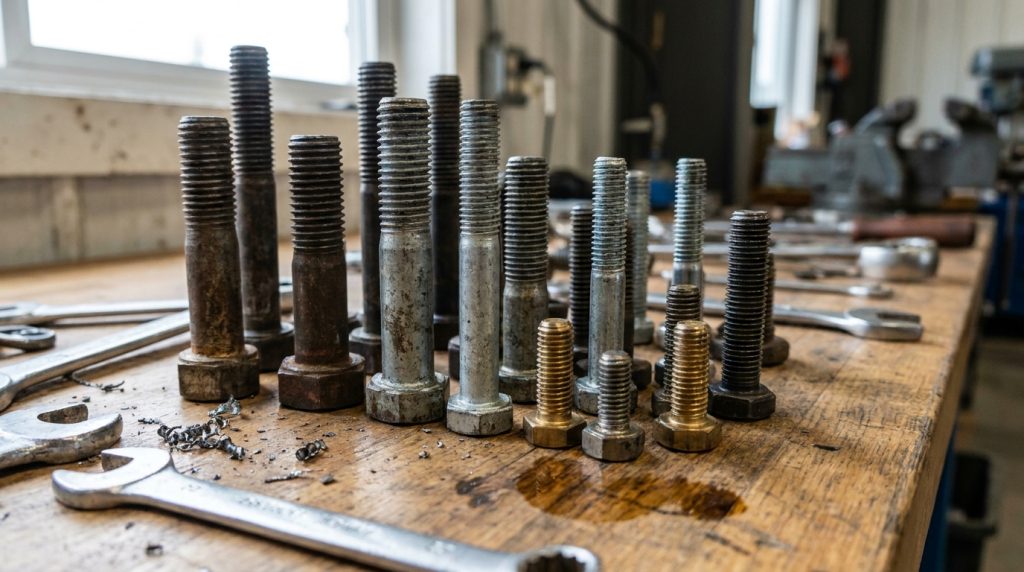
Choosing between Grade 5 and Grade 8 bolts is not just a matter of “stronger is better.” For contractors, mechanics, maintenance teams, manufacturers, and industrial buyers, the right fastener affects joint reliability, safety, service life, maintenance cost, and equipment uptime.
Grade 5 and Grade 8 bolts are both commonly used inch-series fasteners made to SAE J429 mechanical property requirements. They look similar at first glance, but they differ significantly in strength, hardness, ductility, typical applications, and cost.
In simple terms:
- Grade 5 bolts are medium-strength, heat-treated carbon steel bolts commonly used in automotive, agricultural, structural, and general equipment applications.
- Grade 8 bolts are high-strength, heat-treated alloy steel bolts designed for higher clamp loads, higher tensile strength, and more demanding mechanical applications.
The best choice depends on load requirements, joint design, vibration, shock loading, mating materials, installation method, environmental exposure, and the specifications required by the equipment or project.
When exploring the differences between Grade 5 and Grade 8 bolts, it’s essential to consider their applications and strengths in various projects. For instance, if you’re dealing with machinery that may experience oil leaks, understanding the right fasteners to use can be crucial for maintaining structural integrity. You can read more about this topic in the article on gearbox oil leaks and their causes, which discusses whether such issues are urgent and how they relate to the overall performance of mechanical systems. For more information, visit this article.
What Are Grade 5 Bolts?
Grade 5 bolts are medium-strength fasteners made from quenched and tempered medium carbon steel. They are one of the most widely used bolt grades in North America because they provide a strong balance of strength, ductility, availability, and cost.
Grade 5 Bolt Strength
Grade 5 bolts are manufactured to SAE J429 requirements. For common diameters from 1/4 inch through 1 inch, Grade 5 bolts typically have:
| Property | Grade 5 Bolt |
|---|---|
| Minimum tensile strength | 120,000 psi |
| Minimum yield strength | 92,000 psi |
| Core hardness | Rockwell C25–C34 |
| Typical material | Quenched and tempered medium-carbon steel |
| Head marking | Three radial lines |
For larger diameters, strength values may vary based on the specific SAE J429 size range, so always check the manufacturer’s data sheet or applicable standard.
How to Identify a Grade 5 Bolt
Grade 5 bolts are usually identified by three radial lines on the bolt head. These lines are spaced evenly around the head.
If a bolt has no head markings, do not assume it is Grade 5. Unmarked bolts are typically lower strength and should not be used in critical load-bearing applications unless documentation confirms their properties.
Common Uses for Grade 5 Bolts
Grade 5 bolts are used in many everyday industrial and mechanical applications, including:
- Automotive frames, brackets, and non-critical suspension components
- Agricultural equipment
- Light to medium construction equipment
- Machinery guards and mounts
- General manufacturing assemblies
- Maintenance and repair work
- Wood-to-steel and steel-to-steel connections where specified
- Shop-built fixtures and equipment stands
Grade 5 bolts are a practical choice when the joint needs dependable strength but does not require the maximum clamp load or tensile capacity of a Grade 8 fastener.
What Are Grade 8 Bolts?
Grade 8 bolts are high-strength fasteners made from quenched and tempered alloy steel. They are designed for applications requiring greater tensile strength, higher preload capability, and improved resistance to certain high-load conditions.
Grade 8 Bolt Strength
Grade 8 bolts are also covered by SAE J429. For common diameters from 1/4 inch through 1-1/2 inches, Grade 8 bolts typically have:
| Property | Grade 8 Bolt |
|---|---|
| Minimum tensile strength | 150,000 psi |
| Minimum yield strength | 130,000 psi |
| Core hardness | Rockwell C33–C39 |
| Typical material | Quenched and tempered medium-carbon alloy steel |
| Head marking | Six radial lines |
Grade 8 bolts provide significantly higher tensile and yield strength than Grade 5 bolts. That added strength can be valuable in properly designed high-load joints, but it also means the bolt is harder and generally less ductile than a Grade 5 bolt.
How to Identify a Grade 8 Bolt
Grade 8 bolts have six radial lines on the head. This is the easiest visual way to distinguish them from Grade 5 bolts.
Many Grade 8 bolts also have a yellow zinc or zinc chromate finish, but color is not a reliable grade identifier. Finishes vary by manufacturer, coating specification, and corrosion-protection requirement. Always rely on head markings and documentation.
Common Uses for Grade 8 Bolts
Grade 8 bolts are commonly used in:
- Heavy equipment
- Truck and trailer assemblies
- High-load automotive and motorsports applications
- Industrial machinery
- Mining and aggregate equipment
- Power transmission equipment
- High-strength clamping applications
- Critical maintenance repairs where OEM specifications call for Grade 8
- Manufacturing assemblies with engineered preload requirements
A Grade 8 bolt is often selected where the joint must maintain higher clamping force, resist separation, or handle substantial tensile loading. However, it should not be substituted blindly into every Grade 5 application.
For more articles on industrial supply, visit https://cemindustrialsupply.com/news/ for the latest updates.
Grade 5 vs Grade 8 Bolts: Key Differences
The main difference between Grade 5 and Grade 8 bolts is mechanical strength. Grade 8 bolts have higher tensile strength, higher yield strength, and higher hardness. Grade 5 bolts offer moderate strength with greater ductility in many applications.
Strength Comparison
| Feature | Grade 5 Bolt | Grade 8 Bolt |
|---|---|---|
| SAE Standard | SAE J429 | SAE J429 |
| Minimum Tensile Strength | 120,000 psi | 150,000 psi |
| Minimum Yield Strength | 92,000 psi | 130,000 psi |
| Head Marking | Three radial lines | Six radial lines |
| Material | Quenched and tempered medium-carbon steel | Quenched and tempered medium-carbon alloy steel |
| Heat Treatment | Quenched and tempered | Quenched and tempered |
| Relative Hardness | Medium | Higher |
| Relative Ductility | Higher than Grade 8 | Lower than Grade 5 |
| Typical Cost | Lower | Higher |
| Common Use | General mechanical fastening, automotive, industrial equipment, and machinery | High-strength mechanical fastening, heavy equipment, structural machinery, and demanding industrial applications |
Tensile Strength
Tensile strength is the maximum stress a bolt can withstand while being pulled before it fractures. Grade 8 bolts have higher tensile strength than Grade 5 bolts, making them suitable for higher tensile-load applications.
For example, a properly specified Grade 8 bolt may be used in a heavy equipment linkage where high clamping force and tensile capacity are required. A Grade 5 bolt may be more appropriate for a general bracket or frame-mounted accessory where the load is moderate and the assembly benefits from a little more ductility.
Yield Strength
Yield strength is the stress level where the bolt begins to deform permanently. This is especially important in bolted joints because bolts are often tightened to create preload.
A Grade 8 bolt has a higher yield strength, meaning it can generally be tightened to a higher preload before permanent deformation begins. This helps in joints that must resist slipping, separation, or vibration when designed correctly.
Hardness and Ductility
Grade 8 bolts are harder than Grade 5 bolts. Higher hardness contributes to strength but can reduce ductility.
Ductility is the ability of a material to deform before breaking. In some applications, a more ductile fastener may provide more visible warning before failure. A harder, higher-strength bolt may fail with less elongation if overloaded, depending on the specific loading condition and joint design.
This does not mean Grade 8 bolts are “brittle” when properly manufactured to specification. It means they are less ductile than Grade 5 bolts and should be used where the joint is designed for their strength and installation requirements.
Cost and Availability
Grade 5 bolts are usually less expensive than Grade 8 bolts. They are widely available in hardware stores, contractor supply houses, maintenance shops, and industrial fastener distributors.
Grade 8 bolts are also widely available, but they generally cost more due to alloy steel material, higher strength requirements, and heat treatment. For purchasing departments and industrial buyers, the cost difference can be significant when ordering high volumes.
When exploring the differences between Grade 5 and Grade 8 bolts, it’s also beneficial to understand the tools that are commonly used with these fasteners. For instance, knowing the right types of pliers can significantly enhance your efficiency in various projects. If you’re interested in learning more about the different types of pliers and their uses, you can check out this informative article on pliers. Understanding both the bolts and the tools can help you make more informed decisions in your work.
When to Use Grade 5 Bolts
Grade 5 bolts are a dependable choice for many medium-duty applications. They are often the right fastener when the design does not require the higher strength of Grade 8 and when some ductility is beneficial.
Best Applications for Grade 5 Bolts
Use Grade 5 bolts when:
- The equipment manual or engineering drawing specifies Grade 5
- The assembly experiences moderate loads
- The joint does not require high preload
- The mating materials are not strong enough to benefit from Grade 8
- Cost control is important for non-critical applications
- The bolt is used in general repair, fabrication, or maintenance
- A balance of strength and toughness is desired
Common examples include:
- Mounting a steel bracket to a machine frame
- Securing guards, covers, and access panels
- Fastening agricultural equipment components
- Assembling shop fixtures
- Installing medium-duty trailer accessories
- Repairing non-critical vehicle mounts
Advantages of Grade 5 Bolts
Grade 5 bolts offer several practical benefits:
- Good strength for general industrial use
- Better ductility than Grade 8 in many situations
- Lower cost than Grade 8
- Easy availability
- Suitable for many mechanical and maintenance applications
- Less likely to damage softer mating materials when properly torqued
Limitations of Grade 5 Bolts
Grade 5 bolts may not be appropriate when:
- High preload is required
- The joint is exposed to severe vibration or shock loading
- OEM specifications call for Grade 8 or another high-strength fastener
- The bolt is part of a critical safety system
- The fastener must carry high tensile loads
- The application involves heavy equipment, cranes, lifting devices, or engineered structural connections without proper specification review
For critical work, do not select bolts based on appearance, availability, or habit. Use the grade specified by the drawing, equipment manufacturer, or qualified engineer.
When considering the differences between Grade 5 and Grade 8 bolts, it’s essential to understand their applications and strengths. For those interested in learning more about the importance of choosing the right components for mechanical projects, a related article discusses the decision-making process involved in motor repair, including when to rewind, repair, or replace. You can read more about it here. Understanding these factors can help ensure the durability and reliability of your projects.
When to Use Grade 8 Bolts
Grade 8 bolts are appropriate for high-strength fastening applications where the joint is designed to take advantage of their higher tensile and yield strength.
Best Applications for Grade 8 Bolts
Use Grade 8 bolts when:
- The OEM manual or engineering specification requires Grade 8
- The joint needs higher clamp load
- The application involves heavy machinery or high loads
- Vibration resistance depends on maintaining preload
- The mating components are strong enough for the higher fastener load
- The bolt is used in critical drivetrain, suspension, or equipment connections
- The assembly has been engineered for Grade 8 fasteners
Typical examples include:
- Heavy equipment repair
- Truck frame and suspension components where specified
- Industrial machinery mounting
- High-load flange joints
- Power transmission components
- Manufacturing equipment assemblies
- Severe-duty agricultural and construction equipment
Advantages of Grade 8 Bolts
Grade 8 bolts provide:
- Higher tensile strength than Grade 5
- Higher yield strength
- Higher allowable preload in properly designed joints
- Good performance in high-load mechanical assemblies
- Better resistance to joint separation when installed correctly
- Suitability for many OEM heavy-duty equipment applications
Limitations of Grade 8 Bolts
Grade 8 bolts are not always the best choice. Limitations include:
- Higher cost
- Lower ductility compared with Grade 5
- Greater risk of damaging softer threaded components if over-torqued
- More sensitivity to proper installation practices
- Not a substitute for correct joint design
- Potential coating and hydrogen embrittlement concerns for high-strength fasteners if improperly processed
For industrial buyers, it is important to source Grade 8 bolts from reputable suppliers that provide traceability, certifications, and coating information when required.
Is Grade 8 Always Better Than Grade 5?
No. Grade 8 is stronger, but it is not automatically better for every application.
Fastener selection is about matching the bolt to the joint. A stronger bolt can create problems if the surrounding materials, thread engagement, washers, nuts, or joint design are not compatible.
Why Stronger Is Not Always Better
A Grade 8 bolt can generate more clamping force than a Grade 5 bolt. If the connected material is soft, thin, cast, or threaded into aluminum or mild steel, excessive torque can strip threads, crush the joint, or distort parts.
For example:
- Installing a Grade 8 bolt into a soft aluminum housing may not improve the assembly if the internal threads fail first.
- Replacing a Grade 5 bolt with Grade 8 in a slotted bracket may not prevent movement if the joint surface, washer selection, or torque procedure is inadequate.
- Using Grade 8 bolts in a non-engineered repair may shift the failure point from the bolt to a more expensive component.
Follow OEM and Engineering Specifications
If you are repairing equipment, the safest and most reliable practice is to match the manufacturer’s specified bolt grade, size, thread pitch, length, washer type, nut grade, and torque.
For fabricated or custom assemblies, consult engineering guidance or recognized fastener standards. In high-risk applications such as lifting, rigging, fall protection, pressure systems, structural steel, or transportation safety components, bolt selection should be verified by a qualified professional.
Bolt Head Markings and Identification
Correct identification is essential for maintenance crews, field mechanics, quality inspectors, and purchasing teams.
SAE Bolt Grade Markings
| SAE Grade | Head Marking | Typical Strength Level |
|---|---|---|
| Grade 2 | No radial lines (or manufacturer identification only) | Low-strength, low-carbon steel for light-duty and general-purpose applications |
| Grade 5 | Three radial lines | Medium-strength fasteners for automotive, industrial machinery, and general mechanical applications |
| Grade 8 | Six radial lines | High-strength fasteners for heavy equipment, structural machinery, and other demanding mechanical applications |
The radial lines do not count as the manufacturer’s logo. A quality bolt may also include a manufacturer’s identification mark.
Do Not Confuse SAE and Metric Bolts
Grade 5 and Grade 8 are inch-series SAE bolt grades. Metric bolts use property classes such as:
| Metric Class | Approximate Use Category |
|---|---|
| Class 8.8 | Medium- to high-strength metric fasteners for general industrial, construction, automotive, and machinery applications |
| Class 10.9 | High-strength metric fasteners for heavy equipment, industrial machinery, and high-load mechanical assemblies |
| Class 12.9 | Very high-strength metric fasteners commonly used for socket head cap screws, tooling, molds, dies, and other precision high-load applications |
A metric Class 8.8 bolt is not the same as an SAE Grade 8 bolt. This is a common and costly mistake in mixed equipment fleets.
If the equipment uses metric fasteners, replace them with the correct metric property class, thread pitch, and length. Do not force inch fasteners into metric threaded holes.
Verify Unknown Bolts
If a bolt is unmarked, worn, corroded, or undocumented, do not use it in a critical assembly. Replace it with a properly marked and certified fastener.
Maintenance shops should keep Grade 5 and Grade 8 inventory separated and labeled to avoid mix-ups during repairs.
Torque, Clamp Load, and Installation Considerations
The performance of a bolted joint depends heavily on proper installation. Even the correct grade can fail if it is under-tightened, over-tightened, cross-threaded, contaminated, or paired with the wrong nut or washer.
Torque Is Not the Same as Strength
Torque is a twisting force used to tighten a bolt. Clamp load is the force that holds the joint together. Torque is only an indirect way to estimate clamp load.
Factors that affect clamp load include:
- Lubrication
- Coating type
- Thread condition
- Washer hardness
- Surface finish
- Nut grade
- Thread pitch
- Reuse of fasteners
- Accuracy of the torque wrench
A lubricated bolt can develop significantly more clamp load than a dry bolt at the same torque value. Always follow the specified torque condition, such as dry, oiled, zinc-plated, or anti-seize applied.
Use the Correct Nut Grade
A Grade 8 bolt should be paired with a compatible high-strength nut, commonly an SAE Grade 8 nut when specified. Pairing a high-strength bolt with a low-strength nut can strip the nut threads before the bolt reaches the intended preload.
Likewise, washers should be appropriate for the bolt grade. Soft washers can deform under high clamp loads, reducing joint reliability.
Thread Engagement Matters
As a general rule, proper thread engagement is necessary for full joint strength. Thread engagement requirements vary by material and application.
For steel nuts, full thread engagement is typically achieved when the bolt extends through the nut with at least one or more threads visible, depending on the specification. For tapped holes in softer materials, more engagement may be required.
Reusing Grade 5 and Grade 8 Bolts
Some bolts can be reused if they are undamaged and the application allows it. Others, especially torque-to-yield fasteners or critical OEM bolts, must be replaced after removal.
Do not reuse bolts that show:
- Necking or stretching
- Damaged threads
- Corrosion pitting
- Rounded heads
- Cracks
- Galling
- Heat damage
- Unknown service history in a critical application
When in doubt, replace the bolt with a new, properly specified fastener.
Corrosion Resistance and Coatings
Grade 5 and Grade 8 bolts are usually made from carbon or alloy steel, which can corrode if not protected. Coating selection matters in outdoor, wet, marine, chemical, agricultural, and industrial environments.
Common Bolt Coatings
| Coating or Finish | Typical Purpose | Notes |
|---|---|---|
| Plain Steel | Indoor or protected-service applications | Offers minimal corrosion resistance and is best used in dry environments or where a protective coating will be applied |
| Zinc Plated | General-purpose corrosion protection | Common for industrial equipment, machinery, maintenance, and light-duty outdoor applications |
| Yellow Zinc | General corrosion protection with easy visual identification | The yellow chromate finish does not indicate the fastener’s strength grade |
| Hot-Dip Galvanized | Long-term corrosion resistance in outdoor environments | Requires compatible galvanized hardware and often oversized nuts due to the thicker zinc coating |
| Black Oxide | Light corrosion protection with an attractive appearance | Typically requires oil or another sealant to provide meaningful corrosion resistance |
| Mechanical Galvanizing | Corrosion protection with reduced risk of hydrogen embrittlement | Commonly specified for high-strength fasteners used in structural, utility, and infrastructure applications |
Hydrogen Embrittlement Considerations
High-strength steel fasteners can be susceptible to hydrogen embrittlement if exposed to certain plating or cleaning processes without proper controls. This is more of a concern for higher-strength fasteners, including Grade 8.
For critical Grade 8 applications, especially plated fasteners, purchase from suppliers that follow recognized coating and baking procedures where applicable. Ask for certifications if the application is safety-critical or governed by quality requirements.
Stainless Steel Is Not a Direct Replacement
Stainless steel bolts offer corrosion resistance, but they are not direct strength equivalents to Grade 5 or Grade 8 bolts unless specifically engineered and documented.
Many common stainless bolts, such as 18-8 stainless, have lower tensile strength than Grade 5 or Grade 8 carbon/alloy steel bolts. Do not replace a Grade 8 bolt with stainless steel simply for corrosion resistance unless the stainless fastener meets the required mechanical properties.
Grade 5 vs Grade 8 Bolts in Real-World Applications
The right choice depends on the work environment and the consequences of failure.
Automotive and Fleet Maintenance
In automotive and truck repair, bolt grade matters because components are exposed to vibration, shock, cyclic loading, and temperature changes.
Grade 5 may be suitable for:
- Accessory brackets
- General mounts
- Light-duty frame attachments where specified
- Non-critical repairs
Grade 8 may be required for:
- Suspension components
- Steering-related components
- Drivetrain mounts
- Hitch and towing hardware where specified
- Heavy truck and trailer assemblies
Always follow the OEM service manual. Replacing factory bolts with “whatever fits” can create unsafe conditions.
Construction and Contractor Use
Contractors often use bolts for equipment repair, temporary fixtures, brackets, machinery bases, and structural attachments.
Grade 5 is commonly used for:
- General equipment repairs
- Brackets and supports
- Jobsite fabrication
- Non-engineered fastening where loads are moderate
Grade 8 may be used for:
- Heavy equipment repairs
- High-load mechanical connections
- Machinery anchoring components where specified
- Attachments subject to vibration and impact
For structural steel construction, ASTM fasteners such as A325 or A490 may be required instead of SAE Grade 5 or Grade 8. Do not substitute SAE bolts into structural steel connections unless approved by the project specification or engineer of record.
Manufacturing and Industrial Maintenance
Manufacturers and maintenance professionals need consistency, traceability, and repeatable joint performance.
Grade 5 may be appropriate for:
- Conveyor guards
- Equipment panels
- General machine assemblies
- Fixtures and jigs
Grade 8 may be appropriate for:
- Presses and heavy machinery
- Gearbox mounts
- Motor bases with high loads
- Power transmission assemblies
- High-vibration production equipment
For repeat maintenance tasks, standardize fastener kits by equipment model and document torque values, lubrication conditions, and replacement intervals.
Buying Tips for Industrial Buyers and Maintenance Teams
Purchasing the correct bolt grade is only part of the job. Buyers also need to manage quality, traceability, and inventory control.
What to Specify When Ordering
When ordering Grade 5 or Grade 8 bolts, specify:
- Grade: SAE Grade 5 or SAE Grade 8
- Diameter
- Thread pitch: coarse or fine
- Length
- Thread length or fully threaded requirement
- Head style, such as hex cap screw
- Finish or coating
- Nut and washer requirements
- Quantity
- Certification or traceability requirements
- Applicable standard, such as SAE J429
A clear purchase description reduces substitutions and receiving errors.
Example Purchase Description
A good industrial purchase description might read:
“Hex cap screw, SAE J429 Grade 8, 1/2-13 x 2 inches, zinc plated, partial thread, with compatible Grade 8 hex nut and hardened washer, certificate of conformance required.”
This is much clearer than “1/2-inch Grade 8 bolt.”
Inventory Management Best Practices
To prevent mix-ups:
- Store Grade 5 and Grade 8 bolts in separate labeled bins
- Keep metric and inch fasteners separate
- Label coarse and fine thread inventory clearly
- Do not mix unmarked bolts into graded fastener bins
- Train technicians to read head markings
- Use barcode or part-number control for critical fasteners
- Keep certifications for regulated or safety-critical work
Frequently Asked Questions About Grade 5 and Grade 8 Bolts
Are Grade 8 bolts stronger than Grade 5 bolts?
Yes. Grade 8 bolts have higher tensile and yield strength than Grade 5 bolts. A common Grade 8 bolt has a minimum tensile strength of 150,000 psi, while a common Grade 5 bolt has a minimum tensile strength of 120,000 psi.
Can I replace a Grade 5 bolt with a Grade 8 bolt?
Sometimes, but not automatically. A Grade 8 bolt may be acceptable if the joint, nut, washer, and mating materials can handle the higher clamp load. However, you should follow OEM or engineering specifications. In some cases, using a stronger bolt can damage softer components or change the intended failure mode.
Can I replace a Grade 8 bolt with a Grade 5 bolt?
No, not unless the application has been reviewed and approved. A Grade 5 bolt has lower tensile and yield strength. Replacing a Grade 8 bolt with Grade 5 in a high-load or safety-critical application can lead to joint failure.
How many lines are on a Grade 5 bolt?
A Grade 5 bolt has three radial lines on the head.
How many lines are on a Grade 8 bolt?
A Grade 8 bolt has six radial lines on the head.
Are Grade 8 bolts brittle?
Properly manufactured Grade 8 bolts are not generally considered brittle for their intended use, but they are harder and less ductile than Grade 5 bolts. They should be used in properly designed joints and installed according to specification.
What is the metric equivalent of Grade 8?
There is no exact universal metric equivalent. Metric Class 10.9 is often considered similar in strength range to SAE Grade 8, but standards, dimensions, markings, and mechanical requirements differ. Always use the exact fastener type specified for the equipment.
Are stainless steel bolts stronger than Grade 8?
Most common stainless steel bolts are not stronger than Grade 8 bolts. Stainless steel is often chosen for corrosion resistance, not maximum tensile strength. Use stainless only when its mechanical properties meet the application requirements.
Quick Selection Guide: Grade 5 or Grade 8?
Use this general guide as a starting point, not a substitute for engineering specifications.
| Application Condition | Better Starting Choice |
|---|---|
| General machinery repair | Grade 5 |
| Heavy equipment, high-load joint | Grade 8 |
| OEM specifies Grade 5 | Grade 5 |
| OEM specifies Grade 8 | Grade 8 |
| Soft mating material or tapped aluminum | Depends on the engineering design and manufacturer specifications |
| High vibration with engineered preload | Grade 8 |
| Low-cost general fastening | Grade 5 |
| Critical safety component | Always follow the OEM or engineering specification |
| Structural steel connection | Follow the applicable ASTM specification and project requirements |
| Corrosive outdoor environment | Select the appropriate fastener grade and a corrosion-resistant material or protective coating |
Final Thoughts: Choosing the Right Bolt Grade
Grade 5 and Grade 8 bolts both have a place in professional maintenance, construction, manufacturing, and mechanical repair. Grade 5 bolts offer reliable medium-strength performance, good ductility, broad availability, and cost efficiency. Grade 8 bolts provide higher tensile strength, higher yield strength, and greater preload capability for demanding applications.
The key is to choose the bolt that matches the joint—not just the strongest bolt on the shelf. Consider the load, materials, torque specification, nut and washer compatibility, coating, corrosion exposure, and OEM requirements.
For best results, source Grade 5 and Grade 8 bolts from a reputable fastener supplier, verify head markings, request certifications when needed, and train your team on proper installation practices.
If you need help selecting the right fasteners for maintenance, fabrication, fleet repair, or industrial purchasing, review your application requirements and work with a knowledgeable supplier who can provide the correct grade, finish, documentation, and compatible hardware for the job.