
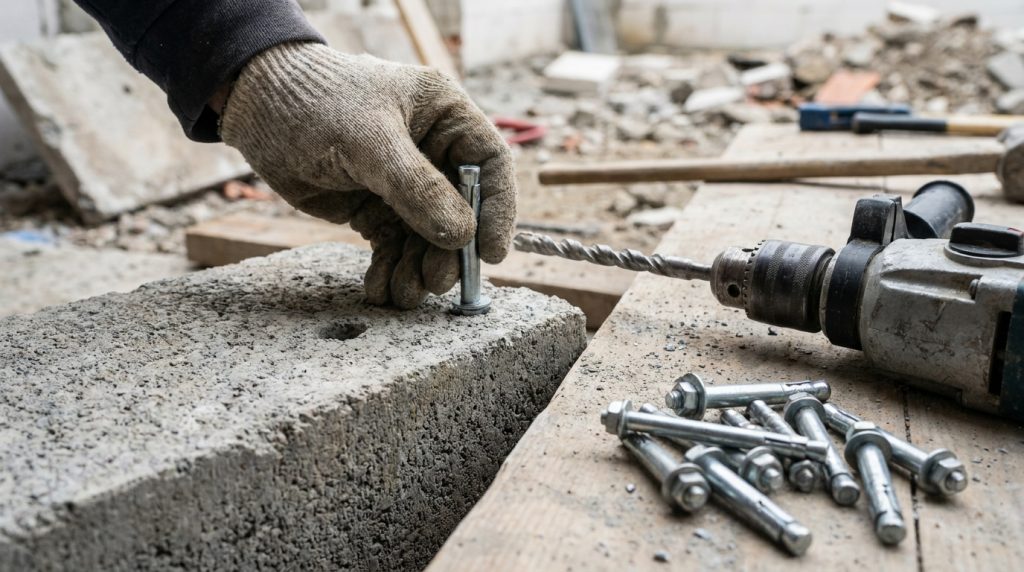
Concrete anchors are mechanical or adhesive fastening systems used to attach structural and non-structural components to concrete, block, brick, or masonry. For contractors, maintenance professionals, manufacturers, mechanics, and industrial buyers, choosing the right concrete anchor is not a small detail—it affects load capacity, installation speed, long-term durability, jobsite safety, and code compliance.
Whether you are mounting steel columns, securing machinery, installing handrails, anchoring pallet racks, fastening electrical equipment, or attaching pipe supports, the anchor must match the base material, load type, environmental conditions, and installation requirements.
The wrong anchor can lead to loose connections, cracked concrete, corrosion, failed inspections, or expensive rework. The right anchor provides a secure, repeatable fastening solution that performs as expected under real-world conditions.
This guide covers the main types of concrete anchors, where they are used, how they are installed, and how to choose the best option for your application.
When considering the best practices for securing structures, understanding the various types of concrete anchors is essential. For those interested in related topics, an informative article on the differences between grinding wheels and flap discs can provide valuable insights into the tools used in concrete preparation and finishing. You can read more about this in the article titled “Grinding Wheels vs. Flap Discs: When to Use Each and Why It Matters” available at this link.
What Are Concrete Anchors?
Concrete anchors are fasteners designed to create a secure connection between an object and a concrete or masonry surface. Unlike wood screws or sheet metal screws, concrete anchors must hold in a hard, brittle material that does not compress or flex the same way as wood or steel.
Concrete anchors work by one of three primary methods:
- Expansion: The anchor expands inside the drilled hole to grip the concrete.
- Undercutting or wedging: The anchor locks into the base material through mechanical force.
- Bonding: An adhesive or epoxy bonds the threaded rod or rebar to the concrete.
Each anchoring method has advantages and limitations depending on the load, hole condition, concrete strength, edge distance, spacing, vibration, and exposure to moisture or chemicals.
Common Applications for Concrete Anchors
Concrete anchors are used across construction, industrial maintenance, manufacturing, and mechanical trades. Common applications include:
- Structural steel connections
- Equipment and machinery anchoring
- Conveyor systems
- Racking and shelving
- Pipe hangers and strut channel
- Handrails and guardrails
- HVAC units and rooftop equipment
- Electrical panels and junction boxes
- Dock equipment and warehouse fixtures
- Signage, fencing, and barriers
- Concrete formwork and temporary bracing
- Seismic and wind-load-resistant installations
For related purchasing support, an internal link opportunity could be: Browse our concrete fasteners and anchoring systems or Compare wedge anchors, sleeve anchors, and epoxy anchors for your next project.
Main Types of Concrete Anchors
Concrete anchors come in several styles, each designed for specific job conditions. The most common categories include wedge anchors, sleeve anchors, drop-in anchors, concrete screws, strike anchors, lag shields, and adhesive anchors.
Wedge Anchors
Wedge anchors are heavy-duty mechanical anchors used in solid concrete. They consist of a threaded stud, expansion clip, nut, and washer. When the nut is tightened, the wedge clip expands against the wall of the drilled hole.
Wedge anchors are commonly used for:
- Structural steel base plates
- Machinery and equipment
- Safety railings
- Storage racks
- Industrial fixtures
- Concrete-to-steel connections
Best for: Heavy-duty anchoring in solid concrete.
Not ideal for: Brick, hollow block, or applications where the anchor may need to be removed flush with the surface.
Wedge anchors provide strong holding power, but they require accurate hole depth, proper torque, and sufficient concrete thickness. They are often available in zinc-plated, hot-dip galvanized, and stainless steel materials.
Sleeve Anchors
Sleeve anchors are versatile expansion anchors that can be used in concrete, brick, and block. They include a threaded stud or bolt, an expansion sleeve, a nut, and a washer. As the fastener is tightened, the sleeve expands against the base material.
Sleeve anchors are commonly used for:
- Handrails
- Light to medium-duty equipment
- Door frames
- Sign brackets
- Shelving
- Masonry attachments
- Fixture mounting
Best for: Medium-duty fastening in concrete, brick, or block.
Not ideal for: Very heavy structural loads where a wedge anchor or adhesive anchor may be required.
Sleeve anchors are useful when the base material varies across the jobsite. However, in hollow masonry, load values may be lower and should be verified with manufacturer data.
Drop-In Anchors
Drop-in anchors are internally threaded expansion anchors installed flush with the concrete surface. A setting tool expands the anchor inside the hole. Once installed, a bolt or threaded rod can be inserted.
Drop-in anchors are commonly used for:
- Overhead threaded rod
- Pipe supports
- HVAC hangers
- Fire sprinkler systems
- Electrical conduit
- Suspended equipment
- Strut channel mounting
Best for: Flush-mount anchoring with removable bolts or rods.
Not ideal for: Shallow concrete, cracked concrete unless rated for it, or applications where a through-fastener is preferred.
Drop-in anchors are popular with mechanical, electrical, plumbing, and fire protection contractors because they allow threaded rod to be attached cleanly and efficiently.
Concrete Screws
Concrete screws, often called masonry screws, are threaded fasteners that cut into concrete, brick, or block. They are installed into a predrilled hole without a separate expansion sleeve.
Concrete screws are commonly used for:
- Electrical boxes
- Wood-to-concrete fastening
- Light fixtures
- Door and window frames
- Temporary bracing
- Furring strips
- Light-duty brackets
Best for: Fast installation and light to medium-duty fastening.
Not ideal for: Heavy structural loads unless specifically rated and approved for the application.
Concrete screws are popular because they are removable and relatively easy to install. However, hole size is critical. If the hole is too large, the screw may not grip properly. If the hole is too small, the screw can break or strip.
Strike Anchors
Strike anchors are expansion anchors driven into a predrilled hole with a hammer. They are often used for quick, permanent fastening.
Strike anchors are commonly used for:
- Electrical fixtures
- Signage
- Light-duty brackets
- Concrete accessories
- Metal track fastening
Best for: Fast, permanent installation in concrete.
Not ideal for: Applications requiring future removal or precise torque control.
Strike anchors save time on repetitive installations, but they are generally not the best choice for adjustable or removable assemblies.
Lag Shields
Lag shields are expansion shields used with lag screws. They are often installed in concrete, brick, or block and are available in short and long versions.
Lag shields are commonly used for:
- Wood framing to masonry
- Light fixtures
- Rail brackets
- Shelving
- Masonry repair applications
Best for: Attaching wood or light fixtures to masonry.
Not ideal for: High-load industrial anchoring or critical structural connections.
Lag shields are an older but still useful anchoring option, especially when paired with large-diameter lag screws.
Adhesive Anchors and Epoxy Anchors
Adhesive anchors use epoxy, acrylic, or hybrid adhesive to bond threaded rod or rebar into a drilled hole. These anchors are often selected for high-load, close-edge, seismic, or cracked concrete applications when specified by an engineer and approved by applicable code requirements.
Adhesive anchors are commonly used for:
- Structural retrofits
- Rebar doweling
- Equipment base plates
- Guardrails
- Seismic bracing
- Concrete repair
- Heavy industrial anchoring
- Close-to-edge fastening
Best for: High-strength applications, rebar installation, and conditions where expansion stress must be reduced.
Not ideal for: Fast installations without curing time or holes that cannot be properly cleaned.
Adhesive anchors require strict installation procedures. Hole cleaning, adhesive dispensing, temperature, embedment depth, and cure time all affect performance.
For more articles on industrial supply, visit https://cemindustrialsupply.com/news/ for more articles.
Concrete Anchor Comparison Table
The table below provides a practical comparison of common concrete anchor types.
| Anchor Type | Best Base Material | Typical Load Range | Removable? | Common Uses | Key Consideration |
|---|---|---|---|---|---|
| Wedge anchor | Solid concrete | Medium to heavy | Partially; the stud remains | Steel plates, machinery, and storage racks | Requires correct torque and embedment |
| Sleeve anchor | Concrete, brick, or block | Light to medium | Partially | Handrails, brackets, and frames | Versatile, but load capacity varies by base material |
| Drop-in anchor | Solid concrete | Medium | Yes; the bolt or rod is removable | Overhead rods and pipe supports | Requires the proper setting tool |
| Concrete screw | Concrete, brick, or block | Light to medium | Yes | Electrical boxes, wood plates, and light fixtures | Correct hole diameter is critical |
| Strike anchor | Solid concrete | Light to medium | No | Fast fixture mounting | Intended for permanent installation |
| Lag shield | Concrete, brick, or block | Light to medium | Yes; the screw is removable | Fastening wood to masonry | Not recommended for critical structural loads |
| Adhesive anchor | Concrete, masonry, or drilled rebar holes | Medium to heavy | Usually not; the rod is typically permanent | Structural retrofits, rebar installation, and seismic applications | Requires proper hole cleaning and full cure time |
When considering the best practices for installing concrete anchors, it’s essential to also understand the tools and materials that can enhance the overall process. For instance, using the right type of flap disc can significantly improve the surface preparation of the concrete, ensuring a stronger bond for the anchors. To learn more about selecting the appropriate grit for your projects, you can check out this informative article on flap disc grits. This knowledge can be invaluable in achieving optimal results in your concrete anchoring tasks.
How to Choose the Right Concrete Anchor
Selecting a concrete anchor should be based on job requirements, not habit. A fastener that works well for one application may be unsafe or inefficient for another.
Identify the Base Material
Before selecting an anchor, confirm the material you are fastening into:
- Solid concrete: Suitable for wedge anchors, drop-in anchors, concrete screws, and adhesive anchors.
- Cracked concrete: Requires anchors specifically rated for cracked concrete when the application demands it.
- Brick: Often suitable for sleeve anchors, concrete screws, and adhesive anchors, depending on brick condition.
- Concrete block: May require sleeve anchors, toggle-style anchors, screen tubes with adhesive, or specialty masonry anchors.
- Hollow masonry: Requires anchors designed to distribute load without crushing or breaking the material.
Do not assume all masonry behaves like poured concrete. Hollow block, old brick, lightweight concrete, and deteriorated concrete can significantly reduce holding values.
Determine the Load Type
Concrete anchors may be exposed to different forces:
- Tension load: Pulling the anchor straight out of the hole.
- Shear load: Force applied sideways across the anchor.
- Combined load: Tension and shear at the same time.
- Dynamic load: Movement, vibration, or repeated cycling.
- Impact load: Sudden force from equipment, vehicles, or tools.
- Seismic load: Movement caused by earthquake conditions.
For machinery, conveyors, pumps, compressors, and industrial equipment, vibration resistance is a major consideration. In these cases, anchor selection should account for load cycling, proper torque, and possibly the use of locking nuts, washers, or engineered anchoring systems.
Check Edge Distance and Anchor Spacing
Anchors installed too close to an edge or too close to each other can cause concrete breakout, cracking, or reduced load capacity.
Important layout factors include:
- Minimum edge distance
- Minimum anchor spacing
- Required embedment depth
- Fixture hole diameter
- Concrete thickness
- Reinforcement location
- Hole alignment tolerance
Manufacturer technical data should be reviewed for approved spacing and edge distance values. For critical installations, consult the project engineer or anchor manufacturer.
Consider Indoor vs. Outdoor Exposure
Environmental conditions affect anchor material selection. Corrosion can weaken the connection and stain surrounding surfaces.
Common material options include:
- Zinc-plated steel: Economical for dry indoor use.
- Hot-dip galvanized steel: Better corrosion resistance for outdoor or damp environments.
- Stainless steel 304: Good corrosion resistance for many exterior and washdown applications.
- Stainless steel 316: Preferred for marine, chemical, coastal, or highly corrosive environments.
For food processing, wastewater, chemical plants, marine facilities, and outdoor industrial sites, stainless steel concrete anchors are often the best long-term choice.
Internal link opportunity: Learn more about stainless steel fasteners for corrosive environments.
Verify Code and Specification Requirements
Some projects require anchors that meet specific approvals or test standards. Examples may include:
- ICC-ES evaluation reports
- Cracked concrete approvals
- Seismic ratings
- Fire resistance requirements
- DOT or state transportation specifications
- OSHA-related fall protection anchorage requirements
- Engineer-approved submittals
Always match the anchor to the project specification. If the plans call for a specific anchor diameter, embedment, material, or approval, substitutions should be reviewed before installation.
Concrete Anchor Installation: Step-by-Step Best Practices
Proper installation is just as important as choosing the right anchor. Even a high-quality anchor can fail if installed in the wrong hole size, at the wrong depth, or without proper cleaning.
Tools Commonly Needed
Depending on the anchor type, installation may require:
- Rotary hammer drill or hammer drill
- Carbide-tipped masonry bit
- Hole cleaning brush
- Compressed air or blow-out bulb
- Vacuum system
- Torque wrench
- Hammer
- Setting tool
- Wrenches or sockets
- Adhesive dispensing gun
- Depth gauge or tape
- Personal protective equipment
Use drill bits that match the anchor manufacturer’s specified diameter. Worn bits can create oversized holes and reduce anchor performance.
Installing Wedge Anchors
Wedge anchors are installed through the fixture and into solid concrete.
Basic installation steps:
- Mark the hole locations using the fixture as a template.
- Drill the hole to the required diameter and depth.
- Clean dust and debris from the hole.
- Insert the wedge anchor through the fixture and into the hole.
- Tap the anchor with a hammer until the washer and nut are seated.
- Tighten the nut to the manufacturer’s recommended torque.
Avoid overtightening. Excess torque can damage the anchor, strip threads, or crack the concrete.
Installing Sleeve Anchors
Sleeve anchors are often installed through the fixture.
Basic installation steps:
- Drill the hole to the specified diameter and depth.
- Remove drilling dust from the hole.
- Insert the sleeve anchor through the fixture.
- Tap it into place until the washer is flush.
- Tighten the nut or bolt until the sleeve expands securely.
Sleeve anchors work in more base materials than wedge anchors, but installation quality still matters. In soft or hollow masonry, do not overtighten.
Installing Drop-In Anchors
Drop-in anchors require a setting tool to expand the anchor inside the hole.
Basic installation steps:
- Drill the hole to the required diameter and depth.
- Clean the hole thoroughly.
- Insert the drop-in anchor flush with the surface.
- Place the setting tool into the anchor.
- Strike the setting tool with a hammer until the anchor is fully set.
- Thread the bolt or rod into the anchor.
Drop-in anchors are especially useful for overhead installations, but installers should confirm that the anchor is fully expanded before applying load.
Installing Concrete Screws
Concrete screws are fast and removable, but they require accurate drilling.
Basic installation steps:
- Drill a pilot hole using the correct bit size.
- Drill slightly deeper than the screw embedment to allow space for dust.
- Remove dust from the hole.
- Drive the screw using the recommended driver or socket.
- Stop when the fixture is snug.
Do not overdrive concrete screws. Overdriving can strip the threads cut into the concrete and weaken the hold.
Installing Adhesive Anchors
Adhesive anchors require careful hole preparation and curing.
Basic installation steps:
- Drill the hole to the specified diameter and embedment depth.
- Clean the hole using the manufacturer’s required blow-brush-blow method or approved vacuum system.
- Dispense adhesive until the color is uniform, if using a two-part cartridge.
- Fill the hole with the recommended amount of adhesive.
- Insert the threaded rod or rebar with a twisting motion.
- Allow the adhesive to cure for the required time based on temperature.
- Attach the fixture and tighten hardware as specified.
Do not load adhesive anchors before full cure. Cold temperatures can significantly increase cure time, while hot temperatures can reduce working time.
Common Installation Mistakes to Avoid
Even experienced crews can run into anchor problems when working under time pressure. The following mistakes are common and preventable.
Using the Wrong Drill Bit Size
A hole that is too large may prevent expansion anchors or concrete screws from gripping properly. A hole that is too small can damage the anchor during installation.
Always verify:
- Anchor diameter
- Required hole diameter
- Drill bit condition
- Minimum hole depth
- Fixture thickness
Failing to Clean the Hole
Dust left inside a drilled hole can reduce anchor performance. This is especially important for adhesive anchors, where bond strength depends on direct contact with the concrete.
For mechanical anchors, dust can interfere with embedment depth and expansion. For epoxy anchors, poor cleaning is one of the most common causes of weak installations.
Ignoring Torque Requirements
Many mechanical anchors must be tightened to a specific torque. Too little torque may prevent full expansion. Too much torque may damage the anchor or base material.
Use a calibrated torque wrench when required by specification, inspection, or manufacturer instructions.
Installing Too Close to an Edge
Anchors placed near concrete edges can cause cracking or breakout under load. This is especially important for handrails, guardrails, column plates, and equipment bases.
If the anchor layout places holes near edges, review manufacturer data or consult an engineer before drilling.
Substituting Anchors Without Approval
It may be tempting to substitute a similar-looking anchor when stock is limited. However, anchors with the same diameter can have different load ratings, embedment requirements, materials, and approvals.
For specified work, document any substitutions and obtain approval before installation.
Concrete Anchor Materials and Coatings
The anchor’s steel type and coating affect corrosion resistance, strength, cost, and service life.
Zinc-Plated Concrete Anchors
Zinc-plated anchors are common for dry indoor environments. They are economical and suitable for many warehouse, maintenance, and light industrial applications where moisture exposure is limited.
Typical uses include:
- Interior shelving
- Electrical fixtures
- Indoor equipment
- Light brackets
- Dry storage facilities
Hot-Dip Galvanized Concrete Anchors
Hot-dip galvanized anchors offer better corrosion resistance than standard zinc plating and are often used outdoors or in damp environments.
Typical uses include:
- Exterior railing
- Outdoor equipment
- Parking structures
- Utility installations
- Agricultural facilities
When using galvanized anchors, make sure nuts and washers are compatible with the coating and thread fit.
Stainless Steel Concrete Anchors
Stainless steel anchors are used where corrosion resistance is critical. Type 304 stainless steel is suitable for many general outdoor environments, while Type 316 stainless steel is preferred in marine, coastal, chemical, and washdown conditions.
Typical uses include:
- Food processing plants
- Wastewater treatment facilities
- Coastal construction
- Chemical plants
- Marine equipment
- Outdoor safety railings
Internal link opportunity: Compare 304 vs. 316 stainless steel anchors for industrial applications.
Concrete Anchors by Industry
Different industries use concrete anchors in different ways. Understanding the application helps buyers and installers select the right product.
Construction Contractors
General contractors and concrete contractors use anchors for base plates, wall connections, temporary bracing, formwork, handrails, and structural attachments. Speed matters, but code compliance and inspection readiness are equally important.
Common choices:
- Wedge anchors for steel plates
- Sleeve anchors for general masonry fastening
- Adhesive anchors for rebar doweling and retrofits
- Concrete screws for temporary or light-duty fastening
Maintenance and Facility Professionals
Maintenance teams often need anchors that are easy to install, available in multiple sizes, and suitable for repairs or upgrades.
Common uses include:
- Mounting guards and bollards
- Securing benches and workstations
- Installing shelving
- Repairing loose fixtures
- Anchoring replacement equipment
Concrete screws and sleeve anchors are often useful for everyday maintenance, while wedge anchors and adhesive anchors are better suited for heavier equipment.
Manufacturers and Industrial Plants
Manufacturing facilities often require anchors that resist vibration, support heavy loads, and withstand environmental exposure.
Common uses include:
- Machinery anchoring
- Conveyor supports
- Safety barriers
- Robotic equipment
- Pumps and compressors
- Storage racks
For vibrating equipment, review anchor load data and consider using engineered anchoring systems with proper embedment, torque, and locking hardware.
Mechanics and Equipment Installers
Mechanics and installers use concrete anchors for lifts, compressors, tool storage, alignment equipment, and service bay fixtures.
Common choices:
- Wedge anchors for automotive lifts when specified by lift manufacturer
- Concrete screws for light fixtures and accessories
- Adhesive anchors for high-strength applications where expansion stress is a concern
Always follow the equipment manufacturer’s anchoring requirements, especially for vehicle lifts and rotating machinery.
Industrial Buyers and Procurement Teams
Industrial buyers need anchors that meet performance requirements while supporting inventory control and cost efficiency.
Key purchasing considerations include:
- Anchor diameter and length range
- Material and coating
- Load ratings and approvals
- Packaging quantities
- Availability of matching nuts and washers
- Lead times
- Manufacturer documentation
- Job-specific submittals
Internal link opportunity: Request a quote for bulk concrete anchors and jobsite fastener packages.
Concrete Anchor Sizing and Load Considerations
Anchor size is usually defined by diameter and length. Larger anchors generally offer greater potential load capacity, but performance depends on embedment depth, concrete strength, installation quality, and spacing.
Diameter
Common anchor diameters include:
- 1/4 inch
- 3/8 inch
- 1/2 inch
- 5/8 inch
- 3/4 inch
- 7/8 inch
- 1 inch and larger for heavy-duty applications
Light-duty fixtures may use 1/4-inch or 3/8-inch anchors. Heavy equipment and structural connections often require 1/2-inch, 5/8-inch, 3/4-inch, or larger anchors depending on engineering requirements.
Embedment Depth
Embedment depth is the portion of the anchor installed into the concrete. Deeper embedment can increase holding capacity, but only when permitted by the anchor design and concrete thickness.
Check:
- Minimum embedment
- Maximum fixture thickness
- Required hole depth
- Concrete slab thickness
- Clearance from rebar or post-tension cables
Never drill into post-tensioned slabs without proper scanning and authorization.
Fixture Thickness
Anchor length must account for the thickness of the material being fastened. If the anchor is too short, it may not reach the required embedment. If it is too long, it may bottom out or interfere with installation.
For through-fastened anchors, calculate:
Required anchor length = fixture thickness + washer/nut allowance + required embedment depth
Manufacturer charts often provide maximum fixture thickness for each anchor size.
Safety, Inspection, and Jobsite Quality Control
Concrete anchoring is a safety-critical task in many applications. Quality control helps reduce failures and callbacks.
Pre-Installation Checklist
Before drilling, confirm:
- Approved anchor type
- Correct diameter and length
- Base material condition
- Required embedment depth
- Edge distance and spacing
- Drill bit size
- Hole cleaning method
- Torque requirements
- Environmental exposure
- Any required approvals or inspections
Inspection Considerations
Inspectors may check:
- Anchor type and markings
- Diameter and length
- Embedment depth
- Installation location
- Edge distance
- Torque values
- Adhesive anchor cure time
- Hole cleaning procedure
- Installer certification where required
Some adhesive anchor installations in overhead or sustained tension applications may require special inspection or installer certification depending on project requirements and local code adoption.
Personal Protective Equipment
Concrete drilling and anchor installation can expose workers to silica dust, flying debris, noise, and hand injuries.
Common PPE includes:
- Safety glasses
- Hearing protection
- Gloves
- Dust protection or respirator where required
- Hard hat
- Work boots
- Fall protection for elevated work
Use dust extraction systems and follow OSHA silica requirements when drilling concrete.
Frequently Asked Questions About Concrete Anchors
What is the strongest type of concrete anchor?
There is no single strongest anchor for every situation. Wedge anchors and adhesive anchors are commonly used for heavy-duty applications in solid concrete. The strongest choice depends on concrete strength, load type, embedment, edge distance, spacing, and whether the concrete is cracked or uncracked.
Can concrete anchors be removed?
Some anchors are removable, while others are permanent. Concrete screws can usually be removed. Drop-in anchor bolts or rods can be removed, but the anchor body remains in the concrete. Wedge anchors and sleeve anchors may be difficult to remove completely. Adhesive anchors are generally considered permanent.
Can wedge anchors be used in brick or block?
Wedge anchors are designed for solid concrete and are generally not recommended for brick or hollow block. Sleeve anchors, concrete screws, adhesive anchors with screen tubes, or masonry-specific anchors are usually better options for brick or block.
How deep should I drill for a concrete anchor?
Drilling depth depends on the anchor type, diameter, required embedment, and manufacturer instructions. The hole is often drilled deeper than the embedment to allow room for dust and proper seating. Always check the technical data for the specific anchor being installed.
Are stainless steel concrete anchors worth the cost?
Stainless steel anchors are worth considering in corrosive environments such as coastal areas, washdown facilities, chemical plants, wastewater facilities, and outdoor installations. While they cost more upfront, they can reduce corrosion-related maintenance and replacement.
Conclusion: Choose Concrete Anchors Based on Performance, Not Guesswork
Concrete anchors are essential fastening components for construction, maintenance, manufacturing, mechanical work, and industrial operations. The best anchor is the one that matches the base material, load requirements, environment, installation method, and project specification.
Wedge anchors are strong choices for solid concrete. Sleeve anchors offer versatility in concrete and masonry. Drop-in anchors are ideal for threaded rod and overhead systems. Concrete screws provide speed and removability. Adhesive anchors support demanding structural and retrofit applications when installed correctly.
Before you drill, verify the anchor type, size, embedment, material, edge distance, torque, and approval requirements. A few minutes of planning can prevent loose fasteners, failed inspections, damaged concrete, and unsafe installations.
Need help selecting concrete anchors for your next project? Review your application requirements, compare anchor types, and work with a knowledgeable fastener supplier to source the right diameter, length, material, coating, and approval documentation for the job.