
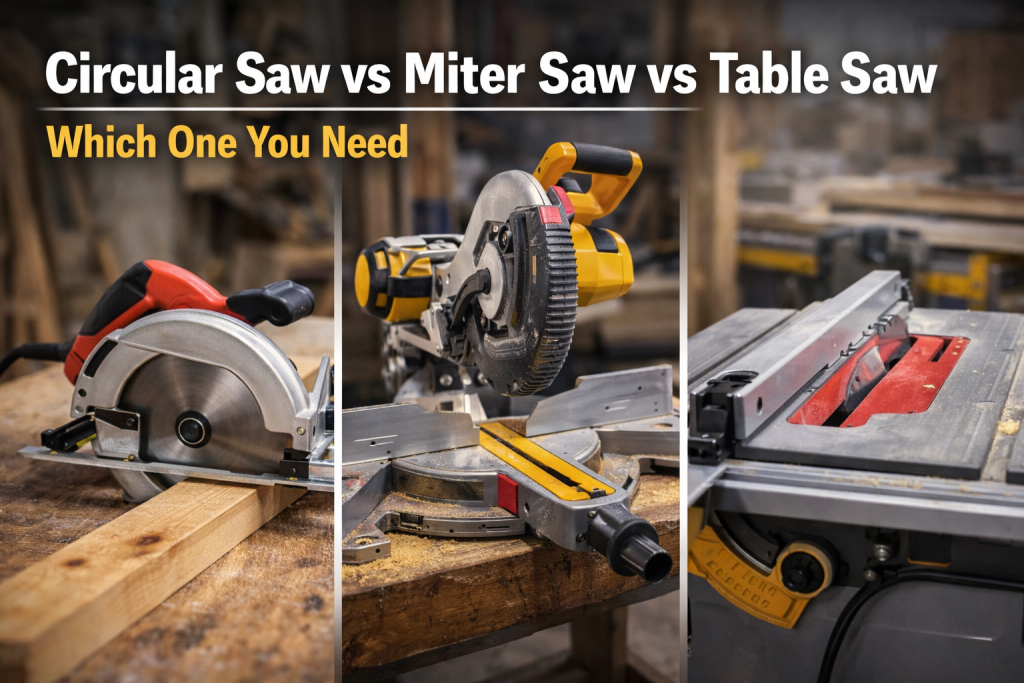
Choosing between a circular saw, miter saw, and table saw isn’t about brand loyalty or horsepower. It’s about understanding what each saw is actually designed to do. Most frustration, wasted money, and unsafe cuts happen when the wrong saw is used for the job.
At CEM Industrial Supply in Coldwater, Michigan, this is one of the most common questions we get from contractors, maintenance crews, and serious DIYers. The right saw choice improves accuracy, speed, and safety. The wrong one slows everything down.
Here’s a clear breakdown of what each saw does best—and which one you actually need.
Circular Saw: The Most Versatile Option
A circular saw is the most flexible and portable of the three. It’s designed to move to the material rather than bringing the material to the saw.
Best used for:
- Framing and rough carpentry
- Sheet goods like plywood and OSB
- Cutting lumber on-site
- Roofing, decking, and siding
- Job sites without dedicated workspaces
Circular saws excel when materials are large, awkward, or already installed. With the right blade and a straight edge, they can make surprisingly accurate cuts.
Limitations:
- Less precise than a miter or table saw
- Requires guides for straight, repeatable cuts
- Not ideal for fine trim or cabinetry
If you only own one saw, a circular saw is usually the most practical starting point.
Miter Saw: Precision Angle and Cross Cuts
A miter saw is built for accuracy and repeatability. It brings the blade down onto stationary material, making it ideal for clean, consistent cross cuts and angles.
Best used for:
- Trim and finish carpentry
- Crown molding and baseboard
- Framing studs cut to length
- Angled cuts and bevels
- Repetitive cross cuts
Miter saws shine when accuracy matters and cuts need to be repeated quickly. Compound and sliding models add even more flexibility.
Limitations:
- Not designed for ripping long boards
- Requires a stable work area
- Less portable than a circular saw
If your work involves trim, framing, or precise angles, a miter saw saves time and delivers cleaner results.
Table Saw: Accuracy, Power, and Control
A table saw is the most precise and powerful option of the three. It’s designed to bring material through a fixed blade with maximum control.
Best used for:
- Ripping lumber to width
- Cabinetry and furniture work
- Repeated identical cuts
- Dados, grooves, and joinery
- Workshop-based projects
Table saws excel in controlled environments where accuracy, consistency, and finish quality are critical.
Limitations:
- Requires dedicated space
- Less portable
- Higher learning curve and safety requirements
For shop work, cabinetry, and production-style cutting, nothing replaces a table saw.
Side-by-Side Comparison
If you need portability and flexibility, a circular saw is the best choice.
If you need clean, repeatable cross cuts and angles, a miter saw is the right tool.
If you need precision ripping and high accuracy, a table saw is the solution.
Many professionals eventually use all three because each saw solves a different problem.
Blade Choice Matters Just as Much as the Saw
Even the best saw performs poorly with the wrong blade.
Common blade mistakes include:
- Using framing blades for finish work
- Using dull blades on hardwood
- Using general-purpose blades for specialty cuts
- Ignoring tooth count and material compatibility
At CEM Industrial Supply, we often solve cutting problems by changing the blade—not the saw.
Corded vs Cordless Considerations
Cordless saws offer mobility and convenience on job sites. Corded saws provide consistent power for longer cuts and heavy materials. Blade quality and technique matter more than power source in most applications.
Which Saw Should You Buy First?
If you’re just starting out:
- Circular saw first
- Add a miter saw for accuracy
- Add a table saw when shop space allows
If you’re upgrading:
- Match the saw to the type of work you do most
- Don’t overspend on power when accuracy matters more
Get the Right Tool for the Job
At CEM Industrial Supply in Coldwater, Michigan, we help customers choose saws and blades based on how they actually work—not marketing hype. Whether you’re framing, trimming, or building in the shop, the right saw setup saves time, material, and frustration.
Stop in or call and talk to someone who uses these tools every day.
Frequently Asked Questions
Which saw is best for beginners?
A circular saw offers the most versatility and value for most users.
Can a circular saw replace a miter saw?
For rough cuts, yes. For precise angles and repeatability, no.
Is a table saw necessary for woodworking?
For cabinetry, furniture, and precise ripping, yes.
Do blades really make that much difference?
Absolutely. Blade choice often matters more than the saw itself.