
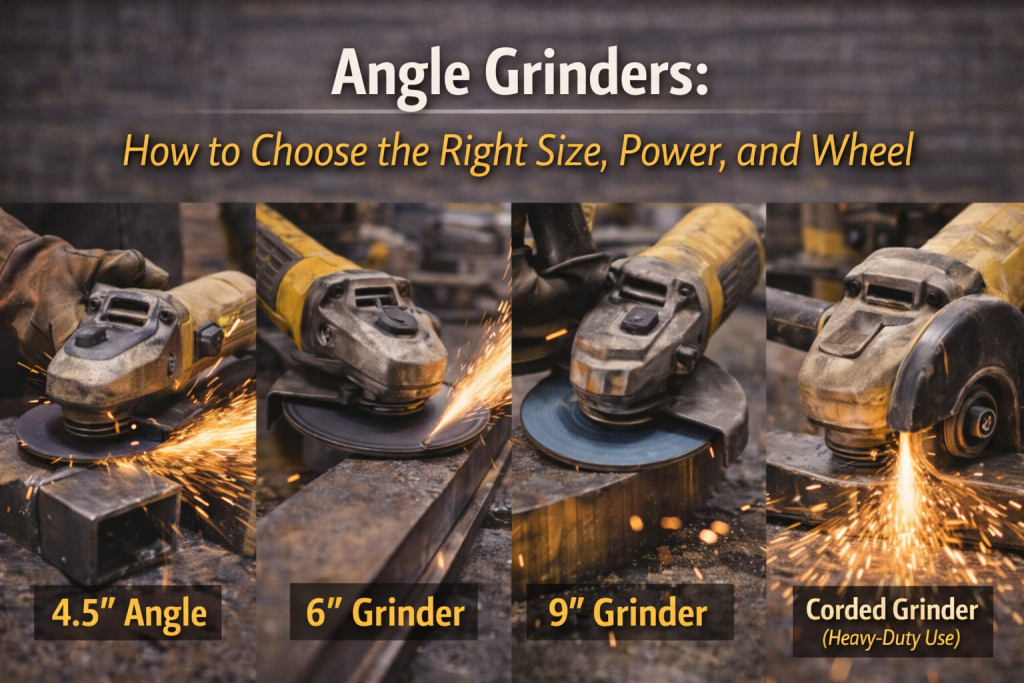
Angle grinders are one of the most abused—and misunderstood—tools on the job site. Wrong wheel, wrong size, or wrong power level, and you’re dealing with slow cuts, burned material, broken discs, or serious safety risks.
At CEM Industrial Supply, grinder issues usually come down to mismatched setups, not bad tools.
Here’s how to choose the right angle grinder for the job.
Grinder Size Isn’t About Convenience — It’s About Control
Angle grinders are defined by wheel diameter, and that directly affects torque, depth of cut, and control.
- 4-1/2″ to 5″ grinders
Best for light fabrication, sheet metal, cutting bolts, and tight spaces. - 6″ grinders
A middle ground for heavier cutting and grinding without jumping to large-frame tools. - 7″ and 9″ grinders
Built for aggressive material removal, thick steel, and continuous-duty grinding.
Using a small grinder for heavy work overheats motors and destroys wheels. Oversized grinders reduce precision and increase fatigue.
Power Requirements Matter More Than RPM
Most grinders spin at similar RPMs. The difference is torque under load.
Look for:
- Higher amp ratings (corded)
- Higher voltage platforms (cordless)
- Soft start and overload protection
Grinding thick material with underpowered tools leads to stalling, kickback, and burned discs.
Wheel Selection Is Where Most Failures Happen
Grinders don’t fail—wheel misuse does.
Common wheel types:
- Cutoff wheels (straight cuts only)
- Grinding wheels (material removal)
- Flap discs (blending and finishing)
- Wire wheels (cleaning and rust removal)
Never side-load cutoff wheels. Never grind with wheels not rated for it. Always match wheel RPM to grinder RPM.
Corded vs Cordless Grinders
Cordless grinders are excellent for:
- Quick cuts
- Field work
- Elevated or mobile tasks
Corded grinders still dominate for:
- Continuous grinding
- High material removal
- Shop environments
Many pros carry both.
Safety Isn’t Optional With Grinders
Angle grinders cause more injuries than most power tools when misused.
Always use:
- Proper guards
- Rated wheels
- Eye and face protection
- Firm two-handed control
If the grinder feels unstable, the setup is wrong.
The Bottom Line
The best grinder is the one matched to the job—not the one with the biggest motor or newest battery.
If you’re unsure which grinder or wheel combination makes sense, CEM Industrial Supply can help you set it up correctly the first time.