
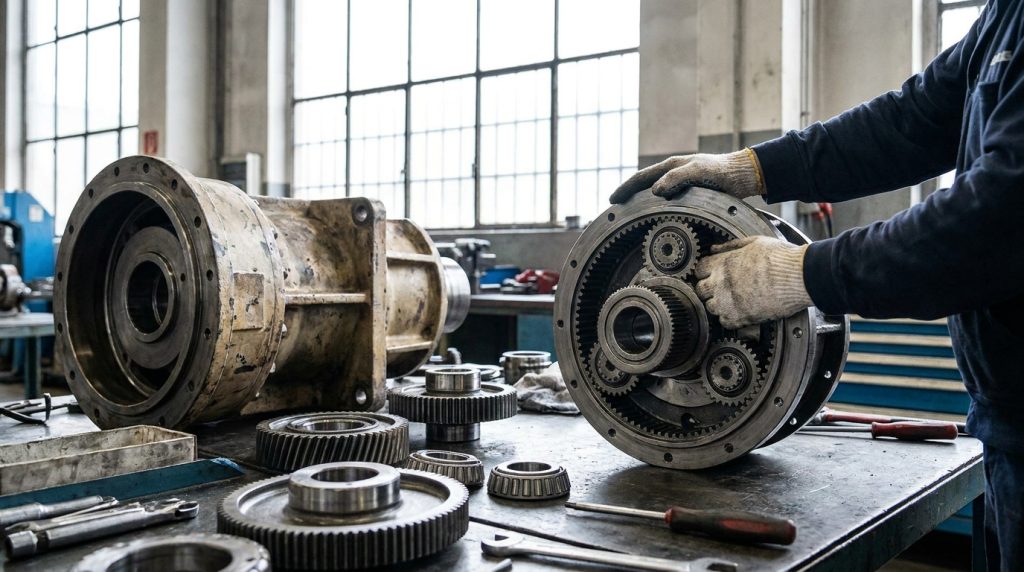
Understanding Planetary Gearboxes: A Comprehensive Guide for Industrial Applications
Planetary gearboxes represent a pinnacle of mechanical engineering, offering a compact, efficient, and robust solution for a wide array of industrial power transmission needs. Their unique design, characterized by a central “sun” gear, orbiting “planet” gears, and an outer “ring” gear, allows for high torque density, precise speed reduction, and remarkable coaxial input/output shafts. This article delves into the intricate workings of planetary gearboxes, exploring their fundamental principles, diverse applications, selection criteria, and the critical role of proper maintenance and repair in ensuring their longevity and optimal performance. For plant managers, maintenance professionals, industrial engineers, manufacturers, agricultural operators, and equipment buyers in Coldwater, Michigan, and beyond, understanding the nuances of these sophisticated power transmission components is paramount to operational efficiency and cost-effectiveness.
For those interested in the intricate workings of planetary gearboxes and their various applications, a related article that delves into the importance of electric motor rewinding services can provide valuable insights. Understanding how electric motors operate and the role of gear systems can enhance your knowledge of machinery efficiency. To explore this topic further, you can read the article on electric motor rewinding services at CEM Industrial Supply.
The Inner Workings of a Planetary Gearbox
At the heart of a planetary gearbox lies a deceptively simple yet highly effective arrangement of gears. The system typically consists of three primary components:
Sun Gear
The sun gear is the central gear in the planetary arrangement, analogous to the sun in our solar system. It is driven by the input shaft and meshes with the planet gears. The diameter and tooth count of the sun gear play a crucial role in determining the overall gear ratio and torque output of the gearbox.
Planet Gears and Carrier
Surrounding the sun gear are one or more planet gears, often referred to as “satellites.” These gears are mounted on a planet carrier, which is also connected to the output shaft. The planet gears simultaneously mesh with the sun gear and the internal teeth of the ring gear. As the sun gear rotates, it forces the planet gears to revolve around it while also rotating on their own axes. This dual motion is key to the gearbox’s functionality.
Ring Gear (Annulus)
The outermost component is the ring gear, also known as the annulus. This gear has internal teeth that mesh with the external teeth of the planet gears. The ring gear is typically stationary or driven by a secondary input, depending on the specific configuration and desired output. In a standard reduction gearbox, the ring gear is usually fixed.
How Power Transmission Occurs
The fundamental principle of power transmission in a planetary gearbox relies on the relative motion of these three components. The most common configuration for speed reduction involves fixing the ring gear. In this scenario, the sun gear (input) drives the planet gears. As the planet gears are constrained by the stationary ring gear, they are forced to orbit the sun gear. This orbital motion of the planet carrier (output) results in a reduced output speed and a significant increase in torque.
The gear ratio of a planetary gearbox is determined by the number of teeth on the sun gear, the planet gears, and the ring gear. The formula for the gear ratio (R) in a fixed ring gear configuration is generally expressed as:
$R = 1 + (Z_r / Z_s)$
Where:
- $Z_r$ is the number of teeth on the ring gear.
- $Z_s$ is the number of teeth on the sun gear.
This formula highlights how a larger ring gear relative to the sun gear results in a higher gear reduction. The planet gears act as idlers, distributing the load and enabling the compact design.
Advantages of Planetary Gearbox Design
The unique architecture of planetary gearboxes imparts several significant advantages, making them a preferred choice in demanding industrial environments:
- High Torque Density: The load is distributed across multiple planet gears, allowing for a significantly higher torque output for a given gearbox size and weight compared to conventional parallel shaft gearboxes. This is crucial for applications where space is limited but high power is required.
- Coaxial Input and Output Shafts: The input and output shafts are aligned on the same axis. This simplifies system design and integration, reducing the need for additional components like angle drives or offset couplings.
- High Efficiency: Due to the even load distribution and optimized meshing, planetary gearboxes exhibit excellent efficiency, typically ranging from 95% to over 98% per stage. This translates to lower energy consumption and reduced heat generation.
- Compact and Lightweight: The concentric design and load distribution contribute to a smaller physical footprint and lower weight, making them ideal for mobile equipment, robotics, and tight installations.
- Versatility and Modularity: Planetary gearboxes can be configured in multiple stages by adding additional planetary sets, allowing for very high gear ratios. They can also be adapted for different input and output configurations.
- Smooth Operation: The even distribution of forces and multiple meshing points lead to smoother and quieter operation compared to single-stage gearboxes.
Applications Across Industries
The inherent strengths of planetary gearboxes make them indispensable in a vast spectrum of industrial applications. Their ability to handle high torques, provide precise speed reduction, and operate reliably in harsh conditions sets them apart.
Manufacturing and Automation
In manufacturing, planetary gearboxes are integral to automated processes requiring precise and powerful motion control. They are commonly found in:
- Robotic Arms: The high torque density and compact size are perfect for the joints of industrial robots, enabling precise and repeatable movements for assembly, welding, and material handling.
- Conveyor Systems: Providing reliable and efficient speed reduction for driving conveyor belts in factories, warehouses, and distribution centers.
- Machine Tools: Used in CNC machines, lathes, milling machines, and other precision equipment to drive spindles, axes, and tool changers, ensuring accuracy and efficiency.
- Extrusion Machines: Essential for driving the screws in plastic and rubber extruders, where high torque and consistent speed are critical for material processing.
- Packaging Machinery: Facilitating precise movements and speed control in filling, sealing, labeling, and capping machines.
Material Handling and Logistics
The efficient and robust nature of planetary gearboxes makes them a staple in material handling operations:
- Forklifts and Industrial Trucks: Powering the drive systems and lift mechanisms, providing the necessary torque for heavy loads.
- Cranes and Hoists: Driving winches and lifting mechanisms, ensuring controlled and safe movement of heavy materials.
- Automated Guided Vehicles (AGVs): Providing the propulsion and steering control for autonomous material transport.
- Silos and Storage Systems: Operating augers and screw conveyors for loading and unloading bulk materials.
Renewable Energy
The growing renewable energy sector heavily relies on the performance and efficiency of planetary gearboxes:
- Wind Turbines: They are critical components in the nacelles, connecting the rotor blades to the generator. The ability to transmit massive torques and withstand significant dynamic loads is essential.
- Solar Tracking Systems: Used to accurately position solar panels to follow the sun throughout the day, maximizing energy capture.
- Hydropower Systems: In some applications, they are used in sluice gate operation and other auxiliary systems.
Agriculture
Agricultural operations benefit from the ruggedness and power of planetary gearboxes:
- Tillage Equipment: Driving rototillers, plows, and cultivators, providing the necessary torque to break up soil.
- Harvesting Machinery: Used in combine harvesters, balers, and forage harvesters to drive various components.
- Sprayers and Spreaders: Ensuring consistent and controlled application of fertilizers, pesticides, and seeds.
- Irrigation Systems: Powering pump drives and large-scale sprinkler systems.
Other Industrial Applications
The versatility of planetary gearboxes extends to numerous other sectors:
- Marine Propulsion: Used in smaller vessels and specific applications requiring compact, high-torque drives.
- Mining and Construction: Operating heavy-duty machinery like excavators, loaders, and crushers, where durability and high torque are paramount.
- Oil and Gas: Employed in drilling equipment, pumps, and processing machinery.
- Pulp and Paper Mills: Driving large rollers, presses, and conveyors in demanding environments.
Types and Configurations of Planetary Gearboxes
The fundamental planetary gearbox design can be adapted and combined to create a wide variety of configurations tailored to specific performance requirements. Understanding these variations is crucial for selecting the optimal unit.
Single-Stage vs. Multi-Stage
- Single-Stage Planetary Gearbox: Consists of one sun gear, one set of planet gears, and one ring gear. These are typically used for moderate gear reductions.
- Multi-Stage Planetary Gearbox: Achieved by connecting multiple single-stage planetary sets in series. The output shaft of one stage becomes the input for the next. This allows for extremely high gear reduction ratios, often exceeding 1000:1. Each additional stage typically reduces the speed by a factor of 3-10, while proportionally increasing torque.
Gear Ratio and Torque Ratings
- Gear Ratio: The primary specification, indicating the extent of speed reduction and torque multiplication. Ratios can range from 3:1 to over 10,000:1.
- Torque Rating: The maximum continuous torque the gearbox can transmit without exceeding its thermal or mechanical limits. This is a critical factor in gearbox selection, alongside peak or intermittent torque requirements.
Mounting and Output Shaft Configurations
Planetary gearboxes offer a variety of options to suit diverse installation needs:
- Flange Mount: The most common type, allowing the gearbox to be directly bolted to a machine frame or motor.
- Foot Mount: Features mounting feet for secure attachment to a base.
- Shaft Output: Can be configured with a solid shaft (keyed or splined) or a hollow shaft (for direct mounting onto a driven shaft).
- Integrated Motor Adapters: Designed to directly couple with standard electric motors, creating a compact, integrated drive unit.
Special Features and Designs
- Right-Angle Planetary Gearboxes: Incorporate bevel gears at the input or output to achieve a 90-degree change in direction, further enhancing installation flexibility.
- High-Speed Planetary Gearboxes: Designed with specialized materials and lubrication systems to handle high input speeds.
- Washdown and Food-Grade Gearboxes: Constructed with materials and sealing methods suitable for environments requiring frequent cleaning or contact with food products.
- Explosion-Proof Gearboxes: Built to meet stringent safety standards for use in hazardous environments where flammable gases or dust may be present.
Planetary gearboxes are essential components in various mechanical systems, providing high torque and compact designs. Understanding their functionality and applications can greatly enhance the efficiency of machinery. For those interested in optimizing their industrial operations, exploring maintenance strategies is crucial. A related article offers valuable insights into motor repair, which can complement your knowledge of gear systems. You can read more about these strategies in this informative piece on efficient industrial motor repair.
Selecting the Right Planetary Gearbox for Your Application
Choosing the correct planetary gearbox is a critical decision that impacts the reliability, efficiency, and longevity of your equipment. A thorough understanding of application requirements, combined with an awareness of planetary gearbox capabilities, will lead to the optimal selection.
Key Selection Criteria
- Torque Requirements: This is the most crucial parameter.
- Rated Torque: The continuous torque the gearbox will experience.
- Peak Torque: The maximum torque experienced during transient events (e.g., startup, load surges). Ensure the gearbox can handle these peaks with adequate safety margins.
- Momentary Torque: Short-duration torque demands.
- Torque Reversibility: Whether the application involves frequent or high-magnitude reversal of torque.
- Speed and Gear Ratio:
- Input Speed: The rotational speed of the prime mover (e.g., motor).
- Output Speed: The required speed of the driven equipment.
- Required Gear Ratio: Calculated as Input Speed / Output Speed. Consider the possibility of using multiple stages for very high ratios.
- Duty Cycle and Operating Environment:
- Continuous vs. Intermittent Duty: Gearboxes designed for continuous operation will have different thermal management and lubrication requirements than those used intermittently.
- Environmental Factors: Consider temperature extremes, presence of dust, moisture, corrosive substances, vibration, and potential for shock loads. This will influence material selection, sealing, and protective coatings.
- Power Input and Output Interface:
- Input Shaft/Motor Connection: Specify motor frame size, shaft diameter, keyway, and coupling type.
- Output Shaft Configuration: Solid shaft, hollow shaft, flange mount, foot mount, etc.
- Efficiency and Energy Consumption:
- While planetary gearboxes are generally highly efficient, losses increase with higher gear ratios and higher speeds. Consider the long-term energy savings associated with a more efficient unit, especially for continuously operating machinery.
- Backlash:
- The amount of play between meshing gears. For applications requiring high positional accuracy (e.g., robotics, precision automation), low backlash is essential. Multi-stage planetary gearboxes can be designed for very low backlash.
- Mounting Orientation:
- Ensure the chosen gearbox is suitable for the intended mounting position (horizontal, vertical, or any angle) and that lubrication systems are appropriate.
- Service Factor:
- A multiplier applied to torque calculations to account for application severity, such as shock loads, frequent starts/stops, and high ambient temperatures. A higher service factor indicates a more demanding application, requiring a more robust gearbox. Standards like AGMA (American Gear Manufacturers Association) provide guidance on service factors.
Using Calculators and Technical Resources
Many manufacturers, including CEM Industrial Supply, offer online selection tools or can provide expert assistance to guide you through the selection process. Providing detailed information about your application’s operational parameters will enable them to recommend the most suitable planetary gearbox solution.
Comparing Planetary Gearboxes to Other Drive Types
While planetary gearboxes excel in many applications, understanding their strengths relative to other drive types is important:
- Worm Gearboxes: Offer very high gear ratios and are often self-locking. However, they are generally less efficient than planetary gearboxes, generate more heat, and have limited torque capacity for their size.
- Helical Gearboxes: Provide high efficiency and good torque capacity, but their input and output shafts are parallel, requiring more space and potentially additional components for non-parallel applications.
- Spur Gearboxes: The simplest type, but offer lower torque density and are generally noisier than other types.
In summary, for applications demanding high torque in a compact space, coaxial shafts, and high efficiency, planetary gearboxes are often the superior choice.
Planetary gearboxes are essential components in various mechanical systems, providing efficient torque transmission and compact design. For those interested in exploring more about precision motion solutions, a related article discusses linear rail systems that complement the functionality of planetary gearboxes in automation and robotics. You can read more about these innovative systems by visiting this link. Understanding both planetary gearboxes and linear rail systems can enhance your knowledge of modern engineering applications.
Maintenance, Troubleshooting, and Repair of Planetary Gearboxes
The robust design of planetary gearboxes contributes to their reliability, but like all mechanical components, they require proper maintenance to ensure optimal performance and prevent premature failure. Understanding common issues and their solutions is crucial for plant managers and maintenance professionals.
Preventive Maintenance Schedule
A proactive maintenance approach is key to maximizing the lifespan of your planetary gearbox. This typically includes:
- Lubrication:
- Oil Level Checks: Regularly monitor the oil level and top up as needed with the manufacturer-recommended lubricant.
- Oil Changes: Follow the manufacturer’s recommended intervals for oil changes, which depend on operating conditions, temperature, and load.
- Oil Analysis: Periodic oil analysis can detect wear particles and contamination, indicating potential problems before they become critical.
- Visual Inspections:
- Leaks: Inspect for oil leaks around seals and gaskets.
- Noise and Vibration: Listen for unusual noises (grinding, whining) or excessive vibration, which can indicate bearing wear, gear damage, or misalignment.
- Temperature: Monitor the gearbox operating temperature. Excessive heat can indicate lubrication issues, overloading, or internal friction. Infrared thermometers can be useful tools.
- Filter Replacement: If the gearbox is equipped with an oil filter, ensure it is replaced according to the manufacturer’s schedule.
Common Troubleshooting Scenarios
| Problem | Possible Cause(s) | Recommended Action |
| :– | : | : |
| Excessive Noise | Insufficient lubrication; worn bearings; gear tooth damage; misalignment. | Check oil level and type; inspect for bearing wear; examine gear teeth for pitting, chipping, or wear; ensure proper alignment of input and output shafts. |
| Overheating | Insufficient lubrication; overloading; incorrect lubricant viscosity; worn bearings. | Verify oil level and correct type; reduce load if exceeding rated capacity; check for bearing wear; ensure lubricant viscosity is appropriate for operating temperature. |
| Oil Leaks | Worn or damaged seals; loose fittings; cracked housing. | Replace seals; tighten fittings; inspect housing for cracks and consider professional repair or replacement. |
| Reduced Torque Output | Internal gear damage; worn bearings; insufficient lubrication; slippage. | Inspect internal components for damage; check bearings; ensure adequate lubrication; identify potential slippage in the drive system. |
| Vibration | Unbalanced rotating components; worn bearings; improper mounting; misalignment. | Check for foreign debris; inspect bearings; ensure secure mounting; verify alignment of input and output shafts. |
| Difficulty in Starting | High starting torque load; internal binding; insufficient lubrication. | Assess load requirements; inspect for internal binding or debris; ensure proper lubrication during startup. |
The Importance of Professional Repair and Rebuilding
While minor maintenance can often be performed in-house, more complex issues like significant gear wear, bearing failure, or housing damage often require specialized expertise. CEM Industrial Supply, based in Coldwater, Michigan, offers expert industrial gearbox repair and rebuilding services.
Benefits of Professional Repair:
- Expert Diagnosis: Experienced technicians can accurately identify the root cause of the failure.
- High-Quality Parts: Using OEM-specification or equivalent replacement parts ensures performance and longevity.
- Precision Machining and Assembly: Rebuilding requires specialized tools and knowledge to ensure components are reassembled to precise tolerances.
- Testing and Validation: Repaired gearboxes are typically tested under load to verify performance and ensure they meet original specifications.
- Warranty: Reputable repair services provide warranties on their work, offering peace of mind.
Whether it’s a worn bearing, damaged gear teeth, or a complete overhaul, entrusting your planetary gearbox to experienced professionals like those at CEM Industrial Supply ensures your equipment is back online quickly and reliably.
Safety Considerations for Planetary Gearboxes
Working with industrial machinery, including planetary gearboxes, necessitates a strong emphasis on safety. Adhering to best practices will prevent injuries and equipment damage.
Personal Protective Equipment (PPE)
Always wear appropriate PPE when working near or maintaining planetary gearboxes:
- Safety Glasses/Goggles: To protect eyes from flying debris or lubricant splashes.
- Gloves: To protect hands from grease, sharp edges, and hot surfaces.
- Safety Shoes: With reinforced toes for foot protection.
- Hearing Protection: If the gearbox operates at high noise levels.
- Protective Clothing: To prevent entanglement with rotating parts.
Lockout/Tagout Procedures
Before performing any maintenance or repair work on a planetary gearbox or the machinery it is connected to, ensure proper lockout/tagout (LOTO) procedures are followed. This involves:
- De-energizing: Safely shut down the prime mover and any associated power sources.
- Locking Out: Apply locks to energy isolation devices (e.g., circuit breakers, valves) to prevent accidental re-energization.
- Tagging Out: Affix tags indicating that the equipment is being worked on and should not be operated.
Adherence to standards such as OSHA 29 CFR 1910.147 is crucial.
Guarding and Enclosures
Ensure all rotating components, including shafts, couplings, and the gearbox exterior where appropriate, are adequately guarded. This prevents accidental contact with moving parts. Regular inspection of guards for damage or missing components is essential.
Lubricant Handling
Handle lubricants with care, following the manufacturer’s safety data sheets (SDS). Some lubricants can be slippery, and contact with skin may cause irritation. Ensure proper ventilation when working with lubricants.
Lifting and Handling
When removing or installing heavy planetary gearboxes, use appropriate lifting equipment (e.g., hoists, cranes) and follow safe lifting practices. Ensure the load is balanced and secured before lifting.
Emergency Procedures
Be familiar with your facility’s emergency procedures, including the location of emergency stops, fire extinguishers, and first-aid equipment.
Frequently Asked Questions About Planetary Gearboxes
Q1: What is the primary advantage of a planetary gearbox over a traditional parallel shaft gearbox?
A1: The primary advantage is its high torque density. Due to the load being distributed across multiple planet gears, a planetary gearbox can transmit significantly more torque for its size and weight compared to a parallel shaft gearbox. Additionally, they offer coaxial input and output shafts, leading to a more compact and integrated system design.
Q2: How often should I change the oil in my planetary gearbox?
A2: The frequency of oil changes depends heavily on the specific gearbox model, the operating environment, load conditions, and operating temperature. Always consult the gearbox manufacturer’s recommendation. As a general guideline, for typical industrial applications, oil changes might be recommended every 2,000 to 5,000 operating hours or annually, whichever comes first. However, for severe applications (high temperatures, heavy loads, dusty environments), more frequent changes may be necessary. Oil analysis can provide more precise guidance.
Q3: What is backlash in a planetary gearbox, and why is it important?
A3: Backlash refers to the small rotational play between meshing gear teeth. In a planetary gearbox, it’s the cumulative play in the entire gear train. Backlash is important for applications requiring precise positioning and control, such as robotics, automated assembly, and precision machining. High backlash can lead to inaccurate movements and reduced system responsiveness. Different gearbox designs and manufacturing processes can achieve varying levels of backlash, from standard to very low.
Q4: Can a planetary gearbox be used for speed increasing applications?
A4: While most commonly used for speed reduction, planetary gearboxes can also be configured for speed increasing. This typically involves driving the ring gear while holding the sun gear stationary, or driving the planet carrier while holding the sun gear stationary, depending on the desired ratio and configuration. However, speed increasing applications generally impose higher stresses on the components and may have more limited ratio capabilities compared to reduction units.
Q5: What is a common cause of premature failure in a planetary gearbox?
A5: Premature failure is often attributed to insufficient or incorrect lubrication, overloading beyond the gearbox’s rated capacity, contamination (e.g., dirt, moisture in the lubricant), improper installation (e.g., misalignment), or impact damage. Regularly scheduled maintenance, including lubrication checks and oil analysis, along with operating the gearbox within its specified limits, are crucial for preventing these issues.
Planetary gearboxes are sophisticated mechanical power transmission components that offer unparalleled efficiency, torque density, and compact design. From the demanding environments of manufacturing and agriculture to the critical functions in renewable energy, their role is indispensable. Understanding their intricate workings, selecting the right unit for your application, and implementing rigorous maintenance and safety protocols are essential for maximizing their performance and longevity.
For businesses in Coldwater, Michigan, and the surrounding regions, maintaining the operational efficiency of your industrial equipment is paramount. If your planetary gearbox requires expert attention, whether for routine maintenance, diagnostic troubleshooting, or complete repair and rebuilding services, CEM Industrial Supply stands ready to assist. Our team of experienced technicians and engineers are equipped to handle a wide range of industrial gearbox repair and rebuilding challenges, ensuring your critical machinery remains productive and reliable.
Contact CEM Industrial Supply today to discuss your industrial gearbox needs and learn how our expertise can benefit your operations.