
Understanding Gearbox Technology: Worm Gear vs. Helical Gearbox for Industrial Applications
In the demanding world of industrial operations, selecting the right power transmission components is paramount for efficiency, reliability, and longevity. Among the most critical components are gearboxes, which are designed to alter torque and speed between a prime mover and driven machinery. Two prevalent types, worm gearboxes and helical gearboxes, each possess distinct characteristics that make them suitable for specific applications. Understanding their fundamental differences, advantages, and limitations is crucial for plant managers, maintenance professionals, industrial engineers, manufacturers, agricultural operators, and equipment buyers seeking optimal performance.
This comprehensive guide will delve into the intricacies of worm gearboxes and helical gearboxes, offering practical insights to help you make informed decisions. We will explore their operational principles, typical applications, design considerations, and key factors for selection. By the end of this article, you will have a clearer understanding of which gearbox type, worm gear or helical gear, is better suited for your particular industrial needs.
When comparing worm gears and helical gearboxes, it’s essential to consider various factors such as efficiency, load capacity, and application suitability. For those interested in understanding more about the materials and tools that can complement these gear systems, a related article on flap disc grit can be quite informative. You can explore this topic further by visiting this guide on flap disc grit, which provides insights into selecting the right grit for different materials, including steel and stainless steel.
How Worm Gearboxes and Helical Gearboxes Operate
The fundamental difference between worm and helical gearboxes lies in the geometry of their gear teeth and their meshing action. This distinction dictates their performance characteristics, including efficiency, torque multiplication, and self-locking capabilities.
The Mechanics of Worm Gear Drives
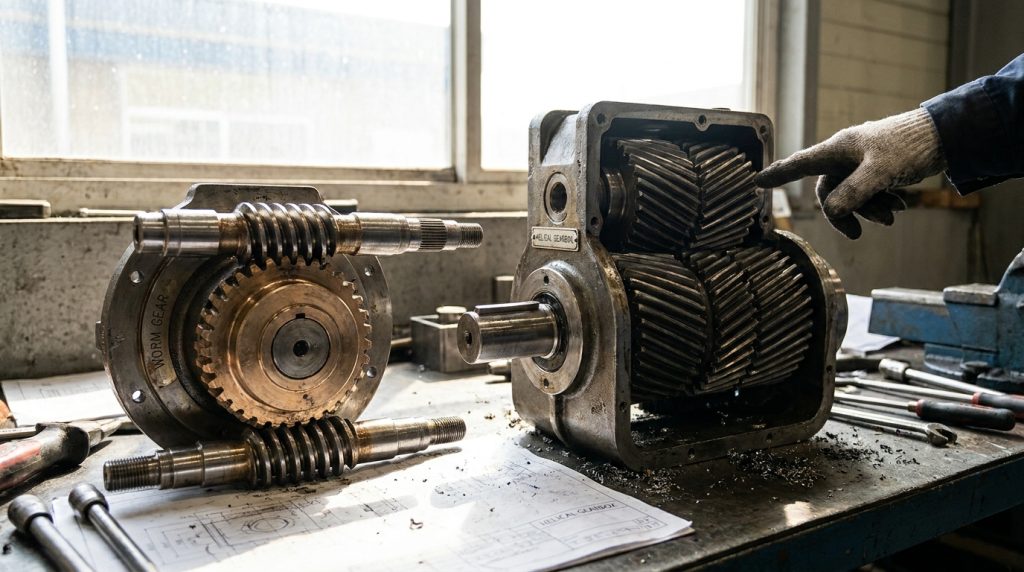
A worm gearbox consists of two primary components: a worm screw (similar to a screw thread) and a worm wheel (a gear that meshes with the worm). The worm screw is typically the input shaft, driven by a motor. As the worm screw rotates, its threads engage with the teeth of the worm wheel, causing the wheel to rotate.
The key characteristic of a worm gear drive is that the axis of the worm is perpendicular to the axis of the worm wheel. This arrangement allows for a significant speed reduction and a corresponding increase in torque in a single stage. The helix angle of the worm thread is shallow, which contributes to the high gear ratios achievable.
A significant advantage of worm gear drives is their inherent self-locking capability. Due to the shallow helix angle and the friction between the worm and the wheel, it is often impossible to back-drive the worm wheel. This means that the output shaft cannot rotate the input shaft. This property is invaluable in applications where holding a load in position is critical, such as hoists, cranes, and conveyors where a sudden power failure could lead to dangerous load descent.
The Mechanics of Helical Gear Drives
Helical gearboxes employ gears with teeth that are cut at an angle to the axis of the gear. This angle is known as the helix angle. When two helical gears mesh, the teeth engage gradually along the face of the tooth, rather than all at once as in spur gears.
The teeth of helical gears form a helix shape, resembling a portion of a screw thread. In a typical helical gearbox, the input and output shafts are parallel. The meshing action of helical gears results in a smooth, quiet, and efficient power transmission. The angled teeth distribute the load over a larger area, which reduces stress on individual teeth and increases the load-carrying capacity compared to spur gears of the same size.
Helical gearboxes can be configured in single or multiple stages to achieve desired speed reductions and torque increases. By combining multiple helical gear pairs, high gear ratios can be achieved, although generally not as high as those attainable with a single-stage worm gear drive. Unlike worm gear drives, helical gear drives are not inherently self-locking. The output shaft can typically be back-driven, which may require the addition of braking systems in certain applications.
Applications and Suitability of Worm Gearboxes
Worm gearboxes are chosen for applications where high torque multiplication, compact design, and the ability to hold a load are paramount. Their unique characteristics lend themselves to a variety of industrial uses.
High Torque Reduction in Compact Spaces
The primary strength of worm gearboxes lies in their ability to achieve very high gear ratios in a single stage. This means a significant speed reduction and torque increase can be accomplished within a relatively small and compact housing. This is particularly advantageous in applications where space is limited, such as on packaging machinery, food processing equipment, and automated assembly lines.
Applications Benefiting from Self-Locking Properties
The self-locking feature of worm gear drives is a critical advantage in applications where the driven load must be held stationary without the need for external braking mechanisms.
- Lifting Equipment: In hoists, cranes, and winches, the self-locking nature prevents the load from dropping in case of power interruption. This is a fundamental safety feature.
- Conveyor Systems: For inclined or vertical conveyors, worm gearboxes can hold the material in place when the drive is stopped, preventing slippage or rollback.
- Material Handling: Palletizers, lifts, and automated storage systems often utilize worm gear drives to precisely position and hold loads.
Other Common Worm Gearbox Applications
Beyond their self-locking capabilities, worm gearboxes are found in numerous industrial settings:
- Actuators: Linear and rotary actuators often incorporate worm drives for precise positional control and high output torque.
- Printing Presses: Used for adjusting roller positions and providing necessary torque for material feeding.
- Industrial Mixers and Agitators: Providing the high torque required to mix viscous materials.
- Machine Tools: In certain applications for power feed mechanisms.
Advantages and Disadvantages of Worm Gearboxes
Advantages:
- High Gear Ratios: Can achieve very high reduction ratios in a single stage.
- Compact Design: Offer high torque density, making them suitable for space-constrained applications.
- Self-Locking Capability: Essential for safety and positional holding.
- Quiet Operation: Generally quieter than other gear types due to the sliding contact between worm and wheel.
- Smooth Torque Transmission: Provides a consistent and smooth output.
Disadvantages:
- Lower Efficiency: Compared to helical gearboxes, worm gear drives generally have lower efficiency, especially at higher reduction ratios. This is due to the sliding friction between the worm and the wheel, which generates heat.
- Heat Generation: The lower efficiency leads to significant heat generation, often requiring cooling mechanisms (e.g., fins on the housing, oil coolers) and specific lubrication.
- Wear: The sliding action can lead to higher wear rates, particularly on the worm wheel, necessitating regular maintenance and lubrication.
- Limited Back-Driving: While often an advantage, the inability to easily back-drive can be a disadvantage if manual adjustment of the output shaft is required.
- Cost: For very high power applications, the cost of a high-efficiency helical gearbox might be comparable or even lower than a worm gearbox with robust cooling and lubrication systems.
Applications and Suitability of Helical Gearboxes
Helical gearboxes are a workhorse in many industrial sectors due to their robustness, efficiency, and versatility. They excel in applications requiring high speed and torque, smooth operation, and long service life.
High-Speed and High-Torque Applications
The efficient meshing of helical gear teeth makes them ideal for applications involving high speeds and substantial torque loads. Their ability to transmit power smoothly and quietly is also a significant benefit.
- Automotive Industry: Found in transmissions and differentials for their efficiency and quiet operation.
- Manufacturing Plants: Used in heavy-duty conveyors, crushers, shredders, and presses.
- Mining and Aggregate: Robust helical gearboxes are employed in crushers, screens, and bulk material handling systems where durability is key.
- Power Generation: Used in large machinery and auxiliary systems.
Applications Requiring Smooth and Quiet Operation
The gradual engagement of helical gear teeth minimizes vibration and noise, making them a preferred choice in environments where noise reduction is important or where smooth operation is critical for product quality.
- Food and Beverage Processing: Gentle product handling and hygienic design requirements.
- Pharmaceutical Manufacturing: Precise control and quiet operation for sensitive processes.
- Textile Machinery: Smooth power delivery for delicate fabric processing.
General Purpose Power Transmission
Beyond specialized applications, helical gearboxes are widely used for general power transmission tasks across various industries, providing reliable and efficient speed reduction and torque increase.
- Pumps and Fans: Driving centrifugal pumps and large industrial fans.
- Mixers and Blenders: For less viscous materials or where extremely high torque is not the primary driver.
- Machine Tools: In various feeding and driving mechanisms.
- Agricultural Machinery: Powering harvesters, balers, and other heavy equipment.
Advantages and Disadvantages of Helical Gearboxes
Advantages:
- High Efficiency: Significantly more efficient than worm gear drives, especially at lower gear ratios. This translates to lower energy consumption and less heat generation.
- High Load Capacity: The angled teeth distribute load over a larger surface area, allowing for higher torque transmission capabilities.
- Durability and Long Service Life: Robust construction and efficient operation contribute to extended operational life.
- Smooth and Quiet Operation: Minimal vibration and noise due to gradual tooth engagement.
- Versatility: Can be configured in single, double, or multiple stages for a wide range of gear ratios.
- Reversible: Most helical gearboxes can be back-driven, offering flexibility in certain applications.
Disadvantages:
- Axial Thrust: The helical angle creates an axial thrust component along the shaft, which must be accommodated by appropriate bearing arrangements.
- Noise at High Speeds: While generally quiet, at very high speeds, noise levels can increase compared to some other gear types.
- Cost: For extremely high gear ratios, multiple stages may be required, increasing the complexity and cost of the gearbox.
- Not Inherently Self-Locking: Requires external braking systems if the load needs to be held stationary without power.
When considering the advantages of different gearbox types, it’s also important to explore related topics that can enhance your understanding of mechanical systems. For instance, if you’re interested in optimizing performance in various applications, you might find it useful to read about essential factors in selecting contractors for specific repairs. This article provides valuable insights that can help you make informed decisions in your projects. You can check it out here: top tips for choosing the best roof leak repair contractors.
Comparing Worm Gear and Helical Gearbox Performance
A direct comparison highlights the distinct strengths and weaknesses of each gearbox type, guiding the selection process based on specific operational requirements.
Efficiency and Power Loss
Efficiency is a critical factor influencing energy consumption and operational costs. Worm gearboxes, due to the sliding friction between the worm and wheel, typically exhibit efficiencies ranging from 50% to 90%, with efficiency decreasing significantly as the gear ratio increases. Single-stage worm gear efficiency at lower ratios might be around 85-90%, but it can drop to 50-70% for very high ratios (e.g., 100:1).
Helical gearboxes, on the other hand, benefit from rolling contact between teeth, leading to much higher efficiencies, typically ranging from 95% to 98% per stage. Even with multiple stages, the overall efficiency of a helical gearbox remains considerably higher than that of a comparable worm gearbox, especially for moderate to high gear ratios. This translates into lower energy bills and reduced heat generation.
Torque and Speed Capabilities
Worm gearboxes excel in providing extremely high torque multiplication at low output speeds within a compact unit. They are ideal for applications where a large reduction in speed is needed, and high starting torque is required. However, their rotational speed limit is generally lower than that of helical gearboxes due to heat build-up and potential wear.
Helical gearboxes can handle a wider range of speeds, both low and high, and can transmit very high torques. They are suitable for high-speed input applications and can be designed for very demanding torque requirements. While they can achieve high gear ratios through multiple stages, the torque multiplication in a single stage is less dramatic than with a worm gear.
Space Requirements and Mounting Configurations
Worm gearboxes are renowned for their compact size relative to the torque they can transmit. This “high torque density” makes them indispensable in applications where space is at a premium. Their perpendicular shaft arrangement also offers flexibility in mounting.
Helical gearboxes, especially multi-stage units for high reduction ratios, can be physically larger. However, their parallel shaft arrangement is very common and often integrates seamlessly into existing machinery designs.
Noise and Vibration
The sliding contact in worm gearboxes generally results in quieter operation compared to spur gears. However, helical gearboxes, with their smooth, rolling contact, often offer even quieter and smoother operation, particularly at higher speeds. The gradual engagement of helical teeth minimizes impact and vibration.
Self-Locking and Back-Driving
This is a defining characteristic. Worm gearboxes inherently offer self-locking, a crucial safety feature in many lifting and holding applications. Helical gearboxes are not inherently self-locking and usually require external braking systems if this functionality is needed. The ability to back-drive a helical gearbox can be an advantage for manual adjustments or in specific drive train designs.
Maintenance and Lubrication
Worm gearboxes require specialized lubrication, often high-viscosity oils, to manage the heat generated by sliding friction and to reduce wear on the bronze worm wheel. Regular oil changes and inspection for wear are critical.
Helical gearboxes typically use standard industrial gear oils and generally require less frequent maintenance, primarily focusing on lubrication and seal integrity. Their higher efficiency means less stress on the lubricant and components.
When considering the best gearbox for your application, it’s essential to understand the differences between various types, such as worm gears and helical gearboxes. Each has its advantages and disadvantages, which can significantly impact performance and efficiency. For those looking to explore more about tools that can enhance your projects, you might find it helpful to read about the differences between different types of saws in this article on circular, miter, and table saws. Understanding these tools can complement your knowledge of gear systems and improve your overall project outcomes.
Selecting the Right Gearbox: A Practical Guide
The choice between a worm gear and a helical gearbox hinges on a thorough analysis of your application’s specific demands. CEM Industrial Supply assists clients in making this critical decision.
Key Selection Criteria
To make an informed choice, consider the following factors:
- Required Gear Ratio:
- High Ratio (e.g., > 50:1): Worm gearboxes often provide this in a single stage, offering a compact solution.
- Moderate to High Ratio: Helical gearboxes can achieve this through multiple stages, offering higher efficiency.
- Torque Requirements:
- High Output Torque at Low Speed: Worm gearboxes excel here due to their torque multiplication.
- High Throughput Torque: Helical gearboxes can handle significant torques and are suitable for high-power applications.
- Speed Requirements:
- Low Output Speed, Moderate Input Speed: Both can work, but worm gears are common for extreme reductions.
- High Input or Output Speeds: Helical gearboxes are generally preferred for their efficiency and lower heat generation at higher speeds.
- Efficiency and Energy Consumption:
- Prioritize Energy Savings: Helical gearboxes offer superior efficiency.
- Accept Lower Efficiency for Other Benefits: Worm gears may be acceptable if space or self-locking is paramount.
- Self-Locking Requirement:
- Essential for Safety/Holding: Worm gearboxes are the natural choice.
- Not Required or Managed by Brakes: Helical gearboxes are suitable.
- Space Constraints:
- Limited Space: Worm gearboxes offer high torque density.
- Ample Space: Helical gearboxes are a versatile option.
- Noise and Vibration Sensitivity:
- Minimize Noise/Vibration: Helical gearboxes generally offer smoother and quieter operation.
- Duty Cycle and Operating Environment:
- Heavy-Duty, Continuous Operation: Both can be robust, but factors like heat dissipation and lubrication become critical for worm gears. Helical gears often withstand continuous high loads well.
- Cost Considerations:
- Initial Cost vs. Total Cost of Ownership: While a worm gearbox might seem cheaper initially for high ratios, its lower efficiency and potentially higher maintenance could lead to a higher total cost of ownership compared to a multi-stage helical gearbox.
Application Scenario Examples
Scenario 1: Automated Vertical Lift System
- Need: High torque to lift a heavy load, ability to hold the load when power is off, relatively low output speed.
- Recommendation: Worm Gearbox. The self-locking feature is critical for safety, and the high gear reduction in a compact unit is ideal.
Scenario 2: High-Speed Industrial Fan in a Processing Plant
- Need: Efficient power transmission at relatively high speeds, smooth operation, long service life.
- Recommendation: Helical Gearbox. High efficiency minimizes energy consumption, and smooth operation is desirable.
Scenario 3: Conveyor for Bulk Material Handling in a Mining Operation
- Need: High torque to move dense materials, durability, robustness in harsh environments.
- Recommendation: Helical Gearbox. Their high load capacity and durability make them suitable for demanding mining applications. If inclines are significant and holding is a concern, a worm drive might be considered for specific segments or supplementary braking added to a helical drive.
Table: Worm Gear vs. Helical Gearbox Comparison
| Feature | Worm Gearbox | Helical Gearbox |
| : | :– | :– |
| Gear Type | Worm screw and worm wheel | Helical gears |
| Shaft Arrangement | Perpendicular | Parallel |
| Gear Ratio | Very High (single stage) | Moderate to High (multi-stage) |
| Efficiency | Lower (50-90%), decreases with ratio | Higher (95-98% per stage) |
| Torque Multiplication | Very High | Moderate to High |
| Speed Capability| Lower maximum speeds | Higher maximum speeds |
| Self-Locking | Yes (inherent) | No (requires external braking) |
| Noise/Vibration | Generally quiet | Very quiet and smooth |
| Heat Generation | High (due to sliding friction) | Low (due to rolling contact) |
| Wear | Higher (especially on wheel) | Lower |
| Space Efficiency| High torque density, compact | Can be larger for high ratios |
| Applications | Lifting, positioning, high reduction needs | General power transmission, high speed, high load |
Maintenance, Troubleshooting, and Safety for Gearboxes
Proper maintenance and prompt troubleshooting are essential for extending the lifespan and ensuring the reliable operation of any industrial gearbox, whether worm or helical.
Essential Maintenance Practices
For Both Worm and Helical Gearboxes:
- Lubrication: This is the most critical aspect.
- Regular Oil Level Checks: Ensure the oil level is within the manufacturer’s specified range.
- Scheduled Oil Changes: Follow the manufacturer’s recommended oil change intervals, which depend on operating hours, load, temperature, and the type of lubricant.
- Lubricant Analysis: Consider periodic oil analysis to detect wear particles, contamination, or lubricant degradation. This can predict potential failures before they occur.
- Seals and Gaskets: Inspect regularly for leaks. Damaged seals can lead to lubricant loss and contamination, causing premature wear and potential failure.
- Mounting Integrity: Ensure the gearbox is securely mounted and that mounting bolts are tight. Vibration can loosen fasteners.
- Noise and Vibration Monitoring: Listen for unusual noises (grinding, knocking) or excessive vibration. These are often early indicators of internal damage or misalignment.
- Temperature Monitoring: Use temperature gauges or infrared thermometers to monitor gearbox operating temperatures. Excessive heat can indicate lubrication issues or overload.
Specific to Worm Gearboxes:
- Bronze Wheel Wear: Monitor the worm wheel for wear. Signs of wear include a change in tooth profile or excessive backlash.
- Lubricant Viscosity: Worm gears often require specific high-viscosity lubricants designed for sliding friction. Ensure the correct type is used.
Specific to Helical Gearboxes:
- Bearing Health: Pay attention to bearing noise and vibration, as they are crucial for the smooth rotation of helical gears.
- Axial Thrust Bearings: Ensure the bearings designed to handle axial thrust are functioning correctly.
Common Troubleshooting Scenarios
| Symptom | Potential Cause (Worm Gear) | Potential Cause (Helical Gear) | Recommended Action |
| :- | : | : | : |
| Overheating | Low oil level, wrong lubricant, overload, poor ventilation | Low oil level, overload, worn bearings, high ambient temp | Check oil, reduce load, improve ventilation, check for damage |
| Excessive Noise/Vibration | Worn gears, loose mounting, misaligned shafts, bearing failure | Worn gears, misaligned shafts, bearing failure, foreign object | Inspect gears, tighten mounting, check alignment, replace bearings |
| Leaking Oil | Damaged seals, gaskets, overfilling, high pressure | Damaged seals, gaskets, overfilling, high pressure | Replace seals/gaskets, drain excess oil, check pressure |
| Reduced Output Torque | Slipping clutch (if applicable), internal damage, low oil | Internal damage (worn gears, broken teeth), low oil | Inspect for internal damage, check oil level, assess torque output |
| Difficulty in Back-Driving | Normal operation (self-locking) | Obstruction, bearing seizure, severe internal damage | If abnormal for helical, investigate immediately |
Safety Precautions for Gearbox Operation and Maintenance
- Lockout/Tagout Procedures: Always implement strict lockout/tagout procedures before performing any maintenance or inspection on a gearbox or the machinery it is connected to.
- Personal Protective Equipment (PPE): Wear appropriate PPE, including safety glasses, gloves, and hearing protection, especially during maintenance.
- Hot Surfaces: Gearboxes can operate at high temperatures. Allow them to cool down sufficiently before touching them.
- Moving Parts: Be aware of pinch points and rotating components.
- Proper Lifting Techniques: Use appropriate lifting equipment and techniques when handling heavy gearboxes.
- Ventilation: Ensure adequate ventilation around gearboxes, especially worm gears, to dissipate heat.
- Emergency Stops: Know the location of emergency stop buttons for the machinery.
- Manufacturer’s Manuals: Always refer to the specific manufacturer’s operation and maintenance manual for your gearbox model.
When to Consider Industrial Gearbox Repair or Rebuilding Services
Even with diligent maintenance, gearboxes can eventually wear out or suffer damage. For industrial plants in Coldwater, Michigan, and surrounding areas, CEM Industrial Supply offers expert gearbox repair and rebuilding services.
Signs Your Gearbox Needs Professional Attention
- Persistent Overheating: Beyond normal operating temperatures, indicating an underlying issue.
- Constant Unusual Noises: Grinding, squealing, or clanking that cannot be attributed to normal operation.
- Visible Wear or Damage: Cracked housings, worn gear teeth, or damaged shafts.
- Significant Oil Contamination: Metal shavings or debris in the oil can signal internal wear or damage.
- Sudden Loss of Torque or Speed: A drastic drop in performance suggests a serious internal problem.
- Frequent Leaks: Persistent oil leaks that cannot be resolved by replacing seals.
- End of Expected Service Life: Even well-maintained gearboxes have a finite lifespan.
The Benefits of Professional Gearbox Repair and Rebuilding
- Cost-Effectiveness: Repairing or rebuilding a gearbox is often significantly less expensive than purchasing a new one.
- Minimized Downtime: CEM Industrial Supply understands the critical nature of industrial operations. Our repair services aim to minimize downtime through efficient diagnostics and rapid turnaround times.
- Restored Performance: Expert technicians can diagnose and fix issues that may be beyond the scope of routine maintenance, restoring the gearbox to optimal performance.
- Extended Equipment Life: Professional rebuilding can significantly extend the operational life of your existing gearboxes.
- Customization and Upgrades: During rebuilding, CEM can often incorporate upgrades to enhance performance, efficiency, or durability, such as improved seals, higher-grade lubricants, or modified cooling systems.
- Warranty: Reputable repair services typically offer warranties on their work, providing peace of mind.
CEM Industrial Supply specializes in the repair and rebuilding of a wide range of industrial gearboxes, including worm gear and helical gear types, from various manufacturers. Our experienced team utilizes advanced diagnostic tools and precision machining techniques to ensure your gearboxes are returned to optimal working condition.
Frequently Asked Questions About Worm Gear vs. Helical Gearboxes
Q1: Which type of gearbox is more energy-efficient, worm or helical?
A1: Helical gearboxes are generally significantly more energy-efficient than worm gearboxes. This is due to the rolling contact between helical gear teeth, which results in lower friction losses compared to the sliding contact found in worm gear drives.
Q2: When is the self-locking feature of a worm gearbox essential?
A2: The self-locking feature of a worm gearbox is essential in applications where the load must be held stationary when power is removed. This is crucial for safety in lifting equipment (hoists, cranes), preventing accidental descent, and in material handling systems where slippage could cause damage or hazards.
Q3: Can helical gearboxes be used for applications requiring high gear ratios?
A3: Yes, helical gearboxes can achieve high gear ratios by employing multiple stages. While a single-stage worm gearbox can offer a very high ratio, multiple stages of helical gearing provide an efficient alternative for high reduction needs, albeit in a potentially larger footprint.
Q4: What are the primary causes of gearbox failure, and how can they be prevented?
A4: Common causes of gearbox failure include inadequate lubrication, contamination of the lubricant, overloading, improper alignment, wear and tear over time, and seal failure leading to leakage. Prevention involves adhering to strict lubrication schedules, using high-quality lubricants, performing regular inspections, monitoring operating temperatures and noise levels, and ensuring proper installation and alignment.
Q5: How do I determine whether my application requires a worm gear or a helical gearbox?
A5: The selection depends on your specific requirements, including the desired gear ratio, torque and speed demands, the need for self-locking capability, space constraints, efficiency targets, and noise considerations. For high torque multiplication with self-locking needs in a compact space, a worm gear is often ideal. For high efficiency, smooth operation, and higher speed capabilities, a helical gearbox is typically preferred. Consulting with an industrial supply expert like CEM Industrial Supply can provide tailored recommendations.
Conclusion
The choice between a worm gear and a helical gearbox is not a matter of one being universally “better” than the other, but rather about selecting the optimal solution for a specific industrial application. Worm gearboxes shine in scenarios demanding high torque multiplication, compact design, and indispensable self-locking capabilities. Conversely, helical gearboxes excel in applications prioritizing high efficiency, smooth and quiet operation, and robust performance across a broad spectrum of speeds and loads.
By carefully considering the criteria outlined in this guide – gear ratio, torque, speed, efficiency, self-locking requirements, space, noise, and duty cycle – you can confidently navigate the selection process. Remember that proper installation, diligent maintenance, and timely troubleshooting are paramount to maximizing the lifespan and performance of any gearbox.
For plant managers, maintenance professionals, and equipment buyers in Coldwater, Michigan, and the surrounding regions, CEM Industrial Supply is your trusted partner for all your industrial gearbox needs. Whether you are looking for new equipment, require expert advice on selecting the right gearbox for your application, or need professional industrial gearbox repair or rebuilding services to restore your existing units to peak performance, our team is ready to assist. Contact CEM Industrial Supply today to discuss your specific requirements and discover how we can optimize your industrial power transmission solutions.