
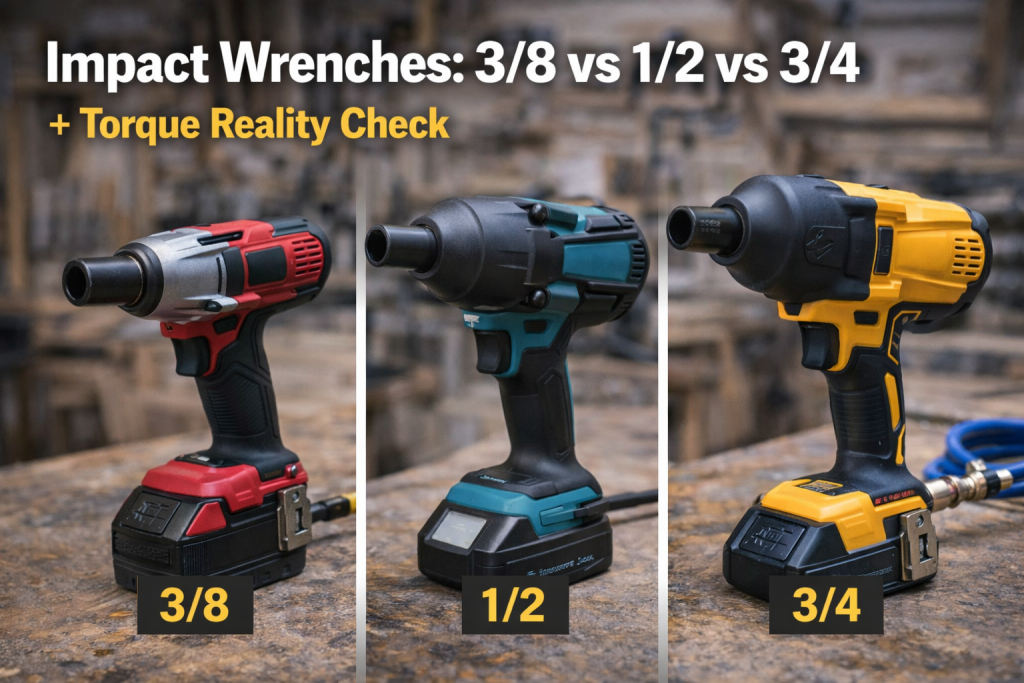
Impact wrenches are one of the most misunderstood tools on the job site. Bigger doesn’t always mean better, higher torque numbers don’t always mean more usable power, and the wrong drive size can actually make work harder—not easier.
At CEM Industrial Supply in Coldwater, Michigan, impact wrench confusion shows up daily. People burn out tools, snap fasteners, or struggle with stuck bolts simply because the drive size doesn’t match the job. Here’s a clear, real-world breakdown of 3/8, 1/2, and 3/4 impact wrenches—and what torque ratings actually mean.
What Impact Wrenches Are Designed to Do
Impact wrenches deliver short, high-energy rotational blows instead of steady torque. That impact action breaks fasteners loose without requiring constant pressure from the user.
Impact wrenches are best for:
- Removing stubborn or rusted fasteners
- Automotive and equipment repair
- Structural bolting
- Production fastening work
- Situations where hand tools fail
They are not precision torque tools. Final torque should always be verified with a torque wrench when accuracy matters.
3/8-Inch Drive Impact Wrenches: Speed and Control
3/8-inch impact wrenches are compact, fast, and easy to control. They’re often underestimated because of their size.
Best used for:
- Automotive interior and engine bay work
- Light mechanical repairs
- Smaller fasteners
- Tight spaces
Typical torque range:
- Roughly 150–300 ft-lbs
These tools shine where speed and access matter more than brute force. They reduce fatigue and are less likely to snap smaller fasteners.
1/2-Inch Drive Impact Wrenches: The All-Around Workhorse
The 1/2-inch impact wrench is the most common and versatile option.
Best used for:
- Automotive lug nuts
- Suspension work
- Equipment maintenance
- General industrial fastening
- Medium-duty structural bolts
Typical torque range:
- Roughly 400–1,000+ ft-lbs (depending on model)
If you only own one impact wrench, this is usually the right choice. It balances power, size, and versatility better than any other drive size.
3/4-Inch Drive Impact Wrenches: Heavy-Duty Power
3/4-inch impact wrenches are built for serious torque and repeated heavy work.
Best used for:
- Heavy equipment
- Structural steel
- Large fasteners
- Industrial maintenance
- Fleet and agricultural equipment
Typical torque range:
- 1,200–2,000+ ft-lbs
These tools are heavier, louder, and more demanding—but necessary when fasteners are large, seized, or structural.
Torque Ratings: The Reality Check
Torque numbers on boxes are often misunderstood. Manufacturers may advertise:
- Max torque
- Breakaway torque
- Nut-busting torque
These numbers are not sustained working torque. Real-world performance depends on:
- Battery size (cordless)
- Air supply (pneumatic)
- Socket quality
- Fastener condition
- Technique
A lower-rated tool with proper sockets often outperforms a higher-rated tool used incorrectly.
Drive Size Matters More Than Torque Alone
Using too large of an impact wrench causes:
- Broken fasteners
- Stripped threads
- Operator fatigue
- Loss of control
Using too small of an impact wrench causes:
- Slow removal
- Overheating
- Tool wear
- Frustration
Matching drive size to fastener size and application is more important than chasing torque numbers.
Pneumatic vs Cordless Impact Wrenches
Cordless impact wrenches offer mobility and convenience. Pneumatic impacts still dominate in shops where continuous use and consistent power matter.
In both cases, air pressure or battery size directly affects real torque output.
Common Impact Wrench Mistakes
At CEM Industrial Supply, these mistakes cause most issues:
- Believing advertised torque numbers without context
- Using chrome sockets instead of impact-rated sockets
- Oversizing the tool for small fasteners
- Undersizing the tool for structural work
- Skipping final torque verification
If bolts are breaking or not coming loose, the setup—not the tool—is usually the issue.
Choosing the Right Impact Wrench
3/8-inch: Speed, control, light-duty work
1/2-inch: Versatility, general-purpose use
3/4-inch: Heavy-duty, industrial applications
Buying the right size once saves money, tools, and time.
Get the Right Impact Setup
At CEM Industrial Supply in Coldwater, Michigan, we help customers choose impact wrenches, sockets, extensions, and air or battery setups that actually work in the real world. If your impact wrench isn’t performing the way you expect, the drive size or setup is usually the fix.
Stop in or call and talk to someone who uses these tools every day.
Frequently Asked Questions
Is more torque always better?
No. Excess torque can damage fasteners and tools.
Can a 3/8-inch impact remove lug nuts?
Sometimes, but a 1/2-inch impact is the correct tool.
Do advertised torque ratings matter?
They’re useful for comparison, but not a guarantee of real-world performance.
Should I still use a torque wrench?
Yes. Impact wrenches are not precision tools.