
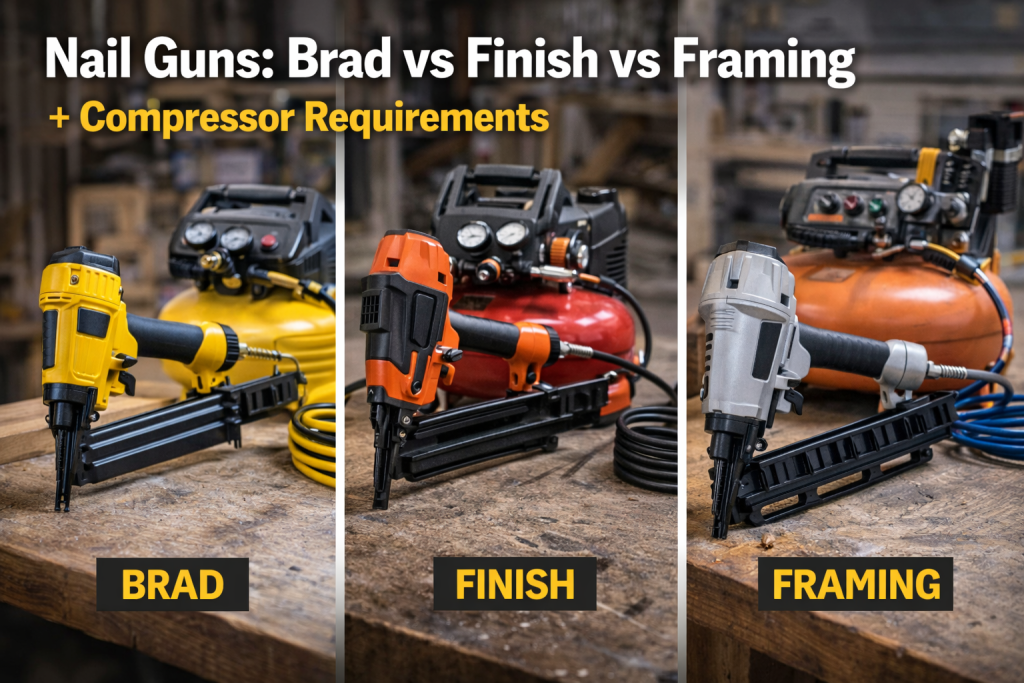
Choosing the right nail gun isn’t about brand—it’s about matching the fastener, tool, and air supply to the job. Using the wrong nailer leads to split trim, weak joints, overdriven fasteners, or wasted time fixing mistakes.
At CEM Industrial Supply in Coldwater, Michigan, nail gun confusion is one of the most common counter conversations we have. Once you understand the difference between brad nailers, finish nailers, and framing nailers—and what kind of compressor each one needs—the decision becomes simple.
What Nail Guns Are Designed to Do
Nail guns are built for speed, consistency, and holding power. Each type fires a different nail size and is designed for a specific range of materials and structural demands.
Using a nail that’s too small causes weak holds. Using one that’s too large damages material and creates unnecessary repairs.
Brad Nailers: Light-Duty Precision
Brad nailers use 18-gauge brad nails. These nails are thin and leave very small holes, making them ideal for delicate work.
Best used for:
- Light trim
- Small molding
- Crafts and hobby projects
- Tacking pieces in place before glue dries
- Thin materials and soft woods
Brad nailers are not structural tools. They provide holding power for alignment, not load-bearing strength.
Typical nail length:
- 5/8 inch to 2 inches
Finish Nailers: Trim and Cabinet Workhorses
Finish nailers use thicker nails—typically 16-gauge or 15-gauge—and provide significantly more holding power than brad nailers.
Best used for:
- Baseboards and casing
- Door and window trim
- Cabinet installation
- Stair parts
- Heavier molding
Finish nailers strike a balance between strength and clean appearance. The holes are larger than brads but still easy to fill and finish.
Typical nail length:
- 1 inch to 2-1/2 inches
Framing Nailers: Structural Power
Framing nailers are built for construction and structural work. They fire large nails designed to hold framing members together under load.
Best used for:
- Framing walls
- Deck construction
- Sheds and outbuildings
- Fencing
- Heavy-duty carpentry
These tools are powerful, loud, and not subtle. They are designed to sink nails quickly into dense lumber.
Typical nail length:
- 2 inches to 3-1/2 inches
Brad vs Finish vs Framing: Real-World Differences
Brad nailers prioritize precision and minimal surface damage.
Finish nailers prioritize strength and clean installation.
Framing nailers prioritize speed and structural holding power.
If a joint needs glue, use brads.
If it needs to stay put, use finish nails.
If it needs to carry weight, use framing nails.
Compressor Requirements Explained
Air supply matters more than most people realize. A nail gun is only as reliable as the compressor feeding it.
Brad nailer compressor requirements:
- Low air demand
- Small pancake or portable compressor
- Typically 1–2 CFM at 90 PSI
Finish nailer compressor requirements:
- Moderate air demand
- Portable or mid-size compressor
- Typically 2–4 CFM at 90 PSI
Framing nailer compressor requirements:
- High air demand
- Larger tank and higher output
- Typically 4+ CFM at 90 PSI
Using an undersized compressor causes pressure drops, misfires, and inconsistent nail depth.
Cordless vs Pneumatic Nailers
Cordless nailers offer convenience and mobility, especially for punch-list work and small jobs. Pneumatic nailers remain preferred for long work sessions due to lighter weight, faster cycling, and lower long-term cost.
Air tools still dominate framing and production environments.
Common Nail Gun Mistakes
At CEM Industrial Supply, these mistakes cause most issues:
- Using brads where finish nails are needed
- Using finish nailers for framing work
- Running framing nailers on undersized compressors
- Ignoring PSI and CFM requirements
- Using the wrong nail length for material thickness
If nails aren’t holding or sinking properly, the tool or air supply is usually wrong.
Choosing the Right Setup the First Time
Brad nailer + small compressor = trim and light work
Finish nailer + mid-size compressor = professional trim and installs
Framing nailer + high-output compressor = structural work
Buying the correct tool once is cheaper than replacing damaged material or redoing work.
Get the Right Nail Gun and Compressor
At CEM Industrial Supply in Coldwater, Michigan, we help contractors, maintenance teams, and DIYers match nail guns, nails, hoses, and compressors correctly. If your nailer isn’t performing the way it should, the setup—not the tool—is usually the issue.
Stop in or call and get set up right.
Frequently Asked Questions
Can a brad nailer replace a finish nailer?
No. Brad nailers lack the holding power needed for trim and cabinets.
Do framing nailers require larger compressors?
Yes. Framing nailers have much higher air demand.
Is cordless better than pneumatic?
Cordless is convenient; pneumatic is better for long jobs and consistent performance.
What PSI do nail guns use?
Most operate between 70 and 120 PSI, depending on the model.