
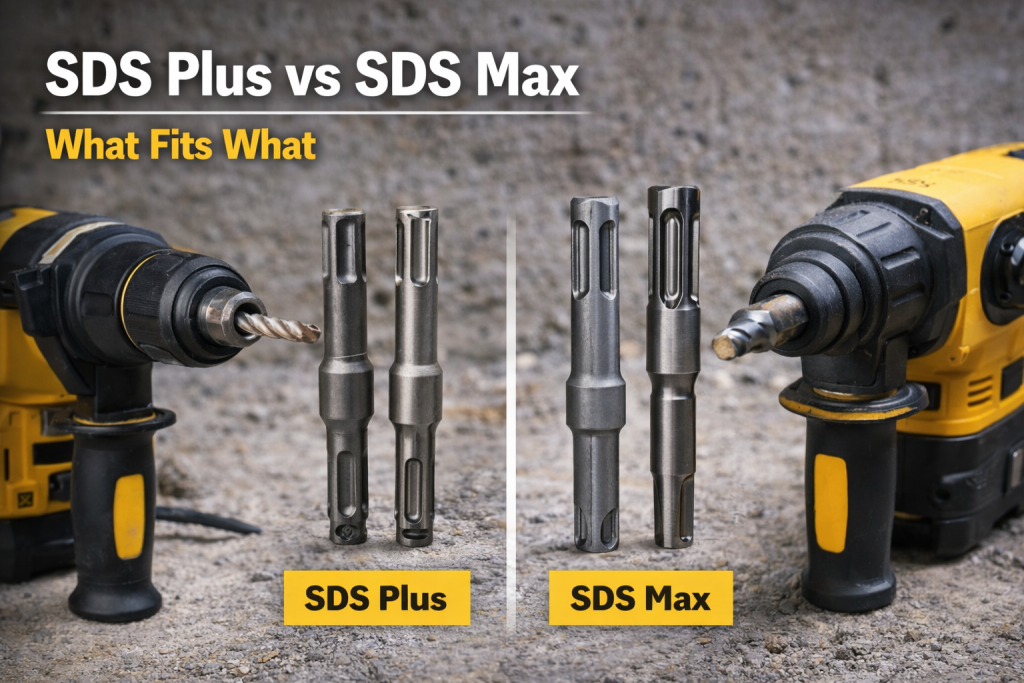
If you’ve ever tried to force the wrong bit into a rotary hammer, you already know this lesson the hard way: SDS Plus and SDS Max are not interchangeable. They’re built for different tools, different workloads, and very different levels of impact energy.
At CEM Industrial Supply in Coldwater, Michigan, SDS fitment confusion is one of the most common reasons customers struggle with concrete drilling. Once you understand what SDS Plus and SDS Max are designed for—and which one fits your work—the choice becomes simple.
What SDS Actually Means
SDS stands for a slotted shank system that allows the drill bit to slide slightly inside the chuck. That movement lets the rotary hammer deliver impact energy directly into the bit instead of fighting against a traditional chuck.
This is why rotary hammers drill concrete faster, cooler, and with far less effort than hammer drills.
SDS Plus: The Most Common Rotary Hammer System
SDS Plus is the most widely used rotary hammer bit system and covers the majority of anchor and concrete drilling jobs.
SDS Plus is best for:
- Light to medium concrete drilling
- Anchor holes
- Rebar-sized drilling
- Electrical, plumbing, and HVAC work
- Maintenance and general construction
Typical hole size range:
- About 3/16 inch up to 1 inch
- Most efficient under 3/4 inch
SDS Plus tools are lighter, more maneuverable, and easier to use overhead or in tight spaces. For most contractors and maintenance teams, SDS Plus handles 80–90 percent of concrete drilling needs.
SDS Max: Built for Heavy-Duty Work
SDS Max is designed for larger, more powerful rotary hammers and significantly heavier work.
SDS Max is best for:
- Large-diameter holes
- Deep concrete drilling
- Structural concrete
- Chipping and demolition
- Commercial and industrial applications
Typical hole size range:
- Roughly 3/4 inch and larger
- Can exceed 2 inches depending on bit type
SDS Max bits are thicker, heavier, and designed to withstand much higher impact energy. These tools are not about finesse—they’re about power and endurance.
Key Differences Between SDS Plus and SDS Max
SDS Plus bits have a smaller shank diameter and lighter construction. SDS Max bits are larger, heavier, and built for extreme impact forces.
SDS Plus tools prioritize control and versatility. SDS Max tools prioritize raw drilling power and demolition capability.
Trying to use an SDS Plus bit in an SDS Max tool—or vice versa—won’t work and can damage the tool.
Common Fitment Mistakes
At CEM Industrial Supply, these are the most common SDS-related mistakes:
- Buying SDS Max bits for an SDS Plus rotary hammer
- Assuming SDS Plus can handle large, deep holes
- Using adapters instead of the correct system
- Choosing bit size before choosing the right tool
Fitment always starts with the tool, not the hole size.
Choosing the Right System for Your Work
Choose SDS Plus if:
- Most holes are under 3/4 inch
- You’re installing anchors or fasteners
- You need mobility and control
- Work is light to medium duty
Choose SDS Max if:
- You drill large or deep holes regularly
- You’re working in structural concrete
- You need chiseling or demolition capability
- Speed and durability matter more than weight
Buying bigger than necessary usually adds cost, fatigue, and frustration without improving results.
Bits Matter Just as Much as the Tool
Even the correct SDS system performs poorly with worn or incorrect bits.
Common bit mistakes include:
- Using dull carbide tips
- Drilling without clearing dust
- Applying excessive pressure
- Using worn shanks that reduce impact transfer
Most drilling problems are solved by matching the bit to the tool and the job.
Get the Right SDS Setup the First Time
At CEM Industrial Supply in Coldwater, Michigan, we help contractors, maintenance teams, and DIYers choose the correct SDS Plus or SDS Max tools and bits based on how they actually work—not guesswork.
If drilling feels harder than it should, the fitment is usually wrong.
Frequently Asked Questions
Can SDS Plus bits fit in SDS Max tools?
No. The shank sizes and locking systems are different.
Is SDS Max better than SDS Plus?
Not better—just more powerful. It’s only necessary for heavy-duty work.
Can SDS Plus drill concrete?
Yes. It handles most anchor and general concrete drilling jobs.
Do SDS adapters work?
They exist, but they reduce performance and are not recommended for serious work.