
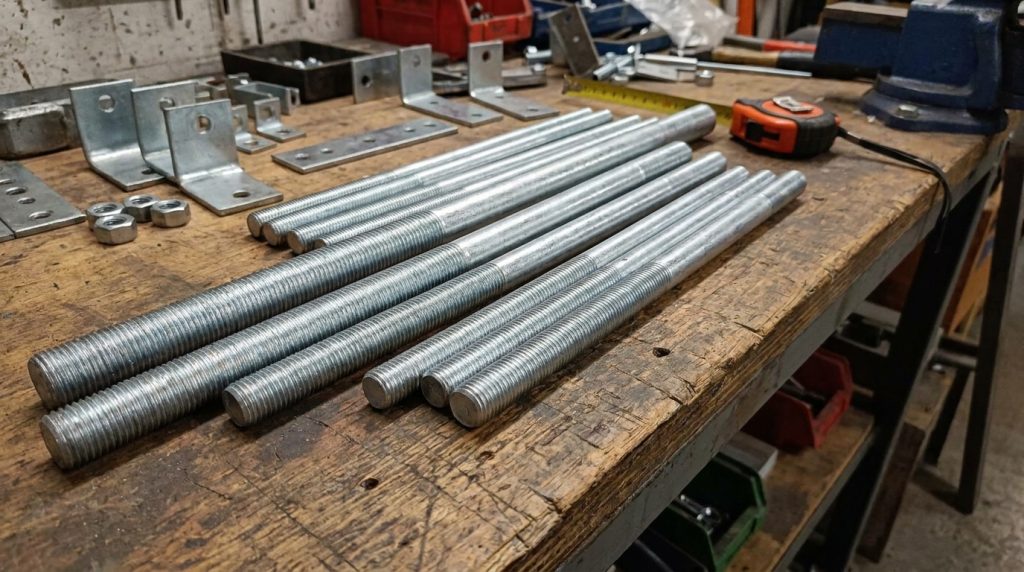
Threaded rod is one of the most versatile fastening products used in construction, maintenance, manufacturing, repair, and industrial assembly. Also called all-thread, threaded bar, studding, or fully threaded rod, it provides continuous external threads along the full length of the rod, allowing nuts, washers, couplers, anchors, and other components to be positioned wherever needed.
For contractors, mechanics, facility maintenance teams, and industrial buyers, choosing the right threaded rod is not just a matter of diameter and length. Material, thread pitch, strength grade, corrosion resistance, coating, and application environment all affect performance and safety.
This threaded rod guide explains common sizes, grades, materials, finishes, and applications so you can source the correct product for structural supports, machinery, pipe hangers, electrical installations, concrete anchoring, and general fabrication.
Threaded rod is a straight metal rod with threads cut or rolled along its entire length or, in some cases, on each end. Because the threads run continuously, users can cut the rod to custom lengths and install nuts at almost any point.
Threaded rod is commonly supplied in standard lengths such as:
- 12 inches
- 24 inches
- 36 inches
- 6 feet
- 10 feet
- 12 feet
It is available in a wide range of diameters, materials, grades, and thread types for light-duty, heavy-duty, structural, and corrosion-resistant applications.
Common Names for Threaded Rod
Depending on the industry or region, threaded rod may be referred to as:
- All-thread rod
- Threaded bar
- Studding
- Ready rod
- Continuous thread rod
- Fully threaded stud
- Threaded metal rod
These terms are often used interchangeably, but specifications matter. For critical applications, always verify the diameter, thread pitch, grade, material, finish, and applicable standard before purchasing or installing.
Fully Threaded vs. Partially Threaded Rod
Most threaded rod used in construction and maintenance is fully threaded. However, some applications use partially threaded studs or rods.
| Type | Description | Common Use |
|---|---|---|
| Fully threaded rod | Threads extend along the entire length of the rod | Pipe supports, hanging systems, bracing, and general fastening |
| Partially threaded rod | Threads are located on one or both ends with an unthreaded center section | Engine studs, structural connections, and custom assemblies |
| Double-end stud | Threaded at both ends with an unthreaded shank in the middle | Flange bolting, industrial machinery, pumps, valves, and automotive applications |
Fully threaded rod offers the most adjustability, while partially threaded studs may provide better alignment, shear strength, or fit in specialized assemblies.
For those looking to deepen their understanding of threaded rods and their various applications, a related article that provides valuable insights is available at CEM Industrial Supply Services. This resource outlines the different services offered, including custom fabrication and sourcing of industrial supplies, which can complement your knowledge of sizes, grades, and applications of threaded rods.
Threaded Rod Sizes and Thread Types
Threaded rod size is typically specified by diameter, thread pitch, and length. For example, a common specification might be:
1/2"-13 x 36" Zinc-Plated ASTM A307 Threaded Rod
This means the rod has a 1/2-inch nominal diameter, 13 threads per inch, a 36-inch length, a zinc-plated finish, and meets ASTM A307 requirements.
Common Inch Threaded Rod Sizes
In the United States, threaded rod is commonly available in UNC coarse threads and, in some cases, UNF fine threads.
| Diameter | Common UNC Thread Pitch | Typical Applications |
|---|---|---|
| 1/4 in. | 20 TPI | Light fixtures, small brackets, and electrical installations |
| 5/16 in. | 18 TPI | Light-duty supports and maintenance repairs |
| 3/8 in. | 16 TPI | Pipe hangers, HVAC supports, and strut systems |
| 1/2 in. | 13 TPI | General construction, anchoring, and equipment supports |
| 5/8 in. | 11 TPI | Heavy-duty hangers and structural supports |
| 3/4 in. | 10 TPI | Concrete anchoring, machinery mounting, and industrial equipment |
| 7/8 in. | 9 TPI | Heavy industrial fastening and structural assemblies |
| 1 in. | 8 TPI | Structural steel connections and heavy equipment applications |
| 1-1/4 in. | 7 TPI | Large structural connections and heavy-duty support systems |
| 1-1/2 in. | 6 TPI | Heavy construction, industrial anchoring, and infrastructure projects |
TPI means threads per inch. A 1/2″-13 rod has 13 threads per inch.
Metric Threaded Rod Sizes
Metric threaded rod is specified by diameter and thread pitch in millimeters. For example:
M12-1.75 x 1 meter
This indicates a 12 mm diameter rod with a 1.75 mm thread pitch.
| Metric Size | Standard Coarse Pitch | Approximate Inch Equivalent |
|---|---|---|
| M6 | 1.0 mm | About 1/4 in. |
| M8 | 1.25 mm | About 5/16 in. |
| M10 | 1.5 mm | About 3/8 in. |
| M12 | 1.75 mm | About 1/2 in. |
| M16 | 2.0 mm | About 5/8 in. |
| M20 | 2.5 mm | About 3/4 in. |
| M24 | 3.0 mm | About 1 in. |
| M30 | 3.5 mm | About 1-1/4 in. |
Metric and inch fasteners are not interchangeable. Always match nuts, washers, couplers, and anchors to the exact thread system.
Coarse Thread vs. Fine Thread
Most threaded rod used in construction is coarse thread because it is easier to install, less likely to cross-thread, and more tolerant of jobsite conditions.
Fine thread may be used when more precise adjustment or higher resistance to loosening is needed.
| Thread Type | Advantages | Common Uses |
|---|---|---|
| Coarse thread | Faster installation, performs well in dirty environments, and is easier to source | Construction, HVAC, pipe supports, and general maintenance |
| Fine thread | Provides more precise adjustment, greater thread engagement per inch, and improved vibration resistance in some applications | Industrial machinery, automotive, and precision equipment |
For general industrial purchasing, UNC coarse threaded rod is the most common choice unless drawings or specifications call for fine thread.
Threaded Rod Grades and Strength Ratings
Threaded rod grade determines its strength, ductility, and suitability for specific applications. For load-bearing work, grade selection is critical.
Strength requirements should be verified against project specifications, engineering drawings, building codes, or equipment manufacturer recommendations.
Low Carbon Steel Threaded Rod
Low carbon steel threaded rod is widely used for general fastening and support applications. It is economical, easy to cut, and suitable for non-critical installations.
Common uses include:
- Electrical conduit supports
- Light pipe hangers
- HVAC duct supports
- Maintenance repairs
- Brackets and fixtures
- General shop fabrication
A common specification for low carbon steel threaded rod is ASTM A307 Grade A, which covers carbon steel bolts, studs, and threaded rod intended for general applications.
ASTM A307 Threaded Rod
ASTM A307 threaded rod is one of the most commonly used all-thread products in construction and maintenance.
Typical applications include:
- General-purpose fastening
- Non-critical structural connections
- Pipe supports
- Equipment mounting where high strength is not required
- Anchoring with proper design approval
ASTM A307 is not a substitute for high-strength structural rod. If the assembly carries significant loads, experiences vibration, or supports life-safety systems, consult the project engineer or applicable standard.
Grade B7 Threaded Rod
ASTM A193 Grade B7 threaded rod is a high-strength alloy steel rod, often heat-treated for improved tensile strength. It is commonly used in pressure piping, flanges, petrochemical plants, power generation, and industrial equipment.
Common uses include:
- Flange bolting
- Pressure vessels
- Valves
- High-temperature service
- Heavy machinery
- Industrial process piping
B7 threaded rod is often paired with compatible heavy hex nuts, such as ASTM A194 Grade 2H nuts, depending on the application.
Grade B8 and B8M Stainless Threaded Rod
ASTM A193 B8 and B8M threaded rods are stainless steel grades used where corrosion resistance is required.
- B8 generally refers to Type 304 stainless steel.
- B8M generally refers to Type 316 stainless steel.
Common applications include:
- Chemical processing
- Marine environments
- Food processing equipment
- Water treatment plants
- Outdoor industrial installations
- Corrosive service environments
316 stainless steel typically offers better resistance to chlorides and harsh chemicals than 304 stainless steel, making it a common choice for coastal, marine, and chemical exposure.
Grade 55 and Grade 105 Anchor Rods
For structural steel and concrete anchoring, threaded rods may be specified under standards such as ASTM F1554.
Common ASTM F1554 anchor rod grades include:
| Grade | General Strength Level | Typical Use |
|---|---|---|
| Grade 36 | Mild-strength carbon steel anchor rod | Light- to moderate-duty structural anchoring and general construction |
| Grade 55 | Medium-strength anchor rod | Building columns, equipment bases, and structural steel connections |
| Grade 105 | High-strength anchor rod | Heavy structural applications, industrial anchoring, and critical equipment foundations |
ASTM F1554 anchor rods may be fully threaded, partially threaded, or headed, depending on design requirements. These are commonly used for embedding into concrete foundations.
Grade Comparison Table
| Specification / Grade | Material Type | Common Application | Notes |
|---|---|---|---|
| ASTM A307 | Low-carbon steel | General construction, maintenance, and light-duty fastening | Economical, general-purpose fastener specification |
| ASTM A193 B7 | Alloy steel | High-strength industrial bolting, pressure vessels, and piping | Commonly used for flanges, valves, and high-temperature service |
| ASTM A193 B8 | 304 stainless steel | Corrosion-resistant fastening in general industrial environments | Excellent all-purpose stainless steel option |
| ASTM A193 B8M | 316 stainless steel | Marine, chemical processing, and corrosive environments | Provides greater chloride resistance than 304 stainless steel |
| ASTM F1554 Grade 36 | Carbon steel | Anchor rods for structural foundations and base plates | Common choice for general structural anchoring |
| ASTM F1554 Grade 55 | Carbon steel | Structural anchoring and equipment foundations | Higher strength than Grade 36 |
| ASTM F1554 Grade 105 | Alloy steel | Heavy-duty structural anchoring and industrial foundations | High-strength specification for demanding applications |
When sourcing threaded rod, do not rely on appearance alone. Different grades can look similar, especially after plating or coating. Request mill test reports or certificates of compliance when required.
For more articles on industrial supply, visit https://cemindustrialsupply.com/news/ for the latest updates.
Threaded Rod Materials and Finishes
Material and finish determine how well threaded rod performs in specific environments. The right choice depends on exposure to moisture, chemicals, temperature, abrasion, and load.
Plain Steel Threaded Rod
Plain steel threaded rod has no protective coating. It is suitable for indoor, dry, non-corrosive applications.
Advantages:
- Economical
- Easy to cut and weld when allowed by specification
- Commonly stocked
- Suitable for fabrication and temporary assemblies
Limitations:
- Rusts quickly in damp or outdoor environments
- Not ideal for corrosive service
- May require painting, oiling, or other protection
Plain finish threaded rod is often used in shops, warehouses, and interior construction areas where corrosion is not a major concern.
Zinc-Plated Threaded Rod
Zinc-plated threaded rod has a thin electroplated zinc coating that provides moderate corrosion resistance for indoor and light-duty environments.
Common uses include:
- Electrical and mechanical supports
- HVAC installations
- Commercial building interiors
- Light-duty brackets
- Maintenance applications
Zinc plating improves appearance and helps reduce corrosion, but it is not intended for severe outdoor or marine exposure.
Hot-Dip Galvanized Threaded Rod
Hot-dip galvanized threaded rod is coated by immersing the steel in molten zinc. The result is a thicker, more durable zinc coating than standard electroplating.
Common uses include:
- Outdoor construction
- Bridges and infrastructure
- Utility installations
- Exterior pipe supports
- Agricultural and municipal projects
Because hot-dip galvanizing adds coating thickness, mating nuts must be compatible. Oversized tapped galvanized nuts are often required.
Stainless Steel Threaded Rod
Stainless steel threaded rod offers corrosion resistance without relying on an external coating. It is commonly available in 18-8, 304, and 316 stainless steel.
| Stainless Type | Common Use | Key Benefit |
|---|---|---|
| 18-8 stainless steel | General corrosion-resistant fastening for indoor and outdoor applications | Good all-around corrosion resistance for most environments |
| 304 stainless steel | Food processing equipment, water systems, and general exterior applications | Widely available with excellent general-purpose corrosion resistance |
| 316 stainless steel | Marine, chemical processing, coastal, and wastewater environments | Superior resistance to chlorides and other harsh corrosive conditions |
Stainless steel is often preferred when corrosion protection is critical or when scratched coatings would be a concern.
Brass, Aluminum, and Specialty Materials
Threaded rod may also be available in nonferrous or specialty materials.
Examples include:
- Brass threaded rod for decorative, electrical, and corrosion-resistant applications
- Aluminum threaded rod for lightweight assemblies
- Nylon threaded rod for electrical insulation and chemical resistance in select environments
- Inconel or other nickel alloys for high-temperature or highly corrosive service
Specialty materials should be selected based on application-specific requirements, including strength, chemical compatibility, temperature range, and environmental exposure.
When considering the various applications of threaded rods, it’s essential to also think about the broader context of construction and maintenance, such as ensuring the integrity of structures. For instance, if you’re dealing with roof issues, understanding how to select the right professionals can be crucial. You might find valuable insights in this article on choosing the best roof leak repair contractors, which complements your knowledge of threaded rod applications by emphasizing the importance of quality workmanship in construction projects.
Common Threaded Rod Applications
Threaded rod is used across many industries because it can be cut, adjusted, coupled, anchored, and installed with common tools. Below are the most common applications for contractors, manufacturers, mechanics, and industrial maintenance teams.
Construction and Structural Support
Contractors use threaded rod for:
- Suspending ceiling systems
- Supporting ductwork
- Installing pipe hangers
- Securing strut channel
- Mounting equipment to concrete
- Bracing and tie-downs
- Connecting structural components where specified
In commercial construction, 3/8″, 1/2″, and 5/8″ threaded rods are common for mechanical, electrical, and plumbing supports. Larger diameters are used for structural anchoring and heavy equipment.
For load-rated installations, the complete assembly matters. Rod strength, nut grade, washer type, anchor capacity, embedment depth, base material, and installation torque all affect performance.
Mechanical, HVAC, and Plumbing Systems
Threaded rod is a standard component in MEP work. It is commonly used with beam clamps, clevis hangers, pipe clamps, trapeze hangers, and strut channel.
Practical examples include:
- Hanging chilled water piping from structural steel
- Supporting ductwork in a commercial building
- Creating trapeze supports for multiple conduits
- Suspending fire sprinkler lines where approved by design
- Adjusting the elevation of mechanical equipment supports
For overhead work, always follow project specifications and local code requirements. Improperly sized rod or anchors can create unsafe conditions.
Manufacturing and Equipment Assembly
Manufacturers use threaded rod in fixtures, jigs, frames, and assemblies where adjustability is valuable.
Common manufacturing uses include:
- Clamping fixtures
- Conveyor supports
- Machine guards
- Workholding devices
- Adjustable feet and leveling systems
- Equipment frames
- Assembly line modifications
Threaded rod allows production teams to make quick adjustments without custom machining every component. In high-vibration environments, locking nuts, thread-locking compounds, or engineered locking systems may be needed.
Automotive, Heavy Equipment, and Mechanical Repair
Mechanics and repair shops use threaded rod for temporary and permanent repair tasks, including:
- Pullers and press tools
- Engine stand modifications
- Exhaust hangers
- Battery hold-downs
- Custom brackets
- Suspension or chassis repair fixtures
- Alignment tools
For vehicle or heavy equipment applications, strength and fatigue resistance are important. Avoid substituting unknown threaded rod for OEM studs, suspension fasteners, wheel hardware, or safety-critical components unless approved by a qualified engineer or manufacturer.
Concrete Anchoring
Threaded rod is often used with adhesive anchors, epoxy systems, wedge anchors, and cast-in-place anchor designs.
Common concrete anchoring applications include:
- Equipment bases
- Column base plates
- Handrail posts
- Machinery mounting
- Pipe supports
- Seismic bracing systems
- Structural steel connections
When installing threaded rod into concrete, key factors include:
- Rod diameter and grade
- Hole diameter
- Embedment depth
- Concrete strength
- Edge distance
- Spacing between anchors
- Adhesive cure time
- Installation temperature
- Cleanliness of drilled holes
Adhesive anchoring systems require strict installation procedures. Dust, moisture, incorrect hole size, or insufficient cure time can reduce holding capacity. Always follow the anchor manufacturer’s instructions and project specifications.
How to Choose the Right Threaded Rod
Selecting threaded rod requires more than picking a size from inventory. The correct product should match the mechanical, environmental, and regulatory requirements of the job.
Step 1: Identify the Load Requirements
Start by determining what the rod must support.
Ask:
- Is the load static or dynamic?
- Is the rod in tension, shear, or both?
- Is the installation overhead?
- Is vibration present?
- Is the application structural or non-structural?
- Are there code or engineering requirements?
For critical applications, use engineered calculations rather than rule-of-thumb sizing.
Step 2: Choose the Diameter and Thread Pitch
Diameter affects tensile strength, stiffness, and compatibility with nuts, anchors, and hardware.
Common general-use choices include:
- 1/4″ and 5/16″ for light-duty fixtures
- 3/8″ for common hangers and supports
- 1/2″ for general construction and anchoring
- 5/8″ and 3/4″ for heavier mechanical and structural applications
- 1″ and larger for heavy equipment and structural anchoring
Match thread pitch to the mating hardware. Do not force coarse-thread nuts onto fine-thread rod or mix metric and inch components.
Step 3: Select the Correct Grade
Choose a grade based on required strength and specification.
General recommendations:
- Use ASTM A307 for general-purpose, non-critical applications.
- Use ASTM A193 B7 for high-strength industrial bolting and pressure-related applications.
- Use ASTM F1554 grades for structural anchor rods.
- Use stainless steel grades where corrosion resistance is required.
If a drawing specifies a grade, do not substitute without approval.
Step 4: Match the Finish to the Environment
The installation environment strongly affects material choice.
| Environment | Recommended Options |
|---|---|
| Dry indoor | Plain steel or zinc-plated steel |
| Light moisture | Zinc-plated or stainless steel |
| Outdoor exposure | Hot-dip galvanized or stainless steel |
| Coastal or marine | 316 stainless steel or another specified corrosion-resistant alloy |
| Chemical exposure | 316 stainless steel or a specialty alloy selected for the specific chemical environment |
| High-temperature service | Alloy steel or a stainless steel grade specified for the required operating temperature |
For outdoor structural use, hot-dip galvanized and stainless steel are common options, but they are not interchangeable in every application. Consider galvanic corrosion when dissimilar metals are in contact.
Step 5: Consider Installation and Accessories
Threaded rod is usually part of a fastening system. Make sure all components are compatible.
Common accessories include:
- Hex nuts
- Heavy hex nuts
- Flat washers
- Lock washers
- Coupling nuts
- Turnbuckles
- Beam clamps
- Strut nuts
- Clevis hangers
- Threaded anchors
- Chemical anchors
- Rod hangers
- Rod end fittings
Internal linking opportunity: If your website sells related products, link to category pages such as [hex nuts], [flat washers], [coupling nuts], [concrete anchors], [strut channel hardware], and [stainless steel fasteners].
Cutting, Installing, and Maintaining Threaded Rod
Proper handling and installation help ensure threaded rod performs as intended. Even the right grade and size can fail to deliver expected performance if cut poorly, installed incorrectly, or exposed to the wrong environment.
How to Cut Threaded Rod
Threaded rod is commonly cut with:
- Hacksaws
- Reciprocating saws
- Band saws
- Abrasive chop saws
- Bolt cutters for small diameters
- Threaded rod cutters
- Cut-off wheels
Best practices:
- Thread a nut onto the rod before cutting.
- Cut the rod to the required length.
- Deburr the cut end with a file or grinder.
- Remove the nut to help reform slightly damaged threads.
- Apply corrosion protection to cut ends when needed.
For stainless steel, use tools that avoid contamination from carbon steel particles. Contamination can lead to surface rust.
Installing Nuts and Washers
Use compatible nuts and washers for the rod grade and finish.
Key considerations:
- Match thread pitch exactly.
- Use hardened washers where specified.
- Use heavy hex nuts for structural or high-strength bolting where required.
- Do not mix incompatible grades in engineered assemblies.
- Use proper torque only when the specification requires it.
- Avoid galling when installing stainless steel by using suitable lubrication when allowed.
Stainless steel fasteners can gall, especially during rapid installation or when dry. Slower installation speeds and anti-seize compounds may help, if permitted for the application.
Using Coupling Nuts
Coupling nuts join two lengths of threaded rod. They are useful when a single rod is not long enough or when field adjustments are required.
Common uses include:
- Extending hanger rods
- Connecting overhead supports
- Repairing cut rods
- Creating adjustable assemblies
- Joining threaded rod to studs or anchor bolts
For load-bearing applications, ensure the coupling nut grade and thread engagement are suitable for the load. A weak coupling nut can become the limiting component in the assembly.
Preventing Corrosion
Corrosion can reduce cross-sectional area, weaken threads, and make future maintenance difficult.
To reduce corrosion risk:
- Choose the correct material or coating.
- Avoid damaging galvanized or plated surfaces.
- Touch up cut ends where appropriate.
- Keep dissimilar metals separated when galvanic corrosion is a concern.
- Inspect outdoor and chemical-exposure installations regularly.
- Replace severely corroded rod rather than relying on visual appearance alone.
In corrosive service, the cheapest threaded rod is rarely the lowest-cost option over the life of the installation.
Threaded Rod vs. Other Fasteners
Threaded rod overlaps with bolts, studs, anchor bolts, and screws, but each fastener type has different strengths.
Threaded Rod vs. Bolts
A bolt has a head on one end and threads on the other. Threaded rod has no head and is threaded along its length.
| Feature | Threaded Rod | Bolt |
|---|---|---|
| Head | No head; threaded along the rod or at each end | Includes a head for tightening |
| Length flexibility | Can be cut to the required length | Manufactured in fixed lengths |
| Adjustment | Easily adjusted with nuts on either end | Limited once installed |
| Common use | Pipe hangers, supports, anchors, bracing, and custom assemblies | Clamping components together in machinery, structures, and equipment |
| Installation | Typically installed with nuts on one or both ends | Installed with a nut or into a tapped hole |
Threaded rod is ideal when length adjustability is important. Bolts are often better when a headed fastener is required.
Threaded Rod vs. Anchor Bolts
Anchor bolts are designed specifically for anchoring into concrete. Threaded rod can be used as an anchor rod when installed with approved adhesive systems or specified as part of an anchor design.
| Feature | Threaded Rod | Anchor Bolt |
|---|---|---|
| Form | Straight threaded rod, fully or partially threaded | Straight, headed, bent (L- or J-shaped), or threaded, depending on the application |
| Installation | Cut to length and installed with nuts, anchors, or adhesive systems | Cast in place before concrete is poured or post-installed after concrete has cured |
| Common standards | ASTM A307, ASTM A193, and various stainless steel specifications | ASTM F1554 and other anchor bolt specifications |
| Typical use | General fastening, pipe supports, hangers, bracing, and custom assemblies | Anchoring structural steel, machinery, equipment, and base plates to concrete |
For structural concrete work, use the anchor type and grade specified by the engineer.
Threaded Rod vs. Studs
Studs are usually shorter fasteners threaded on one or both ends. Fully threaded studs can look similar to short threaded rods.
Studs are commonly used in:
- Engines
- Flanges
- Pumps
- Valves
- Machinery
- Pressure vessels
Threaded rod is often supplied in longer lengths and cut to fit. Studs are more likely to be manufactured to exact lengths and specifications for a specific assembly.
Buying Threaded Rod: What Industrial Buyers Should Specify
Industrial buyers can reduce returns, installation delays, and compliance issues by writing complete purchase descriptions.
Include These Details in Your RFQ or Purchase Order
A clear threaded rod specification should include:
- Diameter
- Thread pitch
- Length
- Material
- Grade or ASTM specification
- Finish or coating
- Quantity
- Certification requirements
- Domestic or import requirement, if applicable
- Packaging needs
- Compatible nuts and washers, if required
Example:
500 pieces, 1/2"-13 x 36", ASTM A307 Grade A low carbon steel threaded rod, zinc plated, with certificates of compliance required.
For critical applications, request documentation such as material test reports, lot traceability, or manufacturer certifications.
Stocking Recommendations for Maintenance Teams
Maintenance departments often keep threaded rod in common sizes for emergency repairs and modifications.
A practical inventory may include:
- 1/4″-20 zinc-plated rod
- 3/8″-16 zinc-plated rod
- 1/2″-13 zinc-plated rod
- 3/8″-16 stainless rod
- 1/2″-13 stainless rod
- Coupling nuts in matching sizes
- Flat washers and hex nuts
- Anti-seize for stainless installations
- Cutting and deburring tools
Facilities with outdoor equipment, wastewater exposure, food processing lines, or chemical systems should stock corrosion-resistant materials that match their environment.
Internal linking opportunity: Link to related resources such as [fastener grade charts], [thread pitch guides], [galvanized vs. stainless fasteners], [anchor bolt selection guides], and [industrial maintenance hardware].
Common Mistakes to Avoid
Threaded rod is simple to use, but mistakes can create installation problems or unsafe assemblies.
Mixing Thread Types
One of the most common errors is mixing metric and inch hardware or coarse and fine threads. If a nut does not spin on smoothly by hand, stop and verify the thread.
Choosing the Wrong Finish
Zinc-plated rod may be acceptable indoors but can corrode quickly outdoors or in wet locations. For harsh environments, consider hot-dip galvanized, stainless steel, or a specified corrosion-resistant alloy.
Substituting Grades Without Approval
Do not replace B7, F1554, stainless, or engineered anchor rod with generic all-thread. Strength and material differences can affect safety and compliance.
Cutting Without Protecting the Threads
Rough cuts can damage threads and make nut installation difficult. Always deburr cut ends and use a nut to help clean the threads after cutting.
Ignoring the Complete Assembly
The rod is only one part of the system. Nuts, washers, anchors, couplers, clamps, and base materials must also be rated or suitable for the application.
Frequently Asked Questions About Threaded Rod
What Is the Most Common Threaded Rod Size?
For construction and maintenance, 3/8″-16 and 1/2″-13 are among the most commonly used sizes. The right size depends on load, support spacing, code requirements, and hardware compatibility.
Can Threaded Rod Be Used in Concrete?
Yes, threaded rod can be used in concrete with adhesive anchoring systems, epoxy anchors, or cast-in-place designs when properly specified. Installation must follow the anchor manufacturer’s instructions and engineering requirements.
Is Stainless Steel Threaded Rod Stronger Than Steel?
Not always. Stainless steel provides corrosion resistance, but strength depends on the specific grade and condition. High-strength alloy steel such as ASTM A193 B7 may have higher strength than common stainless threaded rod. Always compare specifications, not just materials.
What Is the Difference Between Zinc-Plated and Galvanized Threaded Rod?
Zinc-plated threaded rod has a thinner electroplated zinc coating, often used indoors or in mild environments. Hot-dip galvanized threaded rod has a thicker zinc coating and is generally better suited for outdoor exposure.
Can You Weld Threaded Rod?
Some low carbon steel threaded rod may be weldable, but welding can change material properties and damage coatings. High-strength, heat-treated, stainless, or coated rods require special consideration. Follow welding procedures and engineering requirements before welding threaded rod.
Conclusion: Choose Threaded Rod by Size, Grade, Material, and Application
Threaded rod is a practical, adaptable fastening solution for construction, industrial maintenance, manufacturing, mechanical repair, and equipment installation. Its strength comes from more than the rod itself: proper sizing, grade selection, material choice, coating, installation method, and compatible hardware all matter.
For light-duty indoor work, zinc-plated low carbon steel may be sufficient. For industrial bolting, ASTM A193 B7 may be required. For corrosive environments, stainless steel or hot-dip galvanized threaded rod may be the better choice. For concrete anchoring and structural supports, follow the specified anchor design and applicable ASTM grade.
Before ordering, confirm the diameter, thread pitch, length, grade, finish, and accessory requirements. If the application is overhead, structural, load-bearing, exposed to corrosion, or safety-critical, consult the project engineer or equipment manufacturer.
Need help sourcing the right threaded rod for your job? Review your specifications, match the rod with compatible nuts, washers, anchors, and couplers, and work with a knowledgeable fastener supplier that can provide the correct materials and documentation for your application.