
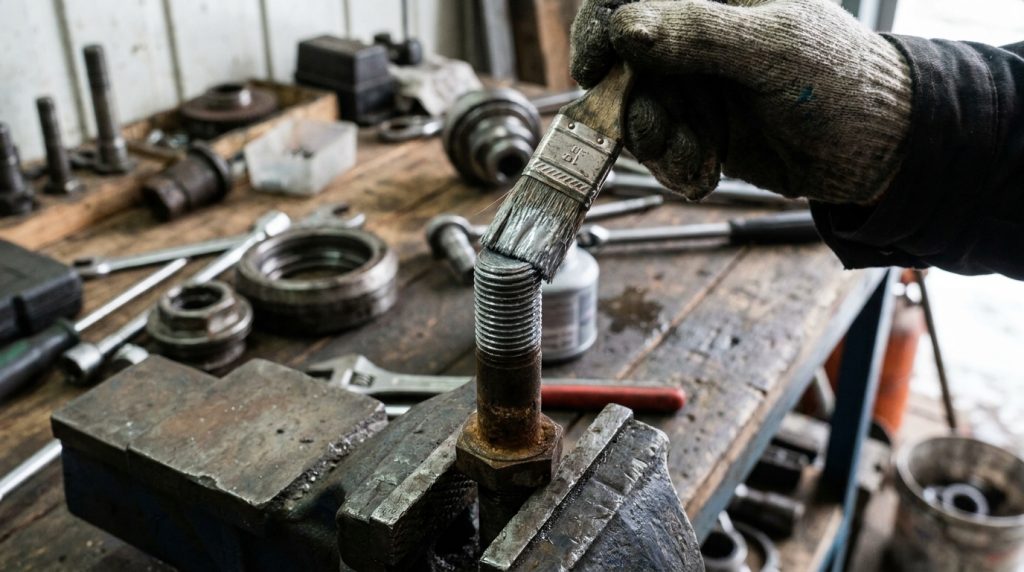
In industrial maintenance, mechanical assembly, equipment repair, and construction, a simple threaded fastener can become a costly problem. Heat, corrosion, moisture, vibration, chemical exposure, and dissimilar metals can cause bolts, nuts, studs, pipe plugs, fittings, and threaded components to seize, gall, or corrode in place. When that happens, removal may require excessive force, drilling, cutting, torching, or replacing expensive parts.
Anti-seize compound is designed to help prevent those failures.
Used correctly, anti-seize lubricant protects threaded and close-fitting metal parts from galling, corrosion, rust, and seizure. It can make future disassembly easier, reduce downtime, and improve the reliability of maintenance work. Used incorrectly, however, it can create problems such as over-torqued fasteners, contaminated assemblies, or incompatibility with certain materials and service conditions.
This guide explains when and how to use anti-seize compound, how to choose the right type, where not to use it, and what maintenance professionals, contractors, mechanics, manufacturers, and industrial buyers should consider before specifying or purchasing it.
For those looking to enhance their understanding of tool usage and maintenance, a related article titled “Impact Driver vs. Drill: Which Tool Should You Be Using and Why It Matters” provides valuable insights. This article discusses the differences between these essential tools and can help you determine when to use an impact driver or a drill, which is particularly relevant when considering the application of Anti-Seize Compound. To read more, visit here.
What Is Anti-Seize Compound?
Anti-seize compound is a paste-like lubricant made from a base grease or carrier combined with solid lubricating particles. These particles may include copper, aluminum, nickel, graphite, molybdenum disulfide, zinc, ceramic solids, or other engineered materials.
The purpose of anti-seize is to create a protective barrier between mating surfaces, especially threaded metal parts. This barrier helps prevent:
- Galling and cold welding
- Rust and corrosion
- Heat-related seizure
- Thread damage during assembly or disassembly
- Fastener breakage during removal
- Fretting and metal-to-metal wear in some applications
Anti-seize compounds are commonly used on bolts, studs, nuts, flanges, bushings, shafts, pipe threads, spark plugs, exhaust hardware, brake components, furnace equipment, and industrial machinery.
Anti-Seize vs. Grease: What’s the Difference?
Although anti-seize compound may look like grease, it is not the same product. Grease is primarily intended to reduce friction between moving components. Anti-seize is primarily intended to protect stationary or slow-moving assembled parts from seizing, galling, and corrosion.
| Feature | Anti-Seize Compound | Grease |
|---|---|---|
| Primary use | Prevents seizure, galling, and corrosion on threaded fasteners | Lubricates moving parts and reduces friction |
| Common applications | Threads, studs, bolts, fittings, flanges, and spark plugs | Bearings, hinges, pivots, gears, and other moving components |
| Solid lubricants | Typically contains metallic or solid lubricants | May contain solid lubricants, but many greases do not |
| High-temperature capability | Often rated for very high temperatures, depending on the formulation | Generally lower temperature limits than anti-seize compounds |
| Best for fasteners | Yes, when specified by the equipment manufacturer or application | Generally not recommended for threaded fasteners unless specifically called for |
For example, a mechanic may use grease on a bearing but anti-seize compound on exhaust manifold studs. A maintenance technician may lubricate a hinge with grease but apply anti-seize to stainless steel bolts in a washdown environment.
Anti-Seize vs. Threadlocker
Anti-seize and threadlocker serve different purposes. Threadlocker is designed to resist loosening from vibration and seal threads, while anti-seize is designed to prevent seizing and enable future disassembly.
| Product | Main Purpose | Typical Use |
|---|---|---|
| Anti-seize compound | Prevents galling, corrosion, and thread seizure | Bolts, studs, pipe threads, exhaust components, and other high-temperature fasteners |
| Threadlocker | Helps prevent fasteners from loosening due to vibration | Bolts and screws that must maintain clamp load in dynamic applications |
| Thread sealant | Seals threaded connections against fluid or gas leakage | Pipe fittings, hydraulic systems, pneumatic systems, and threaded fluid connections |
Do not assume these products are interchangeable. If a manufacturer specifies a threadlocker, applying anti-seize instead may reduce the fastener’s resistance to loosening. If a manufacturer specifies anti-seize, using threadlocker could make disassembly harder and may not provide the needed high-temperature protection.
When to Use Anti-Seize Compound
Anti-seize compound is useful in applications where metal parts are exposed to heat, corrosion, moisture, pressure, or repeated assembly and disassembly. It is especially valuable when fasteners are expensive, difficult to access, or critical to equipment uptime.
Use Anti-Seize on High-Temperature Fasteners
Heat accelerates oxidation and can cause threaded components to lock together. Anti-seize is commonly used on high-temperature assemblies such as:
- Exhaust manifold bolts and studs
- Turbocharger mounting hardware
- Furnace and kiln components
- Heat exchanger fasteners
- Boiler access covers
- Burner assemblies
- Industrial oven hardware
- Engine and powertrain components
For these applications, selecting the correct temperature-rated anti-seize compound is critical. Copper anti-seize and nickel anti-seize are common choices for high-heat work, but the right product depends on the metal, environment, and maximum service temperature.
Use Anti-Seize to Prevent Galling on Stainless Steel
Stainless steel fasteners are widely used in food processing, marine, chemical, architectural, and washdown environments. However, stainless steel is more prone to galling than many carbon steel fasteners.
Galling occurs when metal surfaces stick together under pressure and friction. On threaded fasteners, it can happen during tightening, causing the nut and bolt to seize before reaching proper clamp load. In severe cases, the threads tear or weld together.
Anti-seize compound can help reduce galling on:
- Stainless steel bolts and nuts
- Stainless threaded rod
- Stainless pipe fittings
- Stainless flanges
- Food-grade equipment hardware
- Marine deck hardware
For stainless steel, many maintenance teams use nickel-based, non-metallic, or food-grade anti-seize depending on the application. Copper-based products may not be ideal where galvanic corrosion or contamination is a concern.
Use Anti-Seize in Corrosive or Outdoor Environments
Outdoor equipment and industrial assets are often exposed to rain, humidity, road salt, chemicals, fertilizers, washdown water, or marine air. Anti-seize can provide a protective barrier that helps prevent corrosion from locking threaded parts together.
Common examples include:
- Construction equipment bolts
- Agricultural machinery hardware
- Snowplow and salt spreader fasteners
- Utility trailers and truck components
- Pump and valve hardware
- Outdoor electrical enclosure bolts
- Marine equipment fasteners
- Fence, railing, and structural hardware
For corrosive environments, consider the base material, chemical exposure, and potential galvanic reaction between metals. In marine or chemical plants, a nickel, aluminum, zinc, or non-metallic anti-seize may be preferred over copper depending on compatibility.
Use Anti-Seize on Parts Requiring Future Disassembly
If a component is likely to be serviced later, anti-seize can save significant labor. This is especially important when the part is difficult to access or when broken fasteners could lead to expensive repairs.
Good candidates include:
- Access panel bolts
- Pump casing bolts
- Valve bonnet studs
- Gearbox cover fasteners
- Die and mold fasteners
- Press components
- Wheel hub components where specified
- Brake hardware contact points where appropriate
- Sensor threads where manufacturer-approved
For example, a plant mechanic servicing a pump may apply anti-seize to casing bolts before reassembly. Months later, when the pump is opened again for inspection, the fasteners are more likely to loosen without breaking.
Use Anti-Seize on Dissimilar Metals
When different metals are in contact, especially in the presence of moisture or electrolyte, galvanic corrosion may occur. This can accelerate corrosion of one metal and make threaded joints difficult to separate.
Examples include:
- Steel bolts in aluminum housings
- Stainless fasteners in carbon steel structures
- Brass fittings in steel components
- Aluminum parts with stainless hardware
- Mixed-metal marine hardware
Anti-seize can help create a barrier between dissimilar metals. However, product selection matters. Some metallic anti-seize compounds contain particles that may influence galvanic activity. Always verify compatibility with the metals and environment.
For more articles, visit https://cemindustrialsupply.com/news/.
Where Not to Use Anti-Seize Compound
Anti-seize is useful, but it is not appropriate for every fastener or mechanical assembly. Misuse can lead to incorrect torque, contamination, loosening, or equipment damage.
Do Not Use Anti-Seize Unless Allowed by the Manufacturer
Many fasteners and assemblies are engineered with specific torque values based on dry threads, lightly oiled threads, pre-applied coatings, or specified lubricants. Anti-seize changes friction, which changes the relationship between torque and clamp load.
If the equipment manufacturer provides instructions, follow them. This is especially important for:
- Automotive wheel studs and lug nuts
- Critical engine fasteners
- Structural bolts
- Brake caliper mounting bolts
- Aerospace or defense hardware
- Pressure vessel components
- Hydraulic system components
- Electrical connections
- Safety-critical machinery
If the service manual says “install dry,” do not apply anti-seize unless an authorized engineering procedure permits it.
Avoid Over-Application
More anti-seize is not better. Excess compound can squeeze out, attract dirt, contaminate nearby components, or interfere with sensors, brakes, belts, clutches, electrical contacts, and sealing surfaces.
Apply a thin, even film only where needed. For threaded fasteners, anti-seize should usually cover the engaged threads, not the entire bolt head, shank, washer face, or surrounding area unless the procedure requires it.
Do Not Use Standard Anti-Seize on Oxygen Systems
Oil-based or petroleum-based compounds can be dangerous in oxygen service. Oxygen systems require specially approved lubricants and sealants. Never apply general-purpose anti-seize compound to oxygen valves, fittings, regulators, or piping unless the product is explicitly rated and approved for oxygen service.
Be Cautious Around Electrical Components
Some anti-seize compounds contain conductive metal particles such as copper, aluminum, or nickel. These may create electrical conductivity where it is not wanted. On the other hand, certain electrical applications may use specific conductive anti-seize compounds to reduce corrosion at grounding connections.
The key is to use the correct product. Do not apply metallic anti-seize to electrical or electronic components unless it is specified for that purpose.
Avoid Using Anti-Seize as a General Threadlocker Substitute
Anti-seize reduces friction; it does not lock threads. In some situations, lubricated fasteners may loosen more easily under vibration if no locking method is used.
If vibration resistance is required, use the manufacturer’s recommended solution, such as:
- Threadlocker
- Lock nuts
- Lock washers where appropriate
- Prevailing torque nuts
- Safety wire
- Tab washers
- Double-nutting
- Mechanical locking features
Some assemblies may require both lubrication and locking methods, but that should be based on engineering guidance.
When working with various mechanical components, understanding the importance of using an anti-seize compound can significantly enhance the longevity and performance of your equipment. For those looking to maintain their structures, it’s equally crucial to know how to select the right professionals for repairs, especially when it comes to roofing issues. A related article offers valuable insights on this topic, providing guidance on making informed decisions. You can read more about it in this helpful resource on choosing the best roof leak repair contractors.
Types of Anti-Seize Compound and How to Choose the Right One
Choosing the right anti-seize compound depends on temperature, metal compatibility, chemical exposure, regulatory requirements, load, environment, and whether conductivity matters.
Copper Anti-Seize
Copper anti-seize is one of the most common types. It typically contains copper particles suspended in a grease carrier.
Common uses include:
- Exhaust bolts and studs
- Brake hardware contact points where specified
- Spark plug threads in some older applications where manufacturer-approved
- Flange bolts
- Industrial equipment fasteners
- General maintenance
Advantages:
- Good high-temperature performance
- Good protection against rust and corrosion
- Commonly available
- Suitable for many steel fasteners
Limitations:
- Not ideal for some stainless steel or aluminum applications
- Can contribute to galvanic corrosion in certain environments
- Conductive, which may be undesirable near electrical components
- May not be suitable where copper contamination is restricted
Copper anti-seize is popular in automotive, industrial, and maintenance shops, but it should not be treated as universal.
Nickel Anti-Seize
Nickel anti-seize is often selected for high-temperature, stainless steel, and chemically demanding environments. It is commonly used where copper should be avoided.
Common uses include:
- Stainless steel fasteners
- High-temperature industrial equipment
- Chemical processing equipment
- Turbine and exhaust hardware
- Alloy steel assemblies
- Severe-service threaded connections
Advantages:
- Excellent high-temperature capability, depending on formulation
- Often suitable for stainless steel
- Good chemical resistance
- Useful where copper contamination is unacceptable
Limitations:
- Usually more expensive than copper anti-seize
- Nickel exposure may be a workplace health consideration; follow SDS guidance
- Conductive
- Not always suitable for food-contact or specialized regulated applications
Nickel anti-seize is a strong choice for industrial buyers who need a premium product for harsh operating conditions.
Aluminum Anti-Seize
Aluminum anti-seize typically uses aluminum particles and is often considered a general-purpose anti-seize for many maintenance applications.
Common uses include:
- Steel fasteners
- Aluminum components
- General shop maintenance
- Pipe plugs and fittings
- Pump and valve bolts
- Manufacturing equipment
Advantages:
- Good general corrosion protection
- Often less expensive than nickel
- Useful in many standard industrial environments
- May be preferred where copper is not desired
Limitations:
- Temperature capability varies by formulation
- Not ideal for every chemical environment
- Metallic and potentially conductive
- May not be appropriate for all stainless steel applications
Aluminum anti-seize is often stocked by maintenance departments as a broad-use option, but severe heat or chemical exposure may require a different formula.
Zinc Anti-Seize
Zinc anti-seize is often used to help protect ferrous metals from corrosion. Some formulations are designed for galvanized surfaces or steel fasteners exposed to moisture.
Common uses include:
- Steel bolts
- Outdoor equipment
- Galvanized hardware
- Construction and structural maintenance where specified
- Utility and infrastructure applications
Advantages:
- Good corrosion protection for steel
- Useful in outdoor and wet environments
- May be compatible with galvanized components
Limitations:
- Not typically the first choice for extreme heat
- Not universal for stainless or high-alloy materials
- Product-specific compatibility must be checked
For contractors and maintenance professionals working with galvanized hardware, zinc-based anti-seize may be worth considering.
Non-Metallic and Ceramic Anti-Seize
Non-metallic anti-seize compounds use ceramic, graphite, calcium fluoride, or other non-metallic solid lubricants instead of metal particles. These are often chosen where metal contamination, galvanic corrosion, or conductivity is a concern.
Common uses include:
- Stainless steel assemblies
- Aluminum components
- Electrical isolation applications where specified
- High-temperature fasteners
- Chemical plants
- Food and beverage equipment when approved
- Clean manufacturing environments
Advantages:
- Reduces risk of galvanic interaction from metallic particles
- May be non-conductive depending on formulation
- Good high-temperature performance in ceramic types
- Useful where copper, nickel, or aluminum contamination is restricted
Limitations:
- Performance varies widely by product
- May cost more than standard compounds
- Some graphite-containing products may still be conductive
- Must be verified for regulatory or food-grade use
Non-metallic anti-seize is increasingly common in facilities that want one product for mixed-metal assemblies.
Food-Grade Anti-Seize
Food-grade anti-seize is designed for use in food processing, beverage, pharmaceutical, and packaging environments. These products may be formulated to meet NSF registration categories, depending on intended use.
Common uses include:
- Food processing equipment fasteners
- Stainless steel hardware
- Washdown machinery
- Packaging lines
- Beverage filling equipment
- Pharmaceutical manufacturing equipment
Advantages:
- Designed for regulated facilities
- Often suitable for stainless steel
- Helps reduce galling during sanitation-related disassembly
- May support food safety programs when properly selected
Limitations:
- Must match the facility’s compliance requirements
- May have temperature or chemical limitations
- Higher cost than standard anti-seize
- Should be controlled through purchasing and maintenance procedures
Industrial buyers in food and beverage facilities should verify product documentation, NSF registration where applicable, Safety Data Sheets, and internal quality requirements before purchase.
When working with various mechanical components, understanding the importance of proper lubrication and protection is crucial. For instance, if you’re curious about how to select the right tape for your projects, you might find this article helpful. It discusses different types of tapes and their applications, which can complement your knowledge of using anti-seize compounds effectively. You can read more about it here.
Anti-Seize Compound Selection Guide
Selecting anti-seize compound should be a technical decision, not just a price comparison. The wrong product can increase maintenance issues, especially in high-heat, corrosive, stainless steel, or regulated applications.
Key Selection Factors
Before purchasing or specifying anti-seize, evaluate:
- Base metals: Steel, stainless steel, aluminum, brass, copper, cast iron, alloys
- Temperature range: Maximum service temperature and installation conditions
- Environment: Indoor, outdoor, marine, chemical, washdown, high humidity
- Load and pressure: Thread load, contact pressure, assembly stress
- Regulatory requirements: Food-grade, potable water, oxygen service, military, nuclear, aerospace
- Conductivity: Conductive vs. non-conductive requirements
- Contamination risk: Copper-free, nickel-free, metal-free, silicone-free needs
- Torque requirements: Whether torque values must be adjusted
- Removal frequency: Permanent installation vs. frequent maintenance
- Application method: Brush-top can, tube, cartridge, aerosol, bulk container
Comparison Table: Common Anti-Seize Types
| Type | Best For | Avoid or Verify Before Using On | Typical Buyers |
|---|---|---|---|
| Copper | High-temperature steel fasteners, exhaust systems, and general maintenance | Aluminum, stainless steel, electrically isolated assemblies, and copper-sensitive processes | Mechanics, fleet maintenance shops, and industrial maintenance teams |
| Nickel | Stainless steel, extreme heat, chemical processing, and copper-free applications | Food-contact applications unless approved and workplaces with nickel restrictions | Refineries, manufacturers, chemical plants, and power generation facilities |
| Aluminum | General-purpose maintenance involving steel and aluminum components | Extreme temperatures, aggressive chemicals, and specialty alloy applications | MRO departments, contractors, and machine shops |
| Zinc | Steel and galvanized fasteners, outdoor equipment, and corrosion protection | High-temperature applications and stainless steel fasteners unless compatibility has been verified | Construction companies, utilities, and infrastructure maintenance crews |
| Ceramic (Non-Metallic) | Mixed-metal assemblies, high temperatures, low galvanic potential, and clean environments | Applications requiring an electrically conductive compound | Food processing plants, chemical facilities, and OEM manufacturers |
| Food-Grade | Food, beverage, pharmaceutical, and packaging equipment | High-temperature or chemical-service applications unless specifically approved | Food processors, sanitation teams, and quality-controlled manufacturing facilities |
Product Documentation to Review
For E-E-A-T-aligned maintenance and purchasing decisions, rely on product documentation rather than assumptions. Review:
- Technical Data Sheet
- Safety Data Sheet
- Temperature rating
- Pressure rating if listed
- Material compatibility
- NSF or regulatory registrations
- Manufacturer application instructions
- Shelf life and storage requirements
- Torque adjustment guidance if provided
If your team maintains critical assets, it may be useful to create an internal approved lubricants list. An internal link opportunity would be a resource such as [MRO Lubricants Buying Guide], [Industrial Fastener Selection Guide], or [Preventive Maintenance Checklist] to help standardize product selection.
How to Apply Anti-Seize Compound Correctly
Proper application is essential. A thin, controlled film is usually enough. Excess product can create mess, attract debris, alter torque more than expected, and contaminate adjacent surfaces.
Step 1: Clean the Threads or Contact Surfaces
Before applying anti-seize compound, clean the parts. Dirt, rust, old sealant, cutting oil, metal chips, and damaged threads can prevent proper assembly.
Recommended preparation:
- Remove heavy rust with a wire brush or thread chaser
- Wipe off oil, grease, and debris
- Inspect threads for damage
- Replace badly worn, stretched, or corroded fasteners
- Confirm parts are dry if required by the product instructions
Anti-seize helps protect good threads; it should not be used to hide damaged or unsafe hardware.
Step 2: Apply a Thin, Even Film
Use a brush, gloved finger, swab, or applicator to apply a light coating. On a bolt, coat the male threads that will engage with the nut or tapped hole. On a pipe plug or fitting, apply only where appropriate and avoid contaminating the flow path.
Best practices:
- Cover the engaged threads only
- Avoid coating the first thread if contamination inside a system is a concern
- Do not pack threads with compound
- Keep anti-seize off friction surfaces unless specified
- Keep away from belts, pulleys, clutch faces, and brake friction material
- Wipe away excess after assembly
A common mistake is applying a heavy glob around the entire fastener. This wastes product and increases contamination risk.
Step 3: Adjust Torque When Required
Anti-seize reduces friction. Because standard torque values depend heavily on friction, applying anti-seize can increase clamp load at the same torque setting. This can stretch or break fasteners, damage threads, warp components, or crush gaskets.
Some manufacturers recommend reducing torque when using anti-seize, but there is no universal reduction percentage that applies to every product and fastener. The correct approach is:
- Follow the equipment manufacturer’s instructions.
- Use the anti-seize manufacturer’s torque guidance if available.
- Consult engineering standards or internal procedures for critical joints.
- For non-critical maintenance, apply consistent shop procedures and document them.
This is especially important for flange bolts, engine fasteners, pressure-containing components, and structural assemblies.
Step 4: Assemble Smoothly and Avoid Cross-Threading
Anti-seize is not a fix for cross-threaded or mismatched parts. Start nuts and bolts by hand whenever possible. If resistance appears immediately, stop and inspect the threads.
Good assembly practices include:
- Confirm thread size and pitch
- Start by hand for several turns
- Use the correct wrench or socket
- Tighten evenly in a pattern for flanges or covers
- Use calibrated torque tools when required
- Recheck assembly instructions for washers, gaskets, and coatings
Step 5: Store and Handle Anti-Seize Properly
Anti-seize compounds can separate over time, especially in large containers. Follow manufacturer storage instructions.
General handling tips:
- Keep containers sealed when not in use
- Avoid contaminating containers with dirt or metal chips
- Stir if recommended by the manufacturer
- Store away from excessive heat
- Use gloves and follow SDS guidance
- Label shop containers clearly
- Do not mix different anti-seize products
For industrial buyers, packaging choice matters. Brush-top cans may work well for maintenance carts, tubes for mechanics, cartridges for controlled application, and bulk containers for high-volume manufacturing.
Practical Examples by Industry
Anti-seize compound is used across many trades and industrial sectors. The right use case depends on service conditions and manufacturer requirements.
Automotive and Fleet Maintenance
Mechanics often use anti-seize on high-heat and corrosion-prone hardware. Examples include:
- Exhaust manifold studs
- Turbocharger studs
- Oxygen sensor threads where sensor-safe compound is supplied or specified
- Brake caliper slide contact points where the brake manufacturer specifies suitable lubricant
- Hub-centric wheel mating surfaces in some corrosion-prone applications, avoiding studs unless approved
- Diesel engine service hardware
Important caution: many vehicle manufacturers do not recommend anti-seize on lug nut or wheel stud threads because it can alter torque and clamp load. Always follow OEM service information.
Construction and Heavy Equipment
Contractors and heavy equipment technicians deal with mud, water, salt, vibration, and outdoor storage. Anti-seize can help with:
- Excavator and loader access panel bolts
- Bucket hardware where specified
- Track adjuster components
- Hydraulic cylinder mounting pins or threaded retainers
- Trailer fasteners
- Snow removal equipment
- Road maintenance machinery
In these environments, corrosion resistance and washout resistance are important. Zinc, aluminum, copper, or non-metallic formulations may be selected based on equipment and exposure.
Manufacturing and Assembly Operations
Manufacturers may use anti-seize during production to prevent galling, reduce warranty claims related to seized fasteners, and improve serviceability.
Common applications include:
- Stainless steel equipment assemblies
- Industrial machinery threaded joints
- Adjustable fixtures
- Mold and die fasteners
- Heat-treated tooling hardware
- Conveyor system fasteners
- Packaging equipment assemblies
For OEMs, consistency matters. Anti-seize should be part of a documented assembly process with defined product, application amount, torque values, and quality checks.
Plant Maintenance and MRO
Maintenance, repair, and operations teams use anti-seize to reduce downtime during future repairs.
Examples include:
- Pump housing bolts
- Valve bonnet studs
- Compressor fasteners
- Gearbox covers
- Coupling guards
- Flange bolts
- Boiler room hardware
- HVAC equipment bolts
- Pipe plugs and cleanout fittings
An internal link opportunity would be a related article such as [How to Prevent Fastener Corrosion in Industrial Facilities] or [Pump Maintenance Best Practices for Reducing Downtime].
Marine and Coastal Applications
Saltwater environments are highly corrosive. Anti-seize can help protect stainless, aluminum, and steel hardware used on:
- Boat trailers
- Dock hardware
- Marine engines
- Deck fittings
- Pump and valve fasteners
- Aluminum structures
- Stainless fasteners in coastal installations
Product compatibility is especially important in marine environments because galvanic corrosion is a common concern. Non-metallic or specific marine-grade anti-seize may be preferred for mixed-metal assemblies.
Anti-Seize and Torque: What Professionals Need to Know
Torque is one of the most misunderstood parts of using anti-seize compound. A torque wrench measures twisting force, not clamp load directly. Friction under the bolt head and within the threads consumes much of the applied torque. When anti-seize reduces friction, more of the torque can become clamp load.
Why Lubricated Threads Change Clamp Load
A dry fastener and a lubricated fastener tightened to the same torque may not produce the same clamping force. Lubricated threads can generate higher clamp load, which may be beneficial if accounted for but risky if ignored.
Potential problems from not adjusting torque include:
- Bolt stretch beyond intended limits
- Thread stripping
- Cracked castings
- Warped flanges
- Gasket over-compression
- Broken studs
- Distorted assemblies
This is why critical fasteners should follow engineered torque specifications.
Is There a Standard Torque Reduction for Anti-Seize?
Some general maintenance references suggest reducing torque when using anti-seize, but there is no single safe percentage for all situations. The friction change depends on:
- Anti-seize formulation
- Fastener material
- Thread finish
- Coating or plating
- Washer use
- Surface condition
- Speed of tightening
- Reuse of fasteners
- Temperature and contamination
The safest answer is to follow manufacturer instructions. For critical joints, consult engineering or use tested torque-tension data.
Best Practices for Torque-Controlled Assemblies
For professional maintenance and manufacturing:
- Identify whether torque values are dry or lubricated
- Use the specified lubricant only
- Document anti-seize product name and part number
- Train technicians on application amount
- Use calibrated torque tools
- Replace torque-to-yield fasteners when required
- Avoid reusing damaged or stretched hardware
- Record torque procedures for critical assets
For industrial buyers, choosing one approved anti-seize product for common applications can improve consistency and reduce mistakes.
Common Mistakes When Using Anti-Seize Compound
Anti-seize is simple to apply, but common errors can lead to equipment issues.
Applying Too Much Product
Excess anti-seize can migrate during assembly or operation. It can contaminate sensors, brakes, belts, electrical contacts, gaskets, or process fluids.
Use a thin film. If compound squeezes out heavily around the fastener, too much was applied.
Using the Wrong Type
Copper anti-seize may be common, but it is not right for every application. Stainless steel, aluminum, electrical, marine, food-grade, or chemical service may require a different product.
Before standardizing, compare technical data and service conditions.
Ignoring Temperature Limits
Anti-seize compounds have temperature ratings, but these ratings vary significantly. The grease carrier may burn off at high temperature while solid lubricants remain. That may be acceptable for some applications, but only if the product is designed for it.
Use high-temperature anti-seize for exhaust, furnace, turbine, kiln, and boiler applications.
Using Anti-Seize on Pre-Coated Fasteners
Some fasteners come with pre-applied coatings, dry film lubricants, sealants, or threadlockers. Adding anti-seize can interfere with those coatings and change torque performance.
Check the fastener specification before adding any compound.
Treating Anti-Seize as a Repair for Bad Threads
If the threads are damaged, anti-seize will not restore strength. Replace damaged bolts, nuts, studs, or tapped components. Use thread repair inserts where appropriate and approved.
Safety, Compliance, and Storage Considerations
Industrial users should treat anti-seize like any other chemical product. Proper handling protects workers, equipment, and compliance programs.
Review the Safety Data Sheet
The SDS provides information about:
- Personal protective equipment
- Skin and eye contact precautions
- Ventilation needs
- Hazardous ingredients
- First aid
- Firefighting measures
- Spill cleanup
- Disposal requirements
- Storage conditions
Nickel-based and metallic compounds may require extra attention depending on workplace exposure policies.
Use the Right PPE
Typical precautions may include:
- Nitrile or chemical-resistant gloves
- Safety glasses
- Protective clothing for messy applications
- Handwashing after use
- Avoiding skin contact and ingestion
- Preventing contamination of food areas
Always follow the SDS and site-specific safety procedures.
Control Products in Regulated Facilities
Food, beverage, pharmaceutical, aerospace, nuclear, medical device, and electronics facilities often require strict control of maintenance chemicals.
Best practices include:
- Use approved product lists
- Keep documentation available
- Store chemicals in designated areas
- Label containers clearly
- Train maintenance staff
- Prevent cross-contamination
- Audit chemical usage periodically
An internal link opportunity could be [Food-Grade Lubricants and Maintenance Chemical Compliance Guide] for facilities with quality or regulatory requirements.
Buying Anti-Seize Compound: What Industrial Buyers Should Look For
For purchasing managers and maintenance supervisors, anti-seize selection affects cost, safety, uptime, and inventory control. The lowest-cost tube may not be the most economical if it is incompatible with key applications.
Packaging Options
Anti-seize is available in several forms:
- Small tubes for toolboxes and field service
- Brush-top cans for shop use
- Aerosols for broad coverage, where suitable
- Cartridges for controlled dispensing
- Pails for high-volume industrial use
- Single-use packets for kits and assembly lines
Choose packaging based on application control, contamination risk, usage volume, and technician access.
Standardization vs. Specialty Products
Many facilities benefit from standardizing around one or two general anti-seize products, plus specialty products for severe service.
A practical inventory might include:
- General-purpose anti-seize for standard steel fasteners
- Nickel or ceramic anti-seize for stainless and high heat
- Food-grade anti-seize for regulated production zones
- Oxygen-approved product only where required and controlled separately
Avoid stocking too many similar products, which can increase the chance of misapplication.
Questions to Ask Suppliers
Before purchasing, ask:
- What metals is the product compatible with?
- What is the maximum service temperature?
- Is it copper-free, nickel-free, metal-free, or graphite-free?
- Is it conductive or non-conductive?
- Is it suitable for stainless steel?
- Is it approved for food-grade applications if needed?
- Does it have NSF registration?
- Does the manufacturer provide torque guidance?
- What packaging sizes are available?
- What is the shelf life?
- Are TDS and SDS documents available?
These questions help contractors, mechanics, and industrial buyers select products based on application requirements rather than habit.
Frequently Asked Questions About Anti-Seize Compound
Can anti-seize be used on all bolts?
No. Anti-seize should only be used when appropriate for the fastener, material, service environment, and manufacturer instructions. Some bolts must be installed dry or with a specific lubricant or threadlocker.
Is anti-seize waterproof?
Anti-seize can provide a moisture-resistant barrier, but performance varies by formulation. For wet, marine, or washdown environments, choose a product designed for corrosion resistance and verify compatibility.
Does anti-seize stop rust?
Anti-seize can help reduce rust and corrosion on protected surfaces by limiting exposure to moisture and contaminants. It does not remove existing rust or replace proper material selection, coatings, or corrosion-control programs.
Can I use anti-seize on stainless steel?
Yes, anti-seize is often used to reduce galling on stainless steel. Nickel-based, ceramic, food-grade, or non-metallic compounds are commonly considered, depending on service conditions. Verify compatibility before use.
Should anti-seize be used on spark plugs?
Follow the engine or spark plug manufacturer’s instructions. Many modern spark plugs have special thread coatings and may not require anti-seize. Applying anti-seize when not specified can affect torque and heat transfer.
Is copper anti-seize safe on aluminum?
Copper anti-seize may not be the best choice for aluminum, especially in wet or corrosive environments where galvanic corrosion is a concern. Aluminum, zinc, ceramic, or non-metallic products may be more suitable depending on the application.
How much anti-seize should I apply?
Apply a thin, even film to the engaged threads or contact surface. Avoid excess. If the compound squeezes out heavily during assembly, too much was used.
Does anti-seize expire?
Many products have a recommended shelf life. Over time, the carrier may separate or dry out. Check the manufacturer’s storage and shelf-life guidance.
Conclusion: Use Anti-Seize Compound Strategically, Not Automatically
Anti-seize compound is one of the most valuable products in a maintenance shop, service truck, manufacturing line, or industrial storeroom. When selected and applied correctly, it helps prevent galling, corrosion, rust, and heat-related seizure, making future disassembly easier and reducing the risk of broken fasteners.
The key is to use it strategically. Match the anti-seize compound to the metal, temperature, environment, and regulatory requirements. Apply only a thin film. Follow manufacturer torque instructions. Avoid using it where dry assembly, threadlocker, specialty lubricant, or approved sealant is required.
For contractors, mechanics, maintenance professionals, manufacturers, and industrial buyers, the right anti-seize program can improve serviceability, reduce downtime, and support consistent assembly practices.
Review your current maintenance applications, identify where seized fasteners are costing time and money, and standardize the correct anti-seize products for your team. If you’re building an approved MRO supply list, compare product data sheets, verify compatibility, and work with a knowledgeable supplier to choose the right anti-seize compound for your equipment and operating conditions.