
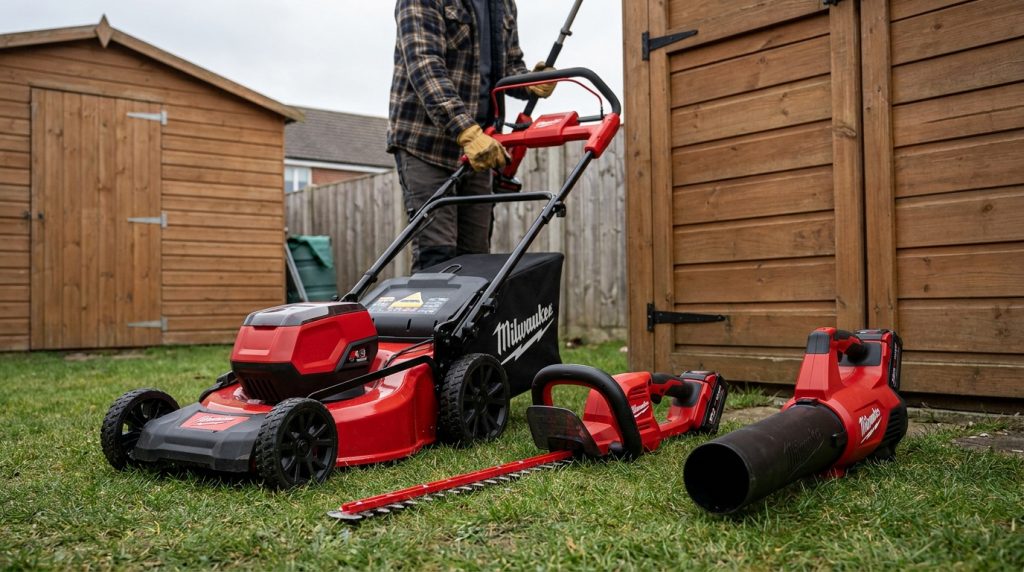
If you maintain grounds, manage a facility, run a landscaping crew, or keep a farm property in shape around Coldwater, Branch County, or Southern Michigan, Milwaukee outdoor power equipment is a strong option when you want pro-grade performance without the fuel mixing, pull starts, fumes, and higher maintenance demands of gas tools.
This Milwaukee Outdoor Power Equipment Guide is written from the perspective of industrial and maintenance users who need equipment that works when the job is on the schedule—not just when the weather is perfect. At CEM Industrial Supply, we help contractors, municipalities, plant maintenance teams, schools, property managers, farms, and serious homeowners choose tools, batteries, accessories, PPE, and jobsite supplies that fit real work conditions.
Milwaukee’s M18 and M12 cordless platforms have become especially popular because they allow crews to standardize batteries across drills, impact drivers, saws, lighting, vacuums, and outdoor power equipment. That matters when you’re trying to reduce downtime, simplify purchasing, and keep your team productive.
Milwaukee outdoor power equipment is designed for users who need dependable cutting, trimming, blowing, pruning, mowing, and cleanup performance without the typical headaches of small gas engines.
For many Southern Michigan users, especially facilities and grounds teams, the biggest benefit is operational simplicity. You charge batteries, install the pack, and get to work. There is no stale fuel, carburetor trouble, spark plug replacement, or winterizing fuel systems before storage.
Key Advantages of Milwaukee Cordless Outdoor Tools
Milwaukee’s cordless outdoor power equipment offers several practical advantages:
- Instant start with no pull cord
- Lower noise than comparable gas equipment
- No fuel mixing or gasoline storage
- Reduced routine maintenance
- Excellent torque from brushless motors
- Compatibility with M18 battery systems
- Lower vibration on many applications
- Better indoor-adjacent usability for campuses, plants, and facilities
- Easier seasonal storage
- Professional-grade build quality
For maintenance departments, these advantages add up quickly. A worker can trim around a building entrance, clear debris from a loading dock, cut fallen limbs, or edge sidewalks without carrying fuel cans or dealing with a cold-start gas engine.
Where Cordless Milwaukee Equipment Excels
Milwaukee outdoor power equipment is especially useful for:
- Commercial property maintenance
- Schools and municipal grounds
- Industrial facility landscaping
- Apartment and HOA maintenance
- Cemetery and park upkeep
- Farm and rural property cleanup
- Light tree work and storm cleanup
- Warehouse and shop exterior maintenance
- Contractors who already use Milwaukee M18 tools
In Coldwater and across Branch County, where properties often include a mix of turf, gravel lots, tree lines, drainage areas, and seasonal debris, cordless outdoor tools can handle a wide range of daily maintenance tasks.
For those interested in enhancing their outdoor power equipment knowledge, the Milwaukee Outdoor Power Equipment Guide offers valuable insights into selecting the right tools for your gardening and landscaping needs. Additionally, you may find it helpful to explore a related article that discusses the advantages and disadvantages of corded versus cordless power tools, which can further inform your purchasing decisions. You can read more about this topic in the article available at Corded vs. Cordless Power Tools: Which is Right for the Job Site?.
Milwaukee Outdoor Power Equipment Platform Overview
Milwaukee’s outdoor equipment is primarily built around the M18 battery platform, including M18 FUEL tools. The M18 FUEL line combines brushless motors, REDLINK PLUS intelligence, and REDLITHIUM battery technology to deliver higher power, longer runtime, and overload protection.
M18 FUEL Outdoor Power Equipment
The M18 FUEL lineup is the heart of Milwaukee’s professional outdoor power equipment offering. These tools are built for heavier use and are a strong fit for commercial and industrial users.
Common Milwaukee M18 FUEL outdoor tools include:
- String trimmers
- Hedge trimmers
- Blowers
- Chainsaws
- Pole saws
- Edgers
- Brush cutters
- Lawn mowers
- QUIK-LOK attachment power heads
- Sprayers
- Pruning saws
- Hatchets and compact cutting tools
The M18 FUEL system is ideal if your crew already owns Milwaukee drills, impacts, grinders, saws, lights, or jobsite radios. Shared batteries reduce the number of chargers and spare packs needed in the shop or service truck.
M18 QUIK-LOK Attachment System
The Milwaukee M18 FUEL QUIK-LOK system is one of the most practical choices for crews that perform varied grounds maintenance. Instead of buying several separate power tools, you use one power head with multiple attachments.
Typical QUIK-LOK attachments include:
- String trimmer
- Edger
- Pole saw
- Hedge trimmer
- Articulating hedge trimmer
- Brush cutter
- Extension attachment
This is especially useful for municipalities, schools, maintenance shops, and contractors who want to save truck space while still being ready for different jobs.
M12 Outdoor and Compact Tools
Milwaukee M12 tools are not typically used for heavy outdoor power equipment in the same way as M18 tools, but the M12 platform is useful for supporting grounds work.
Useful M12 tools and accessories may include:
- Compact pruning tools
- Inspection lights
- Heated gear
- Compact drills and drivers
- Portable inflators
- Jobsite radios
- Small saws and specialty tools
For crews that already use M12 tools, these compact solutions can complement larger M18 outdoor equipment.
Choosing the Right Milwaukee Outdoor Tool for the Job
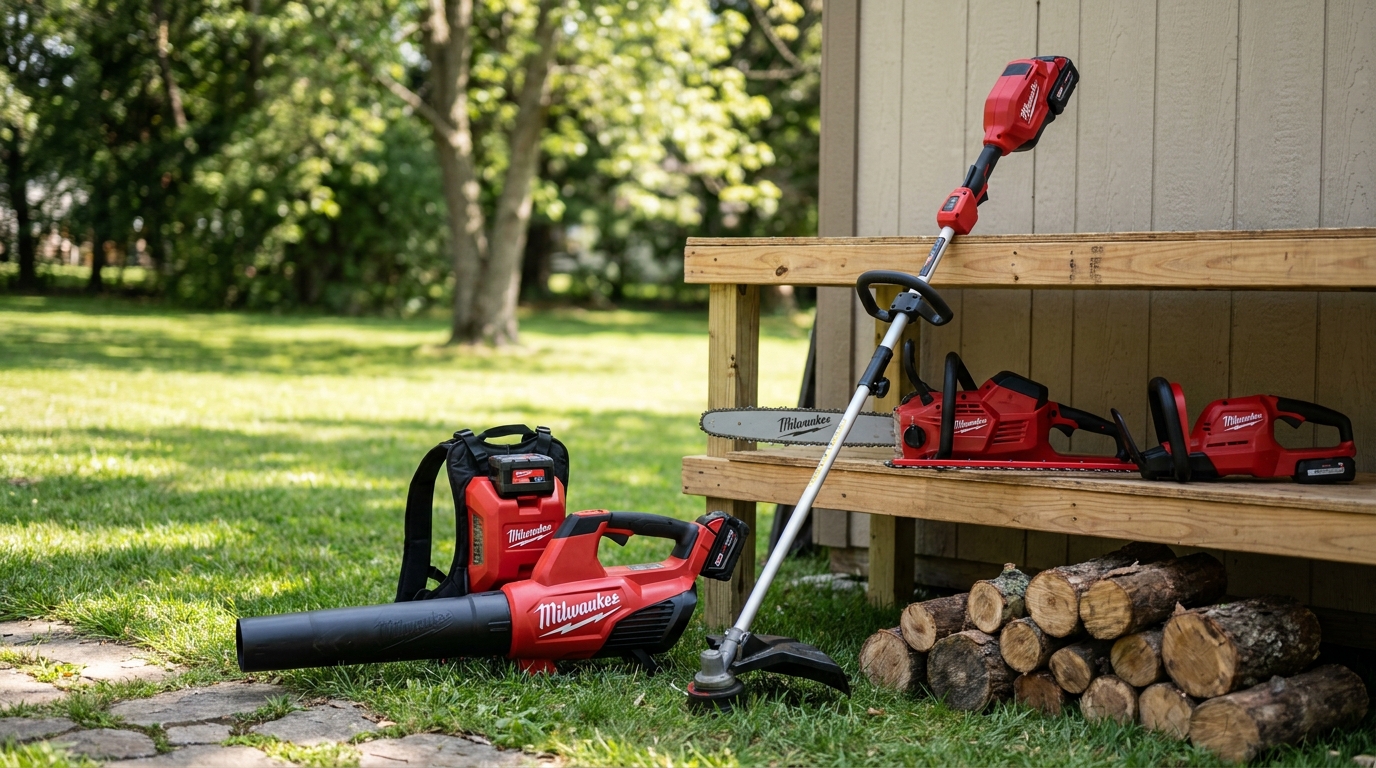
Selecting the right outdoor power equipment starts with understanding the job, property size, crew size, and runtime needs. A landscaping contractor trimming multiple commercial properties has different requirements than a facility maintenance technician clearing sidewalks and dock areas.
Milwaukee Outdoor Power Equipment Comparison Table
| Equipment Type | Best For | Key Buying Considerations | Recommended User |
|||||
| String Trimmer | Grass trimming, fence lines, buildings, posts | Cutting swath, line size, balance, runtime | Landscapers, facilities, homeowners |
| Blower | Leaves, grass clippings, dust, light debris | CFM, MPH, noise level, battery size | Grounds crews, shops, property managers |
| Hedge Trimmer | Shrubs, hedges, ornamental landscaping | Blade length, cut capacity, weight | Campuses, commercial grounds, homeowners |
| Chainsaw | Limbing, storm cleanup, small tree cutting | Bar length, chain speed, oiling, safety | Farms, facilities, contractors |
| Pole Saw | Overhead limb trimming | Reach, balance, chain maintenance | Parks, schools, rural properties |
| Edger | Sidewalks, curbs, landscaped beds | Depth control, blade durability | Municipal, HOA, commercial grounds |
| Lawn Mower | Turf maintenance | Deck size, runtime, cut quality, storage | Facilities, property managers, homeowners |
| Sprayer | Weed control, treatment applications | Tank capacity, pressure, chemical compatibility | Grounds crews, agriculture, maintenance |
String Trimmers and Brush Cutting
A Milwaukee string trimmer is a workhorse tool for most grounds crews. It is used around buildings, signs, fences, parking lots, drainage ditches, and landscaped beds.
When choosing a Milwaukee string trimmer, consider:
- Property size
- Grass thickness
- Need for brush cutting
- Battery runtime
- Weight and balance
- Line diameter
- Whether QUIK-LOK attachments are useful
For light trimming around a commercial building, a standard M18 trimmer may be enough. For thicker grass, weeds, or ditch work around rural Southern Michigan properties, an M18 FUEL model with a larger battery is usually the better choice.
Blowers for Facility and Grounds Cleanup
Milwaukee blowers are popular because they are easy to start, easy to store, and useful year-round.
Common blower applications include:
- Clearing grass clippings from sidewalks
- Cleaning loading dock areas
- Removing leaves from entrances
- Clearing light snow powder from walkways
- Blowing dust and debris from exterior work areas
- Cleanup after mowing or trimming
When comparing blowers, pay attention to both CFM and MPH. CFM measures air volume, while MPH measures air speed. High CFM is useful for moving piles of leaves, while higher air speed helps dislodge stuck debris.
Chainsaws and Pruning Tools
Milwaukee chainsaws are a strong choice for storm cleanup, limb removal, fence line clearing, and light tree work. They are especially useful for maintenance teams that do not cut timber all day but need reliable cutting power on demand.
Key chainsaw buying factors:
- Bar length
- Chain type
- Battery size
- Tool weight
- Automatic oiling
- Kickback protection
- Availability of replacement chains and bar oil
For Branch County farms, industrial sites, and rural properties, a cordless chainsaw is extremely convenient. You can keep it in a service vehicle or maintenance shop and respond quickly to fallen limbs without storing fuel.
Hedge Trimmers and Pole Tools
For campuses, municipal buildings, apartment complexes, and commercial storefronts, hedge trimmers help maintain a clean, professional appearance. Milwaukee hedge trimmers provide quiet operation and fast startup, which is valuable when working near office entrances, schools, or customer-facing facilities.
Pole saws and articulating hedge trimmers are helpful for:
- Tree limb trimming
- Tall hedges
- Fence line growth
- Hard-to-reach landscaped areas
- Reducing ladder use
Any time you can keep the operator on the ground instead of on a ladder, you improve safety.
Please visit our latest post at https://cemindustrialsupply.com/news/ for more information.
Battery and Charger Buying Guide
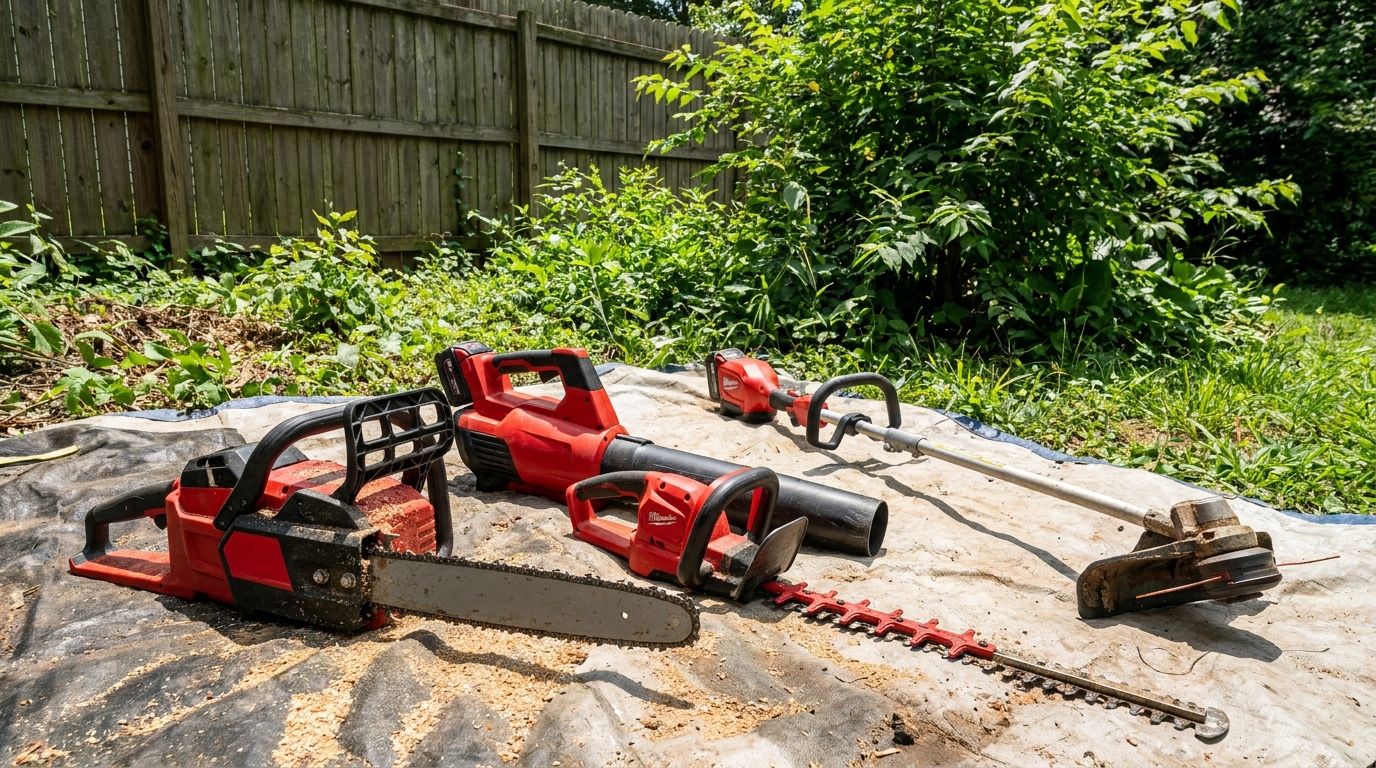
Battery selection is one of the most important parts of building a Milwaukee outdoor power equipment setup. Outdoor tools draw more power than many handheld shop tools, so battery capacity matters.
Understanding Milwaukee M18 Battery Sizes
Milwaukee M18 batteries come in different amp-hour ratings. Higher amp-hour batteries typically provide longer runtime and may deliver stronger performance in demanding tools.
| Battery Type | General Use | Best Applications |
||||
| Compact M18 Batteries | Light-duty, lower weight | Drills, lights, short trimming jobs |
| Mid-Capacity M18 Batteries | Balanced runtime and weight | Trimmers, blowers, hedge trimmers |
| High Output Batteries | Heavy-duty performance | Chainsaws, mowers, high-demand blowers |
| High Capacity Packs | Maximum runtime | Large properties, crews, extended use |
For outdoor power equipment, most professional users should consider Milwaukee M18 REDLITHIUM High Output batteries. These are designed for higher-demand tools and longer runtime.
How Many Batteries Do You Need?
The right number of batteries depends on how you work. A homeowner may be fine with one or two batteries. A commercial crew may need several batteries and multiple chargers.
As a general guide:
- Small property maintenance: 2 batteries and 1 charger
- Facility maintenance team: 3–5 batteries and 1–2 chargers
- Landscaping crew: 6+ batteries and rapid chargers
- Municipal or school grounds crew: battery pool matched to daily route needs
- Farm or rural property: 2–4 high-output batteries for flexibility
If you run multiple tools—such as a trimmer, blower, and chainsaw—having extra batteries prevents downtime.
Charger Options
Milwaukee offers several charger styles, including standard, rapid, and multi-bay chargers. For professional users, a rapid charger or multi-bay charger can be a smart investment.
Consider these charger setups:
- Standard charger for occasional users
- Rapid charger for daily tool users
- Multi-bay charger for crews
- Vehicle charging setup for mobile service teams
- Dedicated charging station in the shop
At CEM Industrial Supply, we often recommend thinking of batteries and chargers as part of the system—not as an afterthought. The best tool in the world does not help if every battery is dead at 10 a.m.
For those looking to enhance their understanding of power equipment maintenance, the Milwaukee Outdoor Power Equipment Guide offers valuable insights into selecting and caring for your tools. Additionally, you might find it helpful to read about the crucial decision-making process regarding motor repairs in this informative article on when to replace instead of rewind a motor. This resource can provide further guidance on maintaining your equipment effectively, ensuring optimal performance in your outdoor tasks. You can check it out here.
Milwaukee Outdoor Power Equipment for Southern Michigan Conditions
Coldwater, Branch County, and Southern Michigan see a full range of seasonal conditions: wet spring growth, humid summers, fall leaf cleanup, and winter storage challenges. Your equipment choices should reflect those conditions.
Spring: Fast Growth and Cleanup
Spring in Southern Michigan often means wet grass, fast-growing weeds, fallen branches, and cleanup from winter storms.
Recommended Milwaukee tools for spring:
- String trimmer
- Blower
- Chainsaw
- Pole saw
- Hedge trimmer
- Sprayer
Spring is also the right time to inspect batteries, sharpen chains, replace trimmer line, check mower blades, and stock up on PPE.
Summer: Routine Grounds Maintenance
Summer maintenance is about productivity and consistency. Crews are trimming, edging, mowing, and blowing off sidewalks regularly.
Recommended summer setup:
- M18 FUEL string trimmer
- M18 blower
- Edger attachment
- Hedge trimmer
- Extra batteries
- Safety glasses and hearing protection
- Gloves and sun protection
Even though cordless tools are quieter than gas tools, hearing protection is still recommended for extended use.
Fall: Leaf and Debris Management
Fall cleanup can be demanding, especially on properties with mature trees. Blowers, chainsaws, and pruning tools become essential.
Recommended fall tools:
- High-CFM blower
- Chainsaw
- Pole saw
- Hedge trimmer
- Rakes and hand tools
- Contractor bags and cleanup supplies
For larger properties, battery planning becomes especially important during fall leaf cleanup. Blowers can use batteries quickly under continuous high-output operation.
Winter: Storage and Readiness
Outdoor power equipment may see less use in winter, but it should not be ignored. Batteries and tools should be stored properly to extend service life.
Winter storage tips:
- Clean tools before storage
- Remove batteries from tools
- Store batteries in a dry, temperature-controlled area
- Avoid leaving batteries in freezing vehicles overnight
- Check battery charge periodically
- Drain and clean sprayers according to product instructions
- Inspect chains, blades, and guards before spring
Cordless tools are easier to store than gas equipment, but batteries still require care.
For those looking to enhance their outdoor power equipment experience in Milwaukee, it’s essential to consider not only the tools themselves but also the materials you might be working with. A related article that can provide valuable insights is how to choose the right abrasive for metal, steel, and stainless. This resource can help you understand the best abrasives to pair with your equipment, ensuring optimal performance and results in your outdoor projects.
CEM Industrial Supply Product Categories That Support Milwaukee Outdoor Work
A good outdoor power equipment setup includes more than the tool itself. Accessories, safety gear, replacement parts, storage, and maintenance supplies all affect productivity.
CEM Industrial Supply supports Milwaukee users with related industrial supply categories that help keep jobs moving.
Milwaukee Cordless Power Tools and Outdoor Equipment
Milwaukee cordless tools are a core choice for contractors and maintenance professionals. Whether you are expanding an existing M18 platform or building a new outdoor power equipment kit, choosing compatible tools helps simplify operations.
Relevant categories include:
- Milwaukee M18 cordless tools
- Milwaukee M18 FUEL outdoor power equipment
- Batteries and chargers
- Combo kits
- Jobsite lighting
- Saws, drills, impacts, and grinders
Batteries, Chargers, and Power Management
Battery management is critical for outdoor crews. The right mix of batteries and chargers can prevent downtime and reduce frustration.
Helpful items include:
- M18 REDLITHIUM batteries
- High Output battery packs
- Rapid chargers
- Multi-bay chargers
- Extension cords for charging stations
- Power strips and shop electrical supplies
Safety and PPE
Outdoor power equipment requires proper PPE. CEM Industrial Supply can support safety programs with practical gear for grounds crews and maintenance teams.
Common PPE includes:
- Safety glasses
- Face shields
- Hearing protection
- Cut-resistant gloves
- Work gloves
- High-visibility vests
- Chainsaw chaps where applicable
- Steel toe or safety toe footwear
- Dust masks or respirators for dry debris
Cutting Accessories and Maintenance Supplies
To keep Milwaukee outdoor tools performing well, users should stock the right accessories and consumables.
Useful supplies include:
- Trimmer line
- Chainsaw chains
- Bar and chain oil
- Replacement edger blades
- Hedge trimmer blade lubricant
- Files and sharpening tools
- Cleaning brushes
- Shop towels
- Lubricants and protectants
Storage and Jobsite Organization
A disorganized truck or maintenance room slows everyone down. Milwaukee PACKOUT storage and other tool organization systems help crews protect tools, batteries, and accessories.
Storage solutions may include:
- Tool boxes
- PACKOUT organizers
- Battery storage cases
- Wall storage
- Shelving
- Service truck storage
- Parts bins
For Branch County contractors and maintenance teams working across multiple sites, organized storage is not a luxury—it is a productivity tool.
Buying Guide: How to Build the Right Milwaukee Outdoor Power Equipment Kit
The best Milwaukee outdoor power equipment setup depends on the user. Below are practical kit recommendations based on common customer types.
Kit for Facility Maintenance
Best for factories, warehouses, schools, churches, and commercial properties.
Recommended tools:
- M18 FUEL string trimmer
- M18 blower
- Hedge trimmer
- Compact chainsaw or pruning saw
- 2–4 M18 High Output batteries
- Rapid charger
- Safety glasses, gloves, and hearing protection
- Storage system for batteries and accessories
Why it works: This setup handles most routine exterior maintenance without unnecessary complexity.
Kit for Landscaping Contractors
Best for crews performing regular mowing, trimming, edging, and cleanup.
Recommended tools:
- M18 FUEL string trimmer
- QUIK-LOK power head
- Edger attachment
- Hedge trimmer attachment
- Pole saw attachment
- High-output blower
- Multiple high-capacity batteries
- Multi-bay charger
- PACKOUT storage
- PPE for each crew member
Why it works: Contractors need flexibility, runtime, and organized transport. The QUIK-LOK system can reduce the number of dedicated tools in the trailer.
Kit for Farms and Rural Properties
Best for farms, acreages, fence lines, barns, and outbuildings.
Recommended tools:
- M18 chainsaw
- M18 string trimmer or brush cutter
- Pole saw
- Blower
- Extra chains and bar oil
- High Output batteries
- Work gloves and eye protection
- Storage case or wall station
Why it works: Rural properties often require quick response to fallen limbs, overgrowth, and storm debris.
Kit for Municipal and School Grounds
Best for public works departments, parks, campuses, and sports facilities.
Recommended tools:
- Multiple trimmers
- Multiple blowers
- Hedge trimmers
- Pole saws
- Edgers
- Battery pool with rapid charging
- PPE inventory
- Maintenance log system
- Secure storage
Why it works: Standardizing on one platform simplifies training, maintenance, and battery management.
Maintenance Tips for Milwaukee Outdoor Power Equipment
Cordless outdoor tools require less maintenance than gas-powered equipment, but they are not maintenance-free. Regular care improves performance, safety, and service life.
Daily Maintenance Checklist
Use this checklist at the end of each workday:
- Remove battery from tool
- Brush off grass, dust, and debris
- Inspect guards and handles
- Check cutting heads, blades, or chains
- Look for loose hardware
- Wipe battery contacts with a clean, dry cloth if needed
- Recharge batteries according to schedule
- Store tools in a dry location
- Report damage before the next use
Weekly Maintenance Checklist
For tools used regularly:
- Inspect trimmer line head
- Check chainsaw chain tension
- Fill bar and chain oil as needed
- Inspect blower intake areas
- Clean hedge trimmer blades
- Lubricate blades if recommended
- Inspect battery housings for cracks
- Check charger cords and plugs
- Review PPE condition
- Update maintenance logs
Seasonal Maintenance Checklist
Before heavy spring or fall use:
- Inspect all tools
- Test all batteries
- Replace worn chains, blades, or line
- Clean storage areas
- Confirm chargers are working
- Stock replacement accessories
- Review operator safety procedures
- Label batteries for tracking
- Check inventory of PPE and first aid supplies
Battery Care Best Practices
Battery care is one of the biggest factors in long-term performance.
Follow these practices:
- Store batteries indoors when possible
- Avoid extreme heat and freezing temperatures
- Do not store batteries on the tool long-term
- Use the correct Milwaukee charger
- Avoid dropping batteries
- Keep terminals clean and dry
- Rotate batteries so the same pack is not always used first
- Remove damaged batteries from service
For Southern Michigan winters, do not leave batteries in an unheated vehicle or shed for long periods. Cold temperatures reduce performance and can affect charging.
Safety Tips for Outdoor Power Equipment Users
Outdoor power equipment injuries are preventable with proper training, PPE, and jobsite awareness. Even cordless tools can cause serious injury if used carelessly.
Required PPE for Common Milwaukee Outdoor Tools
| Tool | Recommended PPE |
|||
| String Trimmer | Safety glasses, face shield, gloves, long pants, hearing protection |
| Blower | Safety glasses, hearing protection, dust mask in dry conditions |
| Chainsaw | Eye protection, hearing protection, gloves, chainsaw chaps, safety footwear |
| Hedge Trimmer | Safety glasses, gloves, long sleeves, hearing protection |
| Pole Saw | Hard hat, eye protection, gloves, clear drop zone |
| Edger | Safety glasses, face shield, gloves, hearing protection, sturdy footwear |
| Mower | Eye protection, hearing protection, safety footwear |
Jobsite Safety Checklist
Before starting work:
- Walk the area and remove debris
- Identify rocks, wire, glass, and hidden objects
- Keep bystanders away
- Watch for vehicles and pedestrians
- Confirm guards are installed
- Inspect the tool and battery
- Plan your cutting or trimming path
- Avoid wet electrical areas
- Maintain stable footing
- Keep both hands on the tool when required
Chainsaw and Pole Saw Safety
Chainsaws and pole saws require extra caution.
Important rules:
- Never cut above shoulder height with a standard chainsaw
- Use pole saws only with proper footing
- Watch for falling limbs
- Keep a clear escape path
- Avoid cutting near power lines
- Maintain chain tension
- Use sharp chains only
- Do not operate when fatigued
For commercial and municipal users, chainsaw training is strongly recommended.
Cordless vs. Gas Outdoor Power Equipment
Many customers ask whether Milwaukee cordless outdoor equipment can replace gas tools. The answer depends on the application.
For many facility, municipal, and property maintenance users, cordless can replace most gas equipment. For all-day heavy clearing or large-scale forestry work, gas may still have a place.
Cordless vs. Gas Comparison
| Category | Milwaukee Cordless | Gas Equipment |
||||
| Startup | Instant trigger start | Pull start, choke, warm-up |
| Maintenance | Low | Higher: plugs, filters, fuel system |
| Noise | Lower | Higher |
| Emissions | No direct exhaust | Exhaust fumes |
| Runtime | Battery dependent | Fuel tank dependent |
| Power | Excellent for many professional tasks | Strong for continuous heavy use |
| Storage | Easy | Fuel management required |
| Operating Cost | Electricity and batteries | Gas, oil, parts |
| Training | Simpler | More engine maintenance knowledge needed |
| Indoor-Adjacent Use | Better | Poor due to fumes |
When Cordless Is the Better Choice
Choose Milwaukee cordless outdoor power equipment when:
- You already use Milwaukee M18 tools
- You want lower maintenance
- Noise reduction matters
- You work near buildings or public areas
- You need fast startup
- You want easier seasonal storage
- Your work is intermittent throughout the day
- You want to reduce fuel handling
When Gas May Still Be Needed
Gas may still be preferred for:
- Remote all-day cutting with no charging access
- Heavy forestry work
- Large brush clearing operations
- Extremely long continuous mowing or trimming days
- Applications where battery logistics are not practical
However, many crews find that a well-planned Milwaukee battery system handles the majority of their daily outdoor work.
How to Maximize Productivity With Milwaukee Outdoor Tools
Getting the best results from Milwaukee outdoor power equipment is not just about buying the tool. It is about setting up the workflow correctly.
Standardize Your Battery Platform
If your shop already uses Milwaukee M18 tools, adding Milwaukee outdoor power equipment is a logical step. Standardization helps with:
- Fewer battery types
- Less charger clutter
- Easier employee training
- Simplified purchasing
- Better tool availability
- Reduced downtime
Build a Charging Station
A dedicated charging station keeps batteries ready and reduces confusion.
A good charging station should include:
- Clearly labeled chargers
- Battery rotation area
- Space for charged and discharged batteries
- Surge protection
- Ventilation
- Dry indoor location
- Maintenance log or sign-out sheet
Label Batteries and Track Usage
For professional crews, label each battery with a number or department name. This helps identify weak batteries and prevent loss.
Track:
- Battery age
- Tool assignments
- Charging issues
- Runtime complaints
- Damage
- Replacement schedule
Keep Accessories on Hand
Nothing slows a crew down like running out of trimmer line, chainsaw oil, or replacement blades.
Stock commonly used accessories:
- Trimmer line
- Chains
- Bar oil
- Edger blades
- Hedge trimmer lubricant
- Safety glasses
- Gloves
- Ear plugs
- Cleaning supplies
Common Buying Mistakes to Avoid
Milwaukee outdoor power equipment is highly capable, but the wrong setup can lead to frustration. Avoid these common mistakes.
Buying Too Few Batteries
Outdoor tools use significant power. If you only buy one battery, productivity will be limited.
Better approach: Buy enough batteries to keep one in use, one cooling if needed, and one charging.
Ignoring Tool Weight
Higher-capacity batteries provide longer runtime, but they also add weight. For overhead work or long trimming sessions, balance matters.
Better approach: Match battery size to the task. Use larger packs for high-demand tools and consider mid-size packs for lighter trimming.
Skipping PPE
Cordless tools may feel less intimidating than gas tools, but the cutting heads, chains, and blades are still dangerous.
Better approach: Treat cordless outdoor power equipment with the same respect as gas equipment.
Not Planning for Accessories
A chainsaw without bar oil or a trimmer without line is useless.
Better approach: Purchase accessories with the tool and keep extras in storage.
Choosing Tools Without Considering the Property
A small blower may work for sidewalks but not large leaf piles. A basic trimmer may not be ideal for heavy weeds.
Better approach: Match the tool to the heaviest regular task—not just the easiest one.
Local Support for Milwaukee Outdoor Power Equipment in Coldwater and Branch County
For customers in Coldwater, Branch County, and Southern Michigan, local support matters. When you need batteries, PPE, accessories, or replacement supplies, waiting too long can interrupt work schedules.
CEM Industrial Supply supports industrial, commercial, agricultural, and maintenance customers with practical product knowledge and dependable supply options. Whether you are building a Milwaukee outdoor power equipment kit from scratch or expanding an existing M18 platform, working with a supplier that understands jobsite demands can help you avoid costly mismatches.
Local users often need equipment for:
- Industrial facilities
- Farms and barns
- Commercial landscaping
- Schools and athletic fields
- Municipal buildings
- Apartment complexes
- Retail properties
- Rural driveways and fence lines
- Warehouses and loading docks
The right Milwaukee setup can help your crew move faster, stay organized, and reduce the downtime associated with gas-powered equipment.
Milwaukee Outdoor Power Equipment Selection Checklist
Before purchasing, use this checklist to make sure you are choosing the right equipment.
Tool Selection Checklist
- What tasks will the tool perform weekly?
- How large is the property or route?
- Will the tool be used daily or occasionally?
- Do you already use Milwaukee M18 batteries?
- How much runtime is needed?
- Is weight or balance a concern?
- Are attachments useful for your crew?
- Do you need commercial-grade durability?
- What accessories are required?
- What PPE is needed?
- Where will tools and batteries be stored?
- Who will maintain the equipment?
- Do operators need training?
Battery Planning Checklist
- How many tools will run at the same time?
- How many batteries are needed per shift?
- Are High Output batteries required?
- Is a rapid charger needed?
- Would a multi-bay charger improve workflow?
- Will batteries be used in cold weather?
- Do you have a dry charging area?
- Will batteries be labeled and tracked?
Safety and Maintenance Checklist
- Are guards and handles installed?
- Is PPE available for every operator?
- Are chains and blades sharp?
- Is trimmer line stocked?
- Is bar oil available?
- Are batteries inspected regularly?
- Are damaged tools removed from service?
- Are operators trained?
- Is there a maintenance log?
FAQs About Milwaukee Outdoor Power Equipment
Is Milwaukee outdoor power equipment good for commercial use?
Yes. Milwaukee M18 FUEL outdoor power equipment is designed for professional users, including contractors, facility maintenance teams, municipalities, schools, and property managers. The key is choosing the correct tool, battery size, and charger setup for your workload.
Can Milwaukee M18 batteries be used across outdoor tools and regular power tools?
In most cases, yes. Milwaukee M18 batteries are designed to work across the M18 platform. That means many users can share batteries between outdoor tools, drills, impacts, saws, grinders, lights, and other Milwaukee M18 tools. Always confirm compatibility with the specific tool and battery.
How many batteries do I need for Milwaukee outdoor power equipment?
For occasional use, two batteries may be enough. For daily facility or commercial use, three to six batteries is more realistic. Landscaping crews or municipal teams may need a larger battery pool with rapid or multi-bay chargers.
Are Milwaukee cordless tools as powerful as gas outdoor equipment?
For many trimming, blowing, pruning, edging, and light chainsaw applications, Milwaukee cordless tools provide excellent professional performance. Gas may still be preferred for continuous heavy-duty forestry or remote all-day work, but cordless is now a practical replacement for many common maintenance tasks.
What Milwaukee outdoor tool should I buy first?
For most users, the first purchases should be a string trimmer and blower. These handle the most common property maintenance tasks. After that, consider a hedge trimmer, chainsaw, edger, or QUIK-LOK attachment system based on your property needs.
How should I store Milwaukee batteries in winter?
Store batteries in a dry, temperature-controlled location. Avoid leaving them in freezing vehicles, unheated sheds, or damp storage rooms for long periods. Remove batteries from tools before storage and charge them according to Milwaukee’s recommendations.
Is the Milwaukee QUIK-LOK system worth it?
The QUIK-LOK system is worth considering if you need multiple outdoor tools but want to save space and reduce equipment cost. It is especially useful for crews that need a trimmer, edger, pole saw, and hedge trimmer but do not want separate dedicated power heads for every task.
What PPE should I use with Milwaukee outdoor power equipment?
At minimum, use safety glasses, gloves, long pants, and sturdy footwear. Hearing protection is recommended, especially for extended use. Chainsaw work may require additional PPE such as chaps, face protection, and a hard hat depending on the task.
Where can I get Milwaukee outdoor power equipment and supplies near Coldwater, Michigan?
CEM Industrial Supply serves customers in Coldwater, Branch County, and Southern Michigan with Milwaukee tools, batteries, chargers, PPE, storage solutions, accessories, and industrial supplies to support outdoor maintenance and professional crews.
FAQs
What types of outdoor power equipment are available in Milwaukee?
Milwaukee offers a wide range of outdoor power equipment, including lawn mowers, string trimmers, leaf blowers, chainsaws, and hedge trimmers.
What are the key features to consider when choosing outdoor power equipment in Milwaukee?
When choosing outdoor power equipment in Milwaukee, it’s important to consider factors such as power source (gasoline, electric, or battery-powered), cutting width, cutting height adjustments, ease of use, and warranty coverage.
Are there any specific maintenance tips for outdoor power equipment in Milwaukee?
To keep outdoor power equipment in Milwaukee running smoothly, it’s important to regularly clean and inspect the equipment, sharpen blades, change oil and filters as needed, and store equipment properly when not in use.
Where can I purchase Milwaukee outdoor power equipment?
Milwaukee outdoor power equipment can be purchased at authorized dealers, home improvement stores, and online retailers.
What are some safety precautions to keep in mind when using outdoor power equipment in Milwaukee?
When using outdoor power equipment in Milwaukee, it’s important to wear appropriate safety gear, follow the manufacturer’s instructions, keep hands and feet away from moving parts, and be mindful of potential hazards such as rocks and debris.