
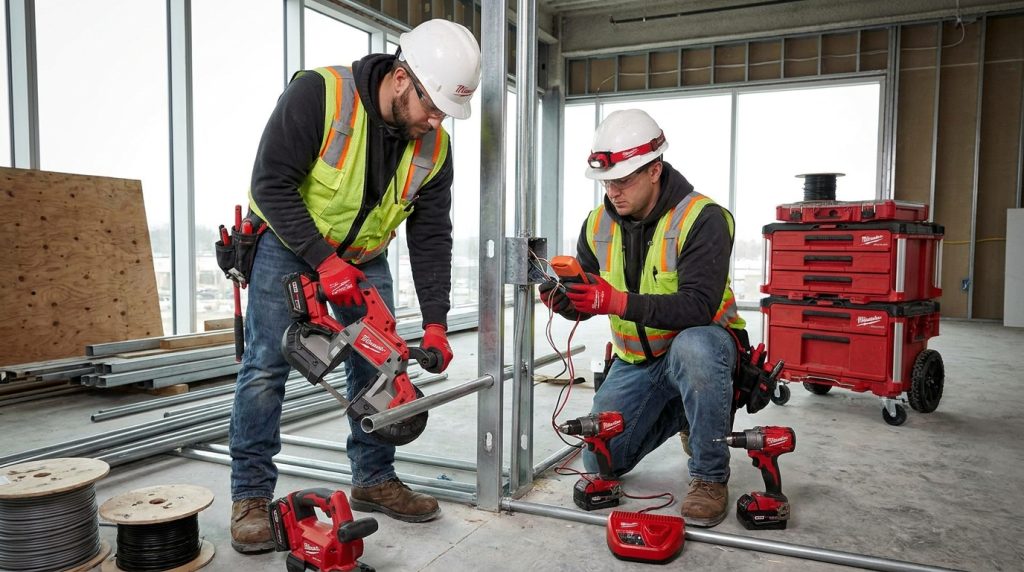
For electricians, tool performance is not just about speed. It is about clean cuts, reliable terminations, safer work practices, fewer trips back to the truck, and equipment that holds up in real jobsite conditions. That is where Milwaukee has earned a strong reputation among commercial, industrial, agricultural, and residential electricians across Coldwater, Branch County, and Southern Michigan.
The best Milwaukee tools for electricians typically fall into a few core categories:
- Cordless drilling and fastening tools
- Cutting tools for conduit, strut, cable, and threaded rod
- Electrical hand tools
- Test and measurement tools
- Lighting and jobsite visibility
- Storage and organization
- PPE and safety accessories
At CEM Industrial Supply, we work with maintenance teams, contractors, facilities, farms, municipalities, and industrial operations that need tools that can take daily use. For electricians, the right Milwaukee setup can reduce labor time, improve jobsite safety, and help standardize kits across crews.
Milwaukee’s M12 and M18 cordless platforms are especially valuable because they cover everything from compact troubleshooting tools to heavy-duty FORCE LOGIC equipment for cutting, crimping, and punching. The key is knowing which platform and tool type fits your work.
When exploring the best Milwaukee tools for electricians, it’s also essential to understand the various types of drill bits available for different applications. A related article that provides valuable insights into this topic is about the differences between SDS Plus and SDS Max drill bits, which can significantly impact your tool selection and efficiency. You can read more about it here: SDS Plus vs. SDS Max: What Fits What. This resource will help you make informed decisions when choosing the right tools for your electrical projects.
Best Milwaukee Cordless Power Tools for Electricians
Milwaukee’s cordless lineup is one of the main reasons electricians stay with the brand. The M12 platform is compact and lightweight, while the M18 platform delivers higher power and runtime for demanding work.
Milwaukee M12 vs. M18 for Electrical Work
Both battery systems have a place in an electrician’s kit. The right choice depends on whether you prioritize compact size or maximum power.
| Platform | Best For | Main Advantages | Considerations |
|||||
| Milwaukee M12 | Service work, panels, controls, overhead work, tight spaces | Lightweight, compact, easy to carry | Less power and runtime than M18 |
| Milwaukee M18 | Rough-ins, industrial work, conduit, anchors, cutting, drilling | More torque, longer runtime, broader heavy-duty tool range | Heavier than M12 |
| M12 + M18 Combo | Full-service electricians and contractors | Maximum flexibility | Requires managing two battery types |
For most electricians, I recommend carrying both platforms. Use M12 for precision work, troubleshooting, and overhead tasks. Use M18 for drilling, cutting, anchoring, and high-demand applications.
Milwaukee M18 FUEL Drill/Driver and Hammer Drill
A quality drill/driver is one of the most used tools in any electrical kit. The Milwaukee M18 FUEL drill/driver or hammer drill is ideal for:
- Drilling holes in studs
- Installing boxes and supports
- Setting anchors
- Drilling through metal, wood, and masonry
- Mounting panels, disconnects, and electrical hardware
The FUEL brushless motor lineup offers excellent power-to-size ratio and improved efficiency. For electricians working in commercial buildings, industrial facilities, pole barns, machine shops, or agricultural service areas around Southern Michigan, the M18 hammer drill is a strong all-around choice.
Buying tip: If you regularly drill into concrete or block, choose the hammer drill version. If you mostly work in wood and metal, a standard drill/driver may be enough.
Milwaukee M18 FUEL Impact Driver
An impact driver is essential for fastening. Compared to a drill, an impact driver is better for driving screws, lag bolts, self-tappers, and fasteners into tougher material.
Electricians use Milwaukee impact drivers for:
- Mounting strut
- Fastening junction boxes
- Driving self-drilling screws
- Installing panelboards
- Securing conduit straps
- Assembling supports and brackets
The M18 FUEL impact driver is powerful enough for daily commercial work, while the M12 FUEL impact driver is excellent for lighter service tasks and tight control cabinets.
Milwaukee M12 FUEL Installation Drill/Driver
For electricians who work in tight panels, cabinets, casework, and awkward overhead spaces, the M12 FUEL Installation Drill/Driver is one of the most practical Milwaukee tools available.
It usually includes interchangeable heads such as:
- Standard drill chuck
- Offset driver
- Right-angle attachment
- Hex driver
This makes it useful for installing devices, working inside cabinets, and reaching fasteners that a standard drill cannot access.
Milwaukee Rotary Hammer for Anchoring
When installing conduit racks, panels, disconnects, cable tray, and supports into concrete or masonry, a rotary hammer saves significant time. Milwaukee M18 SDS-Plus rotary hammers are a great fit for electricians who frequently set anchors.
Common applications include:
- Drop-in anchors
- Wedge anchors
- Concrete fasteners
- Masonry penetrations
- Strut mounting
Expert recommendation: If your crew regularly anchors into concrete, do not rely on a hammer drill alone. A dedicated rotary hammer is faster, cleaner, and easier on the operator.
Best Milwaukee Cutting Tools for Electricians
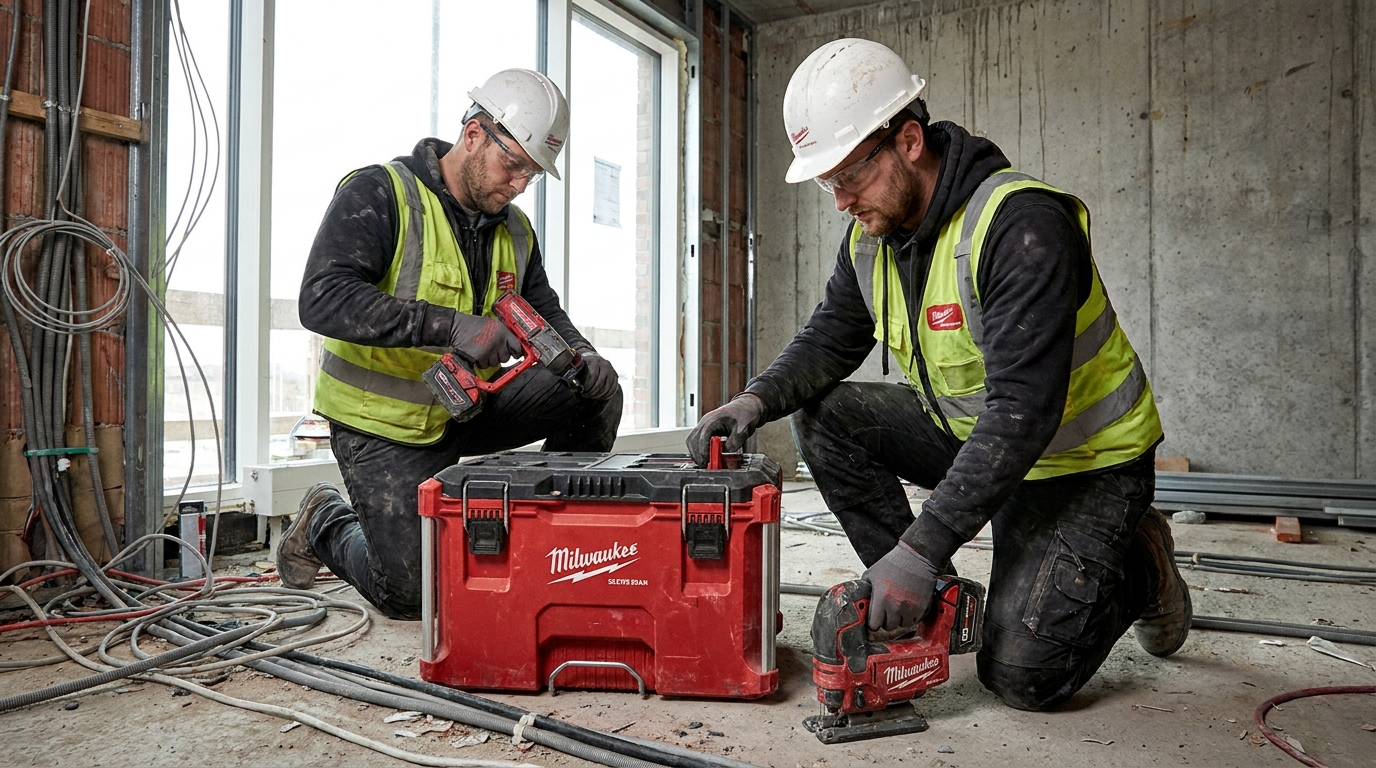
Cutting tools can make or break productivity on electrical jobs. Conduit, cable, threaded rod, strut, and tray work all require clean, repeatable cuts.
Milwaukee M18 FUEL Band Saw
A portable band saw is one of the best Milwaukee tools for electricians because it makes cleaner cuts than many abrasive methods and is safer when used properly.
Use a Milwaukee band saw for cutting:
- EMT conduit
- Rigid conduit
- Threaded rod
- Unistrut
- Angle stock
- Cable tray supports
- Small pipe and tubing
The M18 FUEL compact band saw is ideal for overhead and ladder work, while larger deep-cut models are better for heavier materials.
| Band Saw Type | Best Use | Electrician Benefit |
||||
| M12 Compact Band Saw | Light conduit, tight spaces, service work | Very portable and easy overhead |
| M18 Compact Band Saw | EMT, threaded rod, strut | Best balance of power and size |
| M18 Deep Cut Band Saw | Larger conduit, heavier stock | More capacity for industrial work |
Milwaukee M12 or M18 HACKZALL
The HACKZALL is a compact one-handed reciprocating saw. Electricians use it for demolition, remodels, and tight-space cutting.
Good applications include:
- Cutting old conduit
- Removing abandoned boxes
- Trimming small pipe
- Cutting drywall openings
- Light demolition work
- Access work above ceilings
The M12 HACKZALL is lighter and easier to handle, while the M18 version offers more power.
Milwaukee SAWZALL Reciprocating Saw
For heavier demolition and remodel work, the Milwaukee SAWZALL remains a staple. It is better than a compact HACKZALL when you need longer stroke length, more power, and faster cutting.
Use it for:
- Removing conduit racks
- Cutting through wood framing
- Demoing old supports
- Cutting larger pipe
- Industrial maintenance work
For electricians doing retrofit projects in older facilities around Branch County and Southern Michigan, a SAWZALL can save a lot of time.
Milwaukee Cable Cutter
Manual cable cutters work, but cordless cable cutters are a major upgrade for larger wire sizes. Milwaukee cable cutters help reduce fatigue and improve consistency.
They are especially useful for:
- Service entrance cable
- Large copper conductors
- Aluminum conductors
- Industrial power distribution
- Utility and maintenance work
When selecting a cable cutter, match the tool to the conductor type and maximum cable size. Do not assume every cutter handles ACSR, copper, aluminum, or steel-core cable.
Milwaukee Threaded Rod Cutter
A threaded rod cutter is a specialized tool, but it is extremely useful for commercial electricians. It cuts threaded rod cleanly without damaging the threads, reducing the need to grind or chase the end.
Common uses:
- Trapeze supports
- Pipe racks
- Lighting supports
- Cable tray installations
- Suspended equipment supports
For contractors installing a lot of overhead support systems, this tool quickly pays for itself.
Please visit our latest post at https://cemindustrialsupply.com/news/ for more information.
Best Milwaukee Electrical Specialty Tools
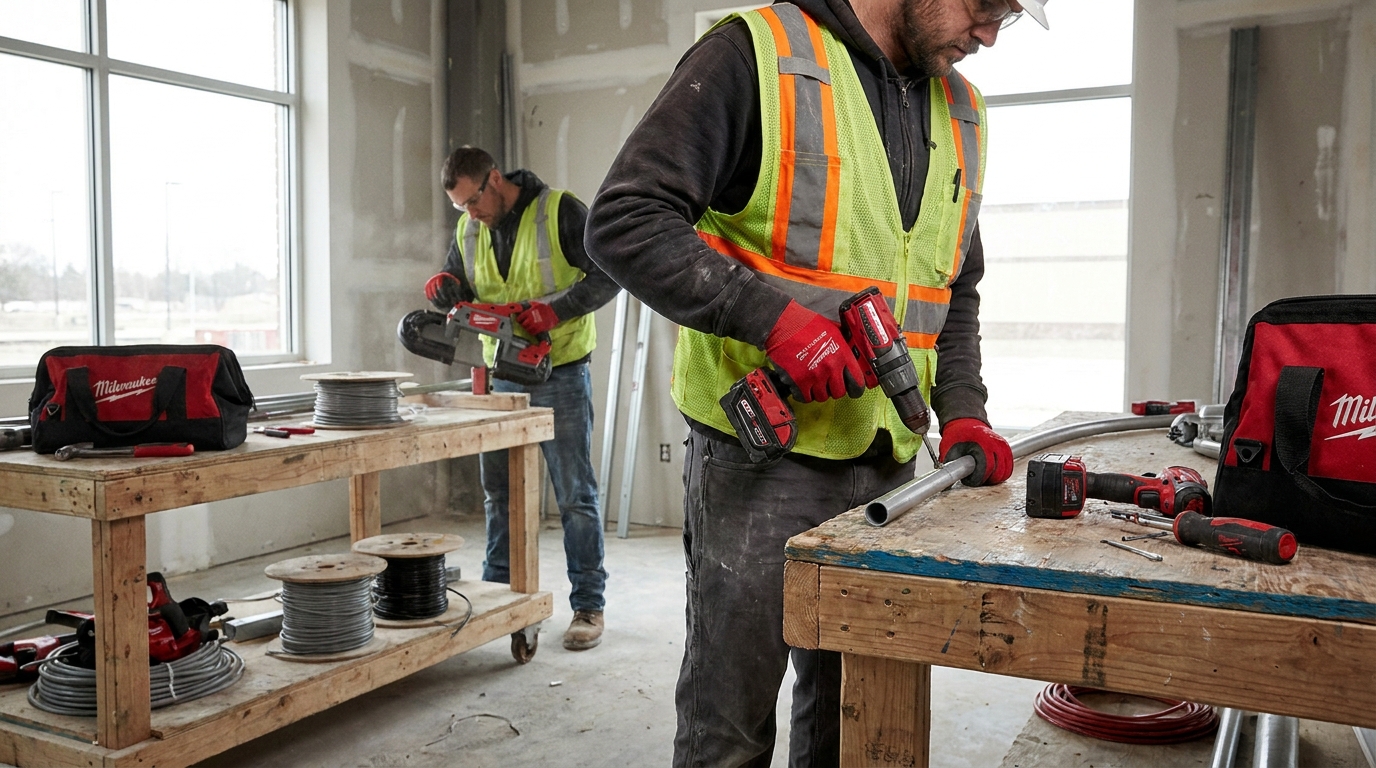
Milwaukee has invested heavily in electrician-specific tools. These are not generic power tools repackaged for electrical work. Many are designed specifically for conduit, cable, wire pulling, and panel work.
Milwaukee M18 FORCE LOGIC Knockout Tool
A knockout tool is essential for making clean holes in electrical boxes, panels, and enclosures. The Milwaukee M18 FORCE LOGIC knockout tool is a major productivity upgrade over manual hydraulic or ratcheting punches.
Benefits include:
- Faster knockout punching
- Less operator fatigue
- Cleaner holes
- Consistent results
- Good for repetitive panel work
Electricians working on control panels, disconnects, switchgear enclosures, and industrial equipment installations will appreciate the speed.
Practical note: Always match the punch and die to the exact conduit size and material. Inspect punches regularly for wear or damage.
Milwaukee M18 FORCE LOGIC Crimpers
For electricians working with lugs, connectors, grounding systems, and larger conductors, a battery-powered crimper improves consistency and reduces strain.
Important factors to consider:
- Crimp force
- Die compatibility
- Connector type
- Wire size range
- Documentation requirements
- UL-listed connector/tool combinations
For industrial and facility maintenance teams, crimp quality matters. A poor crimp can create heat, voltage drop, downtime, and safety issues.
Milwaukee Powered Fish Tape
Pulling wire is physically demanding, especially on longer conduit runs. Milwaukee powered fish tape solutions help reduce repetitive strain and improve productivity.
Useful for:
- Long conduit runs
- Commercial rough-ins
- Remodel projects
- Multi-floor pulls
- Work above ceilings and in tight access spaces
Powered fish tape can be a strong investment for crews that pull wire daily.
Milwaukee Cable Stapler
The Milwaukee M12 cable stapler is popular among residential and light commercial electricians. It speeds up cable fastening and reduces hand fatigue compared to hammer-driven staples.
Best applications:
- NM cable installation
- Low-voltage cable support
- Residential rough-in
- Multi-unit housing
- Light commercial work
Safety tip: Use only approved staples for the tool and cable type. Avoid overdriving staples, which can damage insulation.
When exploring the best Milwaukee tools for electricians, it’s also beneficial to consider how custom industrial gearboxes can enhance overall efficiency in electrical work. For instance, a related article discusses custom industrial gearbox builds from trusted brands, which can be an essential component in various electrical applications. By understanding the synergy between quality tools and reliable gear systems, electricians can optimize their workflow and achieve better results on the job.
Best Milwaukee Hand Tools for Electricians
Cordless tools get the attention, but hand tools still do the detailed work. A well-built electrician’s hand tool kit improves precision, safety, and speed.
CEM Industrial Supply supports contractors and maintenance teams with power tools, hand tools, cutting accessories, PPE, abrasives, fasteners, and jobsite supplies. When building an electrician kit, do not overlook the basics.
Milwaukee Wire Strippers and Cutters
Good wire strippers should cut cleanly, strip accurately, and feel comfortable during repetitive work.
Look for features such as:
- Clearly marked strip gauges
- Comfortable grips
- Bolt cutting holes
- Loop-making holes
- Sharp cutting edges
- Corrosion-resistant finish
Electricians working in industrial controls and panels may want multiple strippers for different wire ranges.
Milwaukee Lineman’s Pliers
Lineman’s pliers are a daily-use tool for cutting, gripping, twisting, and pulling. Milwaukee lineman’s pliers are built for heavy use and are available in several configurations.
Common uses:
- Cutting wire
- Twisting conductors
- Pulling fish tape
- Reaming conduit
- Gripping hardware
- General jobsite tasks
For professional electricians, cheap pliers are rarely worth it. Comfort, edge quality, and durability matter when the tool is in your hand all day.
Milwaukee Screwdrivers and Nut Drivers
Electrical work involves a lot of fasteners. A quality screwdriver and nut driver set is important for panels, devices, fixtures, terminals, and controls.
Consider carrying:
- Multi-bit screwdriver
- Cabinet-tip screwdriver
- Phillips drivers
- Insulated screwdrivers
- Nut drivers
- Precision drivers for controls
For energized work or work near live components, properly rated insulated tools are essential. Always follow NFPA 70E and your company’s electrical safety procedures.
Milwaukee Electrician’s Level
A compact torpedo level is useful for conduit bending, box installation, panel layout, and fixture alignment. Electrician-focused levels often include strong magnets and conduit-friendly features.
Good uses include:
- Leveling boxes
- Aligning conduit
- Setting panels
- Checking bends
- Installing disconnects and controls
When considering the best Milwaukee tools for electricians, it’s essential to also explore the various battery platforms available to ensure optimal performance and compatibility. A helpful resource on this topic can be found in the article about battery platforms, which compares the M12, M18, and FlexVolt systems. Understanding these options can significantly enhance your tool selection process and overall efficiency on the job.
Milwaukee Test and Measurement Tools for Electricians
Test instruments are safety tools, not just troubleshooting tools. Before working on electrical equipment, you need to verify conditions using properly rated instruments.
Milwaukee Digital Multimeter
A digital multimeter is one of the most important tools an electrician owns. It helps measure voltage, resistance, continuity, and sometimes frequency or capacitance depending on the model.
Use it for:
- Troubleshooting circuits
- Checking voltage
- Verifying continuity
- Testing fuses
- Diagnosing controls
- Checking power supplies
Buying guide: Choose a meter with the correct CAT rating for your work environment. Industrial electricians often need higher-rated meters than residential service technicians.
Milwaukee Clamp Meter
A clamp meter allows current measurement without opening the circuit, which is extremely useful for load checks and troubleshooting.
Common applications:
- Measuring motor current
- Checking panel loads
- Troubleshooting HVAC equipment
- Identifying overloaded circuits
- Verifying current draw
For industrial plants, farms, machine shops, food processing operations, and municipal facilities in Southern Michigan, clamp meters are essential maintenance tools.
Milwaukee Non-Contact Voltage Detector
A non-contact voltage detector is a quick screening tool. It should never be your only method of verifying absence of voltage, but it is useful for fast checks.
Use it to help identify:
- Live conductors
- Energized receptacles
- Switch leg conditions
- Potentially energized boxes
- Misidentified circuits
Important: Always confirm with a properly rated meter before touching conductors. Non-contact testers can produce false positives or false negatives depending on conditions.
Milwaukee Jobsite Lighting and Visibility Tools
Electrical work often happens in dark spaces: mechanical rooms, ceiling cavities, basements, crawl spaces, industrial cabinets, lift platforms, and outdoor service areas. Good lighting improves both safety and workmanship.
Milwaukee M18 ROVER Lights
Milwaukee ROVER lights are excellent for area lighting. They are useful for panel work, rough-ins, shutdowns, and emergency maintenance.
Benefits include:
- Cordless operation
- Bright area coverage
- Adjustable light output
- Durable jobsite construction
- Compatibility with Milwaukee batteries
For maintenance crews responding to outages or equipment failures in Branch County, cordless lighting can be the difference between a quick repair and a frustrating job.
Milwaukee Headlamps and Task Lights
A headlamp keeps both hands free. Electricians should carry one for troubleshooting, panel inspection, attic work, and ceiling access.
Good features include:
- Adjustable beam
- Comfortable head strap
- Rechargeable battery
- Hard-hat compatibility
- Dust and moisture resistance
Lighting Selection Table
| Lighting Tool | Best Use | Why Electricians Need It |
||||
| Headlamp | Panels, attics, crawl spaces | Hands-free visibility |
| M12 Task Light | Small work areas | Compact and portable |
| M18 ROVER Area Light | Rooms, shutdowns, rough-ins | Broad illumination |
| Tower Light | Large commercial spaces | High-output jobsite lighting |
| Penlight | Inspections and service calls | Easy pocket carry |
Milwaukee PACKOUT Storage for Electricians
A disorganized tool setup costs time. Milwaukee PACKOUT storage is popular because it allows electricians to build modular systems for service trucks, vans, shop storage, and jobsite carts.
Best PACKOUT Options for Electrical Crews
Useful PACKOUT components include:
- Rolling tool boxes
- Compact organizers
- Deep organizers
- Drawer units
- Crates
- Tool bags
- Wall plates
- Mounting systems
For electricians, PACKOUT organizers are especially useful for fittings, wire nuts, terminals, anchors, screws, labels, bits, hole saws, and small hardware.
Suggested PACKOUT Setup for an Electrician
| PACKOUT Component | Recommended Contents |
|||
| Rolling Tool Box | Larger cordless tools, chargers, batteries |
| 3-Drawer Tool Box | Hand tools, meters, specialty tools |
| Compact Organizer | Wire connectors, terminals, anchors |
| Deep Organizer | Hole saws, fittings, larger hardware |
| Tool Bag | Daily service tools |
| Crate | Extension cords, PPE, temporary supplies |
A well-organized setup is particularly helpful for electricians covering service calls across Coldwater, Quincy, Bronson, Union City, Hillsdale, Sturgis, and surrounding Southern Michigan communities. Less searching means more productive time on site.
Buying Guide: How to Choose the Best Milwaukee Tools for Electricians
The best Milwaukee tools for electricians depend on your daily work. A residential rough-in electrician has different needs than an industrial maintenance electrician or a commercial contractor.
Step 1: Match Tools to Your Work Type
| Work Type | Milwaukee Tools to Prioritize |
|||
| Residential Electrical | M12 cable stapler, M18 drill, impact driver, hand tools, PACKOUT |
| Commercial Electrical | M18 band saw, rotary hammer, knockout tool, fish tape, lighting |
| Industrial Electrical | FORCE LOGIC crimper, cable cutter, meters, M18 heavy-duty tools |
| Service Technician | M12 installation driver, multimeter, clamp meter, compact lighting, PACKOUT bag |
| Facility Maintenance | M18 drill/impact, SAWZALL, testers, lighting, storage, PPE |
| Agricultural Electrical | M18 tools, jobsite lighting, cable cutters, testers, rugged storage |
Step 2: Choose Battery Platforms Wisely
If you are just starting, choose a platform based on your most common jobs.
- Choose M12 if you value compact size and light weight.
- Choose M18 if you need power, runtime, and heavy-duty capability.
- Choose both if you do service, commercial, and industrial work.
Most professional electricians eventually benefit from both M12 and M18 tools.
Step 3: Prioritize High-Use Tools First
If budget is limited, buy the tools you will use every day before specialty tools.
Start with:
- Drill/driver or hammer drill
- Impact driver
- Band saw or reciprocating saw
- Wire strippers and lineman’s pliers
- Multimeter and voltage tester
- Jobsite light
- PACKOUT organizer or tool bag
Then add specialty tools such as knockout tools, crimpers, cable cutters, and powered fish tape based on job volume.
Step 4: Consider Total Cost of Ownership
Do not look only at the tool price. Consider:
- Battery compatibility
- Charger needs
- Replacement blades and accessories
- Tool repair and warranty support
- Downtime reduction
- Labor savings
- Safety improvement
- Crew standardization
A higher-quality tool often pays for itself when it reduces labor time and replacement frequency.
Recommended Milwaukee Electrician Tool Kits by Experience Level
Apprentice Electrician Kit
An apprentice should focus on core hand tools, basic cordless tools, and safety gear.
Recommended items:
- M12 or M18 drill/driver
- Impact driver
- Wire strippers
- Lineman’s pliers
- Screwdriver set
- Tape measure
- Torpedo level
- Non-contact voltage tester
- Basic multimeter
- Headlamp
- Tool bag
Journeyman Electrician Kit
A journeyman needs productivity tools that handle daily service and installation work.
Recommended additions:
- M18 FUEL hammer drill
- M18 FUEL impact driver
- M18 compact band saw
- M12 installation drill/driver
- Clamp meter
- PACKOUT organizer
- M18 ROVER light
- Hole saw kit
- Step bits
- Insulated hand tools
Commercial/Industrial Electrician Kit
For heavier work, add tools that handle conduit, cable, panels, and large conductors.
Recommended additions:
- M18 rotary hammer
- M18 FORCE LOGIC knockout tool
- M18 cable cutter
- M18 FORCE LOGIC crimper
- Deep-cut band saw
- SAWZALL
- Powered fish tape
- High-output batteries
- Tower light
- Advanced meter with proper CAT rating
Maintenance Electrician Kit
Maintenance electricians need troubleshooting, repair, and fast-response tools.
Recommended items:
- Clamp meter
- Digital multimeter
- M12 installation driver
- M18 drill and impact
- HACKZALL
- Headlamp
- M18 area light
- Screwdriver and nut driver set
- Wire strippers and crimpers
- PACKOUT service bag
- PPE, lockout/tagout supplies, and arc-rated gear as required
Safety Tips for Electricians Using Milwaukee Tools
Even the best tool can be dangerous if used improperly. Electrical work carries unique hazards, including shock, arc flash, burns, cuts, falls, and pinch injuries.
Electrical Safety Basics
Always follow your employer’s safety program, OSHA requirements, NFPA 70E guidelines, and site-specific procedures.
Key practices include:
- De-energize whenever possible
- Use lockout/tagout procedures
- Verify absence of voltage with a properly rated meter
- Wear required PPE
- Use insulated tools where appropriate
- Maintain safe approach boundaries
- Keep tools dry and clean
- Inspect cords, batteries, and accessories before use
Cordless Tool Safety
For Milwaukee cordless tools:
- Use the correct battery for the tool
- Do not use damaged batteries
- Keep batteries away from excessive heat
- Do not force the tool
- Use sharp blades and bits
- Secure work before cutting or drilling
- Wear eye protection
- Use hearing protection when needed
- Keep hands away from cutting paths
Cutting and Drilling Safety
When using band saws, reciprocating saws, rotary hammers, and drills:
- Confirm what is behind the surface before drilling
- Watch for hidden wires, gas lines, and plumbing
- Use the correct blade or bit
- Let the tool do the work
- Maintain a balanced stance
- Use dust control when drilling masonry
- Deburr conduit after cutting
- Replace damaged accessories immediately
Jobsite Lighting and Trip Prevention
Good lighting reduces mistakes and injuries. Keep work areas organized and avoid running cords through walk paths whenever possible. Cordless Milwaukee lights can reduce cord clutter and improve visibility in dark spaces.
Maintenance Tips to Extend Milwaukee Tool Life
Professional tools need basic care. A few minutes of maintenance can prevent downtime and expensive replacements.
Daily Tool Care Checklist
Before leaving the jobsite, check:
- Are tools free of dust and debris?
- Are batteries charged for the next day?
- Are blades and bits worn or damaged?
- Are meters stored safely?
- Are hand tools dry and clean?
- Are PACKOUT bins restocked?
- Are safety glasses, gloves, and PPE ready?
Battery Maintenance
To protect Milwaukee M12 and M18 batteries:
- Store batteries in a dry location
- Avoid leaving batteries in extreme heat or cold
- Charge with compatible Milwaukee chargers
- Do not use cracked or damaged packs
- Rotate batteries so wear is balanced
- Keep battery contacts clean
Cold Michigan winters can affect battery performance. If your tools are stored in a service van overnight in Coldwater or elsewhere in Branch County, allow batteries to warm up before demanding heavy output.
Blade and Bit Maintenance
Cutting performance depends heavily on accessories. A premium tool with a dull blade performs poorly.
Maintain:
- Band saw blades
- Hole saws
- Step bits
- Reciprocating saw blades
- Drill bits
- Masonry bits
- Knockout punches and dies
Replace worn accessories before they damage the tool or create unsafe cutting conditions.
Meter Maintenance
Test instruments need extra care.
- Store meters in protective cases
- Inspect leads before use
- Replace damaged probes immediately
- Verify meter operation before testing
- Keep meters dry
- Follow calibration requirements if applicable
- Use the correct CAT-rated equipment
Electrician’s Milwaukee Tool Checklist
Use this checklist when building or upgrading your electrical tool setup.
Core Cordless Tools
- M18 FUEL drill/driver or hammer drill
- M18 FUEL impact driver
- M12 FUEL installation drill/driver
- M18 compact band saw
- M12 or M18 HACKZALL
- M18 SAWZALL for heavier demo
- M18 rotary hammer
Electrical Specialty Tools
- M18 FORCE LOGIC knockout tool
- M18 cable cutter
- M18 FORCE LOGIC crimper
- Powered fish tape
- M12 cable stapler
- Threaded rod cutter
Hand Tools
- Wire strippers
- Lineman’s pliers
- Diagonal cutters
- Needle-nose pliers
- Screwdrivers
- Nut drivers
- Insulated tools
- Torpedo level
- Tape measure
- Utility knife
Test and Measurement
- Digital multimeter
- Clamp meter
- Non-contact voltage tester
- Receptacle tester
- Continuity tester
- Test leads and probes
Jobsite Support
- M18 ROVER light
- Headlamp
- PACKOUT storage
- Chargers
- Extra batteries
- Blades and bits
- Hole saws
- Step bits
- PPE
- Lockout/tagout supplies
Why Buy Milwaukee Electrician Tools Through CEM Industrial Supply?
For electricians and maintenance teams in Coldwater, Branch County, and Southern Michigan, buying tools is not just about placing an order. It is about getting the right tool for the work, matching accessories correctly, and having a supplier who understands industrial and contractor needs.
CEM Industrial Supply supports professionals with practical jobsite categories such as:
- Power tools and cordless tools
- Hand tools
- Cutting tools and abrasives
- Fasteners and anchors
- Electrical supplies
- Safety and PPE
- Material handling products
- Shop and maintenance supplies
- Jobsite lighting and storage solutions
Whether you are outfitting an apprentice, upgrading a service van, standardizing a maintenance department, or preparing for a plant shutdown, CEM can help you think through tool selection from a practical standpoint.
Local Advantage for Southern Michigan Contractors
Working locally matters when time is tight. Contractors and facility teams in Southern Michigan often need fast answers, dependable supplies, and guidance from people who understand regional industries such as manufacturing, agriculture, food processing, construction, and municipal maintenance.
A good tool supplier should help you answer:
- Which Milwaukee platform fits my crew?
- What batteries and chargers do I need?
- Which blades fit the material we cut most?
- Do we need M12, M18, or both?
- Which PPE should be paired with this task?
- Are we buying tools that reduce labor time?
- Are we standardizing across the team?
That practical support is where CEM Industrial Supply brings value beyond the box.
Quick Comparison: Best Milwaukee Tools for Electricians
| Tool | Best For | Recommended User |
||||
| M18 FUEL Hammer Drill | Drilling, anchors, general installation | All electricians |
| M18 FUEL Impact Driver | Fastening boxes, strut, supports | All electricians |
| M12 Installation Drill/Driver | Tight spaces, panels, cabinets | Service and controls electricians |
| M18 Compact Band Saw | Conduit, strut, threaded rod | Commercial electricians |
| M18 Rotary Hammer | Concrete anchors | Commercial and industrial electricians |
| M18 FORCE LOGIC Knockout Tool | Panel and enclosure holes | Commercial/industrial crews |
| M18 Cable Cutter | Large conductors | Industrial and service electricians |
| M18 FORCE LOGIC Crimper | Lugs and connectors | Industrial electricians |
| M12 Cable Stapler | NM and low-voltage cable fastening | Residential electricians |
| M18 ROVER Light | Jobsite visibility | All electricians |
| PACKOUT Storage | Organization and mobility | All electricians |
FAQs About the Best Milwaukee Tools for Electricians
What are the best Milwaukee tools for electricians starting out?
Start with an M18 drill/driver or hammer drill, M18 impact driver, wire strippers, lineman’s pliers, screwdrivers, a non-contact voltage tester, a multimeter, a headlamp, and a tool bag. Add a band saw, rotary hammer, and specialty tools as your work demands grow.
Is Milwaukee M12 or M18 better for electricians?
M12 is better for compact work, service calls, panels, controls, and overhead tasks. M18 is better for drilling, cutting, anchoring, and heavy-duty commercial or industrial work. Many electricians carry both platforms.
Are Milwaukee FORCE LOGIC tools worth it?
Yes, if you regularly crimp, cut large cable, or punch knockouts. FORCE LOGIC tools reduce manual effort, improve speed, and help deliver consistent results. They are especially valuable for commercial and industrial electricians.
What Milwaukee saw is best for cutting conduit?
A Milwaukee M18 compact band saw is one of the best choices for cutting EMT, threaded rod, and strut. It makes clean cuts and is easier to control than many abrasive cutting methods.
Do electricians need a Milwaukee rotary hammer?
If you frequently install anchors in concrete, block, or masonry, a rotary hammer is worth it. It is faster and more effective than using a standard hammer drill for repeated anchoring work.
What Milwaukee tools are best for residential electricians?
Residential electricians often benefit from an M12 cable stapler, M18 drill, M18 impact driver, M12 installation driver, wire strippers, hand tools, headlamp, and PACKOUT organizers.
What Milwaukee tools are best for industrial electricians?
Industrial electricians should prioritize M18 heavy-duty tools, FORCE LOGIC crimpers, cable cutters, knockout tools, clamp meters, digital multimeters, jobsite lighting, and rugged storage.
How should electricians maintain Milwaukee batteries in Michigan winters?
Store batteries in a dry, moderate-temperature area when possible. Avoid charging frozen batteries, and allow cold batteries to warm before heavy use. Rotate battery packs and inspect them for cracks or damage.
Can CEM Industrial Supply help choose Milwaukee tools for an electrical crew?
Yes. CEM Industrial Supply works with contractors, maintenance teams, and industrial customers in Coldwater, Branch County, and Southern Michigan to help match tools, accessories, PPE, storage, and jobsite supplies to real work requirements.
FAQs
What are the best Milwaukee tools for electricians?
Some of the best Milwaukee tools for electricians include the M18 FUEL™ 7/8″ SDS Plus Rotary Hammer, the M18 FUEL™ 1/2″ High Torque Impact Wrench with Friction Ring, the M18 FUEL™ 4-1/2″ / 5″ Grinder, the M18 FUEL™ 1/2″ Drill/Driver, and the M18™ FORCE LOGIC™ 6T Utility Crimper Kit.
What features make Milwaukee tools ideal for electricians?
Milwaukee tools are known for their durability, reliability, and performance. They are designed to withstand the rigors of daily use on the job site and are equipped with advanced technology to enhance efficiency and productivity for electricians.
Where can electricians purchase Milwaukee tools?
Milwaukee tools can be purchased at authorized Milwaukee Tool retailers, hardware stores, and online through the official Milwaukee Tool website and other reputable online retailers.
Are Milwaukee tools covered by a warranty?
Yes, Milwaukee tools are covered by a warranty that varies depending on the specific tool and its intended use. The warranty typically covers defects in materials and workmanship, providing peace of mind for electricians who rely on their tools for their livelihood.
What sets Milwaukee tools apart from other brands for electricians?
Milwaukee tools are known for their innovation, quality, and commitment to meeting the needs of professional tradespeople. They are designed with input from electricians and other professionals to ensure they deliver the performance and durability required for demanding job site applications.